Threads from Henry's Web

Tag: John

  • According to John: No One Has Ascended into Heaven

    I should have posted this earlier. I’ll use as an excuse that our son is visiting us from Arizona. He’s probably not really to blame, but we are very delighted to have him here. Some distractions are a definite gift from God!

    You can find out more information from my Google+ Event, or watch the study via the YouTube embed below.


  • Quote: The Son of Man Lifted up on a Cross

    From my reading for next week’s study on John (Thursday night, 7:00 pm central time via Google Hangouts on Air):

    In the same way in which a flag lifted up on its pole draws together a people and constitutes it a nation, the Son of Man lifted up on a cross draws toward himself all who believe and constitutes them “born of God.” (Weiss, Meditations on According to John, 42)

    I am truly enjoying my reading in preparation for this study. I’ve been talking about metaphors, and leading toward the point that we use multiple metaphors to describe something that cannot be readily depicted in concrete language. Metaphors allow us to talk about the same subject in a variety of ways, each of which may contribute to our understanding.

    When a single metaphor becomes the one and only one permitted in describing an event, we begin to lose some of the content of the reality. Similarly, any time we allow one word for (or description of) God to replace God—what I call conceptual idolatry—we lose some of the reality of our experience of God. We can allow our description to limit who God is. In terms of the atonement, I believe that stating that the one explanation of the atonement is the metaphor of substitution in a forensic context, we start to lose some of the meaning of the atonement.

    Unlike some, I do see forensic and substitutionary metaphors in play in some scriptural descriptions of atonement. I don’t deny them as ways to discuss and understand atonement. My concern is that they not become the sole view, driving out other strong metaphors. The gospel of John uses a couple of different metaphors, especially centering around light and family, and we need to read those in their own context with their own integrity.

    When I was in college, I took Exegesis of Romans, which was intended as a sort of taste of Greek III, from a professor (Malcolm Maxwell for my fellow Walla Walla alumni), who was an advocate of the moral influence theory of the atonement. I was very attracted to the theology involved, but despite my best efforts, I couldn’t find it in Romans. It is wrong, in my view, though without any diminution in my great respect for Dr. Maxwell, to force the moral influence metaphor onto Romans. It is equally wrong to force forensic substitution onto the gospel of John. You may hear its echoes, but it doesn’t dominate.

    The quote above provides a taste. I’ll be discussing this in more detail on Thursday night.

  • According to John: He Who Follows Me … Will Have the Light of Life

    My Bible study tonight done via Google Hangouts on Air, will be on the topic in the title. I’m going to be following up from my discussion of vocabulary last week in looking at the words “light” and “life” in the gospel of John and how they relate to our understanding of the book’s message.

    Here’s the YouTube viewer:

  • Follow-up on According to John: Making Himself Equal with God

    There are a number of points I need to write about to follow up on my hangout from last Thursday night, but first, here’s the YouTube video of the event.

    I would like to remind you that you can ask questions or comment during the event using the Google Hangouts Q&A feature. Normally I’m also watching my Twitter (@hneufeld) and will see any Tweets @hneufeld. If you comment on something here and I can find a place for it in the next event, I will refer to it.

    I plan to follow up before Thursday with posts on the language of the trinity, and biblical inspiration.

    In the meantime, Bob Cornwall has written an interesting post on the language of the trinity. Check it out!

  • Follow-Up on According to John: Theological Development and Determining Date and Authorship

    In my Google Hangout discussion I mentioned using the development of theological concepts in dating a particular writing. I don’t think I really covered the issue involved all that well, so I’m going to follow up briefly here. My purpose is not to argue any particular position, but to illustrate the issues.

    If I might start from a slightly broader approach, one of the ways in which one dates a particular writing is by looking at things in it that connect to events outside of it. Hopefully some of those things outside of it can be dated more precisely than the writing itself. In all cases, one should be aware that no single element provides an absolute answer. One normally gathers a set of arguments and searches for the best possible explanation of all the data. Often people reject an argument as weak when it is not intended to stand alone at all, but rather is just suggestive. It has to be combined with other data.

    To take an example from the Hebrew scriptures, the destruction of Samaria (722-721 BCE) is described both in 2 Kings and in Assyrian records. We can get quite precise dating from the Assyrian records, while we only have relative dating from Kings. We can tie the events together with a high degree of accuracy because the event is described in both.

    Narrowing it down a bit, consider both the authorship and dating of the pastoral epistles, Titus and 1 & 2 Timothy. Many scholars believe that these were written by someone in Paul’s name after Paul had died. Note here how authorship and dating interact. If Paul wrote the pastoral epistles they must date no later than the early 60s CE, since Paul dies in that period. He is unlikely to be producing new epistles after his death! Here, however, it works the other way. If it isn’t Paul that wrote them, then it is likely they were written after Paul’s death. Nobody is likely to be sending around letters claiming to be from Paul while Paul was still alive, at least not without inviting scandal.

    But why the later date? One argument relates to church history. Some would hold that the church organization displayed in the pastoral epistles is too advanced to reflect the time of Paul. In a sense, then, the later writer would be using Paul’s name to bless these developments in church organization. I’m not going to try to argue this one way or the other as that’s not my purpose. What I do want to point out is that this form of dating requires two things: 1) A correct reading of the level of church organization reflected in the epistle, and 2) An accurate assessment of the development of church organization.

    Regarding the first, let’s consider the Greek word episkopos. When you see this word in the pastoral epistles how do you understand it and translate it? How do you see it’s relation to the diakonos? Is it bishops and priests, or perhaps a more informal general overseer and local minister? What is the role and authority of those making the appointments. I’m not an expert on any of this. What I will point out is that people see these terms and the discussion of church leadership in the pastoral epistles differently. This will impact any decision on dating that relates to the development of church organization.

    Regarding the second, one has to determine just how church structure developed. This is a task for a church historian who will look both at the New Testament evidence, and the evidence of the early church fathers as they either reflect or describe the church organization that exists at that point.

    Now remember that each argument need not be decisive. Far from it. There will be many minor indicators and many indicators that could be argued either way.

    I referenced one in my discussion, the dating of Hebrews, and my difference of opinion with my friend (and Energion author), Elgin Hushbeck, Jr. One of the most important datable events of the first century of church history is the destruction of Jerusalem in 70 CE. Now, Elgin and I differ on the probable dating of the book of Hebrews. First, note that if the author of Hebrews is Paul (ably argued by David Alan Black in The Authorship of Hebrews: The Case for Paul), then it must be dated no later than the early 60s CE. Why? See above on Paul’s death.

    But the particular point that I mention here is that Elgin and I take the same piece of evidence and see a different result. I see the author of Hebrews building his entire argument on the tabernacle in the wilderness, and thus see the destruction of the temple (not in existence at the historical time our author is referencing) as much less relevant. In fact, one might argue that the author uses the tabernacle because the temple was no longer in existence. But Elgin argues that one could hardly make this argument after the destruction of the temple without mentioning that event. And as much as I may hate admitting it, he does have a point. So the evidence weighs lightly in this case.

    But now we finally get down to the issue at hand, which is dating based on theological development. This is akin to dating the pastoral epistles based on church organization but each element of the argument becomes harder. Let’s consider the case of christology. I would argue a high christology for the gospel of John. The Word was God. The Word became flesh. Case closed. Well, not quite as easily as all that, but I’d come back to those two points after arguing other interpretations.

    To date a writing in this way requires one to both read the theology of the writing in question correctly and also to have a well calibrated idea of the way in which theology developed. If you move into later times, you can look at whether a writer argues for or against gnostic positions, and just what gnostic positions are reflected. I parallel John 1:1-18 to the thought developed in Hebrews 1:1 – 4:13. In both cases we have the message presented through Jesus (a Son/the Word) placed against the message presented by Moses, with superiority attributed to the message through the Son. I would argue that the christology of Hebrews 1:1-3 is as high as the christology in John. If I then date Hebrews to the decade or so following the destruction of Jerusalem, some would say that the christology is questionable at that point. Most interpreters since the time of the reformation, for example, have interpreted the term “Word of God” in Hebrews 4:12 as referring to the scriptures and not to the person of Jesus.

    If we turn to Elgin’s dating, which is earlier, then his reading of Hebrews as high christology (as he does) means that a high christology and the associated vocabulary would be available much earlier. I refer to Elgin because he’s a friend. There are plenty of scholars who would hold either the position I do or that he does. Elgin and I hope to arrange a discussion of this between us, not so that one of us can win, but so that we can clarify the way these arguments are formulated and help readers make their own decisions. This particular type of argument is one of the weakest. I’m not arguing that it’s not worth doing, but it requires a broad knowledge and very careful work to make successfully.

    A reverse effect is also possible. One might find a way to read Hebrews as having a lower christology, simply present Jesus as the Son of God, because one assumes due to date that this is the way it should be read. In doing this sort of work, one should always be very conscious of one’s own biases.

    My point in going through all of this is to help readers get an idea of how to read introductions to Bible books, especially when those introductions differ. There are massive differences in dating given for portions of the New Testament. Matthew, for example, might be dated all the way from the 40s to the late 80s. Luke is often dated in the mid-80s, but there’s an interesting piece of internal evidence that suggests an earlier date. Acts ends before the death of Paul. One explanation for this is that the book was written before Paul died. There are other explanations; never imagine that a debate such as this is settled in one line! In addition, Luke was written before Acts (relative dating is important!), and so Luke must have been written before the mid 60s because it must have been written before Acts. But if there’s a good reason for Paul’s death to be left out of Acts, other than that it hadn’t happened yet, all this might change!

    Knowing how these arguments are formulated will help you read introductions intelligently.

  • Announcing According to John: The Word Became Flesh

    This will be the second study. I’m going to mention a few things to think about. The question remains as to how many of these things I will be able to address, but I think it’s worthwhile to consider these in any case. The study will be via Google Hangouts on Air at 7:00 pm central time, Thursday, January 18. The event on Google+ is here. And here’s the trailer:

    I’ll embed the YouTube below, but first, some things to think about! The major scripture for the study is John 1:1-18. If you haven’t read the book of John through completely recently, it will help to review the entire book.

    Critical Issues

    One issue of source (and to a lesser extent redaction) criticism comes up for this passage, which is the question of whether John 1:1-18 was written as part of the gospel or whether it is an early Christian hymn adapted for and incorporated into the gospel. There are some folks who regard it as poetry with some prose comments added.

    Read the passage and pay special attention to the boundary between John 1:18 and 19.

    Textual Issues

    I’m going to list two, though one comes in two parts:

    First, in verses 3 & 4 we have a verse division/sentence division issue. Should it read something like “… without him was not anything made that was made”? Or alternatively “… without him was not anything made. That which was in him was …”? You’ll probably find references to these two possible divisions in the footnotes to your translation. I just looked at the NRSV and REB as I was preparing this, and their notes are pretty clear. The NIV at BibleGatway.com isn’t showing a note. Does your Bible have a note?

    The difficulty for the average student is that these translations don’t provide any justification for the decisions made. It would be impractical to expect them to. But if you have a Bible with study notes or a good commentary, you may find a bit more information.

    Second, John 1:18 has two alternative readings, which the REB lists as “God’s only Son” (their text) and “the only begotten God” (alternative). Of course, if you read Greek, you should consult your apparatus to discover the evidence for these readings. How much difference does this make? What is the translation choice of the Bible you use? The NIV kind of combines the readings, while the NASB makes the opposite choice to REB and uses “the only begotten God.” I will definitely discuss this variant and something about how these choices are made.

    Just for fun, I went through my files and extracted a paper on this verse that I wrote in college, for a course titled “Translation Problems.” Though it doesn’t have a date on it, I think this was in my junior year, which makes the paper more than 35 years old. Read it and see if you agree with my younger self! (I note here that this was written when I was still a Seventh-day Adventist, and references to Ellen White and “the Spirit of Prophecy” should be taken in that context.) Younger readers will doubtless be unacquainted with the quaint device used to produce this paper, a manual typewriter. If I remember correctly it was an old Remington, and no, it had no Greek font!

    Theology

    Well, combining theology and inter-textual relationships.

    First, do you think the cultural/philosophical background for the phrase “the Word of God” should be taken from Greek thought (the word logos is so common in Christian speech that it has almost become an English staple!), or should it be found in passages in the Hebrew scriptures/Old Testament? This will have some impact on precisely how we read it.

    Your answer doesn’t have to be one or the other. We discover the precise meaning of a word through it’s use in a particular context, and so this word can be shaped not only by the Gospel of John, but by the New Testament, and by its usage discussing concepts from the Hebrew scriptures, but from doing so in Greek.

    Second, I want to explore a connection to one of my favorite books in the New Testament—Hebrews, and specifically Hebrews 4:12, though the prologue (1:1-3) comes into it. James Moffatt, in the International Critical Commentary volume on Hebrews, says: “Here the writer poetically personifies the revelation of God for a moment…. Here it [the Word of God] denotes the Christian gospel declared authoritatively by men like the writer, an inspired message which carries on the OT revelation of God’s promises and threats, and which is vitally effective” (p. 55). Moffatt distinguishes this from the usage in John 1:1-18.

    Looking from the other direction, Leon Morris, in his volume The Gospel According to John (Revised) in the NICNT states that the only other place where the word (logos) is used undoubtedly with the same meaning is Revelation 19:13 (pp. 63-64).

    I’m going to look at some elements of these two passages. Do you think they are more closely related?

    Finally, I want to examine the concept of testimony. We start here with John the Baptist bearing testimony to Jesus, and near the end of the gospel we see Thomas brought to giving a testimony to Jesus: “My Lord and my God” (20:28)! We’ll tie this in later with the critical question of whether chapter 21 was originally part of the book or was added later as a sort of postscript.

    Doubtless I will have many words on all these topics and perhaps a few more! The YouTube embed is below.

  • Follow-Up on Study of the Gospel of John – Introduction

    I’ll include the YouTube for my first study session on the Gospel of John below. During my discussion I promised to provide a link for the article I referenced suggesting that the Rylands Papyrus, P52, may be dated a bit too early. The article I referenced is available on Academia.edu, and is titled The Use and Abuse of P52: Papyrological Pitfalls in theDating of the Fourth Gospel. I believe registration is required, but it’s not behind a pay wall.

    In addition, you might want to review Larry Hurtado’s comments on an article dealing more generally with early dating of NT manuscripts. The article itself is behind a pay wall, and I haven’t read it.

    I find that these notes generally reaffirm my belief that most paleographical dating of New Testament manuscripts provide too narrow a window, one that is not justified by the level of the evidence. If one truly considered the window, the old date for P52 is about at the lower edge of the new window. Our tendency is to read probabilities as certainties, and thus if we have a date of 125 +/- 25 years, we will often cite it as 125. But that window is important. I’m not a paleographer, so I couldn’t comment on the particulars.

    This coming Thursday, again at 7:00 pm central, 8:00 pm eastern time I will be discussing John 1:1-18. I will post a link to the event, a video trailer for that lesson, and some questions/points to think about prior to the study here tomorrow.

    Also, we will be having a 1/2 hour author interview in the series of Energion Publications Tuesday night hangouts on air with author David Cartwright regarding Cartwright’s recently released book Wounded by Truth – Healed by Love. Elgin Hushbeck, Jr. will conduct the interview. For the second half hour, Elgin will be discussing historicity and the gospels with me, particularly with reference to the Gospel of John. Click here for full information on the Tuesday night hangout.

    And finally, here’s the YouTube for last Thursday’s introduction to my study on the Gospel of John. We’re using Meditations on According to John by Dr. Herold Weiss as the text.

  • Trailer and Theme for My Study of John

    Trailer and Theme for My Study of John

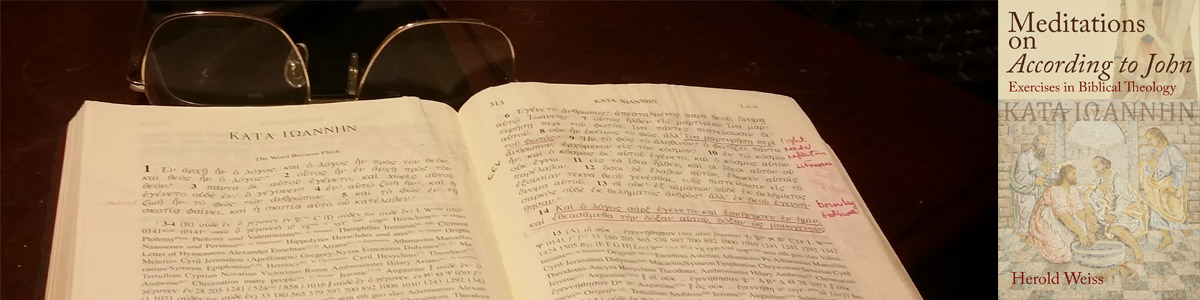
    john banner

    Above is the theme banner for my study of the gospel of John. The video below is a trailer for it. I am working on getting used to video. I’m more comfortable with text, I think.

  • Some Comments on Writing Introductions with Special Attention to John

    Studying JohnI’m planning to start doing some discussion of Bible passages using Google Hangouts on Air during the coming year. Basically, I’m going to work through material I intend to use in Sunday School. One may ask why I’m doing this, considering that the last time I tried, I had little success. Well, the difference is that before we just created a hangout and waited for discussion. In this case, if necessary, I’m just going to talk through the material I’ve prepared and record it for my YouTube channel. This will be my personal channel, which I’ve been neglecting for some time, not my business channel. Thus whether anybody shows up or not I’ll be talking! (Could be a sign of insanity.) Watch for more information here.

    I’m planning to follow the recent book Meditations on According to John by Herold Weiss, which approaches the book thematically. It’s that approach that I like. I will not necessarily agree with everything in the source book, but I’ll stick with the general structure. I’ll be consulting other materials, of course. Right now I’m reading The Gospel According to John (Revised) by Leon Morris in the New International Commentary on the New Testament series.

    Introductions to Bible books are a very interesting art form. One has to cover a broad range of material and draw on many parallels (or not) as well as many themes from the book in order to provide some generalities to help the user in study. The readers, on the other hand, will not necessarily be prepared to hear all of that yet, because they haven’t yet read the book. I recall one of seminary professors remarking that he wanted to offer Introduction to the New Testament and Introduction to the Old Testament as senior rather than freshman religion courses. He thought students were not ready to appreciate a good introduction until they’d been exposed to, and struggled with, more of the questions. He was only partially saying this tongue-in-cheek. I know that I’ve enjoyed reading Old Testament introductions and theologies much more since I completed my MA program than I ever did as an undergraduate.

    But the art of introduction is to provide the material without completely putting the reader to sleep, and come to some conclusions without losing your entire reading public. The problem is that by now there are so many theories on each book of the Bible that it’s very hard to sort through them all, classify them, decide what needs to be covered in detail, and then focus in on a conclusion. And then, suppose you’re wrong! What happens the someone’s understanding of the book ? We consider context important, and this sets the context, but it’s also easy to place a book in the wrong place.

    For example, was the gospel of John written before or after the destruction of Jerusalem in 70 CE? The consensus indicates it was written later, but there are a number of clues in the book that point to an earlier date. Then there are multiple theories for the origins of the book. Does it involve sources, or was it written more or less as is? How many sources and what did they contain? And whether or not there were sources, who was the author, and if you have sources, who authored them and who was the final redactor? All of these questions have an impact on how you will understand the book.

    I’m reading conflicting introductions right now. Leon Morris leans toward Johannine authorship of the gospel and the epistles, and also toward an early date. Herold Weiss tends to see sources, a late date, and an unknown author. I kind of like that as I get to look at both sides. And the thing is that I find lots of reason to doubt almost all conclusions. In this sort of a mass of theories with evidence light on the ground doubt is a very reasonable position!

    I consider myself a defender of biblical criticism. I appreciate such methods as form, source, and redaction criticism. The problem is that to a man with a hammer, everything looks like a nail. To a biblical scholar with form criticism on his mind, everything is an orally transmitted pericope. To a biblical scholar with redaction criticism on the brain, everything appears to have been added by one redactor or another. And with all due (dis)honor to William of Okham, entities are multiplied all across the landscape. I believe there is orally transmitted material in scripture. I believe there are books that are constructed from sources. In fact, Samuel-Kings identifies sources. I believe that there have been redactors. But the details are very hard to pin down.  The more general ones can be stated with some certainty, though not beyond reasonable doubt. the more detailed the conclusion, the less certain one can be.

    Now in the gospel of John, I’m not sure that there are really sources in the classic sense of the word. It seems to me to be a rather heavily united work. Are there stress lines? Yes. I see some places where it doesn’t seem to be sewn together as well as we might like. But after publishing more than 125 books, I can’t count the number of times I’ve told an author, “You’re transition here doesn’t make any sense.” Books written by human beings don’t always meet the criteria of the theology professor in the ivory tower. That’s because it’s hard to find the Bible book written by someone in an ivory tower!

    So was John written by the apostle John or another eyewitness? Is it valuable in studying the historical Jesus? First, let me note that I’m quite weary of reading discussions that hinge entirely on preconceptions about historicity. One senses that certain scholars don’t want any of the gospels to be written by eyewitnesses, because that would suggest too much historicity in the life of Jesus. It’s easier to dismiss if we don’t have actual eyewitness reports. On the other hand we have folks who must conclude that the gospels were written by eyewitnesses because they must be history. We can determine who was the author based on the evidence (if there’s enough) without necessarily giving up everything else.

    For example, I’m not nearly as excited about eyewitness testimony as it seems everyone else is. This comes from my experience with storytelling and hearing. My mother is now 96 years old, and we can sit down with various family members and get into some amazing disagreements about what went on. I remember a rare occasion in a recent discussion when I disagreed with my mother on something that happened and she said, “You know, I think you’re right.” That was astounding. Normally I defer to her because, quite frankly, she has a better memory than I do. But as I compare my memory with the stories others in the family tell, and compare their memory in turn with what others remember, I find that human memory is rather fallible, especially as our lives move forward. Since our family seems to be fairly long lived on both sides, I’ve had plenty of opportunity to hear stories evolve over time.

    But perhaps a better parallel to oral transmission of stories in the gospels is my experience in church discussing reports of contemporary miracles. These stories also change. Persons with more authority in the group tend to tell the most authoritative version, and other people’s stories will converge toward theirs. Over time, there will be different versions. If you were there, you may not recognize the story by the time a few years have passed.

    As a result, I no longer conclude that if we have eyewitnesses, we somehow have a reasonably accurate history, and if we are hearing from the next generation, we immediately do not. Rather, stories can achieve new highs or new lows within hours or days when humans are involved. In my opinion, there is history to be derived from the gospels, but since our kind of history is not what the gospel writers were aiming at, it’s not surprising that it’s hard to achieve. The question is how well the achieved their own aims.

    And so we come to the question of whether any gospel, and particularly the gospel of John, were written as history. The answer, in my view, is yes and no. The problem is that we tend to take this as a binary question with an easy “yes” or “no” answer. No, I don’t think any gospel writer sat down to write history. By that I mean that they did not have as their primary consideration recording of facts in historical sequence for the purpose of providing a precise view of what happened. But that doesn’t mean that they didn’t care what happened at all. What they were interested in was in presenting the meaning of what happened. God has intervened in history and has been present in the person of Jesus of Nazareth. What does this mean? Now to get to the second question means that you have to have some basis in actual events, but your presentation and what you think is important may be different.

    In this I take an example from preachers’ stories used as illustrations. There are some stories that have been repeated many times and now exist in many different versions. But generally differences come from the lesson the preacher wants to take from that illustration. The story will be shaped to its final purpose. That may annoy a consistency freak (and I confess to being disturbed by stories that exist in more than one version), but it’s natural human story telling. Thus we get different numbers of demoniacs when Jesus crosses the sea, or different numbers of times that the cock crows, or that Peter denies Jesus. I think efforts to reconcile this stuff are doomed to failure and of no practical value. In fact, they are some of the best evidence that we’re dealing with real stories told by real people. If someone made it all up, they’d be more consistent.

    So I’m open to the idea that John the apostle wrote the gospel, and that it does, in fact, contribute to our knowledge of the historical Jesus. But I’m more interested in how it contributes to our understanding (rooted in history, yes, but not stuck there) of who Jesus was and is. Interestingly enough, I find that when I read Weiss’s essays, I don’t suddenly find that I must reject his conclusions if I change my mind about the dating of the book. (I haven’t changed my mind about the date, but I might, and I don’t hold my current view of a late date very tightly.)

    As i study the book I’m going to be focusing on theology, but always mindful of history. I’m really enjoying the journey so far.

    PS: A couple of resources from Energion Publications on this topic.

    9780954018719

    Meditations on According to John

  • John 18:1-4 – Getting Christological Perspective

    If you’re acquainted with the synoptic gospels, in reading John 18:1-4 you may notice some substantial differences. What’s missing here is the time of tarrying and waiting, the prayer, any sort of agony or question about what Jesus was about to go through is gone. Verse 4 puts the different feel of the text into words when it says, “Jesus, knowing all that was going to happen to him . . .” (TNIV).

    So which is it? Was Jesus confident and in control, finally giving up his own life, or did he pray that the cup might pass from him? One could try to reconcile these by saying that he knew, but he also wished to avoid, but I think it’s impossible to read the passion story in the gospel of John without seeing a different picture of Jesus than the synoptics portray, always assuming that one lets John speak for himself, and each of the synoptic writers for himself.

    But I’m going to suggest that nonetheless “which is it?” is the wrong question. This is where we get into mystery. Orthodox christology holds that Jesus is fully human and fully divine. Human logic balks at the combination. When we think about Jesus we generally are either thinking of him as more human or more divine. Lacking an infinite perspective, we have to see something finite. In our minds 2 * fully (or 2 * 100%) is just too much to see at once.

    So we have different pictures in the gospels, because being written by finite people (inspired by God) and in finite human language, they can only give us part of the perspective at once. In John we see the divinity of Jesus in the foreground. In Luke especially (22:39-51) we see a much more human Jesus. Again, “which is it?” is the wrong question to ask. It is both, which is how the doctrine developed.

    When we see all the Biblical perspectives on Jesus we realize that he cannot be simply one thing. Various christological heresies have tried to make some one perspective be the perspective. But we can be sure that any explanation that makes too much sense, that makes it too simple to understand isn’t adequate to the task.

    I’m reminded also of God’s work in a person’s life. Who am I? Am I Henry Neufeld, defined by my history, my education, my actions in the past? Or am I a human being in the process of sanctification by the Holy Spirit, with Christ dwelling in me? I assure you that I don’t present the kind of challenge that Jesus, fully human and fully divine, does. But I do present contradictions, and I do look different when you look at me from the perspective of the work God is doing on me.

    In Hebrews 11 we have person after person who was called and used by God. The presentation of these people is invariably more positive than what you find in the Hebrew scriptures. Sarah is filled with faith, rather than laughter. Moses doesn’t fear the wrath of the king, even though he flees. I think Hebrews 11 looks at these people in terms of what God is doing in them, not who they were on their own.

    We can’t have a God’s eye view. God has the infinite expression. But by looking from these various angles that scripture provides, we two can see just a little of what God sees.