This is an exceptionally good chapter to be studying on Maundy Thursday, though I’m going to assume nobody will miss a Maundy Thursday service in order to listen! We’re going to talk about footwashing, signs, miracles, works, and witness and the difference between a sign and miracle. We’re also going to discuss what Jesus meant by “greater works” (John 14:12). What are these “greater works”?
Here’s the key quote from the chapter that will guide what I’ll be talking about tonight:
Jesus lived performing signs that pointed to the time when he would finish his work. Therefore the life of the Christian must provide signs that advertise the source of strength and vision for those who live by faith. Signs and faith must remain closely bound in the lives of the disciples of the one who is THE SIGN that must be seen and believed. (91-92)
You can get more details on the Google+ event, and you can watch either through that link, or using the viewer below.
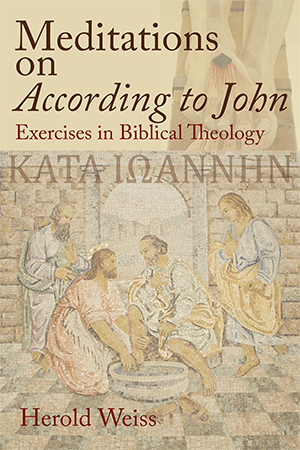
I apologize for posting this so late. I will post the YouTube and some comments tomorrow. Dr. Weiss is the author of the book I’m using for this study, Meditations on According to John.
I’m embedding the viewer here. I spent a great deal of time on Psalm 82, and I think that trying to do that just straight talking until I was out of breath may not have been my best choice. I’ll consider posting further on Psalm 82 and John 10:34 here in writing and hopefully clarify where I was trying to go.
There’s also something to look forward to further down the road. Dr. Herold Weiss, author of our text Meditations on According to John, will join us on March 12 to discuss his approach to the gospel. We’ll touch on date and authorship, but most importantly on the theology of the book.
I’m a little late posting the event for this, but my study of John will continue. I expect to post a couple more notes on the last hangout in this series as well as a follow-up to my conversation with Elgin Hushbeck, Jr. on the Energion Publications weekly hangout. For more information, see the link above. I will embed the viewer below if you want to go via YouTube.
My major purpose in doing this study was to engage in the discipline of following through the book(s), both According to John and Dr. Herold Weiss’s Meditations on According to John thoroughly, discussing the material, and taking questions and comments. This is a difficult process for me because both my training and my inclination is in the historical exegesis of the text, using the word “exegesis” as narrowly as possible to refer to extracting the historical meaning to the first audience. So thinking about the theology is hard work for me, and some of the rough edges definitely show. At the same time, I think this is a worthwhile exercise. Fortunately for me, some people who have a great deal of skill have challenged me on some points and that has helped me dig even deeper.
This week’s topic introduces an interesting aspect of biblical theology: comparing and contrasting the theology of two different passages. Colossians and John share some points of theology here according to Dr. Weiss, and we’re going to look at how one can examine this sort of claim and what the results are.
I do plan some conversations with experts for this series. Dr. Weiss himself has agreed to join me for a discussion. I suspect that one will emphasize christology and the statements he’s made relating the christology of John to various stages of the early church. That will in turn doubtless tie into some discussion of the trinity. Dr. Drew Smith, author of Energion Publications title Reframing a Relevant Faith will be joining me to discuss biblical theology and how it differs from systematic theology among other topics. Dr. Smith has his PhD from the University of Edinburgh in New Testament where his dissertation dealt with the theology of Mark. We’ll try to make him talk about John nonetheless! I will announce dates for these conversations soon.
So join the fun tonight at 7:00 pm central, 8:00 pm eastern, or watch the video later and respond through comments of blog posts.
An interesting discussion arose via a comment to my post on last week’s discussion of the Gospel of John. This relates to a textual variant in John 3:13. The verse ends in most versions, and in the UBS4 Greek NT that I use regularly, with “the son of man.” But there is another reasonably well attested variant which adds “who is in heaven” following “son of man.”
Dave Black, who posted the question, has written a journal article about this. In the comments I said I’d like to get a copy of that article, but it was only moments later that I located it. You can read it here. On this computer I’m having trouble with the Greek text, probably due to font issues, but I was able to follow it well enough as is. [Update: Dave sent me another link, this one to a PDF, and the Greek text is good in it.]
Prior to reading Dave’s article, I had come to the conclusion that I preferred to include this phrase rather than leave it out. I did not make use of this in my study, as it has little impact, as I see it, on what I said. I always dither over how much time to spend discussing textual variants. This is a very interesting variant, however. Please read Dave’s article first. While my reasoning is a bit different, and my interpretation considerably so, he covers the facts of the case, and I’ll just note those differences here.
Please read with a caveat: I’m not a NT textual critic. My last class in NT textual criticism was as an undergraduate. All my graduate work was on the Hebrew scriptures.
Of the canons of textual criticism, the one I consider to be the most useful is this: Favor the reading that best explains the others. I find that choosing the most difficult reading involves so much debate that it adds little weight to the result. I do think it’s valid, i.e., a difficult (but workable) reading is more likely to produce variants through correction, simple misunderstanding, or hearing/seeing what you know is there. But that also feeds into determining which reading best explains the others. In this case, I find it very difficult to see an explanation for the other variants if “who is in heaven” is not the original text. In fact, as Dave notes, Metzger (A Textual Commentary on the Greek New Testament) presents this as the argument of the committee minority, while the majority was swayed by the quality of the witnesses to the shorter text.
I would not necessarily accept the variety of the external evidence if the reading did not also so clearly explain all other variants. In combination, I find them convincing. Of course, one should always remember that textual criticism is not an exact science. There’s plenty of room for valid disagreement. I would note, for example, that the UBS4 rates this reading a B, while my edition of the Textual Commentary, based on UBS3, rates it a C. I’m not sure what happened to increase their certainty. I don’t share it.
At first blush, this reading seems difficult. Here’s the son of man on earth, and he’s also being affirmed in heaven. Either this is a very high christology, or we have a problem. That very problem contributes to the probability that the reading is original. There’s plenty of reason for someone to remove it, thinking it’s an error, but little to add it. But on further reflection, I think it’s very possible we are here, as in vs 11 & 12 (at least) hearing the voice of the author/community, with the affirmation that Jesus has ascended. Though I see a few difficulties with it, I would be unsurprised if everything after John 3:10 through the end of the chapter represented further comment by the author and is not intended as a quote attributed to Jesus.
That said, I will pursue further christological heresies this coming Thursday! Or not … as the case may be.
I want to follow up a bit on the study last night. I’ll embed the YouTube below for those who want to view this study after the fact. A few things occurred to me since the study.
I’m really spending a great deal of time on the use of stories and of metaphors in discussing theology. I’m convinced that we don’t recognize the metaphors we’re using often enough. For example, it’s worthwhile to note that most discussion of substitution occurs inside the metaphor of the courtroom. It’s then important to recognize when a discussion, whether current or in scripture, occurs within another metaphor. John 3:16 occurs in a different metaphor, or perhaps more than one, and it comes after John has evoked the story of the serpent in the wilderness (Numbers 21:4-9). In that story, the key line is “look and live.”
It’s very important to distinguish “light” as John uses it from our 20th/21st century use of that metaphor. Yes, that word is another metaphor. Jesus did not claim that he as going to provide physical light to the whole world. The modern tendency is to think of light as information and enlightenment as the reception of information. For John, and for Jesus as represented in this gospel, light is more closely connected to life. To mix the metaphors, you look up at the light as he is lifted up and you live. The healing of the blind man in John 9 links closely to this metaphor. There is light and the ability to see light.
Metaphors allow us to talk about the same general subject from different perspectives. Thus one can talk about atonement using the metaphor of the battlefield, the courtroom, and the family/community without being contradictory. I would suggest that one shouldn’t mix these metaphors, at least without being very aware of what one is doing and doing so carefully.
I had an excellent audience question, and this time one that wasn’t in my notes as something I might discuss. Just what was John doing? Jesus speaks so differently from the way he does in the synoptic gospels. Why? It’s a good question, and I went the right direction as I started to answer it. Overnight it occurred to me, however, that the synoptic gospels also had in mind building community. They were just more tied to an existing sayings tradition in doing so. The change, in my view, is one of emphasis. The particular kind of community building involved is one of defining oneself. What is it that we believe as a group that makes us a spiritual/religious community? There is a danger here in following the example of the community reflected in According to John. They are distinguishing themselves from the Jewish community, of which they had previously been members. Who are we apart from being Jews who believe in Jesus? We have to avoid following this line of reasoning to anti-semitism, as Dr. Weiss points out. In addition, however, we need to avoid community building that is done over-against others. There is a certain amount of “and you’re not” when one defines a community. But we need to avoid defining ourselves in a way that reflects negatively on others. The community in John had good reason—they were a persecuted minority. We have less reason.
I’m very glad for Dr. Herold Weiss as a guide in this study. I’m assuming those who are joining me are reading his essays. He’s much more to the point. I’m adding a good deal of discussion of the nuts and bolts to help people think about their own theology, or at least I hope it helps. This can get boring, but sometimes wading through the nuts and bolts (intentional mixed metaphor!) is precisely what we need to do.
And here is the YouTube embed for those who may have missed it: