Threads from Henry's Web

Tag: gospel

  • Psalm 119:171 – Sing Praise!

    Psalm 119:171 – Sing Praise!

    Let my lips sing your praise,
    for you have taught me your statutes.

    The underlying theme of Psalm 119 is praise to God for the law. The law is righteous. The law is good. Good things come of keeping the law, even though we have to ask God for the strength to do so.

    I find the relationship of may Christians to the law quite interesting. There quite an interesting theological/biblical discussion between various groups, particularly Lutherans, Calvinists/Reformed, and Wesleyans about the relationship between the law and gospel. As an introduction, let me commend the article on Wikipedia on Law and Gospel, though doubtless many, myself included, would pick at various points.

    In practice, however, we tend to simultaneously declare that we are saved by grace through faith, but then only apply this to the moment of salvation, of becoming part of God’s family. At that point, most of us would say that we are not saved by keeping the law. So we have a distinction here, because law is not the agent, even though law definitely has a role.

    But we turn from that and, whatever we may proclaim, we become people of rules. We want the ten commandments in schools, as though better morality will be achieved because of a display of the ten commandments.

    We aren’t really praising God for the law through all this. Rather, we’re considering that we have to have a stick to use to beat people into proper order. We ditch gospel and grace and become another behavior modification program.

    This is exemplified by the plea I have heard frequently from parents and friends, “Help me get my child/friend back into church.” The goal is to get them into the church structure and organization, such that their behavior can be made more … I’m not sure if it’s more Christlike or more Churchlike.

    I recall having this discussion in a church my mother attended, which she called, to their face, the church of the gottas. You gotta do this, you gotta do that. Having been saved by faith, or rather having been shoved across the starting line by grace received through faith, you gotta get busy running the race and making sure you get everything right.

    My own experience with teaching about tithing is an illustration. Is tithing a command applicable to Christians? For a long time I struggled with the fact that I couldn’t see that it was, yet as part of the leadership team of a church, I was afraid to say so, lest people give even less. I was already irritated by people who spoke of “tithing” 1% or 2%. “Tithing” refers to 10%, though 10% of what is subject to some controversy. But if you’re giving 1%, you’re not tithing.

    My concern, or to be honest, fear, was that if tithing was not a rule, then people wouldn’t give, and then programs of the church that I hoped would be well funded, such as children’s ministries and missions, would suffer.

    It took me a long time to realize that grace was the only thing that was ever going to bring sanctification, including sanctification of our wallets, doubtless the least sanctified of our possessions.

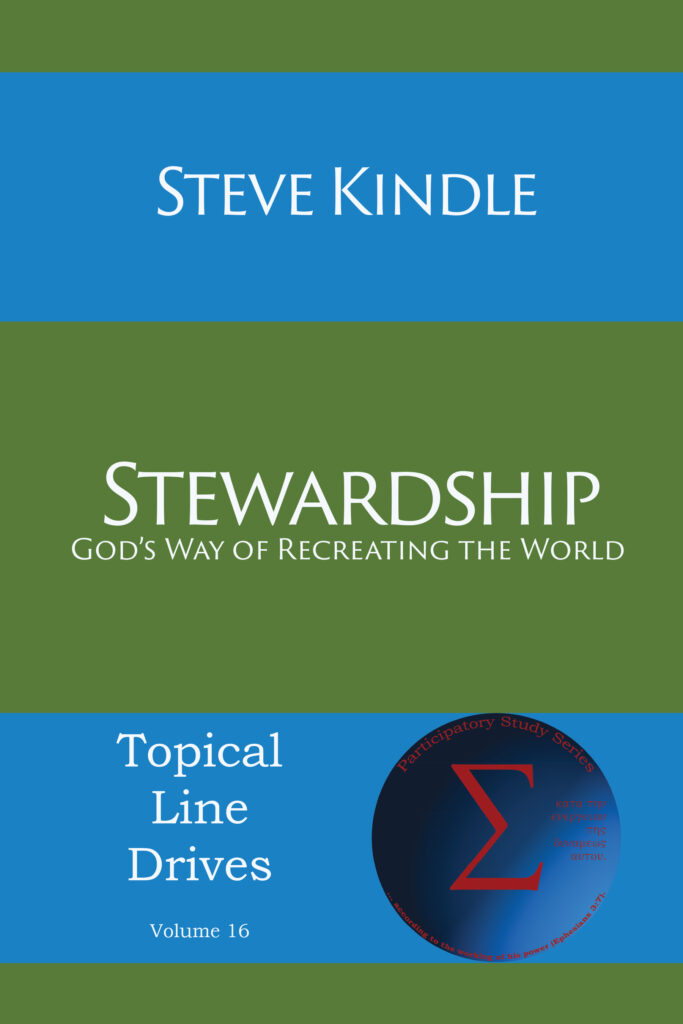
    The bottom line was that in Christ, everything is dedicated to Christ and we make our decisions on spending and giving based on that fact. I had come to this conclusion, but hadn’t expressed it all tat well until I read as an editor, and published the little book Stewardship: God’s Way of Recreating the World by Steve Kindle.

    Here’s a selection from page 25:

    The questions around how much to give are too often reserved for “Stewardship Drives.” So we compartmentalize our giving and tuck it away for another year. In all the talk of stewardship, seldom
    does it go much beyond the pocketbook. Whenever stewardship is reduced to a program, something is terribly wrong, and congregations and individuals continue to struggle.

    The apostle Paul revealed to us the key to successful fundraising in his appeal to the Corinthian congregation to assist in the collection he was taking up for the Jerusalem church. His formula:


    3For, as I can testify, they voluntarily gave according to their means,
    and even beyond their means, 4begging us earnestly for the privilege
    of sharing in this ministry to the saints— 5and this, not merely as we
    expected; they gave themselves first to the Lord and, by the will of God,
    to us,… — 2 Corinthians 8:3-5

    The Macedonians, in spite of their poverty, begged to give to the Jerusalem church—even beyond their means—because they first gave themselves to the Lord. Sure, it is possible to raise a lot of money using sophisticated methods based on psychological triggers and emotional appeals. These are too often resorted to as substitutes for the Macedonian way. A congregation that first “gives themselves to the Lord,” recognizes their stewardship partnership, and everything they do springs from that commitment. So let’s not encourage tithing, that’s about money. Let’s encourage
    seeing all we have as God’s and act accordingly.

    Steve Kindle, Stewardship: God’s Way of Recreating the World, p. 25

    This same approach applies to everything about Christian living, and it’s something we should pay attention to. If we could focus on that connection to God, and the motivation of love that is involved with it, better behavior, empowered by the Holy Spirit, would be the result.

    When we see the law in this way, as a gift, and as a description of what might be and what God is, we can receive it with praises. If it is a club to make people look and act like us, to be “churchy,” then it will always be a negative thing.

    But if we don’t focus on that core of being as the source of all we do, we will inevitably get back to a picky, rule-by-rule attempt at behavior modification, which is sure to fail in the end, not to mention causing a great deal of fiction along the way.

    How can you find joy in being and doing today?

    (Featured image is from Adobe Stock. Licensed, not public domain.)
  • After Teaching on the Sermon on the Mount

    After Teaching on the Sermon on the Mount

    My Sunday School class just finished a several-week study on the Sermon on the Mount. We did not use any study guides as a class, though I consulted three books I publish, One World: The Lord’s Prayer from a Process Perspective, The Jesus Manifesto: A Participatory Study Guide to the Sermon on the Mount, and Ultimate Allegiance: The Subversive Nature of the Lord’s Prayer. Some class members did make use of those references, and I also provided links to and some printed copies of John Wesley’s sermons on this topic. Class members also used a variety of Bible translations and other reference works.

    At the end of the class, one of the members commented that he was very glad to have studied the entire sermon, because he could see how it fit together and how the various parts built on others. He commented that we often read the Beatitudes and the Lord’s Prayer, while not continuing to cover the rest of the three chapters.

    Over the years I have read and studied this sermon many times, and I never fail to find something new with each adventure in it. There are three (well, maybe four) general approaches to it.

    First, let me dismiss my “maybe four.” I had one young man come to my house to try to get me saved. That I already professed Christianity was not important to him. I needed to understand it the way he did. One of the things he wanted me to understand was salvation by faith, which in his view eliminated anything having to do with works. He specifically told me that the Sermon on the Mount does not apply to Christians. I found it interesting that the longest collection of the teachings of Jesus we have was regarded as not applicable.

    Dismissing dismissal, I have found three general approaches, with the first two covering most and the third as a sort of supplement based on sermons I’ve heard.

    1. The sermon is a description of righteousness, designed to let us know we can’t attain it, and drive us to the cross.
    2. The sermon contains the central ethical teachings of Jesus which we are expected to follow.
    3. The sermon is descriptive of ways in which our behavior impacts others and our own social environment, and provides a guide to more effective functioning of society.

    I’ve intentionally made these as distinctive as possible. One of the things that struck me as I studied this time was that the sermon truly can function in all three ways. You might expect a Reformed theologian to embrace something like #1. Wesleyans might tend more toward #2. I’ve only heard a few people who go purely one way or another, though they often sound like they do! The third option is more often exhibited in preaching broadly based on the sermon when the speaker is trying to make applications in the social gospel.

    It struck me this time through that all three elements are present. There are repeated indications that the expectations expressed are well beyond our ordinary capabilities. Loving your enemies is well beyond most of us, though I’ve heard people cut the command down to size to make it possible. Consider, however, that Jesus’ own demonstration of this command involved requesting that the Father forgive those who were in the process of crucifying him.

    In the class we all commented on how potentially frightening it was to sincerely pray, “Forgive us our trespasses as we forgive those who trespass against us.” Do you really want to be forgiven as you forgive? Perhaps you are a paragon on virtue in the matter of forgiveness, but I suspect not many of us are.

    Then there is the simple matter of most of chapter five, which sees all these things as expressions of what’s in the heart. I shocked some in the class by explaining that I had been a murderer during the prior week. I had been on the phone with a customer “service” rep who whose ignorance was exceeded only by his arrogance. (Can you perceive me despising him even now?) I told them that if I’d been physically with him, I’d likely have strangled him. Jesus isn’t giving me points for not being able to carry this out.

    Thus I think that the Sermon on the Mount very much calls us to realize that we are quite imperfect, and also directs us to an unattainable standard. That’s where grace comes in, and grace is reflected in some of those very passages on forgiveness. God is more forgiving than we are.

    At the same time, there is a great deal of value in the second way of looking at this. However unattainable the standard is, it is a good one. That is, it tells us about things that are good to do. The problem with perfection is that you fail to attain it, and end up apathetic. I can’t do what I’m supposed to, so why do anything? Perfectionism has created a large number of failures.

    The problem is that each time you lower the standard, you end up aiming lower. If you’re headed north following the north star you know you’re unlikely to get to that north star, or even the north pole. But if you decide that unattainability makes it unimportant, you’re likely to get nowhere. That’s where keeping a high standard and incredible grace together does well.

    I can’t resist quoting one of my favorite scriptures: “Work out your own salvation with fear and trembling, for it is God who works in you both to will and to do his good pleasure” (Philippians 2:12-13). We often hear that preached by halves. I can’t count the number of times I’ve heard “work out your own salvation with fear and trembling” from someone who was only vaguely aware of the next verse, if at all. Similarly, we can say, “It’s God, so don’t bother to do anything.” Neither of these is effective.

    And that leads to the third point. I wouldn’t use the third option alone, but in many cases this sermon shows us how society works. “Forgive and you will be forgiven,” speaks of God’s forgiveness, but also points to a way of life. The one who is unforgiving builds an atmosphere of unforgiveness. “Judge not, lest you be judged,” is also a very good principle in society. The verse, Matthew 7:1, is one of the more abused passages in scripture with some destroying it by overapplication and others essentially dismissing it by referencing exceptions.

    Jesus himself provides some clarification in Matthew 7:15-20. Thus we wind up with those who avoid 7:1 by calling every judgment “fruit inspection” and those who eliminate fruit inspection by calling it all judgment. Both passages are right there and both apply. There’s some wisdom needed, and doubtless we will not attain perfection!

    I enjoyed reading these passages and looking for the variety of applications. I’m grateful for grace in all circumstances. I’m grateful for a standard, which tells me that God’s glorious purpose is greater than I can imagine. Finally, I’m grateful for wisdom in looking at how we can better live with one another.

    It’s an error to treat everything as an answer to the question of whether one is going to heaven. Some things are about a better life here as well.

  • Perspectives on Paul for 10-14-20

    Perspectives on Paul for 10-14-20

    PowerPoint

    PDF

    https://henrysthreads.com/wp-content/uploads/2020/10/101420.pdf

    Video

  • The Danger of Making Things Tougher

    The Danger of Making Things Tougher

    I don’t spend a great deal of time talking about it, but following my MA in Biblical and cognate languages, I took one quarter in a MA in Theoretical Linguistics program. I had a full ride fellowship with a stipend, but after one quarter I resigned the fellowship and headed for more interesting places and activities.

    In my introduction to linguistics course, the midterm test was made up of a short set of essay questions. I believe we had to answer three of four, though I can’t remember precisely. One of them had to do with comparative linguistics—right up my alley! So I filled it with examples from multiple languages and just plain had fun. More fun, in fact, than I’d had in the class up to then.

    I hadn’t realized that the professor would choose to read what he thought were the best answers to the questions to the entire class. He chose mine. I wasn’t embarrassed by my content, but the context was totally wrong. The university had a strong TESOL program, and the vast majority of the students were in that. They were not pursuing theoretical linguistics. As a general rule, they probably had at most a minor in one foreign language.

    One student responded immediately afterward with a question: “How are we supposed to write something like that when we don’t know all those languages?”

    Her question was absolutely valid. My particular skill set was not that relevant to them. One can be superior at TESOL without knowing, say, Ugaritic. By presenting something not relevant, the professor had actually done something to discourage other students. If they had to do that, well, they couldn’t.

    It wasn’t because I was superior to them. It was because my skill set was different.

    Now let’s make a completely bogus argument. Why not? People do it all the time. Here it is. Knowing more is better. If those students learned more languages, they would have more sources of examples. Why should they not be required to learn all those languages? They’re probably just too lazy.

    A parallel argument might be made about my high school education. Why not require him to take more credits in science and math? Why not require Algebra II, Trigonometry, maybe some Calculus? After all, he will know more!

    Well, in response. I’ll go ahead an be lazy. In fact, I’m a high school dropout. It wasn’t for the normal reasons. I was overseas and enjoying running around the country. But the thing is that I was able to succeed without all those credits, including not having the credits normally required in English. In fact, I have just 2.5 high school credits, and one of those is in typing.

    Yet we make this kind of argument all the time. For the things I find easy, it’s also easy to suggest that others should have to fulfill those requirements. Why not? It’s good knowledge and they might need it. I recall the surprise of some people trying to develop a two year ministry program when I suggested that requiring Greek was not a good idea. There are many reasons for this, including the fact that in a two year program you can’t learn enough Greek to be that useful unless you steal time from other necessary activities.

    But let’s look at the church. We often operate on the same basis. Why not suggest people do it? Why not make the standard higher? We even talk this way in churches that hardly have any standards at all, because as members we want some.

    Whether it’s modest dress, giving, mission work, church activities, or other moral issues in our lives, the solution is generally to suggest doing more. And yes, again, I realize that we rarely enforce those standards, but that makes it even worse. We push people to higher performance and assume they won’t make it, but we figure if we just push a bit harder—you’re giving one percent, how about two?—we’ll get a bit more out of people. When they don’t live up to the implied standard, well, we tried!

    And they may have tried and failed, and added to whatever else they may have been dealing with, they now feel that they are not living up to what their pastor, Sunday School teacher, small group leader, deacon, elder, or generally picky person round the church expects of them.

    It’s like telling (or rather, implying that) those people who were learning how to teach English to speakers of other languages ought to get down to it and learn a few more languages like the theoretical linguist down the row. (Or rather, the guy who had learned a number of ancient languages. I never did get a degree in linguistics!) It won’t help them do their job, but one can hope it will make them feel smarter.

    Actually it won’t. Setting up higher standards doesn’t help one to fulfill those standards, whether or not they’re relevant.

    But there’s another problem in church. When we require those “higher” standards, we also imply that the standards are what church is about, and we can suggest that other people, those who don’t accomplish those standards are not good enough.

    I think this is a good part of what Paul is talking about in Romans 12-14, especially 14. It’s possible to read Paul’s toleration as an acceptance of just anything. I think Paul’s focus is on the message of the gospel. He’s giving up disagreements and minor points of behavior in favor of the message of the gospel.

    I’m not going to do this verse by verse, but try reading those three chapters with this in mind. No, that’s not the only theme, but I think it is uppermost in Paul’s mind. How are we going to witness best to the message of the gospel? So then, “Don’t destroy God’s work over food” (Romans 14:20) the point is to put one’s focus back on the gospel. Forcing one’s detailed rules doesn’t make people better. It detracts from the gospel.

    Being stricter, always trying to be better, will not necessarily make you better. It is often, instead, the road to more complete failure.

    (Please check out the article FROM DOBE TO BEDO by Pat Badstibner on Energion Direct’s From Our Authors.

  • Of Isaiah 40 and Grasshoppers

    Of Isaiah 40 and Grasshoppers

    Last night in our Tuesday night group we discussed this rather interesting chapter, one that I believe expresses the basics of the gospel message well.

    Now I don’t mean by this that it mentions the name of Jesus or even directly predicts anything about his ministry. There is some material here that is used of John the Baptist and Jesus, but that is another subject. What I mean is the basic principles. I will express these as: We can’t, God can, God does.

    There are those who find the whole depravity thing in Christian theology somewhat morbid. But there’s a really simple point, and one I think is obvious once you see it. We really can’t!

    Once we accept the fundamental idea of God as creator at all, we accept total dependence and our inherent smallness. As Isaiah calls us, grasshoppers. God looks down from the circle of the earth and the inhabitants (that’s us) are as grasshoppers.

    If we think about it for a moment, not only can we not do good without God, we can’t do anything at all. We can’t exist. We are, before our creator, nothing at all.

    And yet!

    And yet, God is coming to God’s people. God cares, in great detail.

    Here is the Lord GOD; he is coming in might,
    coming to rule with powerful arm.
    His reward is with him,
    his recompense before him.
    Like a shepherd he will tend his flock
    and with his arm keep them together;
    he will carry the lambs in his bosom
    and lead the ewes to water.

    (Isaish 40:10-11, REB)

    God’s greatness is not something that should make us miserable. Face it, we have looked at the universe and it is incomprehensibly large. We are small. Yet we are significant. If God is the creator, as we believe, then God is incomprehensibly large, and we don’t really have anything to offer.

    And yet!

    When I consider your heavens
    the work of your fingers
    the moon and the stars
    which you have put in place,

    What is a human being
    that you take notice?
    A mortal that you seek him out?

    Yet you have made him a little lower than God,
    with glory and honor you have crowned him.
    You have made him rule over what your hands have made.
    You have put everything under his authority.

    Psalm 8:4-7 (my translation)

    Isaiah 40 tells us that while we can’t, God can, and God will.

  • What Do I Do About Grace?

    What Do I Do About Grace?

    This question has come up a number of times in my Romans study group, and it’s a good one. I’m not one to call all questions good. In fact, I think if you ask the wrong question, you often end up with an answer that leads you astray.

    In this case, however, we’ve gone from Romans 1 through 11, and we’ve been learning about God’s faithfulness and God’s grace. One class member commented that the answer to any question I ever asked should be “God’s grace is sufficient.” That’s not a bad answer. Sometimes, however, we need to go a bit further.

    Paul’s going to do just that starting with Romans 12. Now some people write, teach, and preach as though Paul talks about theology and then makes a break with his theology in order to talk about action or ethics. I disagree. Paul makes clear in Romans 12 that he is building on what he has said before, and what he says is very well founded. We should read his “therefore” in 12:1 as tying this together.

    Because God is faithful, because God has given us his grace, here is the result.

    Using the Word “Law”

    One of the critical elements in understanding Romans, which leads up to this point, is Paul’s usage of the word “law.” When I was in my late teens a person I respected greatly told me that the big mistake in reading Romans and Galatians was misunderstanding “law.” This person told me to understand it as “Torah,” i.e., the practice of Judaism. The issue of the law here was one of whether gentiles needed first to be Jews.

    This is doubtless one of Paul’s points, but it is far from Paul’s whole point. That definition works better in much of Galatians, where requiring gentiles to practice Judaism, with the entry point of circumcision, is much more central. In Romans, Paul uses “law” in some different senses.

    Our tendency here is to try to find out which one sense Paul is using and then apply it throughout, but this may not be the best approach. “Law” can have quite a sizable semantic range, including God’s divine law and purpose for all time, specific bodies of law, such as the Torah as a whole, or the instructions to Noah, or even specific commands. English usage of Law doesn’t quite extend to a body of broad instruction, but that is part of the range of Paul’s usage.

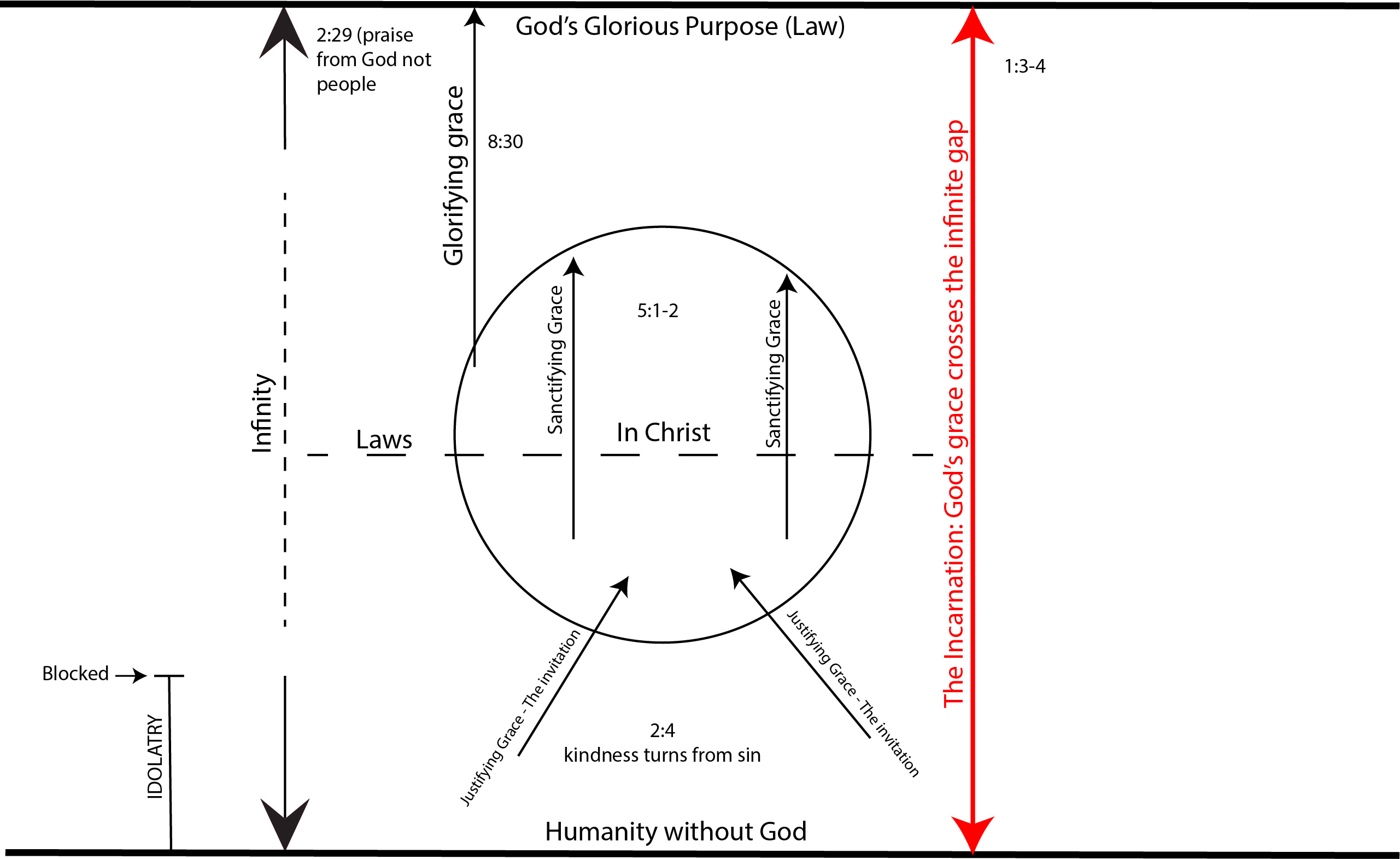
    A Diagram

    Here’s a diagram I provided to my class. I’m going to write a few notes about it. Obviously, this is abbreviated. We have spent months getting to this point with my Romans class.

    I started to put all the notes and the text on the diagram, but that proved a bit too complex and confusing. So herewith a few notes.

    God has made no plan ever that was not intended to produce a holy people. God has a glorious purpose for us, and reaching that purpose perfectly is the ultimate goal. We have, however, all fallen well short of that, and we continue to fall short. But God’s grace is sufficient.

    There should be no balance between faith and works or grace and works, because these are different things and cannot be balanced. There is no amount of works that I can do that will force God’s hand or earn God’s favor. I like to use navigation by the pole star. Think of yourself orienting your journey by sighting Polaris. You do not believe you’re going to get to Polaris by walking in that direction, but you do believe that you’ll get to another destination. The fact that you cannot reach it doesn’t make it less of a guide for what you can reach. (You can find my calculations on the north star here, along with much other verbage!)

    The key here is the invitation of grace, the invitation to be “in Christ,” in which we allow God to work on us and change us, but we cease judging ourselves or others according to the ultimate perfection of a goal we cannot possibly attain.

    Idolatry

    The short line at the bottom left deals with idolatry. The true problem with idolatry is that it places something less than God in the place of God. That can be our own desire to attain, to be in control. We like to be in control. We feel safer if we can say that God will take us to heaven because we have completed a list of chores. But that’s placing something less than God in God’s place.

    Similarly, we can place something less than God’s perfect law in the place of God’s law. (My friend Pat Badstibner has written about this in The Law Is Not Soggy Corn Flakes.) I use Paul Tillich’s terminology to some extent, that idolatry is making something not ultimate your ultimate concern. So we have those who decide that this perfection thing being unattainable, we need to find something attainable and do that.

    Doing the attainable with God (see Philippians 2:12-13 and John 15:1-8) is just fine. God knows where he can take you, and through sanctifying grace will guide you there. (Here’s where I depart from Wesley’s plan. I don’t believe in Christian perfection. I believe that is only accomplished with glorification. It should be made clear, however, that the perfection Wesley spoke about was not the attainment of all of God’s glorious purpose for us either.)

    We start to step into idolatry when we start to trim God’s standards so that they look better to us. By this, again, I don’t mean looking at attainable goals. In fact, that is precisely what God has done with us. I show this in my diagram by the lines representing God’s commands and laws for times and circumstances.

    God’s goal is always the same, but God works this out in many different ways in various times and places.

    God’s Grace Is the Context

    On the right I put the long red line that represents God’s grace. That is the one and only thing that connects us to an infinite God. Only God can cross that gap.

    Let me apply this now to the particular question that came up in class multiple times. What do we do about sin in our midst? Do we forgive, excuse, confront, ignore?

    And here is where we need to watch out. Matthew 7:1 is, I think, one of the most misunderstood and simultaneously disobeyed passages of scripture. It’s an important command. We also have Matthew 7:15ff regarding watching out for false prophets and knowing them by their fruit. Is this latter not an act of judgment?

    I would say that we have to regularly inspect fruit and make decisions based on that. We might have to choose between one person and another to lead the children’s ministry. We might have to decide whether a pastor or teacher is acting as a false prophet. Those would be acts of judgment in one sense.

    Guidance

    The guidance I see in my chart is simply this: We also judge and inspect fruit in the light of the law and the laws.

    First, we understand ourselves to be the objects of infinite grace. We are, ourselves, sinners, in need of God’s grace and action. I realize many find this hard to accept, but I see it in the context of broader reality. I am so pitiful that without God’s creative power I would not exist at all. Thus saying I need God in order to do good is a minor derivative. From that flows the idea that all depends on God.

    Second, as recipients of God’s grace, we know that God is working in us and through us and that we are witnesses to the working of God’s grace. I often tell Christian audiences that there’s no question whether you will witness. The question is whether you will be a good witness or a bad one.

    Thus we conduct all our fruit inspection in the context of the knowledge that we are recipients of God’s infinite grace, and not as superior people looking down upon lesser mortals. That position is left to God.

    So how does that help one decide whether to confront or remain quiet?

    Simply this: It sets the context. What is right becomes the question of what is the right thing to do as a recipient of God’s grace. Proverbs 26:4-5 provides a similar issue. Read it and then ask yourself the question. If I find a fool speaking, which should I do? Listen to the Holy Spirit and decide in the context of grace.

    All to God’s Glory

    As Paul says in 1 Corinthians 10:31, “Whether you eat or drink or whatever you do, do all things to God’s glory.” So ask, “Am I doing this for God’s glory, or am I doing it to justify myself or even glorify myself?” and “Is this done as an act of grace, or an act of condemnation?”

  • Tonight in Romans

    Tonight in Romans

    This evening, at 6 pm at Chumuckla Community Church, we continue the study of Romans, just starting chapter 2. Here’s a quote from some of my reading today:

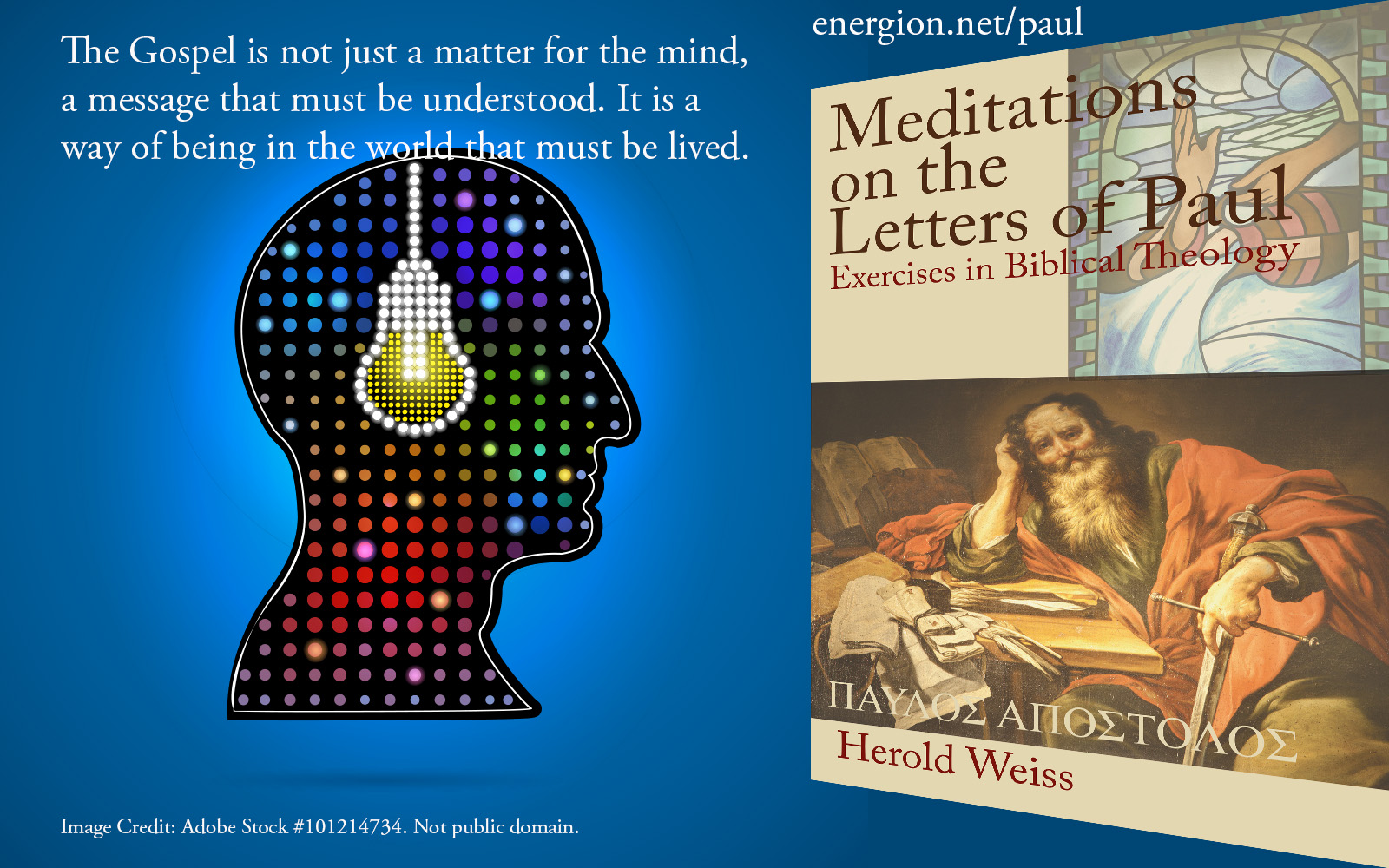
    The Gospel is not just a matter for the mind, a message that must be understood. It is a way of being in the world that must be lived. The Gospel may reach the individual through the mind, and the mind has a task to do with it, considering its premises, judging its arguments, evaluating its goals. But the Gospel must find its home in the heart, the seat of being. It cannot get to the heart without passing through the mind, but it is not effective unless it settles in the heart, changing it in the process. As Paul puts it, the heart must be circumcised (Rom. 2:29). The power of sin in it must be expurgated. The Christian has a mind renewed from above and a circumcised heart. Paul’s promise to his converts is that “the peace of God, which passes all understanding, will keep your hearts and your minds in Christ Jesus” (Phil. 4:7). To keep the mind and the heart together is to live by faith and reason. The love of God that the Spirit pours into the heart does not dislodge the unity of the mind and the heart. It strengthens it. In the Christian, faith and reason abide as one. (Herold Weiss, Meditations on the Letters of Paul, pp. 59-60)

    There are those who think we’re moving slowly. I think we’re moving at lightning speed! If you live in the area, come and join us for an exciting discussion.

  • Elgin Hushbeck on Apologetics

    Elgin Hushbeck on Apologetics

    One of the blessings in my life is the number of friends I have found (and I don’t always make friends easily) who are willing to have great discussions. By “great” I mean ones in which we challenge one another’s ideas with vigor but without anger or condemnation. If you seek only friends and associates who agree with you, you’re missing out on a great blessing.

    Elgin Hushbeck is such a friend. I think I tend to emphasize the places where we don’t agree over those were we do simply because I find those discussions more useful and enjoyable. Elgin is a Christian apologist, which did not help me to warm up to him or his writing (this was before I was a publisher). Apologists often get a bad reputation for a number of reasons, including obsession that makes them narrow, a vigor in presentation that belies weakness of content, discourtesy, and some carelessness with factual accuracy in a good cause. And this is not to mention mistaking a catalog of facts for the good news of the gospel from time to time.

    Elgin doesn’t do this. I want to call attention to his post yesterday on the Energion Discussion Network.  If we could get the “gently and respectfully” part taken care of, the rest would work much better.

    I have found that the style is not a characteristic of one or another theological or political position. Whatever it is you’re advocating, gently and respectfully is going to accomplish more in terms of communicating your message, assuming that’s your goal. If you just want to stick it to the people who disagree with you, your strategy will obviously differ.

    But with regard to the gospel, if your goal is to stick it to an opponent, don’t imagine that you are actually proclaiming the good news. The good news isn’t that you’re right and the other guy is wrong. Rather, it has something to do with God loving both of you, no matter how wrong you are. It depends on God and the Holy Spirit to fix that wrongness.

    (Featured image credit: Openclipart.org.)

  • Perspectives on Paul: Date and Authorship of the Epistles

    I will review how date and authorship is determined (or not) and how that relates to the way we will answer the question of Paul’s gospel.

  • Paul’s Gospel or Another Gospel, Part 2

    Paul’s Gospel or Another Gospel, Part 2

    Apocalyptic background - flash and lightning in dramatic dark sky

    This is the unintended second part of last week’s discussion, since I didn’t even come close to completing the material. We’ll be launching from Galatians 5:6-9, but I had already discussed the content of those verses. Now we’ll be looking through Paul’s letters, including those attributed to him, but disputed by scholars, looking for the nature of the gospel according to Paul, and what might “another gospel” be.

    Reminder: Resource Page.

    Here’s the viewer: