Threads from Henry's Web

Tag: Books

  • My Latest Book (Partly)

    My new book wasn’t planned–by me, that is. Rev. Riley Richardson, pastor of Gonzalez United Methodist Church (and thus my pastor) were talking one day about books, and he said, “What I need is an extremely simple book that I can give to new members that will tell them what to do next and help guide them into discipleship.

    Discipleship:  Jesus With Us

    Being a publisher, and more specifically a publisher whose publications are driven by what I perceive as educational needs in churches, I immediately suggested to Riley that he write such a book and I would publish it. But he didn’t jump right on the bandwagon until I offered to help. So on the new book you will see right below Riley’s name the phrase “with Henry Neufeld.” That means Riley got to make all the decisions, and I helped him produce it. I helped myself by incorporating material from some of our existing Participatory Study Series tracts with Riley’s approval.

    For those who don’t know him, Riley is an energetic, evangelical Methodist pastor. He’s practical and down to earth. So the book isn’t really mine, despite the title to this blog post, but I had quite a bit to do with it and I’m happy to be able to offer it as a tool for pastors, church leaders, and every member who has ever wondered what to do next when someone becomes a Christian or joins the church.

    The statistics are not so good for new Christians staying in the church. Discipleship and fellowship are key elements to sticking with it. Both Riley and I pray that this little book will be a help to many.

    This book will not (or at least should not) teach the pastor anything new about discipleship. It’s a tool to use in ministry and in sharing with others. Activities and study questions are included so it can be used in small groups.

    A couple of personal notes–first, nepotism is involved in the cover production. That beautiful cover is the work of my nephew, Jason Neufeld (contact info at jasonneufelddesign.com). Riley has designated his royalties to go to the Ukraine missions that are carried out by Pacesetters Bible School and partially supported by Gonzalez United Methodist Church.

  • From the Land of the Deluded

    A couple of weeks ago I made the mistake of trying to reply to a point in Plantinga’s review of The God Delusion, and got caught. The first commenter on that post suggested I should read the actual book “if only to be able to evaluate reviews of a different book going by the same title.”

    Well, I have now read the book, and it was less irritating than I expected, though my expectations were fulfilled. In general, I was not surprised by anything Dawkins had to say. This should not be shocking considering that I have studied Christian theology fairly extensively for a non-theologian (I remind readers that my field is Biblical studies, not theology, and thus at theology I am an amateur), and I have also read a good bit of Dawkins’s writing, and I am very fond of it, even though I recognize that I am precisely the type of Christian theist for which he has the greatest contempt. This latter point is repeatedly emphasized in the text of The God Delusion.

    There is, however, one way in which the book is worse than I expected. I linked earlier to a post by Bruce Alderman, in which he performed a humorous source analysis on this text. I got a good laugh out of it, but at the time I was assuming it was pure humor. Having read the book, I think I can build on his analysis.

    Bruce’s H source writes much like the Richard Dawkins of books like The Blind Watchmaker. He does surgery on ideas with a laser scalpel, coming to specific points, and then rebuilding the structure with care and precision. You may disagree with his conclusions, but you normally do so by debating his premises, not by criticizing his logic. Such a person presumably wrote most of chapter 5. There, even though I disagree with some conclusions about religion in general, we find an excellent presentation of Darwinian explanations for the evolution of religion, or a propensity to religion in humanity.

    I originally intended to say that Bruce’s A source, contrary to H, uses a shotgun approach, but on further reading and reflection I don’t think that is an adequate description. The approach would better be compared to the use of a blunderbuss, a weapon to which I was introduced by Tolkien in “Farmer Giles of Ham.” There the question of what a blunderbuss is received this response:

    Indeed this very question, it is said, was put to the Four Wise Clerks of Oxenford, and after thought they replied, “A blunderbuss is a short gun with a large bore firing many balls or slugs, and capable of doing execution within a limited range without exact aim. (Now superseded in civilized countries by other firearms.)

    However, Farmer Giles’s blunderbuss had a wide mouth that opened like a horn, and it did not fire balls or slugs, but anything he could spare to stuff in.

    The aforementioned farmer Giles of Ham used a blunderbuss on a giant with the result that:

    . . . By luck it was pointed more or less at the giant’s large ugly face. Out flew the rubbish, and the stones and the bones, and the bits of crock and wire, and half a dozen nails. And since the range was indeed limited, by chance and no choice of the farmer’s many of these things struck the giant; a piece of pot went in his eye, and a large nail stuck in his nose.

    “Blast!” said the giant in his vulgar fashion. “I’m stung!” . . .

    So DawkinsA has loaded his blunderbuss with whatever was available, pointed it in my general direction (or perhaps I stuck my face in front of it), and fired. And thus, in the words of the giant, “Blast! I’m stung.” Well, actually, not so much, and unlike Tolkien’s giant I have no inclination to turn aside.

    Those who haven’t dealt with the vagaries of source and redaction criticism will perhaps get less amusement from Bruce’s analysis or from my aside, but those who have will recognize the stylistic differences that can make one wonder what happened between one passage and the next. I think this is also the problem that resulted in the exchange in the comments to my previous post. Basically you can get two completely different impressions from reading this book. The first is of a proposed dialog which invites a broad range of people who are opposed to placing religious dogma above science, of indoctrination, of forcing religious beliefs on people, and of limiting the freedom of scientific inquiry. The second is of a desire to suppress religion if it is possible to do so by any means short of violence, and describes all people of any variety of religious faith in disparaging terms.

    There is one basic element that I fully expected, and did in fact find. For Dawkins science is all there is. There is no supernatural of any kind, and his use of the term “supernatural” is not so nuanced as that of some theologians. For him, “supernatural” is anything that cannot in theory at least be fully investigated by scientific means.

    Thus he occasionally indicates that he is not arguing against the guy in the sky with a beard concept of God, yet in practice he is arguing against the philosophical equivalent. His God must be measurable and explainable in natural terms, thus any attributes one supposes God might possess that do not fall within that scope are automatically dismissed.

    Dawkins operates with a thoroughgoing ontological naturalism. This is it. If I were to allow him that assumption, generally implicit, we could simply say, “That’s the ball game.” And in fact most of the book is superfluous for the simple reason that Dawkins never allows a supernatural definition of God to come into play at all. Despite what he says, God is not a hypothesis. He would be a rather bad hypothesis if he were one.

    While Dawkins does not believe in God, he appears to believe he has god-like powers. Repeatedly he suggests that the religious faith of scientists or other thinkers whose work he appreciates were not really sincere, but rather went along with their time. Such is the case with Kant (footnote to p. 231, quoting A. C. Grayling favorably), Mendel (p. 99 becoming a monk was ” . . . equivalent of a research grant.”), the American founding fathers (p. 39 – “. . . the greatest of them might have been atheists. Certainly their writings on religion in their own time leave me in no doubt that most of them would have been atheists in ours.”).

    It’s astonishing how easy it is to know what someone would have been years after the fact!

    In my view, more even than an attack on belief, this book is an attack on moderation. By moderation I mean any system that does not automatically push for the extremes, but recognizes that there are a range of positions between. I do not mean that one has to accept that those other positions have an equal claim to truth; I simply suggest recognizing that they exist. Dawkins wants the conflict to be between fundamentalists of any religion and atheism. He objects to being called a fundamentalist atheist, but this very attitude suggests that in some ways the title fits. My experience with Christian fundamentalists indicates to me that if you disagree with them in any little thing, you are the enemy. I’m often called an atheist by such people because I accept the theory of evolution. Dawkins has problems with all of the folks in the middle, with moderates being a frequent target. (For notes on my view of moderation, see Moderate Thinking.)

    I’m going to divide this response into several posts, though I will post them all together. A directory follows, though you can find the entire series by choosing category The God Delusion.

    So from the land of the deluded, let me present just a bit of a response. I’m not an apologist. I’m frequently embarrassed by what Christian apologists have to say. My apologetic is very simple, and we sang it in the Easter Sunrise service at my church: “You ask me how I know he lives, he lives within my heart.” It’s subjective. I don’t expect it to convince you. But it’s what I bring to the table. Categorize me as a deluded simpleton, but a joyful one!

  • Special Price on Not Ashamed of the Gospel

    I have set up a special price of $9.00 per copy for my personal confession of faith, Not Ashamed of the Gospel for Easter. The price will continue in effect until April 21, 2007. You need to use the link above to go to our catalog site (Energion Publications Announcement).

    Anyone interested can feel free to copy the link. There is no secret; it is just the catalog page with “&so=easter” added to it!

    OK, so much for commercial announcements….

  • Review: Priscilla’s Letter

    Hoppin, Ruth. Priscilla’s Letter. Fort Bragg, CA: Lost Coast Press, 1999. ISBN: 1-882897-50-1

    In general when I write something I call a “review” I might better call it a set of notes. I don’t think my opinion about a book, positive or negative, is of much value in and of itself. But if I can give you some direction in terms of what is valuable, and what is not so valuable–that seems worthwhile to me.

    I had my attention called to this little book when the author, Ruth Hoppin, was an author of the month for the Compuserve Religion Forum. Unfortunately, I hadn’t read the book at that point, and thus was unable to engage the author seriously on her major arguments. Such arguments as she did give left me wondering if she was not continuing well past the limits of her evidence.

    Nonehteless, I think I’m biased slightly in favor of her conclusion. I would like to see some substantial solution to the authorship of Hebrews, one that could command a substantial consensus of Biblical scholars. I’d also be quite pleased to see the authorship of a book of the New Testament by a woman, because I believe it is important that we include more women in ministry. I do not believe it is essential to have such a letter. It’s merely useful to help shake some people loose who are too much bound by tradition.

    Unfortunately I ended this book in the same position in which I started it. I’m of the opinion that there is no solution to the authorship of Hebrews. All possible hypotheses have some problems, and none is likely to command the respect of a consensus of Biblical scholars, nor does any deserve to.

    This is not because Biblical scholars are too lazy, or too divisive to come to a conclusion. There simply is insufficient evidence to put a name to the author of Hebrews. The blurb on the back cover notes: “Recognition of Priscilla’s claim will advance the social and religious status of all women.” That is a goal devoutly to be desired, and yet I have to ask why such advancement should depend on whether or not a woman wrote one of the books of the Bible. It is plainly clear, as one can see from Ms. Hoppin’s little book, along with a substantial percentage of the books in my library, that women can write well. Church leaders who will reject the obvious gifts of the women who are present in their congregations are unlikely to be convinced against their will be easily deniable evidence.

    And that’s really the problem with this book. It is not that it is a bad book. It’s actually rather good. It’s not that it displays sloppy scholarship. In general, it is well-researched and painstakingly footnoted. The problem is that the author claims: “The scale tells us that the Epistle to the Hebrews should be ascribed to Priscilla.” After reading the same evidence as presented in this book, I would say that what has been demonstrated is simply that Priscilla should not be excluded as a possible author of Hebrews.

    There is an interesting rhetorical approach in this book which I find fairly common in books of critical Biblical scholarship. After some substantial speculation, the author will make a very positive statement about what has gone before. Her “charge to the jury” approach provides an interesting framework for this rhetorical certainty, as we are repeatedly reminded of the accumulating evidence in favor of Priscilla. But if we look more carefully, each element of this case is very speculative.

    For example, one of the reasons for rejection of Paul as the author is the style of the epistle, which does not seem to match that of Paul’s authentic letters. This is a fairly good argument against Paul, and one that I personally find convincing. But the reason it is a convincing argument is that I have authenticated letters of Paul, and I have the book of Hebrews, and I can compare the styles. While Hebrews itself is not a large literary work to give me comparative material, it is sufficient to show that, at a minimum, this letter is unlike the epistles Paul is known to have written. Since I have several of Paul’s letters, and they all show common features of form and style, the probability increases that Paul used a single style for epistles, and didn’t change that a great deal due to subject matter or audience. This is not conclusive, but it is highly persuasive.

    But in the case of Priscilla, I have absolutely nothing to go on. I have nothing that she wrote. I have no information on her theology, except that she associated with Paul, and we know of people who associated with Paul (Apollos, for example) whose theology was apparently not identical. So in this case Priscilla’s claim is not derailed simply because we have no evidence in that category. This argument applies equally to stylistic and theological criteria.

    The one issue of style that can potentially be tested is whether the author is most likely a man or a woman. Ms. Hoppin dedicates two chapters to that topic, chapter 3, “Is the Author Feminine?” and chapter 4, “Does the Author Identify with Women?” But here again we do not have large volumes of theological texts in Greek from the 1st century that were written by women to compare to the one letter we have before us. It’s quite possible that differences in approach between the 1st century and the present outweigh any differences between a man and a woman writing then.

    The author of Hebrews does, indeed, give us a substantial list of women in Hebrews 11, but remember that every one of those stories came from somewhere in Hebrew scriptures and or tradition, largely written and transmitted by men. Thus they were women already acknowledged by the faith tradition to be important women of faith. I think it is quite possible for a woman to have written Hebrews 11, but unfortunately I also consider it quite possible for a man to have done so.

    All of the evidence with regard to Priscilla’s education, her skill with the Greek language, her theological and Biblical knowledge is largely speculative. I’m quite certain, based on the scriptural evidence presented that Priscilla was a teacher in the church, and I can’t help but point out to my complementarian brethren that it is quite clear that she taught men. If you get nothing else from this book, get that one point. Priscilla and Junia (Romans 16:7) are both good examples of women of influence in the church. Speaking of which, what is there to prevent Junia from being the author of Hebrews? We don’t know that she was, but we also don’t know that she wasn’t.

    Must the author of Hebrews come from those people known to be in Paul’s circle? I think this is one of the weakest elements of the argument. I would suggest that yes, indeed, there are enough Pauline related themes in Hebrews to suggest that the author was somehow touched by Paul’s teaching. But the tenuous connection of the author of Hebrews to the Pauline circle (knowing Timothy, Hebrews 13:23, hardly guarantees that the author will also be directly “tight” with Paul. The relationship with Paul’s theology could easily be mediated by Timothy himself, for example. And if the author is Priscilla, why does she not mention coming with Aquila, rather than with Timothy, or perhaps mention both? I don’t think this is truly a barrier to Priscilla’s authorship, but that idea is no more speculative than most of the evidence in favor of Priscilla.

    This is just a sample of the issues I found in this book. I would mention in passing that in determining that the destination letter must be Ephesus, some weight is placed on the community of Essenes there. Again, there is no necessity, in my view, to see that the book of Hebrews relates exclusively to Essene themes. It is a great temptation when dealing with ancient history to focus everything on the things for which you do have evidence. The Qumran community must be Essenes, because we know about them, and if they’re not Essenes, they’re just some new sect. But there are differences, and just how substantial a distinction is there between calling the Qumran Community “Essense with some distinctive doctrines” and “a community with the following doctrines”? In fact, the latter seems better, because then we will be less tempted to apply quotes from the Dead Sea Scrolls to every Essene community we come across.

    In determining the relationship between two sets of ideas it is equally important to check the things that are dissimilar as it is to check the things that are similar. I’m remind of the line in the movie Johnny Dangerously when Johnny’s mother is attempting to persuade a neighbor and rival to loan her some money. She says something like, “We have lot’s in common.” “No,” says the other, “we have nothing in common.” “Well,” says Johnny’s mother, “we both do laundry, we’re both swell lookers, and neither one of us is Chinese!” That’s from memory, but I think it is close enough. Similar techniques are often used in identifying sects and movements in history, because it is so unsatisfying not to have a solution to a problem. Thus we prefer any solution that is not excessively improbable over simply admitting we don’t know.

    In the case of the authorship of Hebrews, my conclusion is that we don’t really know. Having said that, I think anyone studying the book would do well to consider Ruth Hoppin’s contribution to the subject. Her proposal is certainly not less probable than all the rest. It is simply one effort to to work through the sparse evidence to a possible conclusion. The ride is fun, even if I don’t find the final stop all that convincing.

  • I’m Much Worse than That

    . . . from their point of view, that is.

    This is a kind of “take-2” on my Conscience of a Christian Publisher post. Centuri0n had a brief spurt of posting comments, but seems to have been silent since accusing me of deleting them at the very time I was restoring them from backups following a server glitch. The only really annoying damage from that glitch was that I didn’t have a backup for one of my own posts.

    Now his “sidekicks” have added a reference to me in another post, and I’ve got to say that if they really understood what I’m saying, they’d like me even less than they do. In a post More on Publishing–A Cautionary Tale, poster Gummby makes some rather odd statements.

    Referring to the publication of a particular book by the PCUSA publishing house, they ask the following questions:

    First: does the author, David Griffin, have a right to be heard? Well, the First Amendment says he does.

    We’re rather reluctant about freedom of speech, are we not?

    Second: does Presbyterian Publishing Corp. have an obligation to publish him? If you’re Henry, perhaps you think that it does. But unlike the Blogosphere, in the publishing world, just because you’ve written something doesn’t mean it is entitled to be printed.

    You know, I try to credit my opponents with good intentions, but there are moments when that is very hard. I challenge anyone to point out what I have said that would imply that a publisher would be obligated to publish a particular manuscript. In fact, in my prior post, I indicated quite clearly the boundaries of the material that I would publish. And anyone involved in publishing knows that just because one has written something doesn’t mean it’s entitled to be published, although modern technology makes it fairly easy to manage if one is determined enough. I myself have rejected manuscripts, even in the short history of my own company, and will certainly reject more. Right now as a small and new publisher, I’m more in the process of soliciting than rejecting, but soliciting is also a very selective process.

    Clearly the real problem for centuri0n and his sidekicks is not that I would accept anything, but rather that I would accept things that they would reject. Having read their blog, I admit their complaint is quite correct. It’s clear that we don’t see the same things as valuable, and we may not even see the same things as Christian.

    Third: why would a publishing house knowingly publish something that, in the words of the moderator of their own general assembly, is “too over the top to be taken seriously”?

    Well, I can’t speak for this particular publishing house, but if I was making the choice I would ask the following:

    • Is this within the subject and mission range of my company?
    • Are the questions raised worth considering?
    • Is the research properly done?
    • Is it well enough written?

    I personally don’t have much sympathy with the position of the book referenced in Gummby’s post, but I would not reject it simply because I don’t find the position taken very probable on the face of it.

    But those are just the questions I would consider if I were publishing the book myself. There are many books I would not print (would that I had a chance at such high quality manuscripts!) that nonetheless I would hope to see published, would read, and would recommend to others. A couple of examples are The Blind Watchmaker and Atlas Shrugged. Neither are Christian books, and they don’t fall into my range of materials, but both are, I think, excellent and challenging reading. Nonetheless I don’t agree with significant portions of either book. The key is that I don’t have to agree with something–and disagreeing means I don’t think it’s true, does it not?–to think something is worth reading.

    Thus I found the following statement false, shall we say.

    In other words, the ends justifies the means. The “end” of provoking a “discussion on substantive issues about faithful citizenship in this country,” justifies the “means,” which is publishing a book whether or not the claims will be convincing or are even true.

    Well, actually, the end does justify the means, when the means is the best and most appropriate way to accomplish those ends. And the free interchange of ideas is the best way to provoke “discussion on substantive issues about faithful citizenship in this country.” Apparently Gummby would prefer that people only discuss ideas approved by him, an attitude normally taken by tyrants. Fortunately, he lacks that sort of power in this country.

    A book might be convincing without being true, and it might be convincing to one person, but not convincing to another. That is the point of promoting the free interchange of ideas. Now there is nothing here that forces me or anyone else to publish anything. If Gummby submitted a manuscript to me, I could reject it based on the criteria listed above. If I rejected it on some other basis, that would be dishonest of me, because I have said I will publish things within that particular range.

    If I have an obligation, as centuri0n suggested earlier, to publish those things that I present at the truth, then I cannot foster any dialogue or conversation at all. The only thing I can contribute is my ideas as owner and editor. That idea is silly.

    I do not present things that I publish as the truth, but the author’s best effort to present the truth, and my best effort to choose things that will promote conversation.

  • Conscience of a Christian Publisher

    A friend tipped me off by e-mail to a post, and I think it is appropriate to respond. The poster, Centurion, expresses his concern about Christian booksellers and publishers, and their choices in terms of what to offer their customers, especially considering that many of them regard their business as a ministry as well.

    I’m a Christian publisher, a very small one, offering 15 titles at this point, some of them my own, and I certainly do have a conscience about what I publish. My conscience, however, seems to tell me something substantially different than Centurion’s.

    (more…)

  • Free Christian Apologetics Books to Selected Bloggers

    Chris Eyre has started a series of comments (What Price Apologetics? and Christian Apologetics) on the Consider Christianity Series by Elgin L. Hushbeck, Jr.. Chris is somewhat critical of the series, and I thought he would provide a good starting point for discussion of it. Note that I own the publishing comany (Energion Publications) and that I edited the series. I’ll probably not get too deeply involved in this, because I think that a writer should be immune from getting beaten up by his own editor, and therefore one has to take favorable comments by that same editor with due consideration for his bias.

    Those who read this blog regularly should not expect either Chris’s or Elgin’s views to be identical to mine. I think it would be fair to say that Elgin is more conservative, and Chris more liberal, but precisely how much remains for you to discover! I don’t publish either on the web or in print because someone agrees with me, but rather because I think they have something valuable and challenging to say.

    Now, for those who have read this far and are still waiting to hear about free books, here’s the deal. I am granting myself five sets of the Consider Christianity series to hand out to bloggers who might like to join this discussion. At first I thought I’d look for the top five entries on apologetics that somehow linked into the discussion, but then I decided that if people are to discuss a book, they really need a book, and they can’t buy it to discuss it to get a free copy. Is that sentence long and unclear enough?

    So, to get a free copy of one or more of the Consider Christianity series, e-mail me with the following:

    If you are chosen to receive some books, I’ll ask for your snail-mail address at that time.

    I have no idea what the response will be, as I’ve never tried something like this before. If there are more entries than I have books, I’m going to choose in categories, and then take a first come, first served approach amongst those who are best qualified, which means essentially that other than fulfilling the categories I’m going to do my best to be fair.

    Categories are:

    • Secular bloggers who would like to challenge the contents
    • Christian bloggers from other apologetics approaches. Elgin uses evidentiary apologetics, and it would be nice to get a pressupositional response
    • Christian blogger likely to be supportive to some extent
    • Small, low-traffic blogs (I’m not that high traffic myself!), that show promise

    I’ll fill these categories first. If I get a very good response, and the discussion looks good, I reserve the right to add a set or two sent to people who either expand the range of ideas or who have particularly interesting blogs.

    I think you can guess at this point that the whole idea here is to generate discussion of Elgin’s books. I have a mercenary interest in this and I don’t claim otherwise. But I do think these books are worth discussing, and I think you will benefit from the debate.

  • Book: 52 Weeks of Ordinary People – Extraordinary God

    Let me warn you that I’m all kinds of biassed on the subject of this little book, just 68 pages long. My wife wrote it, and I publish it. In addition, it fulfills a niche that I think is very important in devotional books–materials designed for study, action, or prayer groups that meet on a weekly basis.

    It grew out of an experience at our home church at the time. There was a group of ladies who met on Wednesday nights, but did so very informally. They called themselves the “pointless sisters,” but they weren’t really pointless at all. They were some of the Martha’s of the church, busy with many things. Jody discovered that they were normally printing out one of her e-mail devotionals, and reading it as the devotional part of their gathering. For them, the study and prayer portions of their time were fairly short. They needed something to charge them up and get them started, and Jody’s devotionals were just the thing.

    My wife is the master of the five minute devotional. I find it tough to work within a small time frame. Those who read this blog can testify to that! But Jody can get right to the point, heading straight for where the rubber meets the road. In fact, she says that if you are convicted reading one of her devotionals, you can be sure that she was convicted by it first. She tells you what God has been telling her as she studies.

    Nearly 18 months ago now, we published the big book, Daily Devotions of Ordinary People – Extraordinary God with a year of daily devotions selected from the ones she had sent out of the last couple of years. After this experience of seeing how some devotionals were used, I asked her to select just 52 weekly devotions for use by small groups. She then added thought questions to each one, along with some suggestions for additional reading, to provide some material for discussion. The result was 52 Weeks of Ordinary People – Extraordinary God.

    The advantages are simple. It’s a bit much to expect all the members of a small group to buy a $19.99 devotional book. But a $7.99 book is another matter. Further, precisely because of my commitment to small groups, Energion Publications offers quantity and non-profit discounts, and there are a number of retailers who also discount from the retail price.

    If you’re not spending devotional time with God each day, consider starting. If you have a small group looking for a way to start their meeting with a challenging devotional thought, consider this book.

    (I also wrote about devotions in my series on your very own continuing education program on the Pacesetters Bible School Newsletter Blog.)

  • Transforming the Cross

    Transforming the Cross

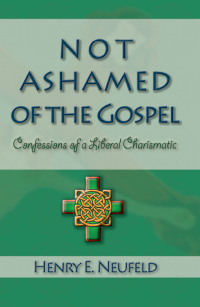
    Not Ashamed of the Gospel: Confessions of a Liberal Charismatic[The following Good Friday meditation is extracted and slightly adapted from my book Not Ashamed of the Gospel: Confessions of a Liberal Charismatic, pp. 17-22. This post was truncated at some point in the history of this blog. This is a restoration of the content on January 6, 2018.]

    There might be many reasons why someone would be ashamed of the good news about God that is represented in what we call the “gospel.”

    Historically, the shame was in worshipping a convicted and executed criminal, calling him God and following his teachings.  Very few people doubt that Jesus died, and that he was executed by the barbaric method of crucifixion.  Raised from the dead, alive today—that’s another matter entirely.  But the death is the best established thing about Jesus.  I’ve entered into debates about whether such a person as Jesus existed historically.  All of these debates start—must start—with a list of things that I will demonstrate limiting myself strictly to the tools of a historian, to the extent that past events can be demonstrated.  These are the things that Jesus did or that happened to him.  Many scholars have created such lists.  Invariably, “crucified by the Romans” is on them.  Jesus’ death by crucifixion is as established as a historical fact gets.

    It seems remote and distant to us.  If we have shame in anything about Jesus or Christianity, it is something different than it was for Paul and other early disciples.  For us, the cross is the symbol of a religion, a person, or a faith system.  We see it on churches every day.  We have pictures of crosses, sometimes with a figure of Jesus hanging on them.  Sometimes the figure will be portrayed with a halo.  We make earrings and necklaces with crosses.  We know the crucifixion is a horrible thing, but the symbols involved in it have become commonplace and familiar, and they are objects involved in the rituals of the church, not in execution.

    We may be ashamed of some of the people who carry crosses, or of some of the groups that worship in buildings with crosses on them.  We may object to where crosses are placed, such as on the lawns of public buildings.  But none of this is quite what the “shame of the cross” would have been for the early followers of Jesus.

    Put yourself back in Paul’s time.  Jesus was recently executed.  The one political power in the world was the authority by which that execution was carried out.  That particular form of execution was one reserved for the worst, and especially for rebels and political offenders.  There was a shame in worshipping someone who had been crucified.  It had the aura and the stigma of worshipping a mass murderer, perhaps a bit like modern Americans would feel about a cult worshipping Charles Manson.

    But in addition, it was something dangerous.  The followers of Jesus were proclaiming as divine someone executed by the Roman authorities.  Divinity was being carried by someone who was a rebel and a dangerous character.  Proclaiming the kingdom of a rebel was an act of rebellion in and of itself.

    And here we have Paul proclaiming that he is not ashamed of this good news.  He glories in the cross, glories in an instrument of shame.  In disaster, he finds good news.

    One of the key elements of that good news lies in the fact that you see a cross with much different emotions than did the people of Paul’s day.  That element is transformation.  The symbol of the cross has been transformed from one of disaster, death, agony, shame, and despair into one of hope for many people.  Not all people, and we’ll discuss that as well.

    That transformation comes from the way in which God used the experience of the cross.  God came to the earth in the human form of Jesus.  God experienced life with us.  He took action as we might need to take action under the circumstances of our lives.  He found himself in an occupied country, living under cruel foreign domination.  He didn’t just come and appear on a mountaintop.  He got involved in human experiences, human emotions, human weaknesses, and yes, human strengths as well.  When it came down to it, he died a death in just the way that a human would have to do it in that time and place.

    The first part, then, of the transformation was involvement.  The cross would never have been transformed as a symbol without the involvement.  God, the infinite gap-crosser, crossed the gap and stayed on our side long enough to experience the worst of the worst.

    But not only did he get involved, he stayed involved.  The second part of that transformation was endurance.  God didn’t quit.  He carried through.  If he had not, we could think of the wonderful time when God was with people, lived with us, talked with us, worked with us, but we would always have a distance from him, because he would never have experienced the one thing that seems to terrify most of us—death.  “Through death, he destroyed the one who had the power of death” (Hebrews 2:14).  “He endured the cross; he treated the shame with contempt” (Hebrews 12:2).

    Jesus knew when to ignore what others thought was shame.  The shame was intended to fall on the one who was punished.  But Jesus had no reason to be ashamed and he knew it.  Knowing what one should ignore is an important part of living in this imperfect world.  Many people, Christians and others, have endured torture and death with dignity and even peace because they knew this lesson.  What was intended to bring shame on them instead became a source of glory.

    The transformation that Jesus accomplished on the cross, symbolized by the transformation of the cross itself, is something that we all can grasp.  Circumstances and our environment are not fixed things that we have to take as they are.  They can be transformed by our attitude and by the way that we deal with them.  Every cross in your life, everything that you would prefer not to have done or not to have encountered can be transformed.  When we give testimonies of things that have happened to us, this is what we are doing.  Some think that testimony meetings are about telling how dark our lives were before God intervened.  And sometimes they are.  But if you are focusing on the darkness, and the negative things that have happened, perhaps you haven’t let those things be transformed yet.  Did you become involved, stay involved, and endure?  Did you have contempt for the supposed shame?  The real point of a testimony, a witness, is to present how things have changed, not how much they are the same.

    But there’s one more part of this process.  Some of you may be wondering whether I’m going to ignore it.

    Jesus triumphed over the adversity.  He rose again from the dead.  His movement should have died.  It came back to life.  Without this, the transformation could not have taken place.  In this sense, only one who was God, or totally in tune with God’s spirit, could have triumphed.  We daily deal with circumstances and troubles.  Jesus was dealing with the nastiest circumstance of all—death.  He was there to deny and destroy the one who had the power over death.

    I’m not going to argue here about the physical resurrection of Jesus.  It’s very hard, if not impossible to prove a miracle.  But I do think the greatest evidence that something different happened that day in Palestine is that the movement surrounding Jesus didn’t go away.  Having seen Jesus crucified, his movement should have failed, but it didn’t.

    But the critical element in transforming the symbol of the cross from one of shame to one of hope and glory was simply that the followers of Jesus believed that he had conquered death.  You may debate me about the idea that without something special happening on the morning of the resurrection, the followers of Jesus would simply have scattered.  You may have another explanation you think works as well.  But I think there can be no doubt that unless the followers of Jesus believed that something had happened, there would have been no transformation, no Jesus movement, no Christianity, and the cross would forever have remained a symbol of shame, or passed into history as an example of the barbarism of ancient cultures.

    But the fact is that those followers did believe, they didn’t scatter, but continued to proclaim the victory of the person the Romans had crucified.  And it was in that proclamation that the cross was transformed.

    Jesus could have died with dignity, endured the shame, and risen from the dead, but if nobody had arisen to proclaim those facts, no transformation would have taken place.  It took human beings getting involved, carrying the message, and acting on the good news.  I’m sometimes accused of being very human oriented in my religious beliefs.  But I believe that this orientation toward what people do and how they respond is thoroughly Biblical.  Not only did God accomplish reconciliation through Christ, but he gave us the same ministry.  In other words, God knows and intends the human element to be critical in carrying out his mission on earth.

     

  • Book: Who’s Afraid of the Old Testament God?

    In several recent posts, especially dealing with issues of harsh passages in Hebrew scriptures (or the Old Testament), I have referred to a book, Who’s Afraid of the Old Testament God? by Dr. Alden Thompson. This book was critical as I developed my own view of scripture and especially as I dealt with some of the difficult passages. I generally find that Alden’s views are a bit more conservative than mine, and also that he is usually a bit more gentle in presenting them, which is not a bad thing.

    I was Alden’s student at Walla Walla College in the years before he first published the book, but we dealt with a number of the same issues in his classes. The book is now in its 4th edition, and I’m now the publisher as the sole owner of the publishing company that now offers this little book. There have been few changes through the editions, except for some adjustments of style and language. I find that new readers find it as relevant today as its first readers did in the early 1980s. Christians have struggled with these types of issues for a long time, and many have either been told not to question or have been given pat answers. Sometimes these answers are given as “offers you can’t refuse.” The attitude is “who are you to question God?” and thus if you don’t accept the explanation your faith is weak, or you may even be an infidel.

    Alden takes these issues head on, and finds grace in the Old Testament where others find anger. He doesn’t tell you that you shouldn’t ask such impious questions.

    He starts by suggesting that we need to see the Old Testament for itself (Don’t let your New Testament get in the way of your Old Testament), then puts the entire discussion in a Biblical context through discussion of creation and the fall. This is a fairly traditional chapter, and evangelical Christians should find themselves quite comfortable with this outline. He points to the “very good” of Genesis 1 and the “totally evil” of Genesis 6 showing the deterioration of humanity, and then asking how God is to deal with this state of rebellion. He uses the “great controversy” or “cosmic conflict” theme as a background. Some will want to get right to chapter 3, “Whatever happened to Satan in the Old Testament?” and here there is a unique view of the role of Satan in scripture.

    Then he gets down to the meat of the problem, successively dealing with the apparently strange laws (Strange people need strange laws), relationships between Israel and the Canaanites (Could you invite a Canaanite home to lunch?), and then the worst story in the Old Testament, Judges 19-21. I’m not sure this is the worst story, but it is certainly an excellent example. Alden applies his approach to questions of why such a story is included in the Bible, why God would allow such things to take place among His people, and what it is that we are to learn from the story. If you haven’t read it, do so now, possibly even starting with Judges 17 (Micah’s Images). If you find it difficult to see God’s grace in action in those chapters, you might find it valuable to read Alden’s discussion–it might transform your view of Old Testament history.

    From there Alden turns to “The best story in the Old Testament: The Messiah.” Here he discusses the Messianic prophecies and their application to the ministry of Jesus. Both conservatives and liberals will find some things to question here, because he neither affirms every Old Testament prophecy in the way that many conservative Christians would prefer, nor does he discard the notion of fulfilled prophecy. This chapter in itself is a worthwhile study for anyone who plans to discuss these Old Testament prophecies and their application.

    Finally, he deals with the prayers in the Psalms. We tend to read the Psalms a bit selectively, sticking with thoroughly comforting passages. But what about Psalm 137:8-9? How comforting is that? Is such vengefulness Christian? He titles the chapter, “What kind of prayers would you publish if you were God?”

    A common theme throughout the book, though it is not addressed head-on, is Biblical inspiration. Why are there things that are this difficult in the Bible if God is trying to communicate with us? How can we be sure of getting truth from the Bible. Alden doesn’t address Biblical inerrancy by that title, but he does look at the process of inspiration and how it works, and helps us find an anchor in the two laws (love God, love neighbor) as presented by Jesus to help us work our way through passages that are difficult to interpret.

    I have thoroughly appreciated this book from the time I first read it. I have taught a number of classes using it. I have found that it consistenly is a faith building book. At the same time it is honest, and allows the reader to question and feel confident in doing so. I would especially recommend this to Christians who have never been able to enjoy reading the Hebrew scriptures. It will help you get comfortable reading those passages and letting them speak for themselves.

    (Note: In case you missed it at the start, I own Energion Publications, which now publishes this book, so I have a commercial interest in it. As publisher, however, I’m pleased to have it in our line.)