I will not be continuing my eschatology study tonight. I will be giving the final session of the eschatology series next Thursday night. At that time, I will take a break and will return June 23, 2016. I will announce what I’ll be studying as we move forward.
The reason for this hiatus is that I have become less and less happy with using Google Hangouts on Air as the basis for these studies and for the videos we do for Energion Publications. In fact, we’re taking the same hiatus for Energion. When we return, we’ll be using livestreaming, and probably using more than one outlet. We can now livestream on our content on Facebook, Periscope, and YouTube, though we have no problem with YouTube.
For my study, at a minimum, I expect I will livestream it and also provide it in a video and audio podcast.
In the final episode of my eschatology study next week I will discuss the book of Revelation, various ways of reading it, and also some valuable insight that can be gained that has nothing to do with writing or drawing end times charts.
Join me next week, May 19, at 7:00 pm central time. I’ll provide links on this blog.
Recent political discourse reminds me of the parable of the Pharisee and the Tax Collector:
9 He also told this parable to some who trusted in themselves that they were righteous and regarded others with contempt: 10 “Two men went up to the temple to pray, one a Pharisee and the other a tax collector. 11 The Pharisee, standing by himself, was praying thus, ‘God, I thank you that I am not like other people: thieves, rogues, adulterers, or even like this tax collector. 12 I fast twice a week; I give a tenth of all my income.’ 13 But the tax collector, standing far off, would not even look up to heaven, but was beating his breast and saying, ‘God, be merciful to me, a sinner!’ 14 I tell you, this man went down to his home justified rather than the other; for all who exalt themselves will be humbled, but all who humble themselves will be exalted.”
The Holy Bible: New Revised Standard Version. (1989). (Lk 18:9–14). Nashville: Thomas Nelson Publishers.
It has been interesting to read articles by partisans of one party or the other explaining how unelectable the candidate of the other party is, and how that party is truly in trouble and going down in flames. “They’re so bad that we’re good,” seems to be the subtext.
I’m not primarily interested in the politics, however, but in some things in shows about human nature. These articles and conversations point to a dangerous, perhaps even fatal way of measuring ourselves. We do it in church just like we do it in the broader society. If I can point out enough negatives about a church or a group, I will surely have demonstrated the value of my preferred group or position.
Thus comes the Pharisee. Now I think we should be careful about how we talk about the Pharisees. In many ways they would make excellent Christians. They were good people trying to fulfill God’s law. Nonetheless they suffered from one of the many failures of the righteous—self-righteousness. It’s interesting that when we look down on the Pharisees for their flaws, we generally are participating in the same ones. We’re not Pharisees. Aren’t we special?
Jesus is here bringing in a character who will be considered righteous by his audience and putting him up against one who will be considered wicked. Note the prayer. “I thank you that I am not like other people.” Face it! We thank God that we are not like other people on a regular basis. We may pretend to be the tax collector who went home justified. But more often we’re looking for the position of the Pharisee. However much contempt we may put into saying the word “Pharisee,” it’s his position we long for. It’s just that we want to thank God that we “are not like other people … or even like this Pharisee.”
I believe the root, however, is our bad approach to measurement. We want to be “better than.” We want a church that is less unfriendly, more mission minded, more biblical, better structured. If we can say with any justification, even just enough to convince ourselves, that we are better than the church down the street, then we can be happy. As a Methodist, I can give thanks to God that I’m not the frozen chosen as are the Presbyterians or self-righteous like the Baptists.
I’ve been on the receiving end of this, as someone points out to me the flaws of the United Methodist Church, which are doubtless legion. How can I be a member of a United Methodist congregation? Surely all of these flaws mean that I should instead be a [Baptist, Presbyterian, Reformed (some variety), charismatic, pentecostal, house church, high church, etc.].
Here’s what experience has taught me: Don’t look at the church down the street. Ask this question: Am I doing God’s will by being where I am? Where can I best do God’s will?
Every church I have been in has had flaws. If it didn’t have them before I got there, it definitely did after! One of the most dangerous things we can do is determine our value before God by comparing ourselves to other churches. This works in many ways. The church down the street can provide us with an excuse for continuing to behave badly. My Methodist congregation may be comforting itself by noting that it’s better than the Baptists while the Baptists are comforting themselves that they are doing better than we are. We can follow that spiral right to perdition as our errors give others an excuse for theirs.
On the other hand, we can become extremely discouraged by comparing our performance to others. If the church down the road is growing by 10% per year, what’s our problem? If they have money to build a new Family Life Center why can’t we?
We need instead to take the parable to heart. What is God’s will for us? Let’s seek God’s will and God’s mercy as we work that out.
Here’s a video of a sermon I preached many years ago. I wonder if it’s still relevant.
Tonight I’ll be bridging the gap between these two very commonly associated books and doing a look-ahead to my several week study of Revelation. This study will conclude my series on Eschatology.
Amongst the small but diligent group that watches these, are there suggestions for continuation? I will doubtless keep talking, even if the audience is small!
I’m going to try to wrap up my discussion of Daniel. I must remember that my purpose here was not to do an extended study of Daniel, but rather to look at ways of interpreting the book and how they fit into and/or underlie one’s eschatological views.
Chapters 10 & 11 would take quite a number of studies just because of the detail and the fact that it matches history with which very few people are acquainted. So I will recommend some reading regarding this section but will generally summarize and then tie in the ways one might read Daniel with the ways one might read other apocalyptic literature and other statements on eschatology. I will discuss some specific points of the chapters, just not the entire outline.
Yesterday I read a few chapters (4 actually) of Hebrews with Stephen’s Textus Receptus (1550) beside my NA27, both from Logos Bible Software. It was an interesting exercise. I noticed a few things I hadn’t noticed before and was reminded of some things I know, but can easily neglect.
I started into biblical languages to get past the gatekeepers. I wanted to read the original text for myself and discover what was there without depending on others. In that goal I failed. It’s amazing the number of little things you can notice when you look at different edited texts. And that is what our Greek New Testaments these days are. (I’ll stick with discussing the Greek, though I could make similar, but not identical, points about Hebrew.) Someone studies the manuscripts available, or existing editions, or starts with an edition and just looks at particular variants, and produces a text which I then read. I can take the Nestle-Aland 27th edition text and read it from their edition, or from the UBSIV Bible I also have which uses the same text. They list different variants. Why? Because the editors determine that for the purposes of this edition, those are the variants you need to see.
Now it happens I’m fairly happy with most of their choices, though one reason I have various editions is so that I can check on other details. In my reading yesterday, for example, I noticed quite a number of differences in word order. It would be quite a daunting task to cover all those differences in a textual apparatus, but they might actually be meaningful. I’m very careful doing so, but I have been known to argue emphasis based on word order. Do I have the right word order?
My point is not to make one feel helpless. Rather, I think we should be thankful to those who have gone to the work to provide us with these tools. I’m thankful that I can read my Greek New Testament in an edition that combines information from thousands of sources and then gives me notes on a selected set of the most important variants. Hebrews 12:1 has its crowd of witnesses. Whenever I study the Bible, I am standing on a substantial pyramid of other peoples’ shoulders.
At the same time I have to remember that there is a time to get out of the rut of the ordinary and to look at things that are substantially different. I’m now interested in studying variations in word order, though I doubt I will ever have the time. Nonetheless, it looks like a field that could be fascinating to research and study.
Lessons? 1) Always go for the source, even if you won’t really get there. 2) Be thankful to those who have gone before!
Tonight on the Energion Tuesday Night Hangout, Elgin Hushbeck, Jr. will interview author Jay Hall regarding his book on the age of the earth, and then Elgin and I will be joined by Thomas Hudgins for a discussion of some translation/interpretation issues (to be determined as we go!).
In Hebrews 2:1-4 I believe the author of Hebrews provides a basic apologetic outline, and I think it’s a very useful one to follow. After the first two verses, which start from a platform that was already accepted by the audience, the author emphasizes the importance of the decision. If he is right in what he says, the decision is critical in an eternal sense. The elements are these: 1) It was delivered by the Lord, 2) Affirmed by the testimony of those who witnessed, 3) Given divine witness through (a) signs and wonders and (b) the gift of the Holy Spirit.
Looking first from the viewpoint of process, this argument, and indeed the general argument of Hebrews, is based on ground that will be accepted by his audience. They believed that the Torah was firmly established, and many, at least, believed that it was delivered by angels. Throughout the book, we have this focus on sourcing material from the Hebrew scriptures. Those who argue a simple supersession should pay attention to the form of the argument. At the same time as the author argues that Jesus is greater than, he also argues that the revelation in existing scripture is great and should be honored. Too often we fail to found what we have to say on what we already hold in common, when that can be supported.
The first element of his argument has two parts, the words spoken by Jesus, and the affirmation of those words by witnesses. For someone who tends fideistic like myself, this is a bit of a rebuke. It’s not that I don’t believe that Jesus spoke, or that there were those who heard. I’m even optimistic that we can get a picture of Jesus from the gospel record. But I tend to ignore that part of the argument and go straight to the experiential second part. This argument says that the faith is founded on historical realities, and that this is worthy of our attention.
The second element of his argument again consists of two parts, the signs and wonders that follow the gospel, and the gift of the Holy Spirit, delivered as God wills. I’m of course more comfortable here, as my experience (in particular) has much to do with experience (in general).
I was reading this from The Learning Bible (CEV) this morning, and saw that their note refers these signs and wonders (semeiois kai terasin) refer to past events (from the viewpoint of the readers), such as the exodus from Egypt. I would disagree. That is an element either of the first part, or more properly of the commonly accepted foundation of the Hebrew scriptures. Rather, this is the miraculous events/signs that followed the apostles as we read in the book of Acts, for example. It was by acting on behalf of his apostles that God affirmed their witness of Jesus, both in terms of the truth of the stories they told, and in terms of its continued relevance to those who heard.
The second part is the gift of the Holy Spirit, which is, I believe, the life of the church. We can see how critical this is in 1 Corinthians 12-14, for example, and I see this as a loose, but nonetheless real point of connection with Pauline theology.
It’s this last point that I think is the most important in the church today. I believe all these elements should be part of our apologetic, yet having a faith that truly takes hold of hope and makes it possible for one to live differently is, I think, the most important element, and is also the key point of Hebrews. If the church does not show evidence of the gift of the Holy Spirit I think that all the other elements will tend to fail. It is sort of like one builds a machine to accomplish a particular task, explains the science behind it, then the technology that goes into producing the device, and then finally applies the power. But the machine doesn’t accomplish the task.
By “evidence of the Holy Spirit” I don’t mean speaking in tongues, as many in the pentecostal movement believe, but rather in terms of bringing people together and empowering new life in the one God has anointed forever. As Paul points out in 1 Corinthians 14, we can do without speaking in tongues; it doesn’t build the church. But we can’t do without building.
I covered most of the key issues in those two short posts, but to summarize quickly, I note the questions of how one should translated the quotation of Psalm 8:4-6 as it is presented in Hebrews 2:6-8. One of the questions is the text. In some cases translators have “corrected” New Testament quotations of Hebrew scriptures by using readings from the Massoretic text even when the NT writer is quoting from the LXX. In this passage “for a little while” gets a footnote to the MT in some translations.
The question for the translator is whether to reconcile the texts, in this case make Hebrews 2:6-8 correspond to the text of Psalm 8:4-6, so that a reader is not confused (or even challenged) by the difference, or whether the texts should be translated faithfully in each instance. In the case of either decision, what should be indicated in the footnotes?
I was reading this passage today in the NRSV, immediately after having read it in Greek. Here it is:
6 But someone has testified somewhere,
“What are human beings that you are mindful of them,
or mortals, that you care for them?
7 You have made them for a little while lower than the angels;
you have crowned them with glory and honor,
8 subjecting all things under their feet.”
In this case there is a footnote (one of several), which reads: ”
Gk or the son of man that you care for him? In the Hebrew of Psalm 8:4-6 both man and son of man refer to all humankind
In fact, the plural continues into the remainder of verse 8, which is not quoted: “Now in subjecting all things to them, God left nothing outside their control.” It is not the authors argument here that everything is placed under the command of humanity in general, but rather of one human being, Jesus. I fully agree with the translators (and their footnote), that Psalm 8 is referring, in its original context, to humankind in general, and our relationship, as a whole, to God—our place in creation.
By translating the quotation “accurately,” as it occurs in a different text and location, the translators have disrupted the discourse of this passage. So while I will not call this an error (it’s certainly intentional, and I can formulate the arguments for doing it, even though I find them dismally unconvincing), I do think it’s a very unfortunate approach. One could let readers know that the quoted text, in its historical context, refers to humanity as a whole, but that it is being used here specifically of one particular human male, Jesus.
In fact, one could argue that acknowledging “humankind” in Psalm 8 need not be inconsistent with the usage here, as we will shortly see the author of Hebrews continue with the argument that Jesus must very much be one of us (humankind) in order to be able to redeem us. One could discuss the idea of being “in Christ,” though that is not the language of Hebrews. In Hebrews the language is one of kinship and community.
I do think that this makes it harder, though not impossible to follow the flow of the authors argument in this passage.

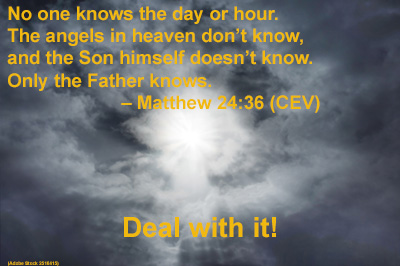


 I’m going to try to wrap up my discussion of Daniel. I must remember that my purpose here was not to do an extended study of Daniel, but rather to look at ways of interpreting the book and how they fit into and/or underlie one’s eschatological views.

 I’ve written about this a couple of times before, though using the NIV1984 and NIV2011, in