Threads from Henry's Web

Category: Religion

All posts relating to religion, including those on the relationship of religion to other fields, such as science and politics

  • Creationism vs Anti-evolutionism

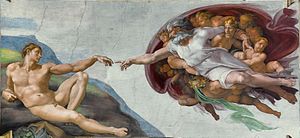
    The Creation of Adam
    Image via Wikipedia

    According to Todd Wood there’s a real difference, and I agree, although I think real creationists are a bit thin on the ground.  He writes about this on the Center for Faith and Science International web site. One of the requirements, in my view, is the admission that the foundation of young age creationist thinking is accepting Genesis 1-11 as history and building from there.  To claim that one accepts young age creationism based solely on current scientific evidence is simply no believable.

    That is precisely where Todd Wood and Kurt Wise (author of Faith, Form, and Time–the one creationist book you should read if you want to understand it) are refreshingly honest.  They admit they start with their conviction about what the Bible says and that there is much science to be done to back up such a view.

    What caught my attention in this article is the reference to George McCready Price, a Seventh-day Adventist who pioneered modern day creationism and flood geology.  I got to Price’s writings by starting with Frank Lewis Marsh and his small book Evolution or Special Creation.  Marsh was somewhat more accessible than Price.

    Despite the fact that I believe that to read Genesis 1-11 as history is generally to misread it, I appreciate the faith stance of Todd Wood and Kurt Wise and their honesty in admitting their starting point in faith.

    (I’m experimenting with Zemanta.  I may have overdone the linking!)

    Enhanced by Zemanta
  • Christ the King Sunday

    I sometimes complain about the way lectionary passages are cut off before difficult passages, so I thought it might be nice to mention the truly wonderful selection of the gospel for Christ the King Sunday today. The gospel passage is Luke 23:33-43. At our “Lectionary at Lunch” gathering, led by Geoffrey Lentz, a number of folks were questioning this passage choice.

    The key, of course is in verse 38, with the inscription placed above Jesus’ head: This is the king of the Jews. It’s placed as an insult, but is wonderfully and ironically completely true! This follows the record of how the crowd is mocking Jesus, and then it’s followed by the conversation with the two malefactors crucified on either side. Then Jesus behaves as a king–a king in the style of his kingdom.

    It’s such a good example of the difference between God’s kingdom and our various kingdoms. We encounter the king on a cross. It reminds me of Revelation 5:1-6. There nobody is found worthy to open the scroll. The angel tells John to stop weeping, because the lion of the tribe of Judah is worthy. But when he turns to look, there’s a lamb that looks like it has been slain.

    God just doesn’t do things our way!

  • Ignorant of Church Domes

    I think the combination of ignorance and bigotry expressed by opponents of this church is both said and somewhat frightening.

    (HT: Dispatches)

  • Responding to the New Atheism

    Laura at Pursuing Holiness has a good post on a Christian response to the New Atheism. I agree largely with Laura, though I would comment on a couple of details.

    First, a common objection I hear to the new atheists is that they are too vocal and forceful. I think this criticism is not well directed. There is no reason to expect atheists to be quiet about what they believe. As Christians we do not want to be muzzled. What purpose is there in trying to do the same to others.

    Second, my Christian friends, there are real atheists out there. There are some people who call themselves athesists who really are just backslidden Christians or often people have been so offended by other Christians that they can’t stand Christianity as a religion. But there are others who are philosophically convinced that there is no god of any variety.

    Neither of these points is actually in response to Laura, but rather to comments made to me or read elsewhere.

    The Jesus Paradigm

    Christian apologetics is important, but its role is different than many people seem to think. Few people are argued into the kingdom, if any. What apologetics (done right) can accomplish is to clear the ground, deal with particular objections, and help Christians better understand their own theology and its impact on other areas of their lives.

    In the substance of her post I think Laura is right on. The best defense we can possibly give to Christianity is to be Christian disciples. I don’t know where some of the commenters on Laura’s post go to church, but what I hear about social justice in church is not soft or easy. There is a view of social justice which calls for Christians to automatically support government programs that claim to help the poor because that is social justice. Biblical social justice calls on me to give of myself. It’s not a political manifesto; it’s a call to me personally and as part of a church community to carry out sacrificial ministry.

    I am perfectly comfortable with having Christians arguing from all portions of the political spectrum as to what government’s role should be. A Christian’s duty is not fulfilled by advocacy for government action, nor are Christians derelict in their duty if they believe such social action is not an appropriate sphere of government action.

    Christian Archy

    But both groups (and folks like me in the middle) are derelict in their Christian duty if they are not serving others by giving of themselves.

    The church has, in fact, failed in its duty to challenge the culture and to be God’s kingdom in the world. Our first loyalty has to be to the Kingdom of God and not the nations of the world. We need to get our primary loyalty straightened out so that people can tell we’re Christians and that this makes a difference.

    And while we are about this type of social justice we need to remember that the core of any social justice we pursue must be the gospel message. My impression based on our actions is that we do not generally believe, on the left or the right, that the gospel message really can change lives. If we believed it our answer to many issues would be simple: the gospel of Jesus Christ.

    This is not, as Laura put it, merely a form of fire insurance. It is a message that is transforming and demanding, two characteristics missing from too many of our churches. (Of course it is God who transforms, but he has chosen to do so through the proclamation of the gospel.)

    I’d like to commend two books that I publish on this topic, and a third that is forthcoming. Christian Archy (David Alan Black) talks about our first loyalty to God’s kingdom. We will be releasing another volume, The Politics of Witness (Allan R. Bevere) in the same series that discusses why the church cannot speak truth to power today. On the matter of Christian discipleship we have The Jesus Paradigm (David Alan Black).

  • Common Ground on Genesis

    On the Spectrum blog there’s quite a lot of discussion of the age of the earth and a search for common ground. The problem with the phrase “common ground” is that it can mean many different things. Two recent articles on the age of the earth had quotes that caught my attention. As far as I can tell (my specialty is Biblical languages, not any of the various sciences involved), the discussion of the various dating methods is quite good.

    This material comes from members of the Seventh-day Adventist church, my former denomination, and one that is pretty firm on the young age of the universe and a literal seven day creation week. Watching this discussion unfold amongst SDAs is something I find fascinating.

    The first article, Genesis Literalism and the Temple of Doom – I, after summarizing some of the methods, concludes:

    Even if the message is not one we want to hear, recognizing the validity of these tools of science should be the basis for common ground.

    Sounds good thus far. Then we continue with the second article, creatively titled Genesis Literalism and the Temple of Doom – II, and after some more dating methods are summarized we have another conclusion:

    The obvious question, then, is, “how should the Church respond to this evidence?” As suggested previously, perhaps the best way to deal with this evidence, given a predisposition in favor of YEC, is simply to say nothing about age. Taking this approach would act as a hedge against further compelling scientific confirmation of a very old age. To proceed in this way would preserve the Church’s credibility, and would seem to be the only approach to common ground.

    This one doesn’t strike me right at all. Essentially keeping silent about age when you’ve just admitted that the scientific evidence is entirely against young age seems very odd, and doesn’t seem any basis for common ground at all. Common ground between what groups or positions? In essence, by its silence, the church would say “We were wrong, but we don’t want to admit it, so now we’re going quiet.” Or so it seems to me …

    I see two options for someone convinced that the earth is old, yet who espouses some form of biblically based Christianity: 1) Take a new look at the biblical evidence or role in the discussion or 2) Admit science is against you, but uphold what you believe the Bible teaches. The first approach is mine, looking both at how we understand certain passages of scripture and also looking at the role God intended scripture to play in scientific discussions. I’ve written on that before. Dr. Kurt Wise and Dr. Todd Wood are examples of folks who take the second approach.

    I don’t think silence is going to work long term. I hope I will see in future installments that I have misunderstood the intent of the writer. I will certainly continue to read the series.

  • From the Top of a Sidebar

    Why a Missionary?
    Because God says so…

    This is from Michelle’s blog, And She Went Out …. It’s a good quote. Michelle is the host for this week’s Christian Carnival.

  • Dan Dick on Make-No-Wave Church

    … at Make-No-Wave United Methodist Church. For what it’s worth, I think the young pastor was absolutely right to push. May his tribe increase! (HT: John Meunier)

  • Quote of the Day – Greg Boyd

    Responding to a quote from Mark Driscoll:

    I frankly have trouble understanding how a follower of Jesus could find himself unable to worship a guy he could “beat up” when he already crucified him.

    Read the whole article, Revelation and the Violent “Prize Fighting” Jesus.

  • Coloring Outside the Lines

    I’m borrowing my title from Dave Black’s latest essay, because I’m talking about the same subject and I’m about to publish the second edition of his book, Why Four Gospels?. (I suggest reading Dave’s essay first. It’s short!)

    I just spent a weekend with Dave as he spoke at First United Methodist Church here in Pensacola and Chumuckla Community Church a ways to the northeast of here. For some, having a Southern Baptist (Southeastern Baptist)seminary professor (though “missionary” is his preferred title) preach at a United Methodist church might be considered coloring outside the lines. If so, I think it’s a kind of coloring that we need to do more of.

    Why Four Gospels? Front Cover
    Almost Complete Front Cover

    Now in case you haven’t caught on, this is one of my blog posts meditating on books I’m about to publish, in this case, of course, Why Four Gospels?. It’s a little book that is out of the mainstream of New Testament scholarship these days. It challenges the priority of Mark, and proposes that the gospels were written in the order of Matthew, Luke, Mark, and John.

    But that isn’t the most important thing that it does. It challenges the methods used, and in fact takes a completely different approach to what is usual in looking at the reliability and the context in which the gospels were written.

    One of the problems I’ve noted with historical Jesus studies (in which theories regarding gospel authorship are obviously important), is that especially in the popular literature too little time is spent discussing and justifying the basic methodology used. For example, is the best way to discover the historical record of an individual to divide what is recorded of him into small parts and then look for criteria to decided on which of these are probable and which are not?

    I’m not saying one cannot discover the reasoning behind these various choices. One can. But one often has to be very diligent in doing so, because they are often glossed over. I went through a course in gospels in college without every really understanding the nuts and bolts of things like form or redaction criticism, yet I was learning “facts” about the gospels which were derived from those disciplines.

    On the other hand many more conservative handbooks and commentaries poke a few holes in some critical views and then regard their task as complete. Obviously not every commentary can cover every issue in full detail, but I think it should be better covered than it is. (If I might recommend one book, I think Dr. David DeSilva’s An Introduction to the New Testament [link is to my notes] is very commendable on this issue.)

    Robert H. Stein, in Jesus the Messiah [link again to my review] commendably tried to address the criteria and how they should apply. I would note that I’ve changed my mind on a couple of points since I wrote that review, but I would still say that Stein makes a valiant effort but fails to reach his goal. If I may push an analogy, he colors with different colors, but stays inside the lines.

    Along with Bauckham and a few others, Dave Black is not only coloring outside the lines, but switching coloring books as well. How successful this effort will be remains to be seen, in my opinion. But it is much more likely that one can provide support for a more orthodox view of the historical Jesus in this way than simply by trying to alter the criteria one at a time.

    So there’s a much more important goal that Dave Black has in mind here. He’s not just looking at a different order for the writing of the four gospels; he’s examining the way in which we determine that order and in turn attempting to place the gospels in the context of the life of the early Christian church. In a way we could call this historically anchoring the sources as well.

    His effort is commendable in another way: It is concise. In about 120 pages (we may lengthen this mildly with larger type in the Energion edition), he lays out a case that is both broad and strong. I’m not saying he has convinced me on all points; I’m a stubborn character, and not easily convinced. What he has convinced me of in those few pages is that this is a book that you need to read and answer if you think you have a good grasp of gospel or historical Jesus studies.

    And that leads me to the inevitable questions. I’m always asked why I publish books I disagree with. This isn’t a really good example of that, in that I don’t have all that firmly held positions on this topic, general stubbornness aside. But I really like that question. I aim to publish a range of books that tend to push the boundaries within orthodox Christianity. I hope these will make us rethink our ideas, no matter what our present position is.

    Charismatics have questioned my publication of Holy Smoke! Unholy Fire!, which addresses abuses in the charismatic movement and particularly in some revival movements. Recently I’ve been questioned over the just released (and not yet available even on all major online retail sites) Finding My Way in Christianity, which leans to the liberal side. On the other hand, my own book Identifying Your Gifts and Service assumes the continuation of spiritual gifts and includes a prayer language, or speaking in tongues, among them.

    So I’m delighted to add Why Four Gospels? to the mix. Of this book in particular I would say it’s a must read in its subject area. I know I’m the publisher and I’m biased, but remember that I’m also somewhat of a defender of historical-critical methodologies (though the Jesus Seminar criteria are not amongst the things I defend), and thus my bias may not all be one way.

    One amazing feature of this book is the bibliography, which is the size of a chapter in itself. The conciseness and brevity of the book mean it will lead to further study, or so I hope, and the means of that study are provided here along with the questions.