Threads from Henry's Web

Category: Religion

All posts relating to religion, including those on the relationship of religion to other fields, such as science and politics

  • Why Jesus Had to Die

    In the study of the gospel of John I’m doing via Google Hangouts on Air, last Thursday night’s session was titled “I Finished the Work.” This reflects Jesus confidence that he had completed his mission, even before he had died on the cross or risen from the dead.

    For many Christians the reason Jesus had to die is quite simple. He had to die for our sins. More specifically, by his death, Jesus took the penalty for our sin(s) so that we would not have to. In theology this is referred to as penal substitutionary atonement, or sometimes just as forensic atonement, because it is set in a metaphor of the courtroom, and we avoid the just legal penalty of our actions because Jesus takes it instead. Thus if Jesus had not died, we would not be saved, and would be doomed to eternal death.

    But the courtroom is a metaphor, and as such, it may not provide the complete or the only meaning of what it tries to describe. Another metaphor is built on the family, in which we are adopted into God’s family as God’s children and thus are saved. You can find a clear statement of this in 1 John 3:1, but this metaphor is in play frequently in the gospel of John as well.

    Someone familiar with 1 John might point to 1 John 1:8, with the blood of Jesus cleansing us from sin. And indeed there are a number of points where the various metaphors touch. One thing we don’t always understand well in the west is the sense of community, of being collectively part of one nation, people, or family, so much so that we can be referenced as a unit, or spoken of by reference to a king or leader. In Genesis 14, there is a battle. We’re told in Genesis 14:9 that it was “four kings against five.” Surely it wasn’t just the kings! They must have had armies. Of course they did. But they were referenced by the titles of their kings.

    So when these kings were defeated, the people were defeated. If they won, the people won. We have that sort of vocabulary left in terms of sporting events and even of war, but we use it with less meaning. Thus if we said that one person suffered or died for a nation, we would generally be saying that the one person suffered instead of others. But in the ancient near east, we might well be saying that the a whole family or a whole people group was included in the suffering of that one person. In this way we can say that in Christ we have all died, and in celebration of Easter, in Christ we have all been raised. It’s helpful to read the servant passages of 2nd Isaiah (Isaiah 40-55 is identified as 2nd Isaiah) with this in mind. Is the servant a single individual, a group, or the whole of Israel. I think the answer must be “yes,” if we incorporate all the references.

    In 1 John 1:8, we also need to note that there is a different sacrifice in view than a sin offering. Here the issue is cleansing, and it would probably be much better to understand this as a purification offering than a sin offering. (I will try to blog more about these offerings soon!) Jesus dies for us, in this case, but it is not in a forensic sense, not taking a penalty, but rather is a cleansing ritual.

    In the gospel of John another way of expressing atonement, bridging the gap between God and humanity, is the simple one of looking up. We always cite John 3:16, but we’d do well to start with John 3:14 and not stop before John 3:21. Here the metaphor is a simple one of looking up. Looking up at the One sent by the Father, looking to the one who is our pioneer and representative, who is the head of our family, who is showing us the Father (John 1:18). It’s a very simple but important metaphor.

    And in this metaphor Jesus also dies for us, i.e. on our behalf. It is not here a sacrifice for sin, but rather it is the way that he is lifted up so we can see him. The son of man is lifted up on the cross, and in turn, lifted up right out of the world at the resurrection, and this finalizes the mission, the work, that he performed for us, and a great deal of that work was revelatory, showing us the father, curing our blindness so we could see, and getting us to look up so we would be looking at the right person.

    And this leads me back to the question implied by my title. Why did Jesus have to die?

    One reason is simple: To complete his mission. If Jesus was the one sent from the Father, here to show God to us, and thus bridge the gap between heaven and earth, infinite God and finite us, then he needed to do so completely. One cannot come and live as a human without facing and eventually experiencing death. Death is such an overwhelming fact of life. To skip it would make the rest of the story rather meaningless. “For God so loved the world that he looked in on us for a while” just doesn’t have the same ring as coming and going the whole distance as we have to.

    But why did the death have to be so awful?

    Because that is how someone who behaved as Jesus did would die in first century Palestine. That was how the ruling government, the Romans, behaved. If you or I had lived in that time and had possessed the courage and integrity that Jesus did, we would likely have ended up the same way. Certainly, divinity could have avoided the end, but by doing so would have separated itself from humanity. And Jesus was here to do just the opposite.

    I don’t want to deny any metaphor for the atonement. I think it is rich enough of a reality to allow for many metaphors. But I also don’t want to find myself limited to one way of looking at it. It is too rich in meaning to allow for that.

    Here’s the YouTube of “I Finished the Work.”
  • According to John: I Finished the Work

    Tonight (4/2/15) at 7:00 pm central time I’ll be continuing my study of John using the book Meditations on According to John by Herold Weiss. We’ll be working from chapter 10, “I Finished the Work.”

    This is an exceptionally good chapter to be studying on Maundy Thursday, though I’m going to assume nobody will miss a Maundy Thursday service in order to listen! We’re going to talk about footwashing, signs, miracles, works, and witness and the difference between a sign and miracle. We’re also going to discuss what Jesus meant by “greater works” (John 14:12). What are these “greater works”?

    Here’s the key quote from the chapter that will guide what I’ll be talking about tonight:

    Jesus lived performing signs that pointed to the time when he would finish his work. Therefore the life of the Christian must provide signs that advertise the source of strength and vision for those who live by faith. Signs and faith must remain closely bound in the lives of the disciples of the one who is THE SIGN that must be seen and believed. (91-92)

  • Discussing Christian Unity Tonight

    Last night I interviewed author Doris Horton Murdoch about the importance of testimonies. Here’s the YouTube:

    In the Energion hangout for Consider Christianity Week tonight I’ll be joining Joel Watts and Elgin Hushbeck, Jr. to discuss Christian unity. Joel posted about this event today on his blog. The time is 7 pm central time.

    You can find out more about the event on the Energion Publications Google+ page, or you can view it using the viewer below.


  • The Importance of Experience

    I was thinking of titling this “In Which I Annoy My Evangelical United Methodist Friends,” since so many of them are talking about the Wesleyan Quadrilateral and trying to privilege scripture within it in some way. I am not entirely in sympathy with many of these approaches.

    You see, the moment I decided to take a closer look at the United Methodist Church was when I read in the United Methodist Discipline (1992, I think), about the sources of our faith. It’s not that I thought this statement was unique. Neither was it because I thought that Methodists had discovered the way to understand scripture correctly. Rather, I thought it honestly described what we actually do. And by “we” I do not mean just Methodists, but all Christians who use the Bible. We do not understand the Bible without our experience and our tradition, which is just experience collected across space/people and time. Reason ties these things together. Without our reason, we don’t come up with any interpretation of scripture at all.

    What privileges scripture, to the extent that it is privileged, is that it is the most universal, most tested, and most accepted source. My personal experience may be very important to me. In fact, it is. My personal encounters with God have an enormous impact on how I understand my faith. But the fact that I believe that God has told me a certain thing doesn’t make that determinative for someone else.

    Each congregation has a tradition, built on the collected experiences of that group. There will be similarities within a denomination, but there are local traditions. There are family traditions as well, collections of the experiences of members of that family over time. Denominations have traditions of their own and stand within broader tradition streams. For Methodists we have the Church of England as a source of tradition. Yes, we do carry things from that background. Then we have many who have broken off based on various elements of our own tradition.

    All of these experiences have an impact, conscious or otherwise, on how we understand and apply scripture. It cannot be any other way.

    This is one reason why I dislike the inerrancy debates, even though I’ve participated. I do not affirm the doctrine of inerrancy. The usual response to that is for someone who does affirm it to ask me for my list of errors with the intention of providing his or her list of resolutions for those errors. I don’t have a list of errors in scripture. I believe the Bible is what God wanted it to be. But that’s a belief that derives from my doctrine of God and not from any observations about the Bible and history or the Bible and science.

    Each item on such a list of biblical errors can be translated as “My errant understanding of subject X says that my errant understanding of scripture passage Y is in error.” Where’s the inerrant standard, inerrantly understood, that lets me determine whether the Bible is actually inerrant?

    So I make a different affirmation: When you’ve heard the message God has for you in scripture, that message is true. I follow it with an additional note: To the extent you need to, you can discover God’s message for you in scripture. Or anywhere else, for that matter.

    I have absolute confidence that God is speaking. I have similar confidence that my hearing is defective. That goes whether I’m feeling God’s presence as I listen to Mahalia Jackson singing “Just a Closer Walk with Thee,” hearing God’s voice in my head as I pray and spend silent time listening for it, or interpreting a passage of scripture.

    So what advantage does scripture have over my general impressions? To paraphrase Paul, much in every way. I’m tremendously thankful to folks like Abraham who had to listen to God’s voice without having that huge body, the “great cloud of witnesses” (Heb. 12:1) whose testimony has been tested over and over again. It’s the church’s testimony and it’s of paramount importance as I work my way through my own experiences.

    Here’s a discussion of this very issue. Thomas Hudgins and I don’t agree on all the details, but we do agree that these things work together to give us confidence in God.

    But it’s also a training ground. Read about maturity in Hebrews 5:11-14. The Bible fails if we treat it as systematic theology, as a science text, or even as a history text. That failure is not because of some list of theological, scientific, or historical errors. Rather, it’s because God has chose to speak through the testimony (witness to experience?) of many different people at different times and places. He requires us to use discernment and to see what is right and wrong as the decisions are placed before us.

    quad1

    So back to the quadrilateral. I treat it both as quadrilateral and as equilateral. We can enter by any door. Any one of these elements may provide the right question and might contain the right answer. It will not always end at scripture.

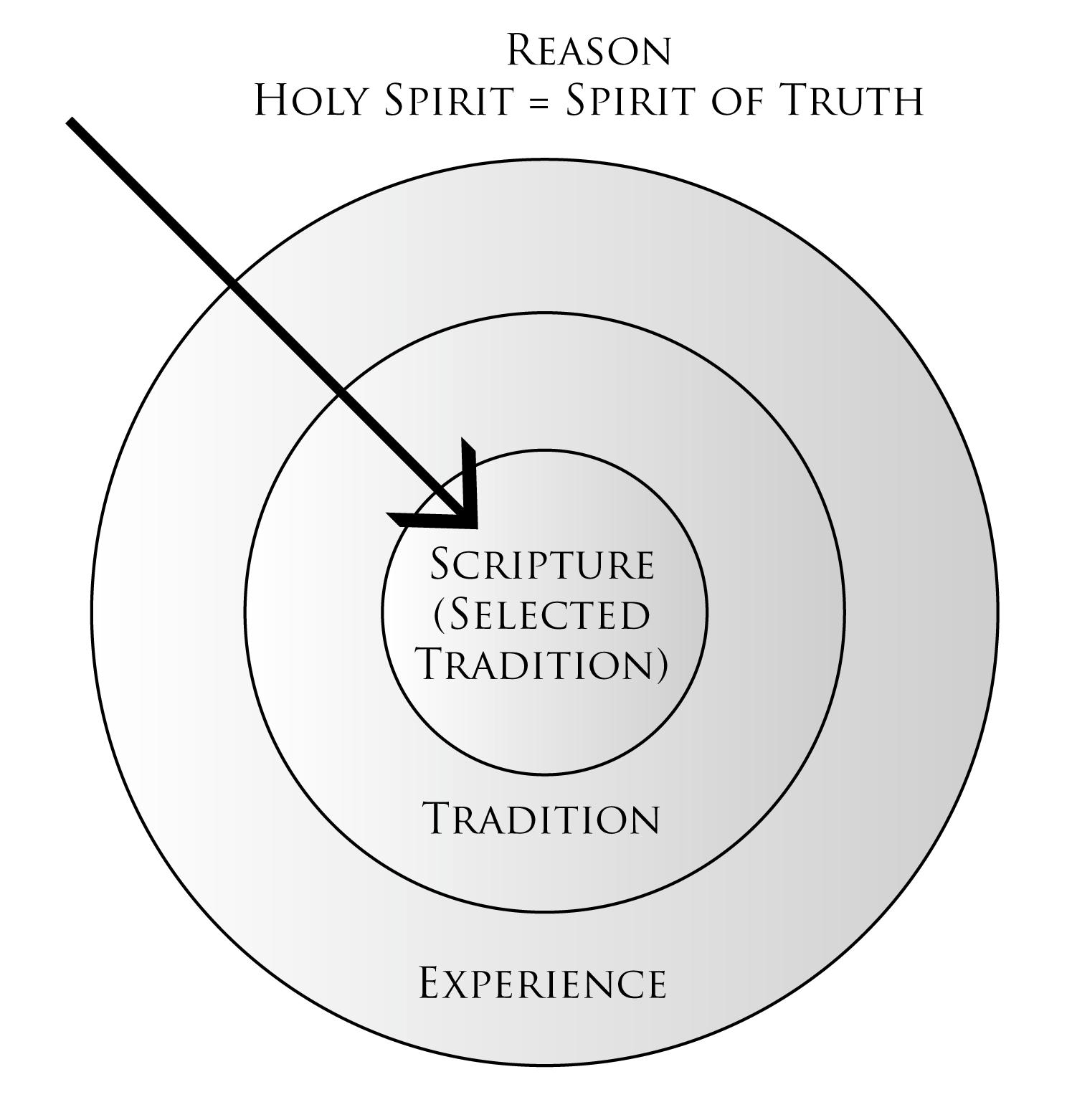
    But … and it’s an important but … there is a problem with the way United Methodists use the quadrilateral all too often. We tend to use it as a four lane highway. Which of the lanes can I get my idea through? If I get my idea through one, that’s enough. Instead, we need to use this as a four layer filter. Every answer we get to a question needs to interact with all elements. How does it relate to scripture? How does it fit with experience? What can we learn about this sort of thing through tradition? All of those questions will, of course, be processed by our reason. But that’s what the Spirit of Truth is for, after all, to guide us into all truth (John 16:13)! I illustrated this process with the diagram to the left in my book When People Speak for God.

    I believe that the nature of scripture is absolutely intentional on God’s part. Rather than giving us easy answers to easy questions he has given us a combination of testimony to God’s action in the world and principles (embedded in the testimony) by which we can make such decisions. When Jesus says, “On these two hang all the law and the prophets” (Matthew 22:40), he provides us with such a principle of interpretation. This is not a principle that helps you discover what the historical intent of a writer was. We have quite useful techniques of exegesis for that. But it provides us a principle for how we, as Christians living in the 21st century should apply it. Sometimes it says that the people who were doing their best to follow God didn’t live up to it. We should take those stories and try to hang the lessons we think we learn from them from the two commands as Jesus said.

    It’s interesting to compare the stories of Patriarchs in Hebrews 11 to their sources in Hebrew scripture. Moses left Egypt, not fearing the wrath of the king (Hebrews 11:27), but he was afraid (Exodus 2:14). A biblical error? A contradiction? No! A testimony to what is seen by the eyes of faith.

    We need to struggle with these stories if we’re to see where we are and where we need to be brought to greater maturity. How many of us need to learn not to fear the wrath of the king? But if we look earlier in that same passage, how many of us need to learn not to take God’s work into our own hands through violence?

    Testimony, the telling of our own stories and experience, doesn’t give us the sort of systematic set of answers we might prefer. But it does train us to think, to discern, and to decide.

    My guess is that’s what God was after in allowing scripture to come into being as it did.

    Oh, and one more thing …

    Tonight I’ll be talking with author Doris Horton Murdoch about testimonies in a Google Hangout on Air titled Lent: Season of Testimonies.

  • What the Greek REALLY Says!

    This was so good I had to embed it!

    https://www.facebook.com/178609685499598/photos/a.558486050845291.147623.178609685499598/1068493119844579/?type=1

  • Forgiveness and Reconciliation

    This past Tuesday night I had a conversation about forgiveness (with a long interlude on fiction writing!) with author Nick May. Nick was a last minute stand-in for two guests. My wife Jody was unable to participate because of a sore throat. Renee Crosby, author of the recent release The Fringe, had catastrophic technical difficulties, and Nick was available. We’re going to interview him along with his colleague, contemporary, and fellow fiction author Heath Taws on March 31. Besides being a fiction author (Megabelt, Minutemen, Molecricket), Nick is the pastor of Northstar Church’s Pensacola campus. Here’s the video:

    One of the topics we discussed was Matthew 6:14-15: “If you forgive other people their trespasses, your heavenly father will forgive yours. But if you don’t forgive other people, neither will your father forgive your trespasses.” Interesting and harsh! Well, perhaps just realistic. I wonder if the person who remains unforgiving can ever truly be forgiven. Nick and I discuss this in the video. I think that forgiveness involves reconciliation, i.e., it’s a two way street. This doesn’t mean that an individual can’t get it started, and can’t benefit from a forgiving attitude. On the contrary, I think it’s important to give up the burden of resentment against someone else, even if they will not participate. In addition, someone has to get started. What I’m suggesting is that unforgiveness creates an atmosphere in which it’s hard, or even impossible, to receive forgiveness. Maintaining a separation between ourselves and other people also creates a separation between us and God.

    One thing I didn’t have time to bring up in the discussion is a suggested translation in Leviticus 5:17 from Dr. Jacob Milgrom, author of the Anchor Bible commentary on Leviticus 5:17. This passage refers to someone who has transgressed and doesn’t know that he has done so. Milgrom suggests that the Hebrew ‘asham when it occurs without an object, means “feel guilt” as opposed to incurring guilt or being guilty. So this passage would best be rendered: “If a person transgresses, and has committed one of the acts with the commands forbid but he doesn’t know it, when he feels guilt, he will bear his responsibility.” The idea is that this sacrifice is for a time when one feels guilty, but is uncertain of what act may have caused that guilt. Thus we have a sacrifice for making oneself feel better! (This last line is my point, not Milgrom’s.) This is covered in detail on pages 343-345 of Volume 1 of his commentary, part of his comments on the reparation offering. I found his suggestion entirely convincing.

    Finally, this morning in my e-mail I received my regular eNewsletter from Rabbi Moffic, who was talking about forgiveness. His particular topic was forgiving ourselves, or receiving forgiveness. His remarks (and the Jewish parable he tells) are well worthwhile. While you’re at his site, consider subscribing to his newsletter. I’ve found it very helpful.


  • John Walton on Different Hermeneutical Presuppositions

    In an interview published on The Jesus Creed, though released by IVP, John Walton comments on different hermeneutical presuppositions. He is referring to the endless debates about how and when creation took place, but the ideas might be useful regarding other topics.

    Walton: We too easily believe that the world of biblical interpretation is a black and white world—that whatever view we have adopted is right and everyone else is wrong. Such a view is too facile. In many cases we do our best to be faithful interpreters, but the Bible just doesn’t offer enough information to give irreproachable confidence. Even as evangelicals with a common core of theological affirmations, we work with varieties of hermeneutical presuppositions and we weigh the evidence differently. Consequently we develop different preferences based on which view has the preponderance of the evidence supporting it. Though ultimately one position undoubtedly is right and others wrong, we are not always positioned to see that well.

    That being the case, it is uncharitable to simply label those who disagree with you as wrong, and even as less than Christian, when they have done their best to engage in faithful interpretation based on orthodox theological presuppositions and a defensible hermeneutic. Theoretically, people will know we are Christians by our love, and I am not sure that we always do a good job of that if we are constantly engaged in denouncing others who are simply trying to be faithful to the text.

    There are several things that interest me here. Overall, I wish more people would take this sort of thing to heart. Of course, when we get to “orthdox theological presuppositions and a defensible hermeneutic” we reopen all the questions again. Often the debate is just what presuppositions are truly orthodox and what hermeneutical principles are, in fact, defensible.

    This reminds me of another post I read recently, titled Types of Scholarship, and posted by Ken Schenck. There are a number of quite useful comments in the post, but he says that “a good deal of scholarship probably is bunk.” That’s very useful to know, right up until the moment that you have to determine just what is bunk and what isn’t. The problem is that not everyone agrees. I have published things that one person will say is quite horrible while another thinks it’s forward looking and well researched. I’ve encountered these contrasting attitudes much more frequently with other scholarly works I read.

    My point here is that much of what is written in any field is going to be discarded eventually, and the process of scholarship–publishing, getting responses, thinking some more, perhaps getting discarded–is probably necessary. If any person or small group of people was permitted to exclude the bunk, then we’d be very likely to filter out the gems, stuff that looks like bunk at first but turns out to be exciting.

    It reminds me of the comment one of my professors in graduate school made about Mitchell Dahood. I was making use of his commentary on the Psalms (Anchor Bible) and commented that I felt that in many cases I just couldn’t buy what Dahood had to say, yet in some cases he would come up with what seemed to me positively brilliant. I wondered if that was the result of my inexperience at the time. The professor said no. He said that Dahood was only right about 20% of the time (no idea where he got that figure!), but when he was right, he was so right that he made up for all the other times.

    So if that professor was right, would I consider Dahood’s work on the Psalms extremely valuable (20%) or bunk (80%)? Personally, I’m willing to filter the material to get the creative input.

    And since I usually try to mention a book or so that I publish, this post relates closely to the book I’m Right and You’re Wrong: Why we disagree about the Bible and what to do about it by Steve Kindle.

  • On Violence and Suffering

    9781893729902fMy friend and Energion author Allan Bevere posted this morning on this topic, and I want to call attention to it for several reasons. First, this is a topic I find very interesting. Second, I think it’s appropriate to discuss the problems of violence and suffering together at some points. Third, I don’t think that emphasizing a distinction between the Old and New Testaments really solves the problem. It ditches some texts, so if your plan is to explain things away text by text you make your task easier. But the basic issues remain the same.

    I also was reading my own book notes on Bart Ehrman’s book God’s Problem. Ehrman tends to set a lot of people off, but I don’t find him all that annoying. Do I disagree? Yes, in many ways. But that just makes life interesting. Recently, I published a book on this topic, Bruce Epperly’s Finding God in Suffering: A Journey with Job. It’s interesting to see what different results people get from reading the same material. Note that Epperly is a progressive Christian and his approach illustrates one of the problems in religious dialog: We dialog with one group and it is applied to a much broader group. I used Waltke in my notes (link above), and Waltke definitely takes a different approach from that of Ehrman. Yet so does Epperly, and it’s a different different approach.

    Then there’s the book Allan is reading, Who’s Afraid of the Old Testament God? As the publisher, I’m obviously very happy with that book, but I should add that Alden Thompson was my undergraduate advisor and taught me Hebrew (2nd & 3rd year). The fourth edition of the book was also the first title released by Energion Publications.

    Now, to add to the fun, we’re planning a discussion between Allan Bevere (The Character of Our Discontent), Alden Thompson, and myself. It’s scheduled for June 2, 2015. Watch for more information here or on any of my social media feeds.


  • What Is Really Essential in Christianity?

    On February 24, 2015, I hosted a discussion between Energion authors Elgin Hushbeck, Jr. and Alden Thompson on the topic Biblical Essentials. Here’s the YouTube:

    Today another Energion author, Dr. Allan Bevere, posted an entry on his blog titled Doctrine: The House in which the Church Lives. (Allan Bevere and Alden Thompson will be participating in a discussion of violence in the Bible, particularly the Old Testament, on June 2, 2015. I’ll post more information on that later.)

    Here’s my question: Is the essentials/non-essentials paradigm a good one? If not, why? If so, what does it accomplish?

    I’m well aware that I’ve asked this question and have used this model on this blog many times before. But I’d like a bit of discussion.

    I have always thought this was a good model to help set up one’s fellowship, as in what congregation or organization should I be a part of. An individual congregation might have one set of “essentials,” while a particular Sunday School class within that congregation had another. The denomination (or other organization of which the congregation is a part) would have a broader set, while the concept “Christian” might specify something much looser.

    Having characteristics on which we gather both to learn and to serve seems valuable to me. But I see a problem when we use that same sort of paradigm as a means of inclusion or exclusion, including the attempt to determine who is “saved” and who is not. The participants in our hangout had a simple answer for that, with which I agree wholeheartedly. Since it’s not our job to determine who goes to heaven and who doesn’t (or any one of a number of other ways of specifying the “eternal in-crowd), we cannot use these essentials for that purpose.

    I do think we can use essentials to help define a label. Labels can actually be good things. Without labels I could not write a blog post. Language labels things. The problem is when we force people (or reality in general) to fit the labels rather than looking for the best label to use with reality from a particular perspective.

    What do you think?

    To help you think, here’s Dr. Herold Weiss, answering a similar question in my interview with him this past Thursday: