I had the pleasure today of hosting Dr. David Alan Black at Chumuckla Community Church. I’ve been teaching there for the last five weeks, and preached once. Today Dave shared pictures of some of his mission work and also preached. His sermon was titled “Jesus and the 30 Year Transition, working from Luke 3:23. Well, and a few other texts.
Dave spoke with strong conviction about turning from temporal things to eternal and from ourselves to something bigger than ourselves. He said that every Christian is a missionary. Your call may be to the other side of the world or the other side of the street. One of the keys is simply to give of yourself to others.
I can’t do justice to the entire message. Dave manages to hold attention. He uses lighter moments effectively while bringing home a solid message. A few folks I know could take some homiletics pointers.
Dave is on his way home, and I’ll be continue to work on publishing, but I was again reminded of one of the privileges of publishing. It’s wonderful to be able to learn from so many wonderful people who are authors for Energion Publications.
I think he makes an important point here, but it is my belief that we all have our ways of avoiding what scripture says. The liberal finds things out of date. The conservative finds ways of categorizing texts, or let’s scripture interpret scripture by finding a text that says something different. The moderate (yes, even passionate moderate!) cuts the sharp edges off of the text making it seem more mainstream and less challenging. And we all find it much easier to notice the passages that correct someone else’s behavior.
I do it very poorly, I admit, but I really want to read scripture so that I can become more closely acquainted with God, seen especially through Jesus Christ, and so that by beholding I can become changed. (Hear the echos of my memorization of the KJV as a child!) Not so that by my beholding I can correct the rest of the world. I want to share, but let the Holy Spirit do the conviction, as necessary.
If we all studied the Bible (and yes, other books as well) with this goal, might the world not be a better place?
Last night after my discussion of eschatology, in which I mentioned that we tend to discover what we’re looking for in scripture, I returned to the house. Now I think this warning is important. We need to check our questions. On my hub site, henryneufeld.com, I use the slogan “helping you find the right questions.” It’s important to examine our questions, as they can determine our conclusions.
And life gave me an illustration. My wife generally has dinner about ready to go when I get done with my study. We were having nachos. She dropped something, and I headed around the counter to pick it up for her. Now at the same time as she dropped something (note that I’m not telling you what it was), I had dropped one pinto bean on the floor. I picked that up first. A stepped-upon pinto bean makes a nasty looking mess. In my head now is dropping an item of food while setting up a plate of nachos.
I go around the counter look back and forth and fail to find the item that my wife had dropped. I see nothing anywhere. Finally, she points at the floor, somewhat frustrated. Her cane has fallen and is right there and obvious as can be. So I picked it up and handed it to her.
What happened? I firmly had in my mind that since we were both fixing our nachos and I had just dropped a food item, she had dropped one too. There was no food item on the floor, therefore there was nothing to pick up. I was totally unaware of the cane, much larger than a food item, sitting there hidden in plain sight.
The question I have is just how many answers will be hidden in plain sight as we study the scripture because we know what is there?
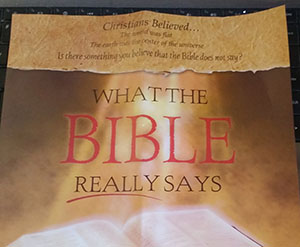
I opened my mailbox today to be greeted by a slick flyer inviting me to discover what the Bible really says about a variety of things. Among the the questions I’m told I can get answered: What is the future of our country during this economic downturn? What does the Bible really say about the second coming? What does the Bible really say about law and grace? What does the Bible really say about a vacation every week?
I’m rather well acquainted with this type of brochure, because I grew up as a Seventh-day Adventist. We had plenty of opportunities to see this sort of advertising. We were supposed to be the people who were right, and thus who would eventually straighten out the rest of the world. Well, at least those who were not destined for the lake of fire.
One of the things that my SDA teachers wanted me to learn was to go to the Bible about everything and to study it for myself. I did, and as a result I decided that the SDA church wasn’t the church for me. Especially on the topic of eschatology, I came to very different conclusions.
That’s the critical thing. The internet and the airwaves are filled with people who claim that they know precisely what the Bible teaches about almost any subject you can imagine, even when the Bible may not say much of anything about it.
To discover God’s message for you in scripture, you need to study for yourself. Now one of the things I was taught to do as a child was to look up the texts the evangelist used to see whether he was citing them correctly. There’s nothing wrong with doing so, but in a way this is a trap.
Studying the texts that someone else provides in the order and in the structure in which they provide them will very often lead you precisely to their conclusions. What you need to do is study the scriptures for yourself, in an order that you may discover, prayerfully, under the guidance of the Holy Spirit that God promises to you, not just to experts or ordained leaders.
While you’re doing that you need to examine just how it is that you come to understand the text, and especially to understand the way in which the text applies to you and to your life.
You can illustrate the problem with the way that the brochure I received talks about a “weekly vacation.” What the writers of the brochure mean is the seventh-day Sabbath. For various reasons that seem good to them, they believe that the command to keep the seventh day holy still applies, while other commands, such as various sacrifices do not. I don’t mean here to argue that they’re wrong about that, but rather that their view comes from a particular way of understanding scripture.
Some of our presuppositions and their impact.
I remember a certain book about the King James Version, one that advocated it as the only Bible Christians should use. “It’s a very scholarly book,” I was told. “It’s filled with footnotes.” The problem is that the footnotes varied between those that were to unreliable sources, those that were plain wrong, and those that were to other examples of the author’s own work.
Similarly, just because a presentation of scripture has a large number of texts doesn’t mean it’s scriptural. Neither does it mean it’s not. What it means is that you should examine it and decide for yourself.
When I cite SDA documents many people approve. Of course we should examine (and dismiss) the claims of schismatics like Seventh-day Adventists. They are, after all, wrong! But there is no type of mistake in understanding scripture that is truly exclusive to SDAs. You’ll find these mistakes in many denominations and tradition streams.
You need to examine everything. Think about these things for yourself. Get multiple scholarly opinions and test your own work against those. If you do this, you may be surprised at how many opinions about the Bible are predetermined by the presuppositions of the person holding that opinion.
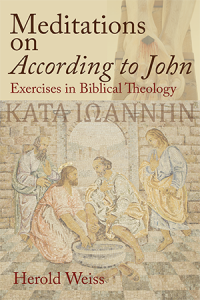
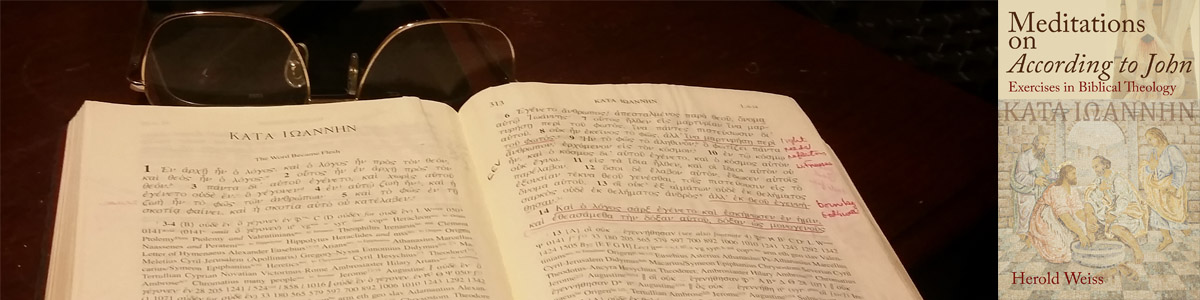
Last week was the closing session in my online study of the gospel According to John using Herold Weiss’s book Meditations on According to John: Exercises in Biblical Theology. I now turn to a new subject, eschatology, and will start with the book Eschatology: A Participatory Study Guide by Edward W. H. Vick. The reason I am starting here is that Dr. Vick provides many definitions and outlines the field and the various views quite well.
I’m going to follow a different pattern for this study, however, so don’t expect a chapter per week. What I’m planning to do is go back to something I’m more familiar with and illustrate these various approaches by looking at specific passages of scripture. I’ll focus on one, but will bring in others to show the connections, both where I see intertextual relationships and where students of eschatology have tended to draw connections irrespective of any demonstrable intent of the author.
You either view using the Google+ Event Page, or with the embedded YouTube viewer below.
In the comments to my announcement for Thursday night’s interview with Dr. Herold Weiss there was a comment that included a question. I missed it and failed to ask it during the interview. I e-mailed it to Dr. Weiss, and he sent me a response. Since this ties into the topic of the interview, I will also include the YouTube embed of the interview video below:
Q: As I’m sure Dr. Weiss knows, the Jesus Seminar allocated no sayings of Jesus in “According to John” as “likely authentic.” How does Dr. Weiss rate Jesus’ sayings in “John”, and how does he explain the vast difference between the Jesus of “John” and the Synoptics?
A: The difference between the Synoptics and John is due to the bifurcation of the oral tradition that started with the disciples but quite early departed into different trajectories. We can identify four of them: the tradition of Q, the tradition in the Gospel of Thomas, the tradition in Mark and the tradition in John. At some points there are connections between them. The tradition of John, as I point out in the book, can be seen being developed within the Johannine community, so that now there are some tensions withing the gospel. As for the work of the Jesus Seminar, I find it a bit pompous. The criteria of authenticity are logical, but their application is always subjective. All the sayings of Jesus are colored by the oral traditions behind them. That is also true of the work of the ‘historians’ of antiquity. They had no sense of responsibility to evidence and facts. The case of Josephus, or Tacitus is well documented. ‘Scientific history’ is a child of the XIX century.
There may be some who think that if we cannot be certain of every word in the gospels as ‘history’ we cannot believe in Jesus. I find that quite amazing. If one is to depend on history for what one believes, then all you have is a Jew who was crucified as a traitor by the Romans. The Gospel is about something else completely.
Well, I hope it’s not my final interview ever, and since we’re going to announce his next book, already under contract (and I have a preliminary manuscript in hand!), it likely won’t be. But it’s a wind-up interview for my study of According to John using Dr. Weiss’s book Meditations on According to John. You can find out more about the interview on the Google+ Event Page, or simply come back to this post and use the viewer embedded here.
Be sure to post any questions in the comments here and I’ll ask Dr. Weiss during his interview.
It has been that kind of a day. I apologize for not posting this earlier. You can find out more about this discussion on the Google+ Event Page or view it using the YouTube embedded below.
I’ve been planning to create some short notes on John, discussions of topics about which I’ve gotten a number of questions. I recorded the first of these today, and here’s the embedded YouTube video:
Tonight I’ve decided that I will focus much more on the trial of Jesus and the relationship between ritual, symbol, and spiritual reality. You can find more information on the Google+ Event Page, or you can view using the embedded viewer below.
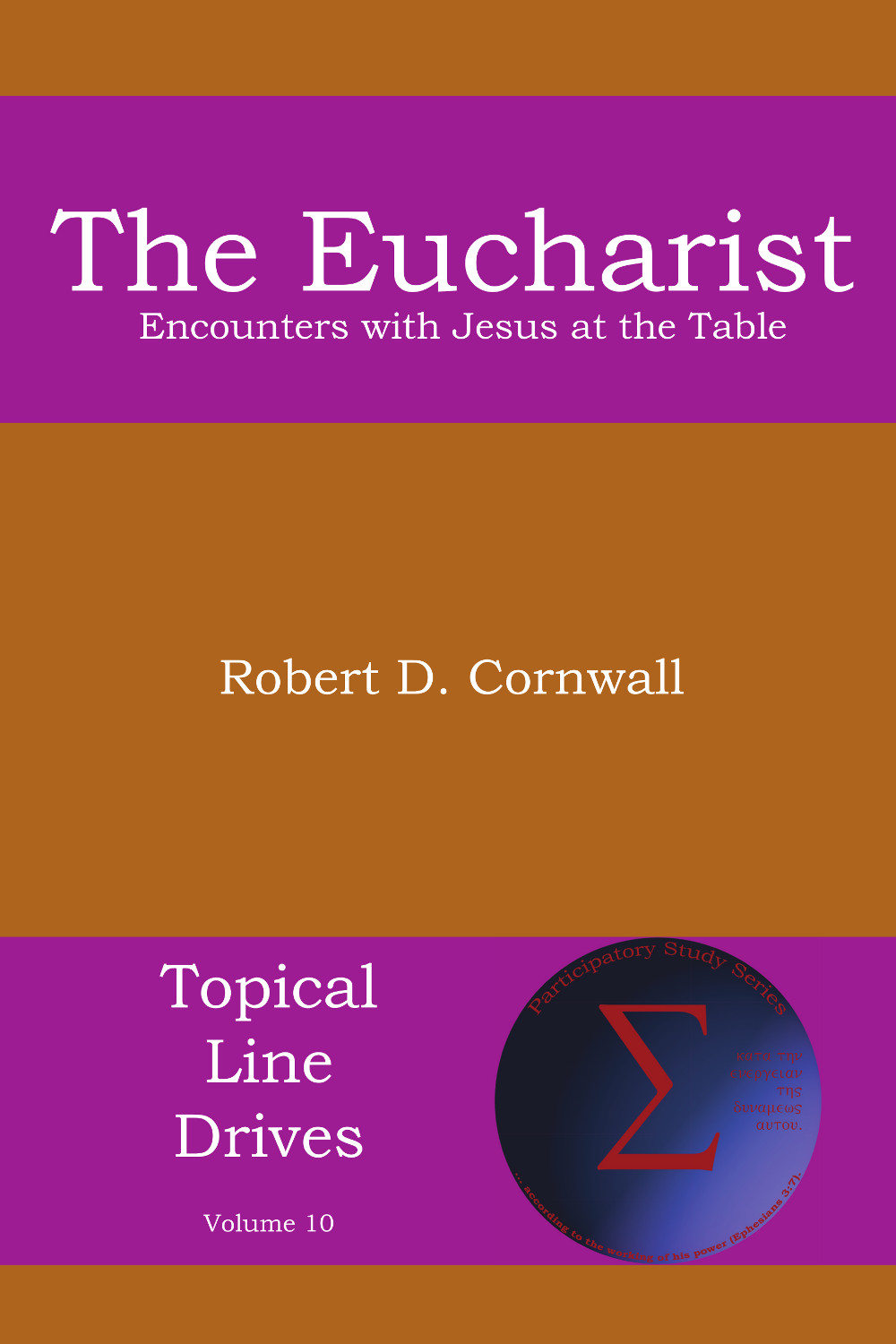
I often don’t like John Calvin, but I do like this view of the Eucharist. I don’t see the need for some kind of physical description, but I do believe that through carrying out this common ritual as commanded by Jesus we share in community.
I like the weekly celebration as part of the service. Our pastor normally connects the celebration with the topic of his sermon and makes it a combination of traditional elements and up-to-the-moment connections. I recently experienced this with someone who read the liturgy word for word, and I must say that the difference was striking to me. I think there are ways to make traditions both familiar, so people feel able to participate and also new, so that participating is an uplifting challenge.

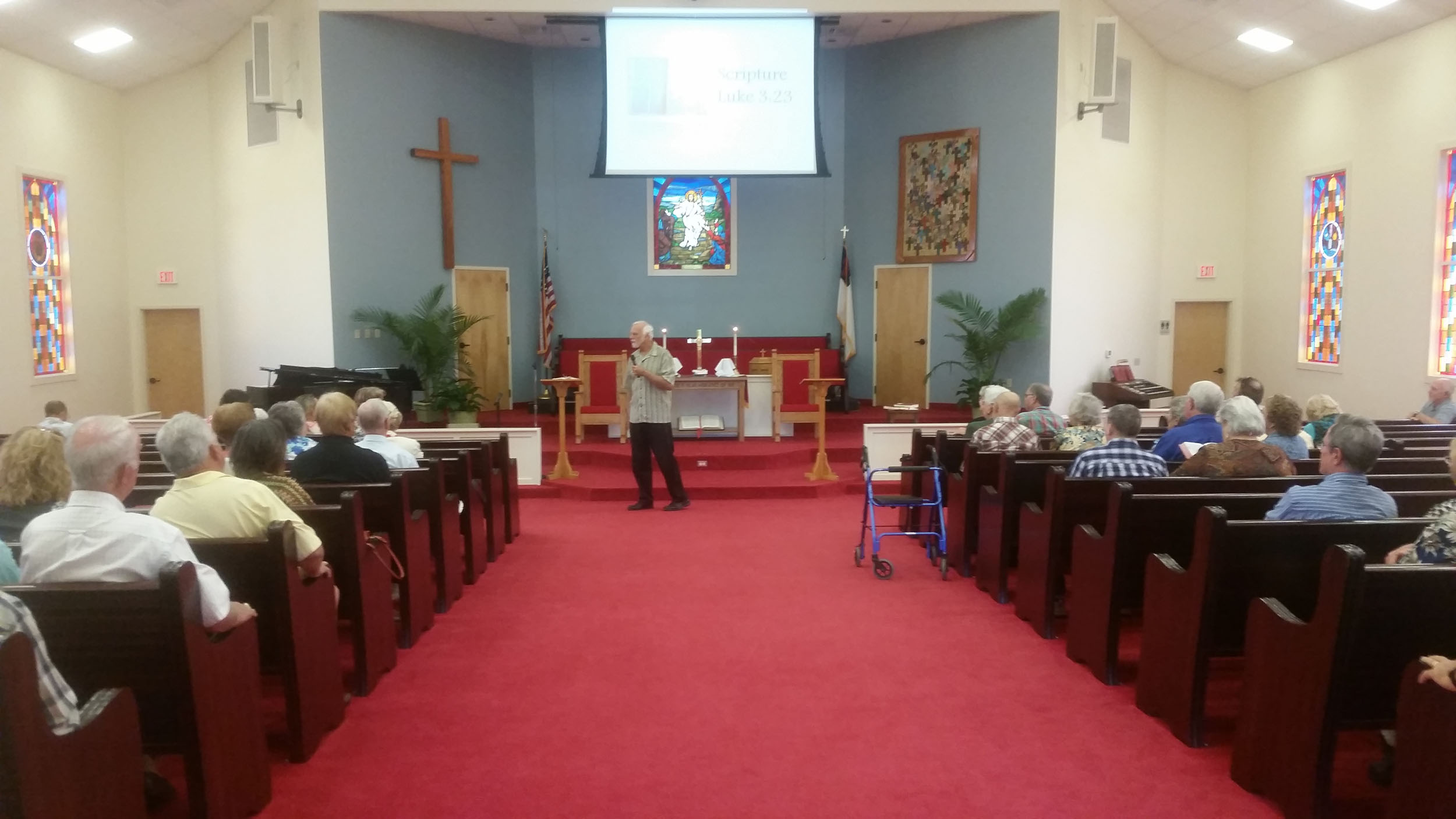 I had the pleasure today of hosting Dr. David Alan Black at Chumuckla Community Church. I’ve been teaching there for the last five weeks, and preached once. Today Dave shared pictures of some of his mission work and also preached. His sermon was titled “Jesus and the 30 Year Transition, working from Luke 3:23. Well, and a few other texts.