On Thursday night I’m going to do two things: 1) Present some material related to chapter 6 of Eschatology: A Participatory Study Guide (titled “Eschatology Future and Present”), and 2) Discuss October 22 as the anniversary of the Great Disappointment of October 22, 1844, as it is recalled in Adventism. On Thursday I will also kick off publication of some articles by Energion authors on that event and its implications for how we study the Bible generally and eschatology in particular. I’ll provide links to that material here.
Here are the links for the event. Below the YouTube viewer, I will post a couple of questions to consider relating to Thursday night’s study.
In the study questions (page 67 of the book), Dr. Vick asks:
(3) We cannot construct a theology without making assumptions. With what assumptions would you organise your beliefs? Which of the assumptions suggested in the chapter would you be in agreement, and which would you reject? [emphasis mine]
The latter part of this question will be hard to answer without the book, but consider the first line. Do you agree or disagree? Feel free to comment here or to bring your comments to the study on Thursday night. If you enter the comments via the Q&A app, they can become part of the study.
For some perhaps even more provocative suggestions, the following questions come from page 65, and might help in feeling out your way on assumptions.
What can I believe and what can I not believe? What are the implications of the answers I give to the question? This question then ramifies into more precise formulations.
What can I not believe about how things happen in the system of an ordered cosmos?
What can I not believe about how historical reports come to be written?
What can I not believe about the reliability of human testimony as an avenue to knowledge, whether given verbally or in writing?
What can I not believe about the capacity of a being with human limitations to foretell the future?
What can I not believe about the supernatural?
What can I not believe about claims that the supernatural causes events to take place within the cosmos? (p. 65)
I’m sure that as you consider these questions, you’ll quickly see their implications for how you might read scripture. One can be open on some of these, certainly. But thinking about how you would approach the question can nonetheless be critical.
We complain about it, write about it, claim it’s important or even critical, design programs to create it, but what is it?
I don’t mean that none of us know what we mean when we say “biblically literate” or “biblically illiterate,” but do we all mean the same thing? I don’t think we do, and that creates problems in communication.
Between age10 and 14 I attended a school that was extremely serious about Bible study. We had study guides that took us through the entire text of scripture, asking questions as we went. We memorized substantial portions of scripture, such as the entire Sermon on the Mount and Psalm 119. We also memorized selections of texts on various topics, such as four texts on the Sabbath and the state of he dead. (We were SDA, so these were considered important.)
I greatly value the knowledge I gained in this way, but when I was done, was I biblically literate?
This depends, of course, on what one means by biblically literate. Here are some definitions I’ve heard (or experienced):
A person who is acquainted with the key scriptures of his or her specific denomination or group. This type of literacy was provided for me by those “4 text” groups on particular doctrines. I could give a Bible study on any of the major Seventh-day Adventist doctrines as long as you didn’t ask me about context.
One who has a general knowledge of where things are located in scripture.
One who vigorously affirms a particular high view of inspiration.
One who is acquainted with the various higher critical methodologies.
One who knows the original languages.
One who knows the related history and literature along with the Bible story.
One who can place any particular story into the broader story of scripture.
(No, I didn’t plan to make that seven. It just happened.)
When I refer to “experiencing” a definition, I mean that I’ve seen someone tacitly dismiss someone else as knowledgeable because they lack one of these elements. I’ve encountrred this attitude about every one of these points. “If he or she doesn’t know x, the person is biblically illiterate.”
I have encountered this with regard to creation. When someone discovers that I accept the theory of evolution, they will suggest that I am unacquainted with Genesis 1 & 2. I am very acquainted with those chapters. In fact, I had to memorize them as one of those long passages in school. Memorizing them does not mean that I will interpret them the same way others do.
I fell into the trap myself recently. I was listening to Deanna Thompson respond to her award for book of the year from the Academy of Parish Clergy for her commentary on Deuteronomy in the Belief series. She confessed that she did not read Hebrew. My initial reaction was to think that it wasn’t really possible for someone to contribute to the interpretation of Deuteronomy (of all things!) without reading Hebrew. Yet right within her brief remarks accepting the award, she expressed some rather profound understanding. I mentally took it back and was glad I had only thought it internally.
This experience does not make me think that learning Hebrew is unimportant. It just makes me think more carefully about what I expect. I have no problem with the value of most of these benchmarks of knowledge. I think they’re important. But what is it that I want the average person in the pew to know? What about my church leaders? Pastors (if we make a distinction)? Seminary professors?
My own definition would be close to #7. I think hearing the overall story of scripture is critical to everything else. Fit the passage into a broad view of the whole. Of course, this type of knowledge might well look superficial to others.
My suggestion would be simply that we pay attention to what type of biblical literacy a person has, if any. Far too many people in the church could really claim none of these elements. We should work on that. But we should also recognize other approaches and what kind of knowledge those other approaches support.
One of the most interesting and troubling things I’ve found about myself and my church (any of the churches of which I’ve been a member!) is the number of things we know we should do and even decide we will do, but which never get done. Seven Marks of a New Testament Church is certainly ecclesiology, but is it shelf ecclesiology (that’s nice) or is it practical ecclesiology (let’s do that)?
In this case I can’t point fingers. In my personal life I need to get more exercise and lose a significant amount of weight. How long have I known this? Well, I’m the son of a doctor who was medical director of a health conditioning center when I was in my teens. And yes, he knew about these things before that time and after that time, and he taught them to me. I cannot claim that I didn’t know what the health effects of a sedentary lifestyle and excessive food intake (biblical gluttony, no?) would be. While I’m working on reforming this now, I do so slowly and under constant temptation to avoid the needed change. It’s not that I’m tempted to do useless things. In fact, I’m tempted to work, and for me work involves being in front of a computer. So one good thing tempts me away from another one. But that doesn’t make it right. I know I should get more exercise. I know I should eat less. Making those changes so that they are a fundamental part of my new normal is very difficult.
Romans 7 anyone? I know many Arminians see Romans 7 as a description of our pre-Christ experience. I see it as very descriptive of what I and many Christians live every day. The problem comes in when we make Romans 7 into a continuous, hopeless loop about everything. Yes, we all have our Romans 7 experiences, but we’re invited into Romans 8. Not that we’ll live at “Thanks be to God, through Jesus Christ our Lord” (7:25) at all times and on all subjects.
It’s easy to make excuses. I’m very busy. It’s hard building up a small publishing company. I have a lot of work to do. I’m very healthy, taking no medications and very rarely missing work. I don’t smoke. I don’t drink. I’m a vegetarian, for heaven’s sake! (Ice cream, sweets, lots of butter, bread—they’ll do it even to a vegetarian!)
But no matter how many excuses I produce, I know this: I need to change.
There are many reasons why we don’t change, and many excuses for why we can ignore things that we hear.
We find some fault with the messenger. The wrong person is making the suggestion, so it can’t really be right.
We nit-pick the message. There’s something in there that won’t work in our situation, so we discard everything new and go back to what we were doing.
We are change-weary. We’ve tried to make changes so many times and have failed. Why should we try yet another thing?
We don’t see our present problems. We’re so used to the way things are and the level of success we’re having, that we think that’s precisely what should be going on.
Other people are much worse off than we are. The church down the street is so inward-looking. By comparison, we’re outgoing, gospel-oriented, and on fire for missions. (This is like my “I don’t smoke” excuse. I’m better than the person who’s killing himself with cigarettes.)
This change is going to cause problems. Usually this means that the leadership is afraid of losing control.
I don’t have enough guidance. Where is the calendar, worksheet, study guides, long term plan, etc.?
I could go on, but we’ll stop at seven. Nice number!
I think, nonetheless, that our bottom line is fear. We are surviving the way we are, but will we survive after we change? The pastor wonders if he’ll lose members. The members wonder if they’ll be happy with the new church service on Sunday morning. The education team wonders if anyone will attend Sunday School. Everyone wonders whether they’ll be annoying their neighbors. And while we might not admit it, we wonder whether we’ll be happy ourselves. So we stay the same.
One of the great fears is that we will lose control. This has been the bane of the church from very early times, I think. We’re very much afraid of the movement of the Spirit because the Spirit is not under our management. Not that we don’t try!
Transforming congregations learn to choose and choose again. They don’t have to get it right the first time around. They can gain insight from any action they take and that insight will aid them opting to take the next step into the future. Transforming congregations acknowledge that when they act with courage, some people may decide to leave, but they would rather decide to do something than to remain lukewarm about everything. (p. 126)
Bruce Epperly comes at this from another angle in Transforming Acts:
The spiritual leaders acknowledged that they couldn’t do everything. They confessed that the task of sharing God’s word left no time for taking care of domestic issues. They needed partners in ministry: so they prayerfully chose a group of people to insure that everyone had a share in the community’s resources. They let go of control, and let go of power, so that human needs could be met.
In ways that are still countercultural, they relinquished the power of the purse for a greater good, the well-being of the whole people of God. They recognized that within the body of Christ, everyone has a role – their spiritual leadership of the community did not lead to micromanaging or power plays, or a sense of spiritual superiority, but a vision of shared responsibility. Perhaps, their selfless leadership inspired the Apostle Paul’s vision of the multi-gifted body of Christ in which the well-being of one shapes the health of the whole body and the whole body, operating effectively, provides nurture and support for each constituent part. (pp. 67, 68)
Giving up control and choosing to act. When we have acted, we choose to learn from that action and act again.
What has impressed me about the church, not to mention my own life, is what a difference we could make if we simply acted on the things we already know are right. Yes, new information is good, but we have a tendency to collect the information and fail to perform the actions. There are many controversial things. But if we laid those aside and simply acted on what we know to be right, what might happen?
I doubt that church would like like the church in America at this moment.
In my Eschatology study last Thursday (Oct. 15, 2015) I tried to answer an audience question. Here it is:
Is the sense of the presence of Jesus today dependent on the historical Jesus surviving death? Or, is it more like the presence of a departed parent that lingers after death?
And here’s the video, set to the point where I discussed the question.
I’m not terribly satisfied with my answer. What’s more, I am never satisfied with my answer to this and similar questions. What’s even yet more, I doubt I will ever be satisfied.
I’m sure some will find this surprising. I can certainly talk about heaven in a very present and real sense. I claim that I do not cross my fingers during the Apostles’ Creed when I come to “resurrection of the dead.” On the other hand, those who see life after death more as the presence in our memories as someone after death seem to think this is quite adequate. For me, it is not. Well, it might be.
A common modern view of life after death sees this as a simple result of our unwillingness to admit that we are truly bound by time and destined to come to an end in the sense in which we live now. Belief in the afterlife is a way to avoid this end. We don’t want to be something that exists in the memories of others or who impacts the universe through the echoes of what we were and did in our physical lives. Thus we imagine an afterlife.
There is another possibility, one that was mentioned in a recent video interview I conducted with Dr. David Moffett-Moore. I believe he was quoting someone else, but I’ll credit him for the moment. (I haven’t located the precise portion of the interview.) He said we could be seen as spiritual beings having a physical experience rather than physical beings who have spiritual experiences. I want to consider the possibility that the reason many of us see some sort of survival is not that we are carrying out wish fulfilment, but rather that we detect the echoes of this other reality. The reason we sense that the person isn’t gone is that in that spiritual sense, they are not.
And that leads automatically to what “that spiritual sense” might be. And there the problem gets complicated. Just how do you talk about something for which we have only distant echoes? Plato’s cave and the shadows seem easy by comparison. Then there is 1 Corinthians 2:9, “What no eye has seen, nor ear heard, nor the human heart conceived ….”
What we tend to do with this, however, is to take what we have already and make what no human heart has conceived be more of what we already have. We have our physical life, our comforts, our friends, and so forth, so in this other realm we will have more of those things. More people, better relationships with them, more stuff (or less need for stuff, but more satisfaction), a bigger, better place. It would be just like moving to the mansion down the road, the one we couldn’t possibly afford, only much, much more! Bigger! Better!
But what if what we can’t conceive is something we can’t conceive? I don’t mean that the mansion we can’t afford, but can have when we get to heaven, is so large we can’t imagine it that large. What if the concept “mansion” is simply the wrong one? What if no matter how we conceive of that mansion in size, splendor, comfort, or anything else, we’re no closer, because it’s simply the wrong thing to be imagining?
Here are some questions I tend to hear when talking about this: But is it real? Is heaven a place? Is it just imaginary?
And here’s the problem with our language. If I say you’re going to live in a new house, but it’s really not something you can understand, you just don’t have the concepts, you’re likely to turn to the most likely alternative: It’s imaginary; it doesn’t exist. So in order to make heaven truly inviting and special, I’m asked to affirm that it is real—just as real as my house that I can see through my office window. Just as real, but better. Well, if that’s the “real” then I can’t possibly tell you that.
We really can’t conceptualize it. On the one hand I don’t want to limit it to the chemical processes of memory inside physical bodies alone. On the other, I don’t want it to be some place else in three-dimensional space, like a fine housing development out in space somewhere. I think we get echoes from it in our minds and spirits, and we have to tie those echoes to something we can conceive, but that doesn’t mean the concepts we form are the whole story.
And I’m very dissatisfied with my answer, but it’s the only one I have. With it, I live in continuous hope.
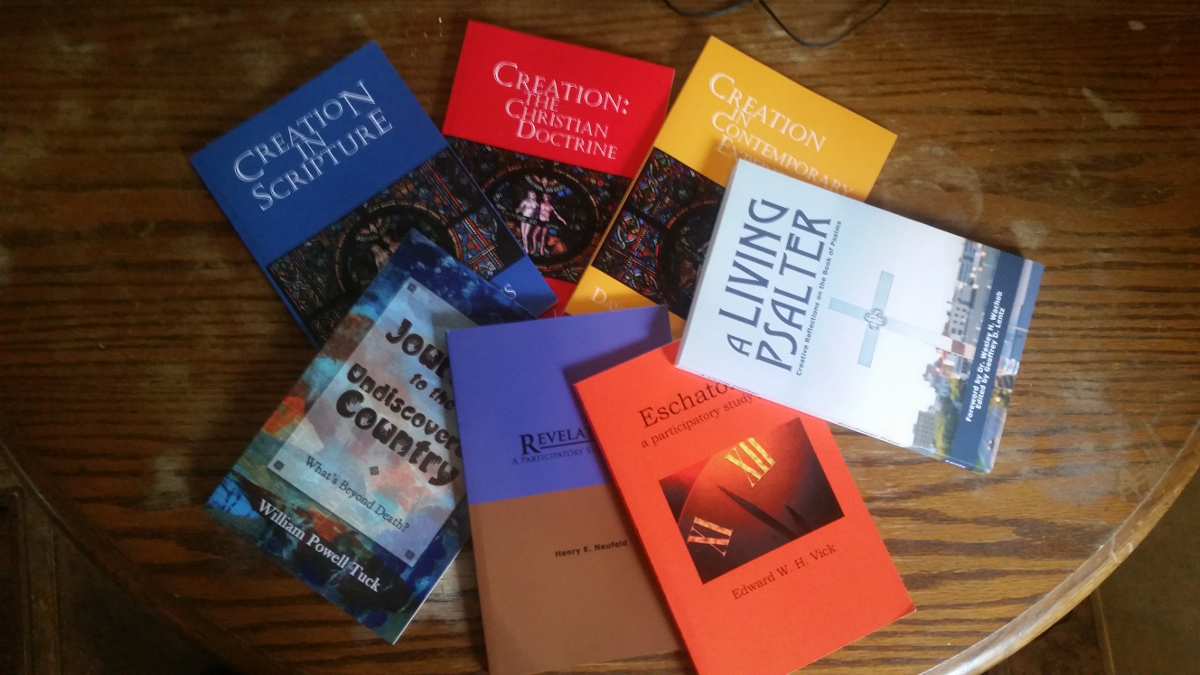
(Let me recommend the book whose cover I show at the top of this post: The Journey to the Undiscovered Country. Bill Tuck spends some time with the various concepts he finds and looks at the echoes as they occur in scripture.)
Taken from chapter 5 of Eschatology: A Participatory Study Guide by Edward W. H. Vick. You can find out more about this study on the Google+ Event page.
Description:
This study is from chapter 5 of the book Eschatology: A Participatory Study Guide by Edward W. H. Vick. This will be some very basic background, discussing the quest for the historical Jesus and how it has impacted our understanding of Christian eschatology.
We will also discuss (again!) the critical issue of the way in which we read and interpret scripture and how that will impact our understanding of eschatology, which draws on such a wide variety of sources.
Well, I didn’t do it alone, but I don’t think I can plead completely “not guilty.”
Tonight at 7 pm (about a half hour from when I’m posting this), I’ll be interviewing Lee Wyatt, author of the new book The Incredible Shrinking Gospel. Join me!
I have been asked whether I accept open theism or process theology. The fact is that I accept extreme uncertainty about the way God relates to space and time, but that I think the process theologians come closer to the way the Bible story seems to read while traditional theism seems to come closer to the assertions Bible writers make about God.
In a way it’s much like my view on the Calvinist-Arminian divide. I think there is scripture on both sides, with the Bible writers moving forward without much concern for resolving the tension between sovereign control and the true free will of creatures, both of which are affirmed in scripture, I believe. God thus remains both outside of time and yet interactive within it; both in control of all that takes place, yet impacted by events chosen by people.
It seems to me that one cannot read the story of God’s action in this world in scripture without seeing the evidence of interaction. If nothing else, Jeremiah 18, to which I refer frequently in my Eschatology series, which explicitly says that God will speak in one way, yet if the people involved change their minds, God will change his. God repents.
Now I’ve heard plenty of ways of explaining this, but none of them feel “settled” to me, so I won’t use the word “heretic” anywhere on the spectrum. Well, I rarely use that word other than with intended humor in any case. I’ve been dubbed Henry the Heretic, (usually) in a friendly way!
Let me summarize these views on God’s relationship to time broadly:
Calvinism – God is sovereign over all and predetermines all that takes place. There are, in fact, a spectrum of views on the details, but this is an intended (over)simplification.
Arminianism – God foresees all, and predestines as he foresees. There are a variety again of ways of seeing the details. This view, along with Calvinism, preserves omniscience in the sense of God knowing every details of what will take place from start to finish, from the end to the beginning.
Open Theism – God could know all of time, but has created space-time, and us in it, in such a way that he does not. In other words, he limits his own knowledge and therefore can interact with us. There are again quite a number of ways of expressing or explaining this relationship. I owe this one to a conversation with Dr. Richard Rice, author of The Openness of God (no longer in print, reprinted as God’s Foreknowledge and Man’s Freewill), but I am relaying the gist by memory, not quoting any of Dr. Rice’s work.
Process Theology – God is inextricably linked with creation and is not so much in control as we might like to think. Free will is, as I understand it, an integral part of everything and God does, in fact respond. For a bit more detail I’d refer you to Bruce Epperly, Process Theology: Embracing Adventure with God, which I publish.
My personal position remains in the open theism camp, with a very strong sprinkling of “I don’t really know” thrown in. It’s just that for me those things short of open theism do not adequately express the view of God that the overarching Bible story expresses, while process theology seems to be a bridge too far for me. But as you can see by the fact that I cite a book I edited and published, not to mention requested from the author as a source on process theology, I hardly regard it as the dangerous heresy that many do.
In fact, one of the things I have become more and more convinced of as I work as a publisher is that people’s actions are not very directly related to their doctrines. I once would have thought that Calvinists would not be that involved in missions, because God has predestined everyone. Yet they carry out missions with vigor. I might have expected Arminians to be less likely than others to “blame God” for every little thing that happens, yet they do precisely that. Both Arminians and Calvinists will talk about their prayers changing the course of hurricanes, surely something at least as predetermined as a human life.
“Orthodox” theologians, by which in this one quoted instance I mean both Arminians and Calvinists, as they both assert full sovereignty, omnipotence, omniscience, and free will, doubt that process theologians will pray, and certainly, if they pray, will not expect God to act. Yes they do, as do open theists.
In fact, if we observed behavior, we would likely find ourselves dividing Christians very differently from the way we do with regard to doctrine. I hope, in this case, to have done some distinguishing without further division!
I’ve had a hard time keeping up with blogging this week. It’s a busy month. On Wednesday nights I’m teaching from Revelation for a youth group at a local church, and of course I have my Thursday night events, one of which I’m announcing here, which are a sort of spiritual discipline for me.
I was going to try to both talk about Daniel and Revelation (in a very general way) and then go on to talk about eschatology and the quest for the historical Jesus, but I have decided not to do that and give myself a slightly more relaxed session talking about the structure and rhetoric of Daniel and Revelation. The two books are substantially different, yet they are the two acknowledged works of apocalyptic literature in the Bible, and almost any Christian discussion of eschatology touches on them at one point or another.
Growing up as a Seventh-day Adventist meant that I repeatedly studied these books. I even took a college class titled just “Daniel and Revelation.” There was an extract of the SDA Bible Commentary combining the comments on Daniel and Revelation in one book.
While I will be looking at these two books in particular, my study since has led me to look at a much broader range of material, from Ezekiel, to several chapters in Jeremiah, to much of the latter portion of Isaiah, and much more in the Bible, and also a considerable amount of non-biblical material. Yet these two books still tend to hold pride of place.
Is their purpose to give us an end-times outline? If so, in what detail, and if not, what is their purpose? I’ll be discussing this on video this evening.
I’ll be working from Chapter 4 of Dr. Edward Vick’s book Eschatology: A Participatory Study Guide and looking at the nature of prophecy and the literary nature of the texts. I’ll also be looking at ways in which we interpret prophetic literature. I apologize for posting this very late. I will try to comment in writing and add some links tomorrow and Saturday.
In the video, Dave calls this simply “The Word of God.” I’m embedding it at the end of this post.
One of my observations in talking to people about their churches and church programs is that they find the first moment when a book or program differs from their situation and take one of two approaches. First, they might discard the entire thing. This is fairly common. That won’t work for us. It doesn’t matter that what we’re doing isn’t working either. Second, they try to follow the program precisely, despite any differences, because if it worked for the expert who wrote the book, it has to work for them.
Neither of these is a strategy that is likely to succeed. Each person, community, church congregation, denomination (or jurisdiction within a denomination) is different. Each one will have different opportunities and perhaps a different call from God. I am passionately convinced that sharing the good news about Jesus with the world is our general calling. Whether that is going to involve a food pantry, classes, involvement in broader community outreach, collecting money for projects across the globe, or any one of a myriad of other possibilities, is wide open.
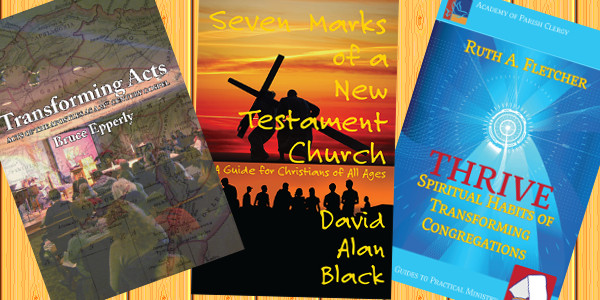
Especially in protestantism we tend to downplay tradition, but our church tradition has a role. The way you will carry out certain missions is going to depend on the history of the church congregation. We don’t all get her in the same way, and we’re not going to move forward in the same way. Dr. Ruth Fletcher, in her book Thrive: Spiritual Habits of Transforming Congregations devotes an entire chapter to choosing, to the necessity of discerning the right path and making and carrying out decisions.
The reason I wanted to emphasize this right now is that quite frequently we think we cannot benefit from something like “apostolic teaching” or “the Word of God” unless we absolutely agree on what it is and how we’re going to deal with it. But just amongst the books that I publish, we have Dr. David Alan Black, a Southern Baptist Greek teacher (and full-time missionary, he’d insist!) and Dr. Bruce Epperly, a United Church of Christ pastor, seminary professor, and a process theologian who are both going back to the same place: Acts of the Apostles. Now I’ll tell you that if you read both of their books, something I urge you to do for reasons beyond the fact that I publish both, you’ll find quite a number of things they disagree on and quite a number of points of different emphasis. But in a church that is often drifting and dying while repeating the same behaviors that led it to its current malaise, that one similarity is enormous. Let’s look back at the early church. Let’s ask what made Christianity what it is. Perhaps there is something there that would help us.
Now one interpreter might be looking for a definitive, apostolic pattern to apply and follow. Another might be looking for a series of commands that one can carry out. Another might be reading the story and asking how are stories might relate. Yet certain things come out of such a study, and certain things result from going to the source.
I’m very protestant in ethos. I’m not at all interested in things like apostolic succession, in the sense of a series of people who had hands laid on them by a person who had hands laid on them leading back to the apostles. But I’m very interested in seeing what those early apostles did. I’m very interested in connecting my story to theirs. There is nothing about that process that is mechanical or that allows me to depend totally on someone else’s work.
Dave makes this point in the interview as he talks about us teaching one another. Why am I comparing what Dave has said with what two other authors have said? Is it so that I can sell more books? Of course I want to sell more books. I’m never going to lie to you and tell you I don’t care about selling books. But that’s not the key reason. I started publishing to do this. I wanted us to teach one another, to do on a broad scale what Dave is talking about in the local church (where I also want to see it done). I want is to help one another learn. I hope we find ourselves challenged.
There is nowhere that I want to see this more than in our use of the Bible. How is it that we can begin to see more of this individual Bible study in the church? And let me specify here by “individual” I mean “individual in community.” Let’s avoid two serious errors: 1) That Bible study is individual without any community control or involvement, and 2) That Bible study is a communal affair that can be handled by an expert passing out information. The reason I named a series I publish “participatory” in spite of the number of people who thought that word was too long, is that it is individuals participating in community who have the best possibility to find the message for themselves, their churches, and their communities.
Ruth Fletcher comments on this. Note how she doesn’t propose the same type of study for all types of churches.
Even though this is an age when people care more about what the church does than what it believes, transforming congregations know they must lessen the gap between people’s experience of God and the church’s teaching about God if the church is once again to become a reliable source of wisdom. Beliefs matter. Transforming congregations that are creedal churches help individuals discover a deeper truth in the words they recite; those that are non-creedal churches create safe space where individuals can work out their own guiding beliefs. They create space within their own tradition where people have the freedom to honestly express doubts, to say what they do not believe, to ask questions that don’t have predetermined answers, and to wonder about the mysteries of the universe. (Thrive, p. 91)
Bruce Epperly has a similar idea:
The first followers of Jesus “devoted themselves to the apostles’ teaching and fellowship, to the breaking of bread and the prayers.” They were a church whose spirituality was truly holistic. They prayed and they studied, and discovered study was a form of prayer. We need thinking Christians, who take theological reflection seriously, who ask serious questions, and challenge unhealthy and superficial images of God and human experience. (Transforming Acts, p. 48)
If you think the various visions are distant from one another consider this: What would happen to the church in America if we were to focus on studying the early church looking for insight into how to be a church following Jesus in the world today? I think that a number of wonderful things might happen despite how we decided to approach the question and the hermeneutical principles we took to the effort. Do I want us to debate such hermeneutical principles? Absolutely! The do make a difference. I think one of the greatest things we can do is to consider and discuss that issue seriously. But if we started at that point, we’d already be devoting ourselves, in our own limited ways, to the apostles’ teaching. Wouldn’t that be a good thing?
The section on this mark in the video begins about 15:30. I’m not setting the video to the starting point, as I suspect most who are willing to invest time in the video will watch it as a whole once.

 On Thursday night I’m going to do two things: 1) Present some material related to chapter 6 of Eschatology: A Participatory Study Guide (titled “Eschatology Future and Present”), and 2) Discuss October 22 as the anniversary of the Great Disappointment of October 22, 1844, as it is recalled in Adventism. On Thursday I will also kick off publication of some articles by Energion authors on that event and its implications for how we study the Bible generally and eschatology in particular. I’ll provide links to that material here.
 The latter part of this question will be hard to answer without the book, but consider the first line. Do you agree or disagree? Feel free to comment here or to bring your comments to the study on Thursday night. If you enter the comments via the Q&A app, they can become part of the study.