Threads from Henry's Web

Category: Religion

All posts relating to religion, including those on the relationship of religion to other fields, such as science and politics

  • Yes, Your Religious Group SHOULD Be Subject to Analysis and Criticism

    Yes, Your Religious Group SHOULD Be Subject to Analysis and Criticism

    no accountabilityand so should mine.

    There are quite a number of ideas that I believe are quite good when practiced voluntarily, and become dangerous and destructive when backed by force. For example, let’s take “political correctness.” Much of what is labelled political correctness is, in my opinion, simple courtesy. Notice the bold text. I think it is courtesy, and thus I follow it as a courtesy. I advocate courteous speech to others. When force is placed behind one person’s (or a group’s) idea of courtesy, so that others are forced to be courteous, all kinds of trouble breaks out. First, and more minor, is the simple problem that if courtesy is to be enforced, then we must have rules for just about every circumstance. The rules will multiply. But second, though more important, the rules of courtesy can prevent criticism. (This is an excellent argument against speech codes on university campuses, places where criticism should be the norm, not the exception.)

    I have commented on this many times with regard to individuals. A person should not become immune to criticism because he or she is too important or revered. In churches I see this with regard to pastors. Some will say “touch not the Lord’s anointed.” I say instead, “Check out the guy who claims God’s anointing very carefully.” In fact, if persons claiming God’s anointing try to exclude examination and accountability, I consider it a very good indication that there is something ungodly and unsavory going on.

    Now I would strongly advocate—advocate, not enforce—courtesy in the process of criticism, both because I think courtesy is a value in itself and because I think your critique is more likely to have an impact if it is presented in a sensible way without extra baggage. But an enforced barrier to examination, including an enforced level of courtesy, such as questions that cannot even be asked, is an opening for scoundrels.

    Freedom of speech is of great value in preventing errors and correcting problems. I advocate this not merely as a constitutional principal here in the United States, but on a personal basis. I would want any organization I support to favor free speech, and in this I include annoying and antagonistic speech, speech that I would call very discourteous. Whoever you are, whatever your position, however long you’ve held that place, I believe the world is better off if people can criticize you, even if some (or most) of those people do so unfairly, unjustly, and downright rudely.

    But what about religious groups? Isn’t it unfair to criticize other people’s cultures or their beliefs? Don’t they have a right to their own beliefs? If you criticize their culture, aren’t you engaging in cultural imperialism?

    First, of course, based on what I have already said I don’t believe it is right to ban even rude and unseemly speech. I don’t have to publish it (I am a publisher). I don’t have to read it or listen to it, but I would never ban it, even if it is totally unjustified. On the other hand, one way one discovers whether criticism was justified or not is by listening, evaluating, investigating, and then perhaps vigorously criticizing those who produced it. One way in which groups try to protect themselves from examination is by claiming that critiquing what they say somehow denies them free speech. I think this is a dangerous point of view. Critique is the proper response to ideas which I think are flawed. If you disagree, critique my ideas.

    But let me follow up with something from my own experience. You may remember the Branch Davidians. There was quite a mess back in the 90s. Now the Branch Davidians are an offshoot of an offshoot of Seventh-day Adventism. I used to be a Seventh-day Adventist, so I took note of events. People were trying to figure out whether the Davidians were actually SDAs. They were trying to figure out who SDAs were. They were looking at the doctrinal beliefs of the Branch Davidians to see why they were behaving as they did. In the storm, the few voices that said one shouldn’t criticize religious beliefs were drowned out, but they did come up.

    One of the problems I see with Christians in the United States is that very few have experience being a minority. While I would regard SDAs as simply another denomination of Christians with certain beliefs held in common with the broader community and others distinctive, SDAs are different enough from the majority that they tend to stand out as a minority. So there was some criticism that washed back from the Branch Davidians all the way back to the Seventh-day Adventist Church, a connection which had not really existed since the 1930s. When people who knew my background asked me, I would explain, but there was also a great deal of misinformation.

    But here’s the question: Was it valid to examine and critique the beliefs of the Branch Davidians? Absolutely! They carried certain beliefs to extremes that eventually resulted in death and destruction. It was not only valid, it was critical to examine these beliefs, both to see how they led to what had happened, and also to distinguish their beliefs from others. There are few ideas that cannot be taken to extremes by someone. There is the person who believes Jesus will return in glory at some point, but that we should live responsibly in the meantime, and then there is the person who believes that Jesus will soon return and that we therefore have no call to live responsibility. A bit further down that road, if it indeed is a connected road, there is the person who believes Jesus will return in two weeks, so he ought to sell all his stuff and stand out on a hill waiting for it to happen. The beliefs result in actions and it is perfectly valid to look at them.

    Look at this two ways: 1) The examination looks at the beliefs and how they connect to action; and 2) the examination illuminates the difference between various groups who might otherwise be considered the same.

    Probably most of the small number of readers who have followed me this far will connect what I’m saying with criticism of Islam and the use of terms such as “Islamic terrorism.” The use of labels needs its own discussion, and I’ve written about it in an earlier post on the Energion Discussion Network. Would you, for example, like to have the protests of Westboro Baptist Church be described as “Christian protests”? Yet that is a distinction we expect people, even non-Christians to make. Despite these people calling themselves Christians, others are supposed to figure out that they really aren’t—according to us. In fact, we expect people to distinguish them not only from Christian groups such as the Episcopal Church or United Church of Christ, which have a strongly inclusive position, we expect them to distinguish Westboro Baptist from Christians who believe homosexuality is sin, yet don’t accept their methods and the extremes. And I think it is good to make such distinctions. In fact, one element of my own definition of being a moderate is that one looks at the whole spectrum of ideas and one carefully distinguishes differences.

    But making these distinctions requires that I carefully examine, analyze, and even critique the positions of all of these groups. I’m criticizing their religious beliefs. And because those religious beliefs impact the world around them, it is a valid thing to do.

    I’ve heard religious beliefs compared to color preferences. People won’t criticize me for preferring the color blue, so they should criticize me for being a Christian. But my Christianity is not only different in intensity than my preference for the color blue (I also kind of like red, green, purple, and occasionally orange), it is also different in type. My color preference will cause me to paint walls some preferred color. Unless we’re co-owners of a building, or it’s a public building, this is unlikely to be a problem for you. My Christianity becomes the foundation for my actions, or I certainly hope it does. Thus you should be interested in my religious beliefs because they will influence my behavior, including my behavior toward you. You have a right to that concern.

    So from this perspective I look at issues regarding terrorism and Islam. I do not believe that we should treat Muslims as terrorists. I’m appalled at the suggestion that they should be registered or forbidden to build mosques in this country. But I come to this position by examining Islam, looking at information about Muslims as people, and knowing some Muslims personally. My problem with the term “Islamic terrorist” is similar to my problem with calling the Westboro Baptists Christian protestors. It is not a matter of numbers. No matter how large the group of people who are misbehaving in the name of a religion, it doesn’t make the good citizens who are members of that religion magically into bad citizens.

    It also doesn’t mean that we can’t take a look and see what is going on in that religion. But we need to do so accurately. I recently received a copy of a lawsuit in which one part alleged that Islam was a religion of violence. To make his case, the attorney cited many individual verses from the Qur’an. Interesting. He’s going to the source documents. But the fact is that Christianity and Judaism would both be very vulnerable to just that same approach. One could make a list of texts from the Bible, whether or not one includes the Christian New Testament, that would make our faiths seem to be quite horrible. Yet the vast majority of us, in either faith, do not behave in that fashion. So the critique that we make of a faith needs to be of the faith as it is understand and practiced by its adherents. That’s a little harder than prooftexting a holy book, but it is also more accurate.

    So here’s another example: Sweden’s Foreign Minister Has Criticized Saudi Arabia. I find it interesting that while she has criticized both Saudi Arabia and Israel, I found much more discussion of her criticism of Israel. What is the key to her criticism? The sentence of a Saudi blogger to 10 years in prison and 1000 lashes for something he said. In another case, a Sri Lankan woman awaits death by stoning there for adultery. The man involved was sentenced to 100 lashes. Those who condemn this sort of thing are told that they are criticizing an ancient culture and imposing their values.

    OK. I am. I believe both of those sentences are, in fact, barbaric. If your ancient cultural prejudices tell you that you can sentence someone to 1000 lashes for anything at all, or stone a woman to death for adultery, I’m quite willing to say it’s barbaric.

    There are some who will think I’m feeding into anti-Muslim prejudice. Things are bad enough with various terrorist attacks. But I think the proper response and the best response is to acknowledge and where proper condemn the actions of those who commit those actions while at the same time maintaining that those who do not commit such actions are not to share the blame. Moderate and liberal Muslims, however many there are of them, are not responsible for the actions of the Islamic State or of the Kingdom of Saudi Arabia. There are plenty of Muslims who disapprove of the actions of both. I’m right with them.

    I think the test of our sincerity—mostly of mine!—is whether I can also condemn those who look like me and claim to be like me when they also do barbaric things. And if we continue down the road of fear and anger in this country we’re going to have plenty of barbaric things to condemn.

    As current barbarism might I mention our incarceration rate (we’re #2, and China, which we consider repressive, is #130, while the “barbaric” Saudis are just #91. The Seychelles are #1 on this list)? And most of that is due to the drug war. Barbarism anyone? (This site says we’re #1.)




  • That Law Doesn’t Apply to You

    That Law Doesn’t Apply to You

    From openclipart.org
    From openclipart.org

    Jody and I are teaching Sunday School tomorrow, and the starting point is the Adult Bible Studies Uniform Series, Winter 2015-2016. Thus we start the Advent season by studying the 4th commandment (the Sabbath command; some count these differently) and related texts. If you know me, you’ll probably know that I’m not a fan of the Adult Bible Studies series. In fact, I’m not really that much of a fan of Sunday School curriculum. The problem I have with it is not bad content, but rather homogenized content, as the series is edited to be used in many contexts. It’s a hazard of producing material that can be used generally.

    If I could have my own way, I’d strongly suggest that such material only be used at the starting level, and that more challenging material follow, eventually leading to Sunday School classes going straight to sources and bringing in a variety of views. But they should bring this variety in through studying serious examples of material from various streams, not by watering down the material.

    That said, I also want to emphasize that I’m not trying to critique the author of these lessons. In fact, I’ve added his book The Bible’s Foundation: An Introduction to the Pentateuch to my planned reading list. I’m not trying to critique the editors either. It’s simply that when something is written for this broad of an audience, the edges get knocked off before it’s finished, and I think the people in our pews can benefit from experiencing those edges. It was the misfortune of this lesson to sand down (in my view) one of the edges that I think very important.

    Note to those who like short posts: This won’t be short. I’m planning to refer my Sunday School class to it if they want more. For the same reason I won’t be quoting much from the lesson, because I expect the primary readers to be people who are holding this lesson in their hands.

    First, I’m going to look at the topic and where I see difficulties. Then I’m going to follow up with some of my own take on that material. I will also talk about the issue of space. Priorities are always hard to work out when you have limited space in which to express your view. I’m also writing against that constraint.

    Two passages take pride of place in the discussion, both from Exodus. The first is Exodus 20:8-11, the Sabbath command itself, and how that might work out in modern times. In this discussion we go from the Sabbath command itself, which specifies that no work is to be performed on the seventh day of the week, and roots this in the creation account (“in six days YHWH God made heaven and earth”). This passage brings discomfort in a couple of different ways, as generally mainline Christians worship on Sunday (if they show up at all), and do not believe in a literal six day creation week.

    In addressing the second point, the lesson gives us one of the best parts of the lesson, noting that the story in Genesis 1, and rooting the Sabbath in creation in the commandment as well, is the faith assertion of the writing that the Sabbath was “embedded within the very structure of the universe” (p. 7). Then he also shows us how a single event can take more than one meaning by referring to the reiteration of this command in Deuteronomy. So this command can have multiple meanings, one more universal (creation) and one more specific to Israel (the Exodus), though considering the way the Exodus motif is drawn into Christianity in the gospels, the second is somewhat universal as well.

    The one thing I would add is that if one looks at the two stories of creation in Genesis, 1:1-2:4a and 2:4bff, one can see that at least the final redactor was not all that concerned with the physical structure or chronological history of creation, but rather had theological issues in mind. Genesis 1:1-2:4a is a liturgical passage. Worship in ancient near eastern temples reflected in some ways the people’s view of cosmology, and so liturgy was (and in my view, is) to reflect reality. Genesis 1 then places the Sabbath command into the heart of the liturgy as a weekly reminder of who is in charge. It’s difficult to be certain precisely how much of that liturgy was thought by author, redactor, or early reader to reflect reality. I suspect that if our concern is science, we should be more interested in the difference in cosmology (waters below, earth, firmament, waters above) than in the chronology, as the latter is liturgical. We do not maintain that Jesus was raised precisely on the date of Easter because we celebrate at that time, and we do not hold that Jesus is somehow raised once a year every year. Similarly, we don’t maintain that the ministry of Jesus was a week-long affair because we commemorate the resurrection through gathering for worship each Sunday. These are liturgical remembrances. The Israelites were capable of designing good liturgy, and embedding God as creator in a central way laid that foundation.

    Thus I don’t think that creationism, whether old or young age, really needs to come into this. I accept the theory of evolution and would have no problem with commemorating creation on a weekly basis on the seventh day of the week. I can even imagine that this liturgical role might have been in the mind of the writer of Genesis 1 at the time, though it’s entirely possible that he thought this literally happened in a literal seven day week. That bothers me no more than his cosmology does, which is not at all. God must speak to people as they are. Imagine Genesis 1 starting with an explanation of the physics of a singularity.

    But having moved past that we ask how do Christians keep the Sabbath today. There are two lines drawn between a text and modern practice in this lesson. I’m pretty sure the way the lines function is pretty much by accident. But I do think this is what classes are likely to get out of the material. On page 8 we are told that for us the Sabbath has become Sunday because we celebrate the resurrection, and we carry out Sabbath-keeping by attending Sunday School and church and participating in the life of the church. This paragraph looks like a kind of direct connection. We do obey this law and we do it in this particular way.

    My problem here is that while I can draw a connection between commemorating the resurrection and commemorating creation, and I think a rather good one, that connection is not made explicit. On the other hand I cannot draw a very good connection between the command to rest and give rest to your entire household and those (even animals) that depend on you and going to Sunday School and church. I can find plenty of Old Testament warrant for participating in community education and worship life, but it’s not what the Sabbath command talks about. So here we travel fairly directly down the road from Old Testament law to modern application, yet I see a chasm in the road that isn’t bridged.

    Before I did deeper into how I might handle the Sabbath command, however, I want to look at the other passage, Exodus 31:12-16. which calls for the death penalty for breaking the Sabbath. The lesson draws a very different line here. Citing 1 John 4:18, we are told that “… we cannot reconcile a loving God who demands death for working on the sabbath. We cannot affirm the death penalty for sabbath violation” (p. 7). And yet, we have Leviticus 19:18 “love your neighbor” on the one hand, and the deaths of Ananias and Sapphira (Acts 5) as death penalty counter-examples. We have a canon-within-the-canon disjunction, but only by assertion.

    One of the tests of a hermeneutic is to ask whether it can be applied consistently. Now I will note that I know of consistent approaches that would deal with all these texts, but they are simply not expressed. That is my key issue here, and it has been my key issue with many United Methodist materials since I first joined a UM congregation. Way too much is presented by assertion. A scholar asserts, so we assume that is what we should believe. Then another scholar asserts something different, and the more thoughtful members wonder what’s wrong. A good illustration is the long-time church member who came to me wondering how she could ever learn to study her Bible. She kept reading the study notes and couldn’t see how the text said what she was seeing. She was shocked when I said, “How do you know the people who wrote the study notes are right?”

    It’s hard to show people how we got to the conclusion as well as the conclusion itself, but if I were to make a choice, it would be for us to present less conclusions and show our work. Teach the members to study by our examples, and they can go form more conclusions for themselves.

    So let’s go back to these two texts. How would I approach them? Here’s the first point:

    Unless you are a Jew, the letter of these two laws does not apply to you.

    How do I know this? Simple. They are addressed to the children of Israel. Read the beginning of Exodus 20. Ask yourself, “Who is the audience?” You’ll get it. I’m appalled at movements to put Ten Commandments monuments on courthouse lawns. The tables are very much an expression of the letter, especially when extracted from the story in which they are presented. We have no intention of keeping most of them. We can start with the one in question in this week’s lesson. We do not keep the Sabbath according to the letter of the Sabbath command and we don’t intend to. We don’t keep the one about graven images either, and we don’t intend to, not according to the letter of the law. We would at least claim that we ought to keep the one about coveting, but doubtless we won’t. So why put the text of those laws up on courthouse lawns? That isn’t (and shouldn’t be) the law that the court is enforcing. When we see people bow down in front of those tables of the law it gets even worse. No, the text isn’t a graven image (according to the letter), but bowing down in front of it and making it a central issue starts pushing the boundaries.

    The boundaries of what, you ask? Well, the boundaries of the principles that are expressed in these commands. Those principles are expressed in a variety of ways, and they are modified in a variety of ways. They come from the story as well as from the command itself. One of the things to note about Bible stories is that many things are told in a very sparse way without commentary. People often cite the she-bears in 2 Kings 2:23-25 as an example of divine violence in the Old Testament, but there are two things one should note: 1) The story doesn’t comment one way or the other as to whether it was a good idea for Elisha to curse the boys and 2) it doesn’t even say that God sent the she-bears, just that they showed up. I think it’s likely that the writer thinks God sent the she-bears and at least didn’t disapprove of Elisha’s behavior. But the story doesn’t actually say that. (See a homily I wrote about Elisha and the She-Bears here.)

    So we start from the point of view that we are not commanded to do any of these things. I can say this at least for my Sunday School class as we are all gentiles! But nonetheless this is scripture for us, and we see God in action. So using this approach let me tell you some of the principles I find in the Sabbath command.

    1. I agree fully with our lesson that God is in charge of time.
    2. God as the creator is made central to our lives, our ethics, and our worship.
    3. Care for one another and care even for creation is embedded at this same place, as the Sabbath command is to apply to all within our gates. We aren’t even to make slaves work. All get to rest.
    4. There is a need to specifically set aside time for rest. I’d suggest that if we don’t do it specifically, the rest time will never happen. I can certainly testify to that in my own life. This fourth point is the place where I violate the principles of the Sabbath command most regularly and directly!

    Considering these principles, does going to church on Sunday fulfil the Sabbath command, not in letter (which would mean truly resting every Saturday all day)? In terms of the first element, I think it does. The shift to the resurrection is not nearly as radical as it seems, as the resurrection is itself a reaffirmation of God as creator. This shift also goes along with another Christian shift, expressed especially well in the book of Hebrews, and that is the shift from the Torah (in its narrower sense as the Pentateuch) as the center of our faith and understanding of God to the person of Jesus. That principle is carried out.

    By keeping this celebration weekly, we also meet in some sense the second principle. Unfortunately, I think we fail to affirm adequately why we are in church each Sunday. It just sort of happens, as it did in our lesson. There we are for no better reason than that it’s what we do. It’s our habit. I don’t want to knock having church attendance a habit. That helps you through the difficult times. But it needs to be much more than that as often as possible.

    But as for time for rest, and giving rest to others, I would suggest our Sunday worship pretty much fails. I’d note the number of work related e-mails I receive on Sunday afternoon from pastors. My point here, however, is not that these pastors shouldn’t send me e-mails on Sunday afternoon. Rather it is that there needs to be explicit times for the rest that we need, and that this rest needs to be extended to others as well. For pastors, Sunday is pretty much a day of work. They need to find themselves a day off. Their Sabbath is likely to come in two parts at least: Their worship with their congregation, which may actually be debilitating, and their time for their own rest that will need to come later in the week. Congregations should be aware that Sunday doesn’t work as a Sabbath for their pastor or generally for their church staff. They should positively participate in finding the appropriate rest time for those who serve them.

    Finally, I go back to point #3, and note that often our worship on a Sunday morning is about us. That is also a failure to apply the principles of the Sabbath command. The rest we need is to be extended to others. It is an inclusive rest, and it applies to all of creation.

    You’ll note here that while I say that the written command does not apply, from its principles I find a great deal that we should consider imperative in our lives. I could easily get all of this wrong. Realizing that the letter does not apply should lead us to a process of discernment and asking just what it is that God would have us to learn from a particular passage. I’m laying out what I see here. What do you see? If you disagree, can we discuss it? Perhaps we’ll all learn together. In applying principles we will get to practice the sort of community that results from us all being part of God’s creation, and in turn all being part of God’s redemption. The law grows! In us, it is alive!

    And then we turn to Exodus 31:12-16, which seems to be the more difficult passage. As I have already said, this law does not apply to me and it does not apply to you. I am not commanded to carry out the death penalty on Sabbath breakers. But can I reconcile the death penalty for Sabbath breaking with a loving God? That’s a more difficult question. I think it needs to be met with a counter-question: Do I have to reconcile it?

    Just as I believe God could not start his discussion with Israel about God’s role as creator by explaining a singularity and the big bang (and is that really the answer or will we look back and laugh at it in another few decades or centuries?), so God could not simply change everything about people in one act. In this case, I’ll only go so far as to say that applying the death penalty to the Sabbath command simply puts it into that most serious category of crimes. Should I support the death penalty for it now? I don’t think this passage answers that question or even points to an answer. I would agree that I could not now affirm the death penalty for this command as the act of a loving God, but I think it’s much harder to discern its role for the Israelites in their very earliest history.

    So the question that I ask instead is what would make Sabbath breaking an offense of the most dire nature. Here I think we must go back first to the fact that these commands are addressed to Israel at Mt. Sinai following the Exodus. There is no death penalty, for example, in Genesis 2:1-4a. There’s just a blessing. Why is there one here? And I see as a good answer that the Sabbath was a marker of identity. It identified Israelites to others as Israelites. It identified them as YHWH’s people. Violation was seen in these passages as tantamount to treason, to a rejection of that identity. That the death penalty applied I would suggest is an example of a thing not changed, rather than an indication of God’s eternal will.

    We often imagine how God might have changed everyone in a moment, but I suspect those of us who have tried to change the ethos of a group of people are much less certain that this result can be obtained quickly. People don’t change all that easily. When God interacts with people we will see not only God but the people he interacts with. If you’re thinking that I’m wrong, just consider how quick we are to want others killed today, whether it is as part of our judicial system or in war. We resort to “kill them” awfully quickly. Perhaps we haven’t moved as much from the world of Exodus 31:12-16 as we’d like to think.

    Fortunately, we have other passages that tend to work on us in those areas as well. We as Christians struggle with identity. We are in the world but we are supposed to be different. Where is our identity to be found now? John 13:35 might suggest something: “If you love one another.” We don’t have the death penalty for this one, but perhaps we ought to consider that this definition of identity should have the highest respect that we can give anything in our church and community.

    Now, having laid out how I see these texts, I want to ask how you do. I’ll be listening to my Sunday School class, and I’ll be happy to listen to (or read!) comments here. My main hope here is that by laying out our thinking we can learn to help one another grow, always looking back to scripture and to those around us to see what principles we should be applying in our lives.


  • On Publishing a Book I Can’t Read

    On Publishing a Book I Can’t Read

    IMG_0867I suppose it had to happen sometime. Well, not really. I could have said no. But I have now taken a step off the edge and published a book I can’t even read. It’s in Simplified Mandarin. I got the translation, did the layout, and then had it checked by the translator. I ran some of it through Google Translate and it came back resembling English.

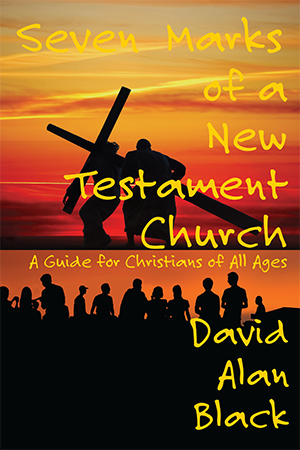
    Really, I’m delighted to have released this book, and hope that many will enjoy it. For those of you, I assume most of my readers, who don’t read Mandarin, the same book is available in English, Seven Marks of a New Testament Church by David Alan Black. I’ve been blogging about it, and will resume that series soon.

    Tomorrow I head to Atlanta for the annual meeting of the Society of Biblical Literature where my company, Energion Publications, has booth 2110. I don’t know if this means I will blog less or more, but I suspect it means something. If you’re there, be sure to drop by and say hello!

  • Eschatology: Ezekiel and the Line Between Prophecy and Apocalyptic

    Tonight I’ll be spending most of my time in Ezekiel 1 along with dealing with some background. I’ll follow this next week by looking at the glory of the Lord in Ezekiel as a guide to the theme of the book. Finally, I’ll look at the temple vision as part of looking at what is literal and what is symbolic, not to mention whether the very “literal/symbolic” dichotomy is actually valid.

    Google+ Event Page

    Or on You Tube:

    I’ll be working a great deal from my own college paper on Ezekiel 1, which I have posted on my web site for reference.

  • Seven Marks: Genuine Relationships

    nt church booksThe fourth mark of a New Testament church that Dave Black finds in Acts he calls genuine relationships. The early believers devoted themselves to the fellowship, to their community. There are so many words for it.

    9781631990465mIn America today we rarely think of the church as a community and even more rarely as our community. Yet much of the New Testament’s teaching on the church centers around things that relate closely to this idea. We go to church for a “service.” We don’t participate in community. We take our children there for some moral education, not so that they can build relationships for their life. Often we barely know one another.

    I’m not trying to make us all extroverts. I’m an introvert. I tend to make small numbers of closer friendships. I’m not talking about the number of friendships we each make. I’m talking about how we fit together into this larger community, one that includes various personalities, a wide variety of gifts, people who are like us, and also people who are not-at-all like us.

    What we think about our community is going to impact everything else we do. Dave’s first mark is “evangelistic preaching.” That’s proclamation of the good news. But is the “good news” of your church the idea that one can join up, provided they’re not too different and become just like everyone else there? Or is the good news that through God’s Spirit we can all, with our various backgrounds, become one in Christ Jesus, contributing with various gifts, and receiving the salvation and healing that Jesus offers?

    I suggest reading 1 Corinthians 12-14. Don’t skip over chapter 13. So frequently people who want to study about spiritual gifts study chapter 12, those who want to look at church order and how to structure your meetings at the church read chapter 14, and those who want to talk about love read chapter 13.

    But that is to miss what Paul is doing. In this book Paul is looking at the various reasons why there are factions in the Corinthian church. When he comes to the start of chapter 12 he’s looking at the great gifted ones who lord it over everyone else. Genuine love, as expressed in chapter 13 is the key. How can one identify genuine gifts in action? It’s by the way they operate under the direction of that one Spirit and the way they carry out love in the church.

    1 Corinthians 13 is not about marriage but about the church. It gives good advice for a marriage because it tells us how genuine relationships work.

    ThriveHow do followers of Jesus work together when the church meets? Chapter 14 tells us they work for “edification.” That’s building. That building is based on the genuine love that is expressed in chapter 13. So these three chapters work together.

    I heartily recommend Dave’s chapter, but I’m going to quote this time from Ruth Fletcher in the book Thrive: Spiritual Habits of Transforming Congregations. Fletcher defines a difference between “friendliness” and “welcome”:

    Friendliness assimilates newcomers into what already exists; welcome integrates newcomers by helping them know they belong. Friendliness says, “We’re glad you came to our table. We hope you feel at home here eating what we like to eat and doing things the way we like to do them.” Welcome goes beyond friendliness to say, “We want you to bring your gifts to this community. We know when you offer those gifts that we will be changed by your presence among us.” (p. 78)

    Fletcher implicitly provides us with a good description of community. Rather than being a place where the current members give and others receive, it’s a place that welcomes people to become part of the giving, whatever it is that they may have to offer.

    9781938434648s
    Bruce Epperly discusses this in his chapter Faith Without Fences

    One of the critical things we need to look at in the church if we are to be such a community is gossip, judgment and criticism. For us to help one another grow, we need to be able to talk about ways to grow. Serious discussion of spiritual growth will not prosper where there is no trust, and gossip destroys trust. Gossip is always followed by judgment and criticism, and it destroys community.

    Losing this spirit of judgment does not mean that one loses the ability to discern between different options, nor that one cannot recognize sin or destructive behavior. It does involve a change in the way we think and talk about these things. Our talking will be impacted by our thinking. Don’t imagine that you can pretend not to be judgmental and nonetheless deal with issues as a community.

    I’m fairly unreceptive of the complaints of those who think that repenting of gossip, judgment, and criticism (three sins endemic in church life) means that we can no longer reform or call others to repentance. Gossip, judgment, and criticism don’t result from a genuine desire to help others find repentance. They result from our desire to feel that we are better than others and to let others in our inside group know that we are better than others.

    A genuine concern for others will result in talking to them and doing it in constructive way. Note that this isn’t a strategy change. It’s repentance from a sinful approach (judgmental) and a turn to a genuinely constructive  approach (edifying/building). If we have genuinely repented of the need to feel morally superior to others, I think we will generally know the difference. Most of us have been helped to find a better approach to some issue by a more experienced or knowledgeable friend. It feels different.

    One critical point is that it comes from relationship. I have friends who help me with my business decisions who can quite comfortable tell me that some idea would be idiotic. We’ll laugh and go on to a better plan. Why can we do that? Because we have a relationship that comes before the correction. I highly value those friends and that correction. It has saved me from many errors.

    “Genuine relationships” open the way to the various elements of community. If you truly want to help those you think are on a wrong path, establish a genuine relationship with them first. As you do so, you may become aware that you also have things in your life that can be improved by what you learn from them.

    I think back on growing up in my missionary family’s home. You could not visit my parents’ church without getting invited to lunch. Not invited to join us at a restaurant, but to come join us for the family meal. My mother always made sure she had enough to feed guests. One never knew who would be a guest.

    In Mexico, when a mother and son needed refuge from violence, she was invited into our home, even though there was a threat of violence to us involved. She was different from us, of the Chamula people, and only spoke a bit of Spanish, much less any English. But she had a home with us as long as she needed it.

    Think about your own church. Would a visitor be welcome? Any visitor? As you bring in new members do you try to remold them after your own image or do they become a genuine part of the church family with their gifts and their warts? Does anyone in your church invite people home to lunch or dinner? Are your homes open? If someone was escaping domestic violence would they get a referral to a nearby shelter or would someone in your church open heart and home to them? If you see young people in your church without parents do you gather in groups to complain about “this generation” or do you decide to welcome the opportunity to get to know them and even mentor them?

    I think becoming a community built on genuine relationships will require a great deal of repentance on the part of the American church. But if we want to truly be disciples of Jesus, carrying out the gospel commission, this is one mark we can’t afford to lack!

  • Review – Tyndale Select NLT: Select Reference Edition

    nlt_with_spineWhen the e-mail arrived offering me a copy of this gorgeous Bible edition, I didn’t really read the material thoroughly enough or I might have declined. I’m a content man. I have one complete bookcase and parts of three more dedicated to Bibles. Very few of them are special in terms of their binding. It’s the text that drives me.

    But I saw that this was the New Living Translation, and that it was in a new edition, and so I said I’d review it. I’m actually glad I did. I’ve read a few of the other reviews, and they emphasize some simple facts about this Bible. It’s a work of art. Mine is goat skin for the cover, the paper and font are magnificent. It’s truly an heirloom Bible. You can find out all these details, however, from Amazon or from the publisher. I’m going to include some pictures in my review here on my blog so you can get an idea.

    Though it is an heirloom Bible it is not one of those huge books that are destined to stay on whatever table they’re placed on first. It’s easy to carry and to use. You can reference it, which is nice, considering it’s a reference edition. So while you may not feel like doing anything too vigorous around it, lest you damage the work of art, it is nonetheless quite useful as a reading or study Bible.

    Those who know me can predict where I’m going next. I’m afraid I have to admit that I start to twitch when I just hold this Bible. I didn’t actually look up the price before I received it, but within moments of actually putting my hands on it, I realized that it was a more costly Bible than I imagined. I’m not going to cite the price in my review, simply because current prices change. I’ll let you follow the link and get that information from the Amazon.com web site. I have never owned, and rarely touched or handled a Bible that costs this much. That leaves me with mixed emotions about it. But a book review should talk about the book from the point of view of what that book was written and/or designed for. I don’t criticize the NLT for not being either The Message or the NRSV. A Bible translation is designed for a purpose, and so is a Bible edition. You can decide what is right for you. If your plan is to buy an heirloom Bible that is to last and be passed on from generation to generation, you should be looking at this one.

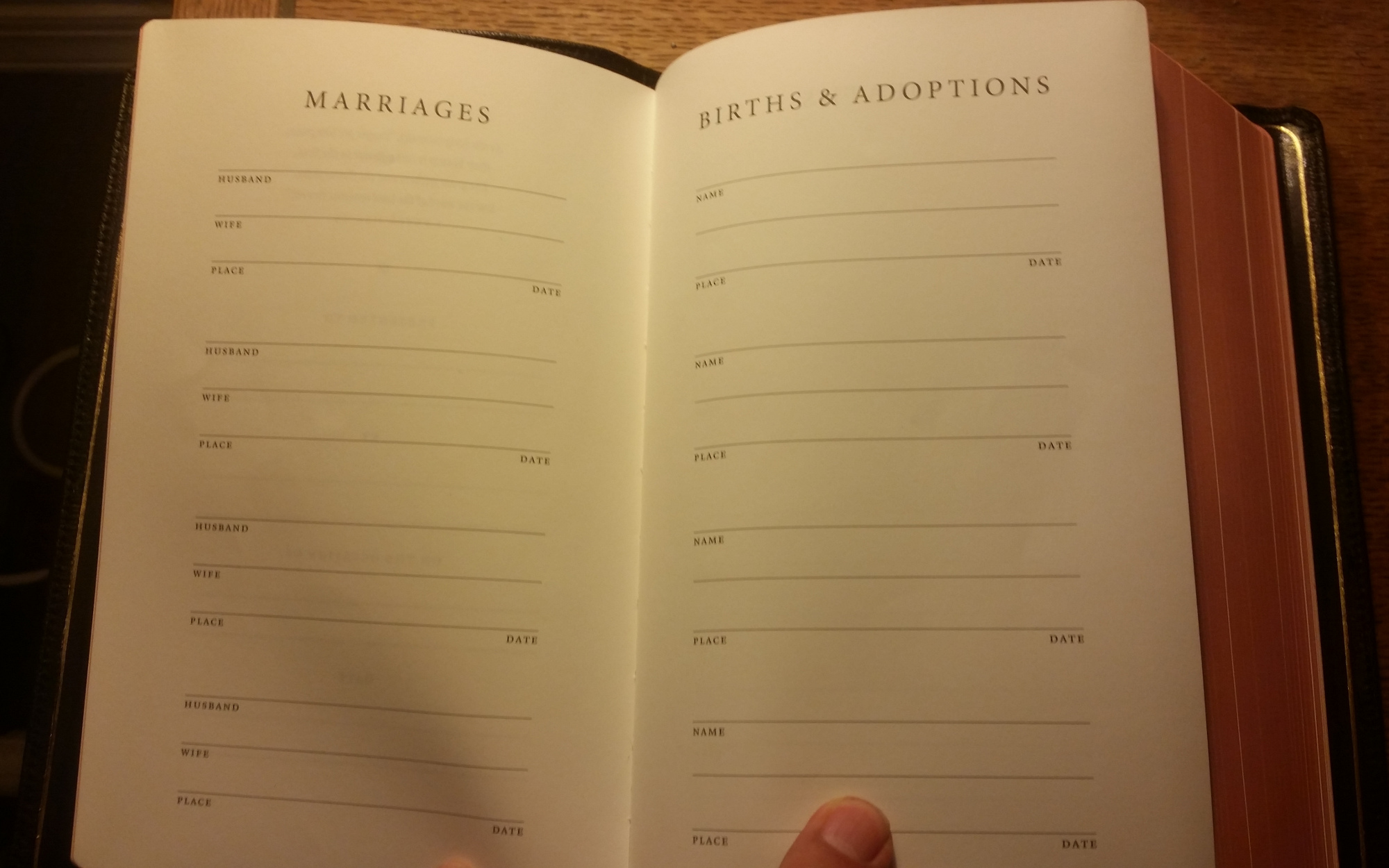
    Did I meniont that this Bible is designed to last and to be passed down from generation to generation. In pursuit of that goal it has lovely presentation and family record pages as well.

    nlt_presentation

    The text is, of course, the NLT. I have a high opinion of this translation for the appropriate audience. In one sense the NLT is descended from the Living Bible. One of the weakness of the Living Bible was that Kenneth Taylor didn’t read Hebrew or Greek. He worked from the English text of the American Standard Version. As a result, while the Living Bible was very readable, it was not always as accurate as it could have been. This problem was corrected for the NLT by a highly qualified evangelical translation committee. They managed to keep the readability, though I think they lost some of the charm and all of the eccentricity. How good that was is open to question. I have linked a couple of references to the NLT to my MyBibleVersion.com web site where you can get some additional information and see how I rate the translation in various categories.

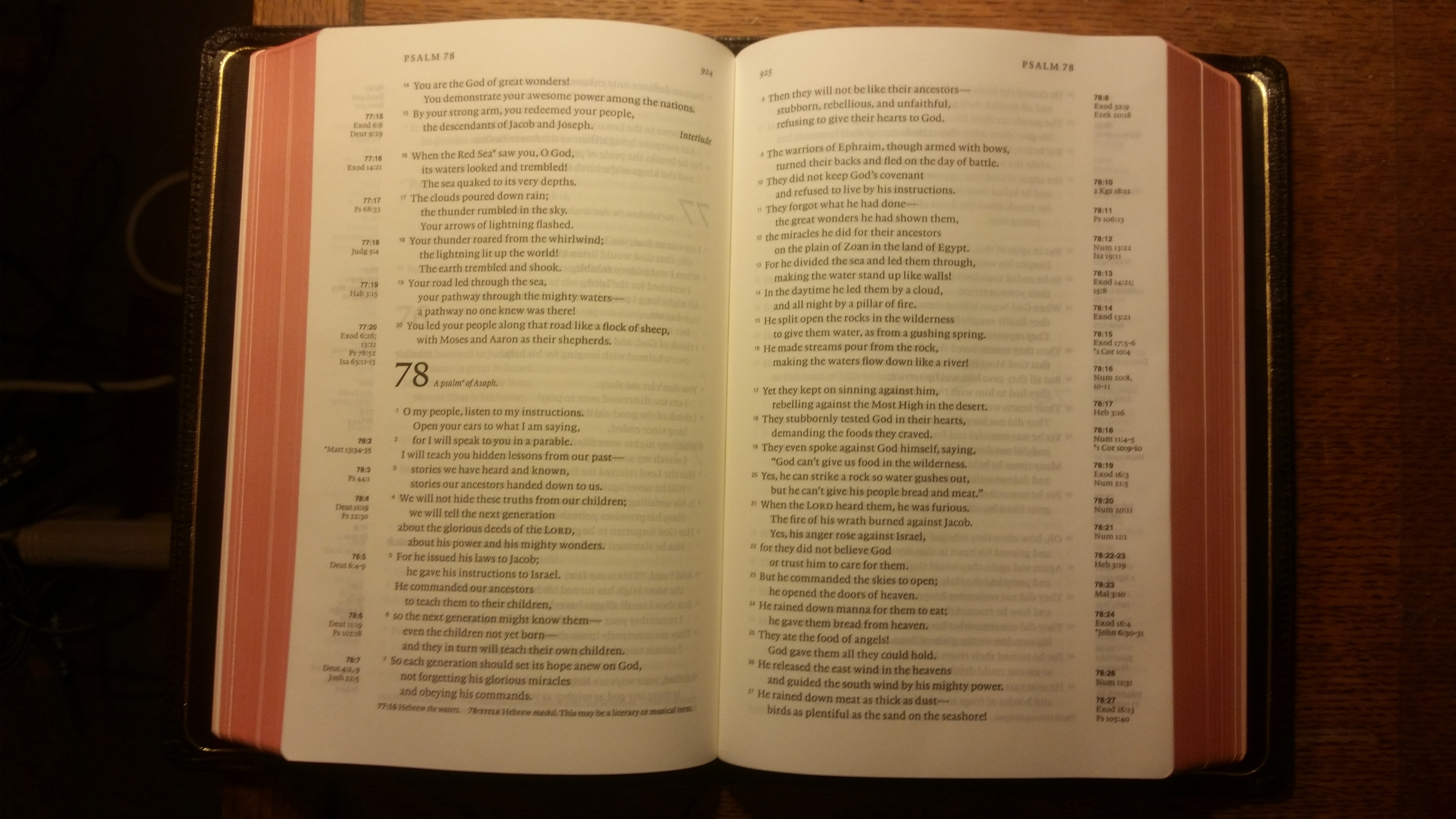
    nlt_interior_psalm_78As I say on the cover of my own book What’s in a Version? the best Bible version is one you read. The first question should be whether you’ll be able to use and understand a Bible version. Accuracy in details is of no particular value if you don’t actually read and comprehend the accurate words. Of course, readability should not be an excuse for inaccuracy. Unfortunately, reviewers of Bible versions frequently call disagreements with their preferred translation of some particular verse “inaccurate,” when it is really just “different than I would have done.” The NLT may be different, but it is competently different.

    The things that stuck out for me in this edition are first things that are missing. This is not a study Bible in the sense of one with study notes, book introductions and so forth. I am pleased with that. Too many people are treating study notes as the inspired text and ignoring the actual text. You won’t do that here. You’ll need a good Bible handbook or Bible dictionary if you want to get that sort of information.

    What you do have is a single column that is a good width for rapid reading. I’ve discussed before many different approaches to reading, and I think one of the most neglected is sustained reading of quantities of the biblical text. This Bible will make that easy. I prefer that greatly to the multiple narrow columns that tend to slow me down. Further, there are quite a number of cross-references. It is possible to become dependent here, just as it is to become dependent on notes, but in this case I think most people can do with the help. The NLT translation notes are included at the bottom of each page.

    nlt_dictionary_concordance

    In the back you have a basic concordance and dictionary. This is not a replacement for your Bible dictionary but it will give you the basics and help you find a variety of references on a topic. This is followed by a selection of maps. Again, no effort is made to compete with your Bible atlas, but for reference on the run or in your study group, the material is better than average.

    nlt_maps

    While the binding, paper, and high quality construction are the distinctive features of this Bible edition, I found that it is fully valuable as a Bible for your actual use. If you do choose to spend the money on an heirloom Bible edition, and hope to pass it on to your children, this will fit the bill. With decent (though not massive) margins, you may also be able to leave your notes and your testimony in it for your children as well.

    I remain a content person, but I can respect a true work of publishing art when I see it, and this is one.

    For those interested in the text, here’s my video review of the NLT:

    (Disclosure: I received a copy of this book free from the publisher for review.)

  • Quote – Allegiance to God’s Realm

    From Bob Cornwall posting on the Energion Discussion Network:

    I realize that some might find this affirmation of God’s realm a bit disconcerting. They might think that I’m recommending some kind of theocracy. In a way, I am, but not in the usual way of thinking. This isn’t a divine government imposed by an earthly realm. This is instead a recognition that our ultimate loyalty belongs to God, and when loyalties conflict, and they will, we must choose the realm of God. The church is called to be an expression of that realm on earth as a reflection of God’s realm in heaven. So, no I’m not advocating making the United States a Christian nation. I’m advocating that we recognize that God’s realm is present on earth as in heaven!

  • Eschatology: Resurrection and Life after Death

    I’ll be tackling this rather intense topic tonight and likely failing to hold it down and get it under control! Following the event I will post more resources.

    Informational Link: What Does It Mean to Survive Death?

    Google+ Event Page


  • Quote of the Day – Judging the Experience of Others

    Since I’ve been talking about Seventh-day Adventists starting yesterday, due to the date, I thought I’d use an Ellen G. White quote. A friend called my attention to this today in a phone conversation.

    Every association of life calls for the exercise of self-control, forbearance, and sympathy. We differ so widely in disposition, habits, education, that our ways of looking at things vary. We judge differently. Our understanding of truth, our ideas in regard to the conduct of life, are not in all respects the same. There are no two whose experience is alike in every particular. The trials of one are not the trials of another. The duties that one finds light are to another most difficult and perplexing.

    So frail, so ignorant, so liable to misconception is human nature, that each should be careful in the estimate he places upon another. We little know the bearing of our acts upon the experience of others. What we do or say may seem to us of little moment, when, could our eyes be opened, we should see that upon it depended the most important results for good or for evil. (Ministry of Healing, 483, emphasis mine)

    I should note that I have found it much easier to appreciate Ellen White as a writer since I left the SDA church and quit trying to read her as a prophetess. While I think in many cases she was off the mark, she also was quite frequently very insightful.

  • Adventists, Other Christians, and The Great Disappointment

    Adventists, Other Christians, and The Great Disappointment

    Substantially changing beliefs have been a defining characteristic of my life. That may be hard to comprehend. It’s even hard to write in a grammatical form. This admission makes some people uncomfortable. Why should they listen to me now, if I have already changed what I may have believed and advocated decades, years, or even months ago?

    I can definitely understand the question. We seek certainty and safety. It’s thoroughly bred into us. Around the caveman campfire, the Saber Tooth Tiger fundamentalist was king. He knew what to do with that spear. He didn’t dither about whether to put out a side of meat, reach out his hand and say “nice kitty,” or kill the tiger.

    But certainty also is dangerous, both when it is not justified and when circumstances change. Thus I embrace passionate action and enough uncertainty to make me willing to change my mind.

    The largest single change was when I left the denomination I grew up in, the Seventh-day Adventist Church, and became first unchurched, and then finally a United Methodist. There are those who find that change mind-boggling. Others find it obvious, as though anyone with adequate intelligence would have made the move.

    Even in that dramatic change in my life I remained convinced of the value of the people whose views I was rejecting. I became an ex-SDA. There are a few SDAs who consider that horrifying. I have left the truth. I have become an apostate. I am now working for the enemy.

    Let those who are not SDAs not rise up to cast the first stone. The condemnation from the SDA side meets its match on the other in those who say, “See! Just like those cultists! They can’t accept that you’ve come over to an orthodox community!” There’s an ironic twist to this accusation from folks who generally believe they have all the truth, are never wrong, and thus SDAs are cultists, especially because SDAs are, well, intolerant.

    Last night in an interview I mentioned that it was a good thing God could work with people who are wrong. That way God can work with me. If you think God is working with you because you have everything right—I suspect you’re wrong about that! But I still believe God is working with and likely through you.

    I’m an un-angry ex-SDA. I affirm the work of my former denomination in many areas while at the same time I differ, sometimes substantially, with that church in matters of doctrines. Differing in matters of doctrine is, I believe, good cause to find fellowship elsewhere. It is not good cause to belittle and condemn. Many mainliners find it very easy to condemn SDAs for views they, the mainliners, don’t even comprehend. I have lost count of the times someone has told me that they really don’t like SDAs because they have such incredibly false doctrines, then when I ask them just which doctrine they find so wrong, they fall back on, “Well, they’re a cult.”

    And that leads me to Adventists and The Great Disappointment. There’s a great deal of detail around this event in Adventist history. There was a lesser disappointment before the “great” one. Prophetic interpretation was adjusted as people moved on. This happens frequently in many, many groups. This occurred before there was a Seventh-day Adventist Church as such, but SDAs grew out of the Millerite movement and the responses to this great disappointment.

    When and what was this great disappointment? October 22, 1844. The expectation was that Jesus would return in glory and take His children home.

    It didn’t happen. The day passed uneventfully.

    Some Adventists came to believe that the date was right, but the event was different. This interpretation is one of the key elements of the reason why I am no longer an SDA myself. Yes, I can list specific doctrines and the interpretation of Daniel 8:14 is one of them. A rather minor one, that is. I could co-exist in a church with people who are wrong about how to interpret Daniel 8:14. Come to think of it, I manage to hang around a church in which I would be surprised if anyone could name the general topic addressed in Daniel 8.

    It’s easy for mainline Christians to point fingers at those who name times for the coming of Jesus or who express excessive certainty about the end-times, life after death, or prophetic interpretation. After all, we have the perfect solution: Ignore those issues. Maybe nobody will notice.

    On the other hand, the people who have been out on a limb, taken the plunge, made the hard call, and lived with the result may have something to say to us as well. That’s where I see SDAs and also other Adventist groups. They may have been disappointed. I may disagree with some of their interpretations even after the disappointment, but they’re still engaged with the topic.

    And so I’m going to do a few things. Starting tomorrow I’m going to publish some articles by SDA authors, folks who are published by my company Energion Publications, specifically about the Great Disappointment and 1844. What might we learn from the experiences of the SDA church? Are we making any of the same mistakes as we read scripture? They felt they were faithful to scripture. We (and they) know they were wrong at the time. But do we carry on some of the same mistakes?

    Join me Thursday night for a discussion on my weekly video study and then watch here and on the Energion Publications News blog for links as the remaining articles are published. The introductory article is already posted.