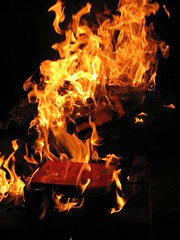
Yes, that might be me! Peter Laarman at RD Magazine says many in American protestantism are addicted to arguing, and need to learn that arguments don’t win people over–contact with people and sharing of stories does it. He titles his piece Why Liberal Religious Arguments Fail, but while I’m well aware of many liberal examples, I think there are plenty on the conservative side of he spectrum as well.
I must temper my support for his position by noting that I recall quite a number of my own positions that I changed due to listening to arguments against the position I held before. People differ from one another on this as well.
The Fifth Column has a post titled On Burning Books (HT: Divine Ripples), referring specifically to the recent burning of a Qur’an. He concludes that:
It may not be prudent, it may not be useful, but it is a stand worthy of respect.
I disagree. Book burning is either the petulant reaction of fearful people looking for control, but lacking convincing arguments, or a way to gain undeserved attention.
The article cites a really bad reason why one might respect book burning: Church councils did it through the years. Wow! Lots of church people gathering together and doing something stupid! Who would have ever imagined it? It just proves that Christians are no more immune from stupidity and control issues than any other group of people.
Here’s a quote:
And it wasn’t just the Koran that burned. During the Middle Ages, the Talmud was frequently targeted for the fire by Church authorities precisely because of the numerous blasphemies concerning Christ and the Blessed Virgin that it contains. Throughout Europe, the book was formally put on trial and censored or burnt, in much the same way Terry Jones tried and burnt the Koran.
And this is somehow an example of a good idea?
I want to make clear her that I’m talking about we should do, what’s a good idea, and not what should be legal. I would never burn the American flag, even in protest, but I firmly believe it should be legal to do so. I would never burn a copy of the Qur’an, but I believe the action should be legal. Lots of stupid things are and should be legal. I do not believe the burning of the Qur’an justifies violent actions in response, just as I do not believe that any insult to Christianity, such as burning a Bible, would justify a violent response from Christians.
Now to be fair, the article does question both the prudence and effectiveness of the tactic. But nonetheless the author concludes that there is something here to be respected.
Our problem with Islam is not that we don’t get to say enough nasty things about Muslims, or that we can’t respond to Islam. We can and do respond respectfully on many occasions. But when someone burns a copy of the Qur’an it sends another message, not one of respectful disagreement, but one of hatred. It does nothing to stop even one act of terrorism. It does nothing to convince any radical Muslim that he is wrong, nor any Muslim, of course. It is the adult equivalent of a child’s temper tantrum.
I’m reminded of a time many years ago when I was in a group of young men. One person got angry at another and started swinging his arms in a sort of suggestion he was going to punch the other one out. He kept saying, “Hold me back! Hold me back!” But he never actually approached the other guy, who would doubtless have won any fight between them. Nobody tried to hold him back either, because we knew he was going to be ineffective. The one difference between this event and that one is that the purported target exercised restraint.
We don’t need to take our cues from the radicals. We don’t need to become like them. They are not concerned about who they kill. We should be. They are not making distinctions between one American and another. We should recognize distinctions in their camp. We should not let terrorism make us less than we are.
I fear, however, that it has already happened to some extent.
I was deeply troubled a few years back when attending a meeting of Christians called to pray for our city (Pensacola, FL). One pastor who was asked to pray for our political leaders offered a prayer that was more of a Republican agenda of things he hoped God would accomplish through our government. I was profoundly troubled by that prayer, especially in an interdenominational setting, but I would be concerned anywhere.
Now let me be clear here. I do see my vote as a moral issue, i.e., I should advocate for things I regard as morally right. I should pray about the way I act in the public square. Further, I have no problem with praying for those in government.
What I have a problem with is combining prayer and my political advocacy. There are things I believe should be done about our budget. These result from my best understanding of how one should implement good government. I have prayed about them and will continue to do so. But I don’t ask God in prayer to do things my way, and I try never to use my prayer life or my fasting as a way to influence others in their decision making.
To a certain extent I see this as running afoul of the early verses of Matthew 6. But being well aware of the Sermon on the Mount, I must also ask if I’m being too critical.
Ed Brayton has a post up regarding a WND column by Ellis Washington which is off-the-map weird. In it, Washington links vegetarianism and fascism because, well, Hitler was a vegetarian. I’m a vegetarian, so I guess by those standards …
In any case, this reminded me of another column back in 2006 which claimed that soy products would make people gay. I posted about it at the time.
I know some of you hate the idea of linking to WorldNetDaily, but I find this stuff hard to believe until I’ve gone and read it myself.
As we become involved in the conflict in Lybia, I’ve been reflecting on the American strategy–or lack thereof–in foreign policy. To the extent that we have such a strategy it appears to be big on expenses on low on good results.
I’m not a pacifist, and I certainly won’t object to seeing Gaddafi out of power. There’s plenty of reasons why he should go. The question in my mind is how we decide where to take military action, and what goals we set.
It’s very difficult to attain victory in a war when the goals are either not well-defined, or difficult to measure, or impossible to attain. The latter is usually the case with goals that are assigned to the military but which the military is ill-equipped to accomplish, such as nation building.
Our politics, and the lack of strategy in our international policy, tend to create situations in which our military will be tied up for long periods of time without any real hope of actual success.
For some reason some people think no-fly zones or sanctions are more humane means of accomplishing the mission than actual war. I disagree. If there is a reason to intervene militarily, that intervention should be aimed at well-defined goals, and the means should be sufficient to accomplish those goals quickly. Any other course of action is actually less humane–it simply kills more people and extends the misery for long periods of time.
If we cannot find the moral justification to take decisive action, let me suggest that we take no action at all.
As I was thinking about this, I watched a show on the History Channel about Sun Tzu, and when the show was over I chose to take a run through The Art of War. It’s not a large book. Here are a couple of notes I underlined today:
There is no instance of a country having benefitted from prolonged warfare (2:6).
It is only one who is thoroughly acquainted with the evils of war that can thoroughly understand the profitable way of carrying it on (2:7).
In war, then, let your great object be victory, not lengthy campaigns (2:19).
Hence to fight and conquer in all your battles is not supreme excellence; supreme excellence consists in breaking the enemy’s resistance without fighting (3:2).