Threads from Henry's Web

Category: Christianity

  • Are You Comfortable?

    Are You Comfortable?

    Are you comfortable in the company of Jesus and Abraham, who took risks for God

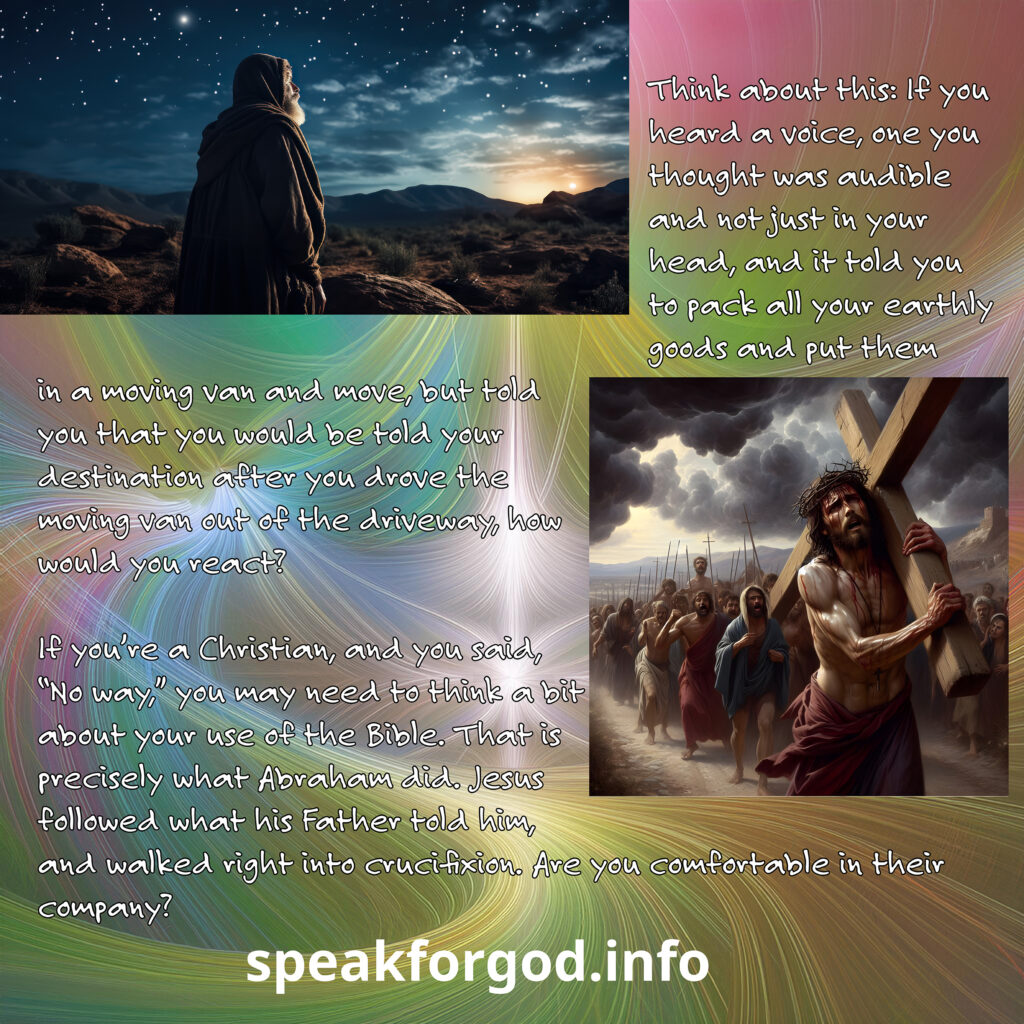
    Think about this: If you heard a voice, one you thought was audible and not just in your head, and it told you to pack all your earthly goods and put them in a moving van and move, but told you that you would be told your destination after you drove the moving van out of the driveway, how would you react?

    If you’re a Christian, and you said, “No way,” you may need to think a bit about your use of the Bible. That is precisely what Abraham did. Jesus followed what his Father told him, and walked right into crucifixion. Are you comfortable in their company?

  • Psalm 119:85 – Arrogant

    Psalm 119:85 – Arrogant

    The arrogant have dug pits for me
    which were not according to your instruction.

    I chose the word “arrogant” here as the translation as a description of those who think they can make their own rules and trap people with them. I’d like to offer translations from a couple of other people.

    Bob MacDonald, in the book Seeing the Psalter, translates:

    For me the presumptuous dig ditches
    that are not of your instruction

    Psalm 119:85, from page 384

    I think “presumptuous catches what I hear in this verse quite well. Bob translates quite directly in an effort to clearly convey the structure of the Psalm.

    Mitchell Dahood, in his Anchor Bible commentary on the Psalms translates,

    The presumptuous have dug pits for me,
    who are not in conformity with your law.

    Psalms 100-150, Anchor Bible, p. 166, on Psalm 119:85

    His translation is quite possible, but I tend to disagree on what is not according to your law. I would see the pits as violations, rather than a general declaration that the diggers are not in conformity.

    Now there are many ways in which one can dig pits for another person. Sometimes it can be an attack on their reputation, falsehoods told about them, or even truths told in a harmful way. I am a strong proponent of privacy. Not everyone needs to know everyone else’s business. Often we do harm even in passing on prayer requests. I’m going to go far afield. I don’t think the psalmist was thinking all these things, but I do think they are based on the same principle expressed in this verse.

    But there’s another form of pit, and that’s making up our own rules and then tripping others with them. I recall a complaint against a pastor because he had not mowed the grass on the rather large property. It happened that I knew and was friends with the former pastor, who had really enjoyed riding a tractor and mowing the grass. That was really not the new pastor’s thing. In this case nobody was arrogant, but they tripped the new pastor with a rule that was imaginary.

    At another time I was working with a visiting singing group from overseas who were at our church to present a program. The leader came to me to ask me if they could move any of the furniture on the platform. I say, “Why not?” He said that they had gotten into considerable trouble in churches for rearranging furniture in order to fit their equipment in.

    I should have realized that, because it takes very little time for things to become traditional in a church, and the positioning of pews and items of furniture can take on an oversize role in “church order.”

    At another time I recall people complaining that a pastor had changed the order of worship. In one case the change had been accidental. But people piously claimed that the service had not be conducted “decently and in order.” That’s from 1 Corinthians 14:40, but I doubt the complainers had read the chapter. I wonder what they would have thought if two or three prophets (1 Corinthians 14:29) had spoken in the service!

    There’s nothing like fake, pious-sounding rules to trip people up. And the “orderly” people are good at sounding pious. We impose this on newcomers. We impose it on our youth. We find things that they have to get right. We want them to learn how to “do church right!” God deserves our best, from clothing to respectful silence, to offerings, and more.

    I recall an American who was in Guyana before us who informed my parents that he had told Guyanese church members to “wash their hair and take off their hats” for church services. I have no idea where the “wash their hair” came from, but the women in the church wore really gorgeous hats. This man had a rule in his mind that was not according to God’s instruction (there are biblical statements that say quite the opposite!), that these women should not wear hats. I assume this came from his local church. Some of my fondest memories of church services are from my time in Guyana. They had no need for someone to tell them how to do church.

    I think we need to be just as clear as to what God hasn’t said as to what God has said. Don’t go digging pits, or ditches, or building walls where God hasn’t placed them.

    I’m going to include a video of some young people discussing things that have driven them away from the church. I found quite a number of really good points here, especially when they discuss telling young people they have to clean up or give up bad habits before they can come to God. That’s a big, ungodly barrier. Grace is a free gift, not a payment for fixing yourself.

    Full disclosure: Two of these young people are my granddaughters!

    (Featured image generated by Jetpack AI.)

  • If You’re Nice, Diversity Will Take Care of Itself

    If You’re Nice, Diversity Will Take Care of Itself

    Bad Ideas I Learned from Good Leaders #2

    I’ve heard this one from so many people that I would hardly know who to blame for it if I wanted to blame someone. I’ve been told that if you will just be nice and positive, you can ignore the differences in your congregation and everything will take care of itself.

    This is incorrect. If you ignore the diversity that is present in your congregation, you will likely encounter a number of problems.

    1. You will find that people will have differing definitions of the boundaries and thus create conflict in the church unnecessarily.
    2. Different people offer different gifts, and if you fail to discover these gifts, there will be missed opportunities.
    3. Problems in the surrounding society may cause division in the church unnecessarily.

    If you don’t believe me on any of this, read 1 Corinthians. Here we have a church with division, and Paul tells them that God has brought them together from differing backgrounds, with different talents, and made them into one body with different gifts. Read especially 1 Corinthians 12. As a follow-up, read Romans 14, or even better Romans 12-14. (I’m not a good proof-text person. Read a few chapters!)

    Note here that I’m not talking about some sort of quota system or diversity inclusion. I believe in inclusiveness, but in this case, I’m assuming what I’ve seen in most churches, and that’s a variety of people already present. The problem is that they are carrying out a one-day-a-week religious program because the church has failed to incorporate them into a single body, the Body of Christ, to have an impact on their world.

    To accomplish this, it is necessary to actively acknowledge the differences among the members of the congregation. These differences should be recognized not for the purpose of a select group of individuals asserting superiority over others, but rather to appreciate the diverse gifts that have been gathered, value those gifts, and collaborate effectively by utilizing all available resources.

    Diversity in any organization is valuable. It allows us to accomplish things that none of us could achieve on our own. The problem is that many of us are so focused on our own strengths and weaknesses that we fail to recognize how others operate and what they can achieve.

    This could be as simple as finding the nerdy young person who doesn’t seem to fit in socially, but who, unknown to you, has a talent with electrical systems and would be able to run your sound system better than anyone else. That young person, being socially uncomfortable, is vanishingly unlikely to volunteer. They probably assume they’ll be pushed aside or ignored for no better reason than that they have been pushed aside and ignored over and over.

    This “different” person doesn’t need you to change their personality. They need you to let them be who they are and do what they are gifted to do. To do this, you need to have a clear understanding of what is a moral difference that is a standard for the church and what is a difference of personality. Too often, we treat Christian discipleship as a personality change.

    Don’t figure that you have to make the Jock do lots of hours of detailed Bible study. God may well have called them to a straightforward understanding of their faith and to be a good, kind, fun loving, and active person. And don’t expect the Nerd to be ready to engage in all those physical and social activities that you think are so essential to life.

    Oh, and don’t expect everyone who gets involved to be ready to serve on a committee. They might be quite willing to take direction but not to spend seemingly endless time discussing.

    In addition, there is value in being clear about the core beliefs of your church (or any other organization for that matter). This is not so you can go hunting for heresy. I recommend a short list of essentials, the common beliefs that unite this specific group. The purpose of clarity is to avoid unnecessary misunderstandings.

    Let me recommend a couple of books to help learn about and deal with diversity, whether in the church or in the community. I commend both of these books for making diversity a value rather than a burden to be borne or a duty to be carried out diligently.

    The first I already mentioned in the first post in this series, Perfectly Square by Dolly Berthelot. This book is short, illustrated, easy-to-read, and fun. It’s not particularly directed at churches. That’s a good thing. Your church is not perfectly square either. Church people are people. There are thought questions and discussion topics listed in the book. It’s good for group reading and discussion.

    It is also not a prescription for programs, but rather it is aimed at changing attitudes and opening up new ways of thinking about the differences we find all over.

    The aim is to recognize these differences and profit from them as a community rather than making them a cause of discord and division.

    The second is a book explicitly for church groups. I Know We’re All Welcome at the Table, but Do I Have to Sit Next to You? Now there’s a long title! But this book provides ideas and courses of action that a community group can use to begin to deal with those people we don’t want to deal with. The focus is on people and groups we may already have identified, probably stereotyped in our minds, and determined that we dislike or worse. How can you get back together.

    My suggestion here is that to really lead we need to learn how to work together, and use all of the diverse gifts and resources we have in our congregations in order to impact our communities.


  • Psalm 119:14 – I Have to Be Joyful Too?

    Psalm 119:14 – I Have to Be Joyful Too?

    In the way of your testimonies I rejoice
    As over great wealth.

    Teachers and preachers often say that Jesus, in the Sermon on the Mount, was moving the law inside and making it of the heart. And that is certainly a theme of that sermon.

    But the fact is that the heart was always the object of the law. We are the ones who tend to look at the statutes, the regulations in modern terms, as the point of the law. It’s a simple path. We look at the law, and we do what we can to do what it says to do. So the point becomes the list of regulations for our lives. Aren’t these regulations wonderful? Shouldn’t we be happy about them?

    Isn’t that what this Psalm is about?

    Let me quote my friend and Energion author Bob MacDonald in the series he has just started on Psalm 119:

    Overall, Psalm 119 is a restful adoration of God and God’s promises.

    Have you thought of it like that?

    I commend his series to you, especially if you are musical. He does studies of the music of the Bible. There is great value in looking at these passages from different perspectives. I try to read a number of these as I meditate on the passage.

    “Restful” and “joy” both represent something internal, a response to the law (remember Torah/instruction), and not an external assent.

    And the Psalmist rejoices.

    I want to quote another one of my Energion authors, Deborah Roeger, author of The Power of Obedience:

    Before we conclude this lesson, we have some personal work to do. We have established that as God’s covenant people we are tailor-made by Him to live by His wisdom not our own! If we would lay down our right to live life on our terms – if we would turn to Him in submission, letting Him rule and reign as the perfect Creator and Lord of life in every aspect of our life – we would then joyfully know by experience what it means to know Him. If there is any area of your life that you have been holding back from Him, would you be willing right now to drop to your knees, bow your heart and your head before Him in complete surrender? Life will never be the same! And praise God for that!

    Deborah L. Roeger, The Power of Obedience, 43.

    This is a conclusion to an extensive lesson, but just on that one paragraph, do you think the Psalmist might well agree?

    (Featured image generated by Jetpack AI.)

  • The Importance and Durability of Words

    The Importance and Durability of Words

    Through a Facebook comment on my post yesterday, The Importance of Things Left Out, another thought came to me connected to my other post yesterday, Psalm 119:13 – Speaking It.

    The comment made my push my memory for when it was that my mother made the comment on Hannah and Elkanah in 1 Samuel 1, and I recall that it was in a Hebrew class at Walla Walla University that my mother and I attended together. The class was Hebrew Readings, and I was taking it as my third year of Hebrew, while she was taking it as her second.

    That class was about 45 years ago. I remembered her comment yesterday. That comment has, in turn, encouraged someone else. She would never have imagined this chain of events.

    It reminds me of coming in contact with a pastor with whom I had had no contact for a similar length of time. He was pastor of the church I attended my first year in college, 1974, and I encountered him again online around 2019 or so.

    In conversation, I mentioned to him that I remembered a sermon he had preached in 1974. It was quite memorable, as it was in a very large, well-off church filled with pillars of the community. It was also his first sermon as a new pastor. He preached on the church of Laodicea and how that church needed to take the lesson to heart, not be lukewarm, and reclaim their first love.

    He was surprised that I had remembered his words. I don’t remember many sermons over a long period of time, but I remembered that one as I wondered how long he would remain as pastor of the church he had just begun to serve.

    What words that you have said will be remembered? Do you want them remembered?

    (Featured image generated by Jetpack AI.)

  • A Video for My Book Identifying Your Gifts and Service

    A Video for My Book Identifying Your Gifts and Service

    A Video for My Book Identifying Your Gifts and Service

    Front cover of the book Identifying Your Gifts and Service
  • Ask Them to Implement Their Own Suggestion

    Ask Them to Implement Their Own Suggestion

    Bad Ideas I Learned from Good Leaders #1

    I’m never going to identify which leader I learned these things from, because I have deep respect for all of them. Many of them helped me ditch bad ideas of my own, though doubtless I still have a bunch!

    The bad thing I learned is this: When someone makes a suggestion for some project in the church, you immediately ask them to lead out in executing that idea.

    There is a very good point involved here. Actually two very good points. First, a person who goes to the trouble of suggesting someone is likely fairly passionate about it, and are likely to be diligent in getting it into action. Second, there are numerous people who will tell pastors and other church leaders all the various things they think “the church” should be doing. They have no intention of serving. They just want to complain. “Why don’t you take the lead on that?” will often either slow down the complaints, or in some cases even get someone moving.

    That’s the good side.

    The bad side is this. Your church is probably already an example of the 80/20 principle: 80% of the work is done by 20% of the people. (Well, you might be more like 90/10, but why be negative?) Most of the good ideas, the ones you should want implemented, are coming from that busy 20%. After all, the 80% don’t really want to go to the trouble of meeting with the pastor to present an idea.

    The 80/20 principle is self-sustaining. The 20% are the workers in the church because they’re the ones with initiative and creativity. Some people aren’t like that. Some people are willing to serve, but they don’t have the imagination, the initiative, or perhaps the knowledge of the church to locate a task and involve themselves with it.

    Since the 20% generally have those characteristics in various (but substantial) measure, they tend to imagine that the 80% aren’t serving because they’re lazy, apathetic, or don’t really care about their church. Some of them may have these problems. But more of them likely are waiting to be identified.

    In my book Identifying Your Gifts and Service (Small Group Edition), I suggest that church members and leaders need to observe one another to learn about gifts and help others find a place to serve that utilizes their individual gifts and also fulfills their needs. Yes, they are serving others, but that service is also of benefit to them, provided they are allowed to use their gifts in positive ways, rather than just being put to work.

    Here’s a summary of the points I make about this in that book:

    1. Listening: Group members identify each person’s gifts based on observations and what they believe the Holy Spirit has revealed. ​ This involves a group discussion where each person shares what they see as the gifts of others. ​
    2. Expressing: Each individual expresses their understanding of their own gifts. ​ This step involves self-reflection and sharing with the group. ​
    3. Examining: A survey is provided to help individuals think about their gifts and areas of service. ​ The survey is designed to stimulate thinking and challenge assumptions about one’s gifts. ​
    4. Fitting: Group members discuss and clarify God’s call on their lives and how their gifts fit into the church’s needs. ​ This step involves prayerful discussion and focus on how to use identified gifts effectively. ​
    5. Unifying: The group examines how individual gifts align with the church’s mission. ​ This step involves the participation of church leadership to help integrate members into appropriate areas of service. ​

    The book emphasizes the importance of listening to the Holy Spirit and to one another, and it provides practical exercises and discussions to help identify and utilize spiritual gifts within the church community.

    A Look Ahead

    One of the key elements in this process is recognizing church members as diverse individuals. They don’t all have the same gifts, goals, personalities, education, or general approaches to life. Learning to recognize these is important. Next week I plan to write about this as a bad idea I learned from otherwise good leaders: Don’t get stuck on expecting one personality type in members of a congregation.

    I will reference there the book PERFECTLY SQUARE. You can get a head start with this lovely little book that’s a quick read.

  • With All the Faults and Failings

    With All the Faults and Failings

    One of the things I find most interesting about the Bible is the way that its stories openly–one might even say brutally–cover the faults and failings of the main characters. Nobody manages to come off all that well in the story. Even Moses, author of the Torah, or perhaps receiver of it, is not presented as a perfect man, though his failings seem rather minor. I’m reasonably certain that I would have done massively worse in his situation!

    I was reminded of this aspect of Bible stories when I listened to the story of Jephthah while walking on my treadmill, and then listening to my pastor’s sermon on Sunday, which was taken from Matthew 1. The sermon was focused on the righteous actions of Joseph, but I couldn’t help looking over the genealogy as he spoke.

    We’re introduced to Jephthah as “a mighty warrior” but he was the son of a prostitute. Yet he’s presented as one of the people who saved Israel. In Judges 11:15-28 he gives quite a recitation of the history of Israel, and in verse 29, the spirit of the LORD comes up him. What struck me in reading the story, besides the always disturbing story of his daughter, is that he is otherwise presented as a solid leader in Israel.

    My mind links things in sometimes odd ways, and what struck me in this story was the mention that Jephthah’s mother was a prostitute. It’s sparse and bold, neither covered up nor overemphasized. It was not, as one can gather from the story itself, something that endeared Jephthah to the good and normal citizens of Israel.

    That, in turn, led me to the genealogy of Jesus in Matthew 1. It’s odd, considering the times, that there are four women mentioned here. Tamar, who seduced her father-in-law while acting as a prostitute (Genesis 38), Rahab, the prostitute from Jericho who saved her family’s lives by helping the Israelite spies escape, Ruth the Moabitess (Deuteronomy 23:3), who was quite clearly a chaste woman, but barred from becoming an Israelite by the law, and finally “the wife of Uriah the Hittite,” the victim of David’s lusts.

    It interested me to consider why the Bible emphasizes these people. And I do the authors of these stories as making these folks stand out. Further, they stand out in some of the most powerful stories in the Bible. Genesis 38 hardly seems a necessary part of the story of the patriarchs, yet it is woven in later.

    I think there’s a point to be made here. The Bible is not a story of spiritual superheroes with superior ancestors. The heroes of the Bible do not stem from noble stock, the sort of people from whom we expect great things. Jephthah had become an outlaw with good-for-nothing men gathered around him. Then he got a call and the spirit of the LORD came upon him.

    And here in Matthew we have a close tie to the stories of Hebrew scriptures in these little hints provided in the genealogy. Jesus is the son of David–such noble ancestry! But look! There are some moments in that story that other people might prefer to tell.

    All that stands between you and me and doing great things is that call and that spirit. Good-for-nothing isn’t really in God’s vocabulary. “Nothing” is waiting for God’s “something.”

    (Featured image generated by Jetpack AI.)

  • Law and Laws in Scripture

    Law and Laws in Scripture

    In my current series on Psalm 119, I’m doing a daily meditation on each verse. These are, by design, short. At the same time, it’s difficult to cover certain nuances effectively in individual posts. One of these is the question of why I would write this particular series.

    I’ve already included my video on the various uses of “law” and related terms in scripture. I’m embedding it here again.

    God’s Eternal Law

    To summarize this, I believe that God has an eternal law. That eternal law is not something that we can comprehend. It rules an entire universe. It is an absolute expression of who God is. Those of us who are not in that “space,” so to speak, are not going to comprehend or attain to this.

    This law expresses not only who God is, but God’s ultimate and glorious purpose for creation, including us. As a starting point for understanding my own view of law and grace, I would point out that we have nothing that is not, in this sense, a gift. We can’t take our next breath without the physical laws, which are God’s creation. We bring nothing into this world that was not given to us.

    But scripture (Psalm 8, for example), also quoted and directly applied in Hebrews 2, carries this concept forward into Christian thought. While everything is a gift, we are, in fact, gifted. Every one of us.

    Various Laws

    Now there are many laws expressed in scripture and in various human documents and institutions. God’s laws as delivered to us are always finite simply because we cannot possibly understand something infinite. When Paul notes (Romans 3:23) that we all fall short of God’s glory, I would take this as also that we cannot really comprehend God’s glory.

    Individual laws or bodies of laws are relative. People are afraid of the word relative, because they think it makes something weak. But things and statements are always relative. We are neither able to make things absolute in all ways, nor would it be desirable to do so.

    To illustrate from daily life, the rules a parent makes for a toddler do not necessarily apply to that same child as a teenager. That’s because the specific commands were related to that particular time and place.

    When we look to biblical laws, we find many of the same things taking place. As Christians, we acknowledge that some laws were for specific times and places.

    Note: Dispensationalism is based on this very real separation, though I think it has substantial problems in that it tries to make something relative more absolute than it was intended to be. In doing so, it both makes thing more rigid, and at the same time makes laws less applicable. Few dispensationalists would agree with a man with whom I had a discussion when he informed me that one clause in a verse in 2 Corinthians referred to a different dispensation than the rest.

    The Torah and Israel (Very Briefly)

    Now Israel’s religion centered more and more over time on the Torah, God’s revelation at Sinai, though many, myself included, would maintain that portions of it developed over a longer period of time. So when an Israelite referred to “the law” as Torah is often translated, he was referring to the core revelation of God to the people of Israel.

    So when the Psalmist starts to celebrate the Torah in this poem, he is, in fact, celebrating both the fact that God made a self-revelation to Israel, and that this revelation was available to him personally. It was not just that this was a life-giving and life-affirming way of carrying out one’s life. It was not just a moral code. It was a revelation that gave meaning to all that was, is, or could be.

    The Revelation of God in Jesus

    We find Jesus portrayed in a similar way in the New Testament. John 1:1-18 is the classic expression. I am a great fan of the book of Hebrews. (I say that Leviticus, Ezekiel, and Hebrews are the three books that have shaped my theology.) Hebrews 1:1-4 is also a classic, though less known passage that expresses this idea explicitly. In the past, we are informed, God’s revelation came at various times and in various ways, but now it has arrived through one who is a Son, a complete portrayal of all that God is.

    So Christian theology is, quite properly, centered in the person of Jesus Christ. I’m not here trying to argue about a “better” religion. I would like to point out that this is the source of a great deal of difficulty when Christians and Jews debate the meaning of Hebrew scripture. We are looking at it with different colored glasses. Rather than seeing the Torah as God’s final and ultimate revelation of God, we see Jesus in the same light.

    But note that the book of Hebrews does not say that the revelation in Jesus Christ, a Son by nature, somehow meant that the other revelation was invalid or useless. It adjusts the center. It changes our viewpoint, and thus changes what we see, but it doesn’t say that the other viewpoint fails to inform.

    I, as a Christian, could actually read Psalm 119 as a celebration of Jesus, though I would not hold that the author saw it or thought of it that way. We read this passage (and most others) very weakly when we consider the point to be one of how hard we should try to accomplish a set of ethical commands and precepts. It is rather a celebration of the God who chose Israel and provided to them the revelation of divinity that is contained in Torah.

    The “Law Words” of Psalm 119

    Psalm 119 uses a variety of words for the the law, including Torah. They are variously translated in various versions, but let’s consider Torah (instruction/law), testimonies, ways, instructions/procedures, statutes, commands, judgments, and words.

    A diagram showing overlapping circles for various terms for law in Psalm 119 displaying all as contained in the broader term Torah

    Each of these terms overlaps in their meanings, but all are included in the overall concept of Torah. Each has a different etymology and some differences in usage, but Psalm 119 seems to be simply using them to bring together the broadest concept of God’s law that is possible.

    This celebration becomes possible for any of us as we celebrate God’s revelation, no matter where or how it is given. Psalm 19 celebrates the revelation of God in the created world, for example.

    Conclusion

    So reading and enjoying Psalm 119 is not just a celebration of commands and a demand for a particular behavior. It is a celebration of the God of law, revealed in Torah. As we see God in other ways and sources, it can become a celebration of those elements as well.

  • It’s Not a Success Story

    It’s Not a Success Story

    Prologue

    I’ve been listening to Robert Alter’s translation of the Hebrew Bible as an audiobook. I’ll doubtless write something about this translation later. But right now I’m listening to Judges, and it’s caused me to think a bit about the broader story of the history of Israel and then of the church.

    Charismatic Leadership

    One of Alter’s comments is that the judges tended to be selected as charismatic leaders with their origins in moves of the spirit, such as angelic visions. So Israel was ruled by a succession of leaders chosen by God’s call given in various ways, and the book of Judges is not very positive on all of this. It doesn’t speak negatively about God’s selection of leaders, but it does comment regularly on the repeatedly dismal results. After a period of safety, the Israelites fall back into apostasy and are conquered by their enemies.

    The author/compiler of Judges tends to think Israel needs a king, presumably with a secured succession, so as to avoid these times of apostasy and failure.

    It doesn’t work out that way. We see the end of the period of the Judges and the beginning of the kingdom in the books of Samuel, and it’s a turbulent time. The first king is at best equivocal, and at worst actively working against God and the interests of Israel. David does maintain the loyalty of Israel, but his son Solomon plants the seeds of failure.

    The Monarchy Isn’t Better

    The northern kingdom pursues an almost continually dismal process of decay, while the southern kingdom has good kings followed by bad kings in a cycle. One could say, “New system of government, same old problems.”

    Following the Babylonian exile, the Jewish people no longer govern themselves and pursue a more consistent course religiously, but one has only to look at some of the leaders described in the books of Maccabees to realize that all was not consistently going well. The Maccabees end up fighting both foreign domination and internal apostasy.

    Christians Have No Basis to Look Down on Others

    As Christians, we sometimes look down on Israel and the Jews after reading all this history, but such a reading is self-righteous and dismally lacking in self awareness. We’ve gone through many ways of “governing” the church, and have only had very short times when one could be totally proud of the church as an organization.

    I believe God as always had a Church consisting of true followers of Jesus. But I also believe God had a people in Israel throughout its history who were truly God’s people even when their brethren. For every Jason, there was a family such as the Maccabees who were faithful.

    But there never was a system of government that worked.

    This led me to think of conversations I’ve had about church governance. Over and over problems noted in a church are blamed on the particular approach to church governance. The church has bishops who supervise pastors? Not responsive enough to the local church. Pastors are responsible only to the local church? No true accountability! The church is led by a team of elders? Unclear leadership! The church is led by a powerful senior pastor? Hierarchical with too much power in one person.

    One can certainly debate ways of managing a church, but no form of governance is likely to be 100% effective.

    My Suggestion

    I don’t have a structural suggestion here myself. My one suggestion is not structural. It is simply this: Look to Jesus. Keep looking to Jesus. Turn your eyes back to Jesus if they drift to other things. It’s the one effective answer to any church problems.