Threads from Henry's Web

Category: Christianity

  • Basis of Faith and Meaning

    A number of people over the years have suggested that because of some doctrinal position or another that I hold, I no longer have a basis for my faith. Those who express themselves a bit less forcefully see it as a weakening of faith, a distancing from God, and a lessening of belief in God’s power. Two doctrines in particular tend to bring this response: 1) My rejection of Biblical inerrancy, and 2) My acceptance of the theory of evolution. In the second case, it seems also that people feel that an acceptance of the theory of evolution robs life of all meaning. If human beings were produced by a process of descent from the smallest form of life, somehow God no longer has a purpose, or no longer has control.

    I’ve been thinking about these things recently, and asking myself just what is the basis for a meaningful Christian life, a question that seems to me to combine these two issues quite nicely. Since I rarely have difficulty finding meaning in any particular day of my life, these aren’t questions on which I spend lots of time.

    Let me list some of the places from which people say they get meaning and find a basis for their faith:

    1. A certain set of historical events, such as the incarnation, death, and resurrection of Jesus
    2. Certain spiritual experiences or encounters with God or the divine in some way.
    3. Don’t know, it just happened.
    4. A deep internal need for God.
    5. God made me specifically, and intended me for a specific purpose.
    6. Community, being part of a church or spiritual family
    7. I make my own meaning.
    8. I became convinced that the Bible was true for logical and historical reasons.

    That list is not exhaustive, but I think it illustrates this adequately. I would have to say that for myself, there are elements of the first, second, third, sixth, and seventh. The focus of my own meaning in the world, however, combines my personal encounters with God with making my own meaning. My encounters with God, however, mean that when I make my own meaning, I do so in relation to God, which doesn’t mean quite the same thing as it does by itself.

    So what would it take to shake my faith or even to make me abandon it? I really can’t think of anything. The classic question for Christians is what would happen if someone found a clearly identifiable body of Jesus, proving he was not physically resurrected. Since I do believe in the physical resurrection, that would be troubling and would require some rethinking of elements of my faith. At the same time, I believe I would simply adjust to the other possibilites in the resurrection. If I had never experienced the risen Christ, I would not find the historical evidence anything like sufficient to convince me of the resurrection. If the physical evidence got worse, I would still have the experience of the risen Christ.

    Similarly, at one time I believed something very much like a hard version of inerrancy–there could be no errors in the Bible of any type, including in historical and scientific matters. Through study I became convinced that this was not the model of inspiration displayed by the scriptures. At the same time I knew that I heard the voice of God through the scriptures. So despite a substantial shift in the method by which I believe God communicates (and it’s quite possible I’ll again change my mind with further study!), I don’t doubt that God does communicate.

    I never had the problem that some people claim with evolution, which is the loss of meaning. I went from believing that God literally formed the first human being from dirt and then literally breathed into this statue so that it became a living creature (Genesis 2:7), to believing that God formed a human being through the process of descent with modification, and when that being was the human being he intended, he saw that it was good. Notice that I don’t see God as ever getting further from the formation of man. The method changed; the result was the same.

    In a conversation with my wife I was searching for an analogy for this difference in the method by which a person was formed. I proposed the difference between a mother laboring and giving birth to a child versus a C-Section. She suggested more the difference in the connection between a parent by birth or by adoption. I still feel a little closer to the first analogy; there really is no difference in how connected the mother is to the child in either birth. I will admit that if adoption (or step-parenting) is done properly, I agree with my wife’s point. The tie should be created and should exist just as tightly as a blood tie. But I’m not sure people understand it that way. The key is that God’s parent-child relationship with human beings is not changed by the method by which he produces those children. It has always interested me that many are happier being descended from dirt than with the idea of being descended from a small life form that lived in dirt–or water.

    I think that if the meaning of your life is shaken by any change in the method of your creation, that meaning may be pretty loosely attached in the first place. You may need to look at your experience of God and your connection to God. I’m often accused of putting more weight on science than on the Bible and faith, but in a most fundamental way I think it is creationists who put a greater weight on science than I do. The methodology of science is, for me, a way of learning about the physical world, with results that are tentative and subject to change at any moment. They have to be, because we learn new things. My meaning doesn’t come to me from my understanding of the function of the physical world, and it isn’t shaken when new things are discovered about the physical world. I’m really placing much less weight on science in my spiritual life than the creationist who feels that he must find a scientific basis for everything in Genesis in order to uphold the faith.

    1Now faith is the substantial nature of things we hope for, the clear conviction of things we don’t see. 2By this means the elders were approved.

    3By faith we understand that the universe was made by the word of God, so that things which are seen didn’t come out of things already visible. — Hebrews 11:1-3 (TFBV)

    It’s my faith–my belief in, my confidence in, and my trust in God that gives substance to my spiritual hopes and gives me clear conviction. This is a different category of “knowing” than knowing that the earth orbits the sun, or accpetance of common descent. Even using the word “knowing” is deceptive, because it is entirely subjective. I can’t prove it to you, I can’t make you hear me. I have good friends who think I’m irrational because of it, and I understand their point of view. But I have the firm conviction.

    This is a conviction that worked from Abel, Enoch, Abraham, and Moses, who had no scriptures at all. They couldn’t believe that scriptures were without error, because they had no such option. They only had their belief that they had encountered and communicated with the living God. That gave them enough to work with, and gave them meaning in their lives. They didn’t have the doctrine of the incarnation or the resurrection. But they were faithful nonetheless.

    39And these all, having received approval of faith, did not receive the promise, 40since God concerning us foresaw something better, so that without us they would not come to completion. — Hebrews 11:39-40 (TFBV)

    Their belief was without seeing, without scripture, and yet they received approval and remained firm. I’m not against facts as part of your faith. But the foundation had better be deeper than the details.

  • Roy Moore (Governor) and Alabama Supreme Court Slate Lose

    There have been a number of articles on these races because of the national issues raised, including the idea that a state court should be permitted to ignore a federal court order that it regards as unlawful. Roy Moore gained fame by refusing to remove a monument to the ten commandments, but when it came down to campaigning for governor he was simply unable to pull it together.

    The article Message and money: Moore needed more, from the Birmingham News provides some analysis. It takes more than a good issue that is popular with the voters to get somebody elected. Alabama voters are probably sympathetic with Moore’s basic position on the ten commandments issue, though ignoring a court order didn’t sit well with some. But a single issue is not sufficient to get someone elected.

    I’m glad to see these particular candidates go down to defeat in Alabama.

  • Christian Violence?

    A Christian game company is producing a game based on the Left Behind series. Their own advertising quotes the New York Times saying that the game “Combines Tom Clancy-like suspense with touches of romance, high-tech flash and Biblical references.”

    The game puts players in the position of either killing or converting their opponents and includes spiritual warfare, scriptures texts and more, according to a story in the LA Times Converting Video Games Into Instruments of God.

    I’m not going to go into this in depth, but I want to ask my Christian friends this: Can a game be made Christian just because we quote some scripture and include prayer? Is there going to be a time when God will sanction this type of behavior?

    From what I can see from the advertising, I don’t think this is an improvement over the average type of violent video game. I’m particularly concerned about the “convert or die” part.

    For full disclosure I should note that I do not accept the “Left Behind” interpretation of Revelation.

    (Thanks to Dispatches from the Culture Wars for alerting me to this.)

  • Unity, Diversity, and Confusion

    Recently I wrote a couple of entries, first on diversity and liberalism, and then on the Together for the Gospel statement. The issues I discussed in those two posts raise quite a number of questions about truth, unity, and Christian fellowship. Many might decide from my comments thus far that I don’t care about truth or correct doctrines at all. But that is not the case. “Doctrine” is simply teaching, and we all have some form of teaching. Even the doctrine that correct doctrine is not primary in salvation is itself a doctrine.

    Where are the boundaries where disagreement is permissible or not permissible? How can we tell what is essential and what is not? It’s easy to quote St. Augustine, “In essentials, unity. In non-essentials, liberty. In all things, charity,” but it’s a great deal harder to define precisely what one means. Two sincere people who accept the idea of unity in essentials and liberty in non-essentials can nonetheless get into quite a fight over just what is essential.

    I think we could view the situation as a sort of continuum.

    Unity by Exclusion Unity in diversity Disunity by confusion
    Doctrinal continuum arrow Non-doctrinal

    To the far left of this spectrum (no left-wing/right-wing implications intended), we have those for whom doctrine is central and absolute. I’m seeing the folks who wrote the Together for the Gospel statement I discussed in my post Who’s Together for What?. For them the way to defend the gospel is to be both very clear and detailed on what is truth, make sure people know it, and only respect those who are fully on track as bearers of the gospel. In the center of this continuum we have those who have a small number of essential doctrines on which they require unity, but outside of that boundary diversity is permissible within the community. On the far right of my continuum, we have those who hold nothing, or almost nothing, as essential, and thus have confusion because they are not defined as a community. Even greater confusion results when a community cannot agree on just where they stand.

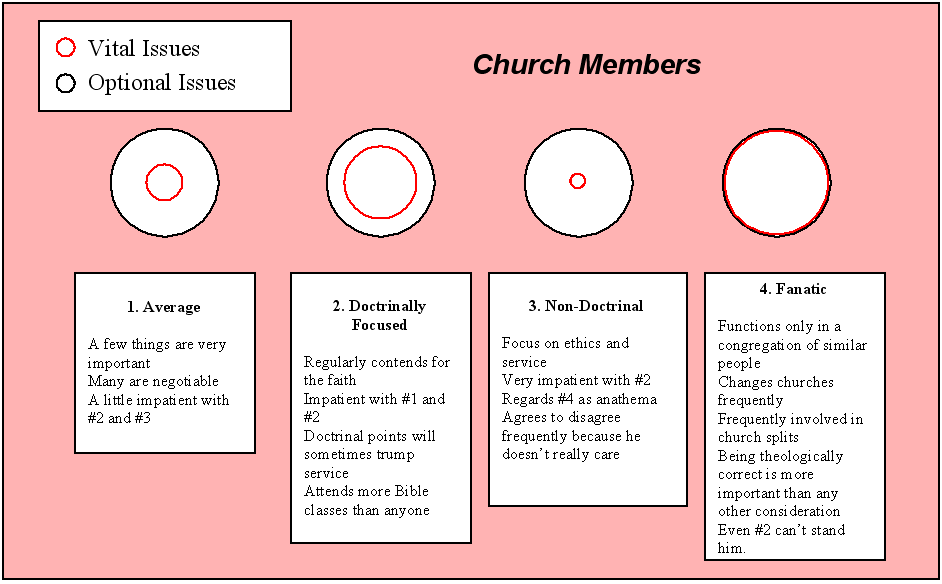
    Let me provide an illustration from another article I’m working on that looks at the type of people who might be part of such organizations:

    Church member attitudes toward doctrine and diversity
    Click the image for a larger view

    Churches that attain unity by exclusion tend to have a large number of essential doctrines. These churches tend to split, and the people in them tend to move from church to church looking for a precise match to their desires. I am not saying that such a church cannot practice unit and cannot teach the gospel; merely that it is difficult to maintain unity in that atmosphere.

    I believe the United Methodist Church, of which I’m a member, tends toward the other extreme. We tend to allow diversity in everything and require unity in nothing. We add to that a debate over where we should be allowing diversity, what is essential, and what is not.

    the-methotaku made a great comment on my previous post, Liberalism and Diversity, in which he started to do precisely what I had planned to suggest in this article–define the distinctives of Wesleyan and then United Methodist theology. Go back there and take a look.

    One reason it is often hard to define the essentials is that one can’t define “essential” without asking “essential for what?” Many people are tired of denominationalism, and I am also concerned when denominations promote themselves over Christianity as a whole. I like to call myself a “Christian, who is a member of a United Methodist congregation” rather than “Methodist.” Why? Because my primary identity is Christian. I don’t think John Wesley would have a problem with that.

    But in order to be a community in ministry to the world, I need to become part of a more tightly defined group. Rather than the very small number of doctrines I suggested as a definition for “Christian” I need some additional points that make one “United Methodist” rather than Presbyterian or Pentecostal, for example. When I define such items, I am not saying that these are additions to what makes me a Christian, rather, they define how it is that I am going to live my Christian witness in the world through a community.

    I can cooperate with anyone with whom I can agree on the essentials for that specific mission. That means that if I am dealing with an enterprise that is broadly Christian, I can cooperate with anyone who accepts basic Christianity. When I meet as a member of a congregation for worship, I expect some additional unity, though I still can allow diversity. I could easily form a small group that would share a larger number of “essential” doctrines–essential to our group, that is.

    But in each case I must try to keep these essential doctrines to the minimum required for that particular community. When I engage in charitable activity in general, for example, I don’t need to find people who agree with me doctrinally. All I need is to find people who agree that there is a human need to be filled.

    It is my prayer for the United Methodist church that we’ll reduce confusion by defining what it is that we find essential and learning to live with it. I don’t know where those lines should be drawn. I would suggest two things–they should be as inclusive as possible while allowing us to be defined as a community, and we should not use what defines us as a community to condemn those who choose a different one.

  • Misrepresenting Science in God’s Name

    The Smithsonian magazine online has an article Dinosaur Shocker, talking about the work of Mary Schweitzer who has found preserved soft tissues in fossilized dinosaur bones. The topic has been picked up by young earth creationists and used as an evidence for a young earth. This has already been discussed on the web, but if you have not read it, here are a couple of key articles:

    Though I was interested in the article, I was more interested in the way in which the material had been used and I want to comment on that briefly, because I have seen it done very often.

    The Smithsonian article made the follow comments on this use of Schweitzer’s material:

    Young-earth creationists also see Schweitzer’s work as revolutionary, but in an entirely different way. They first seized upon Schweitzer’s work after she wrote an article for the popular science magazine Earth in 1997 about possible red blood cells in her dinosaur specimens. Creation magazine claimed that Schweitzer’s research was “powerful testimony against the whole idea of dinosaurs living millions of years ago. It speaks volumes for the Bible’s account of a recent creation.

  • In and Around God

    I found a wonderful post on the relationship to which God invites us over at connexions (via the the Methodist Blogs Weekly Roundup), titled Living in God. The author, Richard Hall, brings to us the word “perichoresis” used by early church fathers to describe the union of the human and divine in Jesus and then the trinity (details in the post and comments to it.

    It’s not the big word that made me like this post so much, but the discussion of it. I rarely like the use of a Greek word in preaching and teaching. If you’re teaching in English, teach in English. Generally. Here, the very mystery of the word, and the mysteries it can be used to describe combine to help us think about mysterious things. And the trinity is indeed a mysterious thing, and so is the closeness of the relationship to which Jesus calls us. Often we forget that. One of the benefits of the doctrine of the trinity is simply that it makes us think constantly about relationships. It forces us to try to imagine relationships that are closer than any that we experience.

    At the same time, it illustrates how much more there is to the atonement than substitution and the paying of debts. I do not reject the notion of substitution in the atonement. I think that substitution is a metaphor that can convey to us some of the meaning. But it is a metaphor, and it conveys only part of the picture. If we allow ourselves to spend time thinking about some of these other aspects, and taking seriously Biblical materials that reach beyond that point, we will find a richness in atonement and reconciliation that will enrich our relationship with God, and flow out into our relationship with others.

    Our hope in both divine and human relationships should be this: They can be better.

  • Liberalism and Diversity

    A couple of weeks ago while teaching I was asked about the title of my book Not Ashamed of the Gospel: Confessions of a Liberal Charismatic, and what I meant by “liberal charismatic.” Now this isn’t an ad for my book–no, really, it’s not!–but that title was not one I gave myself, but rather one I picked up from an opponent, someone who didn’t like either liberals or charismatics. But I have had both titles used about me from time to time by people who were not intending to insult me. I prefer to call myself a “passionate moderate” but I really don’t mind being called liberal or charismatic.

    I also had my attention called to the case of an individual who is a candidate for ministry in the United Methodist church. This individual has a mentor who is very liberal, while the candidate is evangelical. Things aren’t going well. Now I don’t have good, objective statistics on this sort of thing, and because of slippery definitions I’m not sure anyone can get them. But I have heard conservatives, evangelicals, liberals–people from pretty much every perspective–talk about the people that they cannot tolerate in one position or situation for another. I’m sure that a liberal mentor in the situation I mentioned might ask me something like, “But do you think I should help someone who will judge and exclude homosexuals from ministry become a pastor?”

    That’s an excellent question. It falls into a general category of questions that help us define the boundary of what we are each willing to tolerate, or the diversity that we are willing to celebrate. It’s much easier to celebrate diversity in general than it is to celebrate individuals who are very different from you. No matter how liberal you perceive yourself to be, there are probably some group of people, perhaps many groups of people, that you just can’t deal with.

    For me, it’s the true fundamentalist, such as King James Version Only advocates, and people on the fringes of the young earth creationist movement. Some of those folks I just find annoying. So what happens to tolerance?

    Let’s put it this way. For me, tolerance is a value. It is not an absolute belief that I must tolerate everyone and anything that anyone might happen to want to do. I value tolerance fairly highly. In fact, so highly that I would rather be a little less annoyed by the people I mentioned who get on my nerves. I want to treat them more fairly. But my tolerance is not absolute. Paul Hill had freedom of speech. I certainly didn’t like the way he used it, but it did not make me want to eliminate freedom of speech from the constitution. At the same time, I have no tolerance for the way in which he used his speech. I would have no difficulty condemning it in the most forceful terms. As for his actions, when he killed a doctor and a clinic escort in pursuit of his anti-abortion views, I definitely do not find it appropriate to tolerate those. I would note that I also think some of his speech prior to his act at a minimum came very close to incitement, and might have been dealt with on that basis.

    All of us have limits to our tolerance, and all of us should. What I value is the idea of making our circle of tolerance as broad as possible. We need to find a way to accept into our lives people whose views and culture differ greatly from our own. We will benefit from doing so. Our communities will benefit when we do so. Often accomplishing this is simply a matter of learning to look at similarities rather than differences. I have found that with groups of Christians one can often find common ground simply by listing similarities. As long as we’re thinking about those things, we seem very much the same. If we choose to list differences we will tend to feel different.

    There is good reason to look at things both ways. Comparing and contrasting work together. But when we are trying to accomplish something good in our churches and in our communities, very frequently we need to make looking at our similarities the primary goal.

    But does tolerance and diversity mean that one has to agree with what everyone says? There are people who seem to work that way. “Well, that’s OK for you, even though it doesn’t work for me,” someone says. Such people often regard totally contradictory beliefs as equally valid. This type of thinking elminates our critical faculties, at least from our interactions with other people. What we need to do instead is accept and celebrate that there are people who are different, even when I disagree vigorously with their beliefs. In debating those beliefs I can improve my own skills and expand my own knowledge. And yes, horror of horrors, I might find out I was wrong about something and have to change my mind.

    When we exercise tolerance in a community, there is also a need for boundaries. One problem I frequently see with church groups, and especially with the United Methodist Church of which I am a member, is that people attempt to be in community without bothering to define what it is that defines them as a community. Let me use this as an example. In the United Methodist Church we have a fairly substantial and well-defined body of doctrine. When I first joined a United Methodist congregation, I had the notion that people actually had some comprehension of what those doctrinal statements said, and that there would be discussion of such things in the church. I was even concerned that in some cases my views were too liberal for the doctrinal statement while in others, such as with the social principles, my views were too conservative.

    What I found in practice was that there was a huge amount of ignorance, and a general idea that we ought to be tolerant. Since nobody had any idea what the doctrines were, they never questioned me about my positions, and they looked puzzled when I questioned them. As I’ve taught Bible classes in Methodist churches, I’ve found that the dominant feeling is one of confusion. I think this confusion is the result of an attempt at undefined tolerance. The United Methodist Church needs an agreement on what is required, and what is optional, and then we should expect that the required items be accepted by all those who are part of the community, while the optional items are open to one’s personal opinions. This wouldn’t mean mind control; one can always join another denomination. Unlike citizenship in a nation, one doesn’t have to leave the country because one changes one’s church.

    As a passionate moderate, I would like that number of doctrines that we say are essential to be very small. In a pamphlet I publish, Understanding Christian Apologetics, I list just four items, derived from Elgin Husbheck’s book series Consider Christianity. A particular denomination should have more items than those, but nonetheless should be certain that what is listed is what they want to have defining them as a religious community. There can be a larger list that is of commonly held beliefs that are open to disagreement and individual opinion. I believe one could be tolerant and still expect someone who could not be defined by the standards of such a community to find a community where the standards are more congenial.

    People in such a community could still cooperate with others on points of agreement. I think this is an essential for a functioning society, particularly a democratic society. I am always delighted when movements in our two political parties get together across party lines. I wish we did that sort of thing more. We could come together for a period of time on some specific issue, and work separately when we disagree. In such a community the pastoral mentor I mentioned could be held to a standard: There are certain doctrines that must be accepted for ministry in our community, and if someone is within those limits they should be accepted.

    I’m using the United Methodist Church as an example. In the broader community, the key is viewing tolerance and celebration of diversity as a value. It is not a binary condition–one is tolerant or one is not. We may have more important values that will override it. We may even find people who we do not celebrate and who we do not want in our society. That’s all part of living. Provided that we deal with those options appropriately, there is nothing wrong with this.

    I’m going to go forward being tolerant over a large range, but expressing firm limits to my tolerance.

  • Bible Translation and Literary Style

    One thing second or third year Greek students notice, at least those who manage to start actually reading the Greek New Testament, is that various books have different levels of Greek grammar and vocabulary, and different literary styles. There’s a reason why most early reading exercises from the New Testament are from John or Mark. When I first started to read Luke/Acts I wondered what happened, and the first time I plowed through the first four verses of the book of Hebrews I wondered if I’d actually skipped all those Greek classes and just dreamed I’d been there learning.

    I think we can appropriately ask just what a translator needs to convey in terms of literary style, particularly the complexity of the language does a translator need to convey. Surely these elements convey something to somebody, and they are very easy to lose in translation. For example, if Matthew or Mark use a simple and common term for something but Luke uses a rarer or more sophisticated term for the same thing, should the translator reflect this by using a simpler English term for Matthew or Mark, and a more complext term for Luke?

    Translators often give different answers, at least based on their practice in their translations. For example, in my blog entry on translation issues in the passage, I examined how various translations dealt with this issue and some reasons why one might try those various options. Recently I gave a preliminary review of a new translation, The Scriptures, and found that they actually translate the full Greek sentence as a single long English sentence. Some good questions to ask their translation team would be: “Does that long English sentence convey the same idea to English readers as the long Greek sentence would to Greek readers?” and “Is the long English sentence similar in comprehension level to the long Greek sentence?”

    Let me give my answer first this time, and then try to justify it. I think that almost any variety of translation is acceptable and sometimes useful, provided that translators and readers understand the method and purpose. Bible translators need to be more careful on this point because people often naively expect to get “the Bible” no matter what translation they use, while the fact is that each translation will convey some, but not all of the meaning of the text in the source language. This is why I offer a seminar for churches, especially lay members, about Bible translation.

    If you believe that the message of the Bible is worth communicating, then translations to meet the needs of particular audiences are of value. I would especially mention children’s Bibles. The NCV offers easy to read, short sentences and simple vocabulary to children or to those with more limited reading skill. Personally, I find that version hard to read because of those short sentences. But there are people for whom this is the best way to receive the gospel message. My personal preference is the REB, but many people turn up their noses at the loftier language it uses. It communicates to me, but not to those people. And that is the key.

    There are those who ask me why I don’t condemn The Message. After all my own charts show that is extremely low on the formal equivalence scale. (Frequently people just assume that I would accept that having a low score in formal equivalence means a translation is inaccurate. But that is not my position at all, as I have stated repeatedly. The assumption that more literal is the equivalent of more accurate is simply false.) They can point out to me how hard it is to find verses, how word studies would be impossible using that version, and how many liberties Peterson has taken with the text. But what they miss is that Peterson has also wonderfully conveyed other portions of the meaning by his method. Like every translation, regardless of translation approach, The Message conveys some of the meaning of the source and fails to convey other elements.

    In order to determine how a translation “should” be done, you need to know the audience, and what are the critical elements to be conveyed to that audience. Don’t assume that you can get everything, or that you can get everything that’s important, because you can’t get everything, and what is important varies with the audience and the purpose. This is a question I fight regularly. “What Bible version do you use?” someone will ask. Or alternatively, “What Bible version is best?” They are very impatient when I say that I use many Bible versions in answer to the first, and to the second, that I have to know the audience and purpose before I can give an answer. But those answers are correct.

    Advocates of translations that are strongly formal equivalent often use the argument that word studies are much easier to do and that one can better see the relationship between various texts on the same topic when words are translated consistently. But if I may be blunt, these people are talking to a dwindling group of Bible students who actually do that kind of work, and many of those who do use word studies based on English translations do such a lousy job that they are more of a danger than a help. The pressing need is for an acquaintance with the Bible story and the Bible message. If you spend time teaching as I do, I imagine you’ve experienced the fading of Biblical knowledge. Literary references such as to the stories of Daniel and the “law of the Medes and Persians” (for those who miss it, that law can’t be changed), the books of Ruth, Esther, and Jonah, or major episodes in the history of Israel are no longer safe. All we do by limiting the range of meaning we translate to the desires of a small group of people, for example those who wish to dig into concordances and do word studies, is to limit Biblical knowledge to people who do those sorts of things.

    Translating literary style could be an excellent goal. But the translator needs to ask a question when translating Luke, for example. Is it more important for me to convey the fact that Luke writes in a more sophisticated style of Greek than Mark does, or should I focus on conveying the story? I would suggest that in most (but not all) cases you’ll want to convey the story.

  • Praying to be Seen

    A few years ago a number of my students in an introductory Bible study class arrived very excited. There was a town coucil here in Florida (I forget precisely where), that had invited a Wiccan–a witch!–to offer a prayer opening a public ceremony. My students were discussing what they would have done about this obviously heathen prayer, and were cheering folks who had turned their backs on the person offering it.

    “I bet you would have done something good!” said one of them to me.

    “I would have stood silently and respectfully as she prayed,” was my response.

    Why is it so difficult to respect someone else’s spirituality, their prayers, or any other religious activity they pursue? Now we have a story of a school at which one student did not want to sit through a Christian prayer at the commencement, and the ACLU filed suit on his behalf and got an injunction to prevent it. I understand the student’s position. It can be very uncomfortable to be in the minority, especially a minority of one. At the same time, I must say that I have a problem with the ACLU position on this one. I think student initiated, student led prayer, even in a public ceremony should be regarded to some extent as free expression, though at the High School level there would be some limits to this. (See the story at Judge Blocks Prayer at High School Graduation, thanks to Ed Brayton, Religion and the Majoritarian Impulse for calling my attention to this.)

    I think that there are much better ways to deal with a situation like that, including finding ways during the year and at various school ceremonies to acknowledge the beliefs of students who are in the minority. I’ve been in the minority religiously, growing up as a Seventh-day Adventist. “Do you go to church on Sunday?” asks someone. “No,” I reply, intending to continue with “we go to church on Saturday. But I see the “you heathen” look, and I know this is not a person who is interested in hearing about alternatives to the expected Sunday spent in church. That, of course, is very minor, but Seventh-day Adventist businessmen often had considerable problems with Sunday blue laws. Their faith required them to stay closed on Saturday, and the law required them to stay closed on Sunday. The majority felt it had the right to enforce its brand of spiritual life.

    So back to this high school. What do the students do? About 200 of them stood up during the principals opening remarks and recited the Lord’s prayer. Now I have a serious problem with this. Whether the judge was right or wrong about the law, his injunction was the law. Those students said that they didn’t really care about that, they were going to make their prayer demonstration anyhow, disrupting the ceremony. They announced loud and clear that they were the majority and they didn’t much care what the minority thought, or what a federal judge ordered. Others at a rehearsal booed the student involved in the suit.

    Now how does a prayer demonstration fit in with Matthew 6:5: “But when you pray don’t be like the hypocrites, because they love to pray in synagogues and standing on street corners so people can see them. I tell you truly, they have their reward.” How does the attitude of rebellion stand up against Romans 13:1-7? I do believe there is a proper time to protest, but is the use of prayer as a mode of protest really something we want to do?

    But I have a better idea for us as Christians. Consider Philippians 2:4: “Let each person not look after his own interests, but after the interests of others.” What would the Christ-like attitude be in this situation. I’m not talking about the law here. What would our Christian standard be? I would suggest that Christian students–or better Christ-like students would seek to find a way to make the one in the minority feel more comfortable. Perhaps they could acknowledge his faith in some way during the ceremony. Such an approach might prevent a case like this from going to court in the first place.

    The Christian majority in this country is whining about persecution quite a bit these days. We’re dealing with words, folks, and as Christians we’re in the majority. No, your own little sect, or big sect, whatever that may be, and my sect, are not all by ourselves in the majority, but Christians are. We are mostly putting up with one another, and most of the claimed persecution seems to be cases in which we don’t get to do precisely what we want, or what we’ve always done, because there is someone pesky outsider to object.

    It’s not that we’re not free to pray; we are. Our children can pray in public school right now! They can do it legally. What is not permitted is having the state sponsor it. So the real problem is not that your child can’t pray. It’s that you can’t have the teacher force him, and other people’s children, to pray in some specified way.

    But prayer as a demonstration is just noise. I suspect, based on the words of Jesus, that God is not particularly pleased with that sort of noise.

  • A Step for Abiogenesis?

    In a short article, ScienceNOW Daily news discusses some new research that may shed light on how life first emerged on this planet. I want to call attention to the article for a couple of reasons, but primarily because this, in my view, is how real science is done, and how it sounds when announced. No, they don’t know that this is an element of the formation of life, no, they don’t have the rest of the process, even the next step, figured out. What they have done is provide one more option, and filled in one more blank in the unknown.

    Michael Behe, in his book Darwin’s Black Box describes structure after structure and process after process, recounting how we have discovered new complexity as we continue to learn more about how the function. What is a black box at one point in the history of science will not necessarily remain so. Unfortunately, Behe uses all this skillful writing to produce an ode to ignorance, and complains that evolutionary pathways have not been found. He believes they never will be. But as things get more complex, one simply has to work harder to learn the details that are part of the complexity of nature. In this case, there is now a new reaction that opens up possibilities for study. Does it resolve the problem? No! But it suggests new research and provides more options for continuing the search. That’s how science works.

    Some may be wondering how I, a “theistic evolutionist” got onto the topic of abiogenesis. After all, the expected method of argument for theistic evolutionists is to distinguish evolution of life from abiogenesis. I do believe they should be regarded as distinct. But I also believe that abiogenesis will be solved, and an pathway for the origination of life will be formed. How then can I relate this to my belief that God is the creator of life? Actually, I believe God is the creator of everything. I believe God created the universe as a system, a system that works.

    Let me use the analogy of my car. I don’t regard periodic maintenance requirements for my vehicle as a sign of the wisdom of the engineers. Sure, they did well to warn me of those requirements, but I would be happier if they were less frequent, and if it were practical to produce a vehicle that never required maintenance, that would be even better. I also don’t look at the simple parts of my car and determine that they did not require an engineer, while the more complex parts must have been designed. I know that each element was put there as a part of the design strategy of the car. That they work together (mostly) seamlessly, and that I cannot find parts that are “more designed” than others is not a defect.

    Now as all analogies, this one has it’s limitations. My car is very little like a universe. But I think it does illustrate my point. If God designed the universe correctly, then it should work. If it requires periodic maintenance, like my car, it gives evidence of manufacture by a less-than-perfect creator.

    I don’t like the idea of tinkering, whether it comes at the time of speciation or when life first came into existence. I creidt life to God whether intervention was required or not, but I suspect a competent God of getting it right the first time (A “fully gifted universe” to borrow Howard Van Till’s phrase).

    So folks, I think this one will be solved in the next few years, and if you hooked your faith in God to the impossibility of life being formed from non-living matter without special miraculous intervention, you will be disappointed.

    But make no mistake, no matter how thick the gloves are on God’s hands, no matter how many processes supposedly separate him from his handiwork, it is still God that does it. An omnipresent God is not less present when working through process (and consistent processes at that), than he is working directly. The evidence suggests that he prefers working through consistent processes.