Tonight at 7:00 pm central time I’ll be interviewing Dr. Bruce Epperly for the Energion Tuesday Night Hangout.
Category: Books
Anything having to do with books, book reviews, current reading suggestions and so forth. This is a catchall for those elements that don’t fit precisely into other categories, but do have to do with books.
-
In Memory of John Sailhamer
I never met Dr. John Sailhamer, but I appreciate scholars who propose and support theories that are substantially out of the ordinary. I don’t mean crazy, just creative and risky. I found out recently that he has passed away.
In celebration of his life I’d like to link to my review of his book, Genesis Unbound. At the time I reviewed it, it was unfortunately out of print and I’m glad to see that a new edition was published in 2011. I’m showing a link to it at the left of this post.
This is among the books that I strongly recommend that anyone involved in debated issues of creation or with an interest in it should read.
-
Book Notes – Hebrews: A Commentary (NTL)
I recently worked my way through Luke Timothy Johnson’s Hebrews: A Commentary (New Testament Library) along with the Greek text, and I’m going to write a few notes on the book, which may, or may not, constitute a real review. Time will tell!
The problem with many blogger book reviews is that they often amount to no more than various length notifications as to whether the author liked the book or not. There are some really wonderful exceptions to this, and you really can find a great deal of information about a title in the blogosphere, but you can also read many words (such as these) which don’t tell you a thing! As an alternative, you get an argument against everything the author wrote in the book, usually without sufficient quotations or references to let you get a feel for what the reviewer is arguing against.
In my view the ideal review identifies the goal(s) of the book, comments on how successful the book was in accomplishing these goals, has some interaction with the ideas, and finally has a summary evaluation which is based on the stated goals. I recall reading a book about Christian apologetics. I thought it was well written, carefully argued, and thorough. There was one problem, however. The author claimed in the introduction that he would close all the holes in arguments from Christianity and the Bible. He compared the work of others to putting one leaky bucket in another: You slow the leak but you don’t stop it. He was going to stop it. In the end, if I was asked whether I liked the book, I would have to say “yes,” despite (or even because of) the fact that I disagreed in many places. Yet in a review I would have to say that the stated objective was not achieved, and making a claim that one would accomplish such an objective was, shall we say, suboptimal.
In the case of a commentary, the difficulty is greater than with an ordinary book. There are two key problems: 1) Many people have very fixed ideas of what a commentary ought to do, and little forgiveness for a commentary that doesn’t accomplish their list of goals, and 2) People (particularly scholars) have quite a variety of very fixed ideas. No matter how you choose to write a commentary, no matter how large or small you make it, and no matter how carefully you draw compromises between never completing the task and short-changing the reader, someone will complain.
I would like you to note here my own inconsistency. I’m writing in prescriptive language about what ought to be in a review, while arguing against prescriptive ideas about writing a book. I will live with this inconsistency.
Besides, this isn’t a review. Here are my general thoughts.
I found Hebrews: A Commentary by Luke Timothy Johnson to be the most helpful commentary I have read thus far in terms of stimulating theological reflection. By that I mean that the author doesn’t merely provide a view, but he argues it in such a way that it stimulates new thinking. My personal response to some of his views is that they are perhaps a little too tied to orthodox theology and a little less daring than the book of Hebrews deserves, but that is at the nit-picking level. Johnson knows how to present quite orthodox theology in a way that is challenging and helpful.
As I studied using this commentary, reading the Greek text and taking second looks at the textual notes, I often found myself reflecting for some time after I’d read my chosen portion for the day. I rarely find that level of stimulation for thought in a commentary.
This is not David Allen’s volume in the NAC series. Dr. Allen covers everything and references everything. The only negative thing I would say about his commentary is that I have to have some energy built up before I go to consult it. If you want a detailed and complete survey of the topic along with arguments in favor of a particular solution, but all means use David Allen’s work. On the other hand, if you want to get more quickly to the topic for teaching and preaching, use Luke Timothy Johnson.
I know we don’t like to think that we might shirk some portion of the possible study of a passage we’re going to teach or preach. We’d like to think that we covered everything before we tried to present an exposition to others. But we all face the clock. Brevity is not a sin.
So when I want to get right to meditating on the text, but with some solid meat to set it up, I turn to Johnson’s commentary.
Now I haven’t called this a review, yet I’d like to present some interaction. I’d suggest, however, that I’ve already done this in blog posts on Hebrews written after reading material from Johnson’s commentary. You can start with Hebrews and the Problem of Writing Introductions. I could provide a number of links, but the simplest thing to do is to type “Hebrews” in the search box after you get to that article. Nearly everything I wrote on Hebrews after that point references Johnson.
Note: I read
-
A Good Book Review – Running My Race
 A good book review is not one that says nice things about the book, although nice is nice, so to speak. I occasionally read a positive review that makes me wonder whether the reviewer read the book. There are likewise negative reviews that make one wonder. As a publisher, I must take all these in stride.
A really good review, however, is one that shows the reader read the book and also got from it something the author and publisher had hoped to get across.
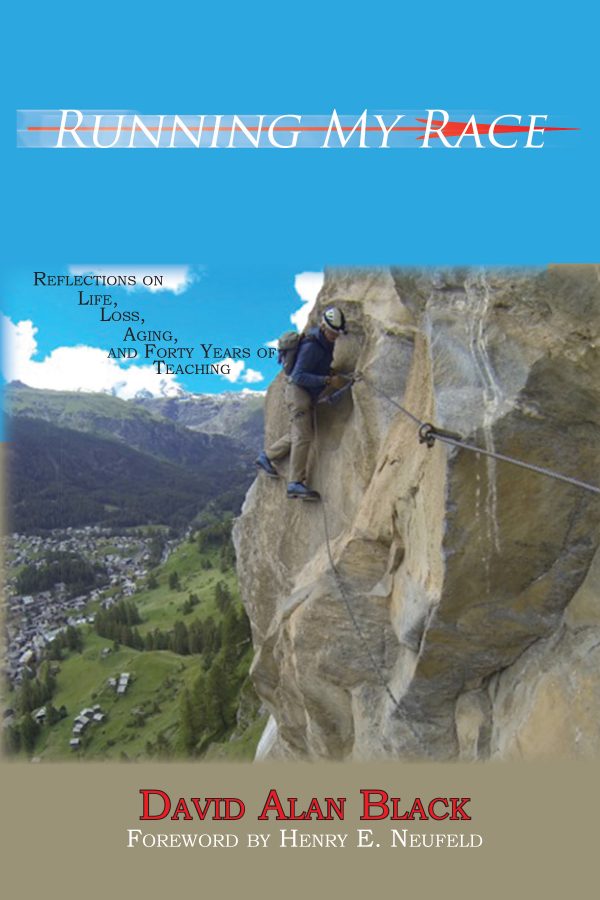
Thus a review of Running My Race (David Alan Black) on The Tired Blog. I was feeling fairly tired today, and then I read this review. It really cheered me up. If I can publish a few books each year that make readers uncomfortable, then I’m doing my job.
Of course, as publisher I’d also like to note that Running My Race is a good book! 🙂
-
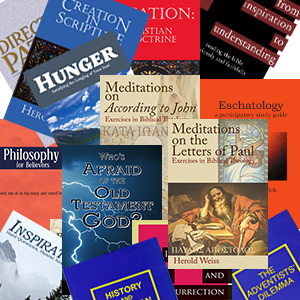
Why I Publish Books by and for Seventh-day Adventists
This may seem like a simple question. A better one might be, “Why not?”
Some Prefatory Remarks
Seventh-day Adventists (SDAs) are often misunderstood, which complicates the issue. If I had transferred my membership from a Presbyterian church, for example, to a United Methodist congregation, it’s unlikely anyone would ask me why I maintain relationships with Presbyterians. As an ex-SDA, however, I’m often asked questions like the one I’m trying to answer right now. SDAs ask me how I could possibly leave the church. At an SDA church where one of my authors was speaking, a young man exclaimed to me, “How could you possibly have difficulties with SDA doctrine?” If you want to understand why I left the SDA church or how I feel about it, you might try reading The Joys and Sorrows of Being ex-SDA.Here’s my key point: While I disagree with the Seventh-day Adventist Church on a number of doctrinal points, especially on issues of prophecy and some applications of the (otherwise valuable) term “remnant people,” I still regard them as brothers and sisters in Christ, in the same way and on the same basis that I regard fellow Methodists, or members of Presbyterian, Baptist, Assemblies, United Church of Christ, independent, or any other Christian congregation. I have disagreements on doctrine with pretty much everyone I know (often including yesterday’s version of myself), and that doesn’t make me deny Christian fellowship.
But there are always those other questions about SDAs. They’re different, yes, but they’re more different in weirder ways than others. Which reminds me of the church Staff-Parish Relations committee that decided that an SDA speaker, who had also spoken at continuing education events for pastors at the conference level, could not be allowed to speak at their church. Having read something about Latter Day Saints, they were certain they didn’t want an SDA to speak. Surely we should stick to Methodist speakers.
There are two forms of ignorance here. 1) There’s ignorance of precisely who SDAs are and what they believe, and 2) There’s the ignorance of just how much weirdness we have in mainline denominations. If I need to find a crazy speaker, but am limited to those who are United Methodists, I will have no difficulty at all!
What I Publish
So what does this have to do with publishing?
Very little, actually. It’s just that people expect it to.
I frequently have to remind people that I am a Christian publisher, publishing books selected for a Christian audience. That doesn’t mean that all our readers are Christians. What’s more, it doesn’t mean that all our authors are Christians. In a blog post titled Why Did You Publish THAT Manuscript? (on the Energion blog), I noted that “We judge manuscripts and not authors here at Energion Publications.”
To me that is a rather obvious point, but it has raised questions. In order to guarantee the publishing of Christian authors only I would have to first define the boundaries of Christianity, and then make myself the judge of whether someone had met those criteria or managed to fall within those boundaries. I can do that for myself with regard to organizations and systems. It’s a simple matter of definitions and categorization. To do it with persons would be problematic. In fact, I personally simply accept anyone’s self-confession of what their religious view is.
Further, as publishers have discovered before, it’s much more difficult to determine whether a person is a good person than it is to determine whether a manuscript is a good manuscript. I choose to deal with manuscripts.
Seventh-day Adventists
I think my earlier remarks largely answer the question. When a manuscript by an SDA author seems to me to be of interest to my audience, an audience which definitely does include SDAs, I’ll publish it, always provided it meets other necessary criteria. I avoid publishing books that are of interest to only one denomination, for example.
Here are some specific points:
- Am I on a mission to convert SDAs and get them out of the SDA church? No. I have no intention of persuading anyone to leave their denomination. In fact, I will state that if you’re leaving any church, including the SDA church, because of anger at the organization, you’re going to find plenty of imperfections wherever you go. If you leave a church congregation or a denomination, do so for positive reasons. I may disagree with some doctrines of the SDA church, and so I moved to an organization that is more doctrinally compatible with my views, but I applaud and highly value the SDA educational and health systems. I also value much of the theological work done by SDAs over the years. I can both disagree with, and value, ideas.
- What about the seventh day Sabbath? I consider the Sabbath a part of one’s approach to worship and a spiritual practice. Where I have seen it carried out as a spiritual practice, I find the seventh day Sabbath valuable. As with any other activity, it can be converted into a legalistic “work,” but the key here is “any other activity.” Because keeping the seventh day as the Sabbath stands out as unusual, people take it as extraordinary evidence of legalism. But it’s simply one more practice that can be positive or negative. I have said before that I miss the Sabbath as practiced in SDA circles. I have other means of seeing sacred time, but there’s nothing that quite matches taking sacred time together with a community.
- Don’t SDAs think they’re the only true Christians? Some of them do. So do one or two Methodists. I think this is a problem for the SDA church partly because of teaching about God’s remnant people. But I have no problem with SDAs as a group over it. Most SDAs that I encounter treat me as a fellow-Christian even though I have left the church. There are occasional folks who treat me as an apostate. I believe that could be solved if there were no people in the SDA church. As things are, we’re stuck with it.
- But SDAs don’t believe we go to heaven when we die! Indeed they don’t. Neither do I. I think the Bible is actually quite unclear about what happens after death, but the balance, I believe, favors soul sleep and a resurrection. I just don’t happen to think it matters. Arguing about this is very time-bound thinking. If I die and go to heaven immediately, there will be one breath here and next (breath? who knows?) on the other side. If I die and sleep with God until the resurrection, there will be one breath here, and the next (whatever!) on the other side. I won’t know the difference. (I publish several books related to this: Eschatology: A Participatory Study Guide, From Here to Eternity, Journey to the Undiscovered Country, and the forthcoming Death, Immortality, and Resurrection. The first and last are by Edward W. H. Vick, an SDA author.)
- SDAs believe in Ellen G. White, a false prophetess. Got you now! Ellen White did indeed have a great deal to do with the founding of the SDA church, though I find her own view of herself and her mission refreshingly humble. I also find a number of her writings to be excellent devotional works (Steps to Christ, Desire of Ages, etc.). We have a voluminous collection of her writings, including letters that she wrote over a long life. The SDA church has had some struggles over how to view her and her relationship to the Bible. Bluntly, however, I’ve found traditions in local congregations of the United Methodist Church that have more sacred standing, in practice, than her writings do in the SDA church. I would say, rather, that the church as a whole, and the modern Charismatic and Pentecostal movements in particular, would do well to learn from the SDA experience. Speaking of which, I’m in the process of releasing Inspiration: Hard Questions, Honest Answers by Alden Thompson. He deals with issues of Ellen White in connection with discussing biblical inspiration in a work that I think the wider church would do well to study.
- How do I deal with SDA authors in my catalog and marketing? Like any other author. I’ll advertise their books for their own denomination, but also present them to others for their wider value. And just like any other author, SDAs may write something that’s addressed more to their own church than to others. In that case, they will be more likely to publish within the denomination, again just like any other author might. I neither emphasize nor do I conceal the denominational connections of my authors.
- Do my SDA authors quote Ellen White in their works? Yes, and no. I tell them to quote Ellen White as they normally would and if it’s necessary, we will add an explanatory note to the book so that others can understand and still benefit. This is a function of the level of controversy surrounding her work, rather than any judgment of it that I might make. Because there is controversy, explanation is helpful. On the other hand, when addressing the larger Christian community, SDA authors often feel it’s best to make their points without reference to an SDA specific source.
- Are you trying to provoke dissent in the SDA church? No more so than in any other church. I do have some books in my catalog that have gone out of print from SDA publishing houses. The level of controversy in the SDA church has nothing to do with my decision. I still judge the book, not the author, and certainly not any former publisher. But beware! I’m not the arbiter of truth, and certainly not the arbiter of SDA doctrine. If you don’t want your beliefs challenged, then it’s my hope that my books are not for you!
Conclusion
I publish SDAs in the same way and on the same basis as I publish anyone else. It’s that simple (he says 1600 words later)!
-

Two Books in New eBook Channels
Credit: Openclipart.org I don’t write that much about my day to day life on this blog, but here’s a snippet and a bit of good information combined with advertising.
Energion Publications keeps me busy, and it’s growing. It never grows as fast as I’d like to do, but even so I have to balance finances and time, and it’s not always easy. Let’s rephrase that. It’s really never easy.
Right now I have five new books in the final stages, from page layout to proofs to finalizing everything for print. You can keep your eyes open for Running My Race by David Alan Black, for which I also wrote the foreword, The Gospel according to Mark: A Participatory Study Guide by Bob McKibben, Holy, Dark Place by Daniel MacGregor (the latest volume in the Areopagus Critical Christian Issues series), A Cup of Cold Water by Chris Surber (the next Topical Line Drive), and The Ground of God by Donna Ennis. Only the first two are in the catalog, but they’re moving along.
At the same time, we’re trying to catch up on ebook production, which is also largely something I do. We publish ebooks for iTunes (iBooks), B&N Nook, Kindle, Google Play, and an assortment of less popular outlets. Today, I prepared several editions of Tithing after the Cross and Seven Marks of a New Testament Church. I just uploaded those books to iTunes and they should become available in the next day or so. They are both already available on the Kindle store. You can find out more about our ebook offerings on Energion Direct. You can find all our Kindle books in our Kindle aStore.
I’m going to write a bit about Seven Marks later today as I finish up my series of blog posts on that book, but I wanted to comment on Tithing after the Cross. As I prepared it for publication in epub format (what iBooks and most outlets other than Amazon.com use), I was struck again by the thoroughness of author David Croteau in dealing with a variety or arguments for and against tithing. But he doesn’t leave it there. In just 94 pages he really does get to what the subtitle calls “a new paradigm for giving.” That latter part is what is important. May think, as I once did, that we have to cling to the idea of tithing, even if it’s a truncated form that just means some type of regular giving, even if that’s 2%. In many churches, people are urged to move toward a “full tithe,” which means 10% of their income. David argues that this is not the New Testament basis for giving.
We have another book, Stewardship: God’s Way of Recreating the World by Steve Kindle. It also starts the discussion of stewardship in a completely different place than your standard stewardship sermon. I’m embedding below the video of my interview with David and Steve on this topic. I think you’ll find it enlightening.
And now back to trying to get a few more things done in the publishing business!
-
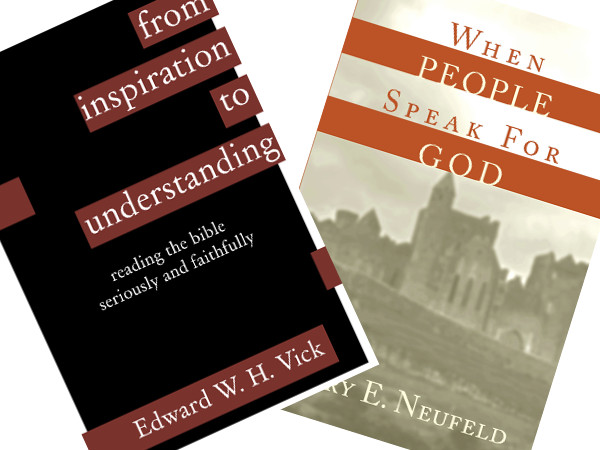
From Inspiration to Understanding eBook Editions
One of the joys of being a publisher, as I’m sure I’ve mentioned a couple (hundred) times before, is the authors I get to work with. I have long considered our understanding of biblical inspiration and authority to be critical to discussions of Christian theology, polity, and ultimately our day to day life. Often we can at least get our bearings in serious debates by at least identifying the differences in how we are using the sources.Because of my interest in this I wrote the book When People Speak for God, which is generally at a popular level. After I wrote that book, I encountered Dr. Vick through one of my other authors and received his manuscript for From Inspiration to Understanding. If his book had been written before, rather than after mine, it would have contained numerous footnotes referencing Dr. Vick’s work.
When we laid out From Inspiration to Understanding at Energion, we were using Scribus, which is actually an excellent page layout product, but is not quite the thing for an extended, thoroughly referenced book. The footnotes had to be laid out by hand, and were done as chapter end notes. This doesn’t convert well to electronic format, so there has been a considerable delay in getting the ebook editions out. But now they are complete.
You can get more complete information on the Energion.com News blog. This is a book I strongly recommend, and the pricing of ebook editions makes it much more accessible.
-
On Publishing a Book I Can’t Read
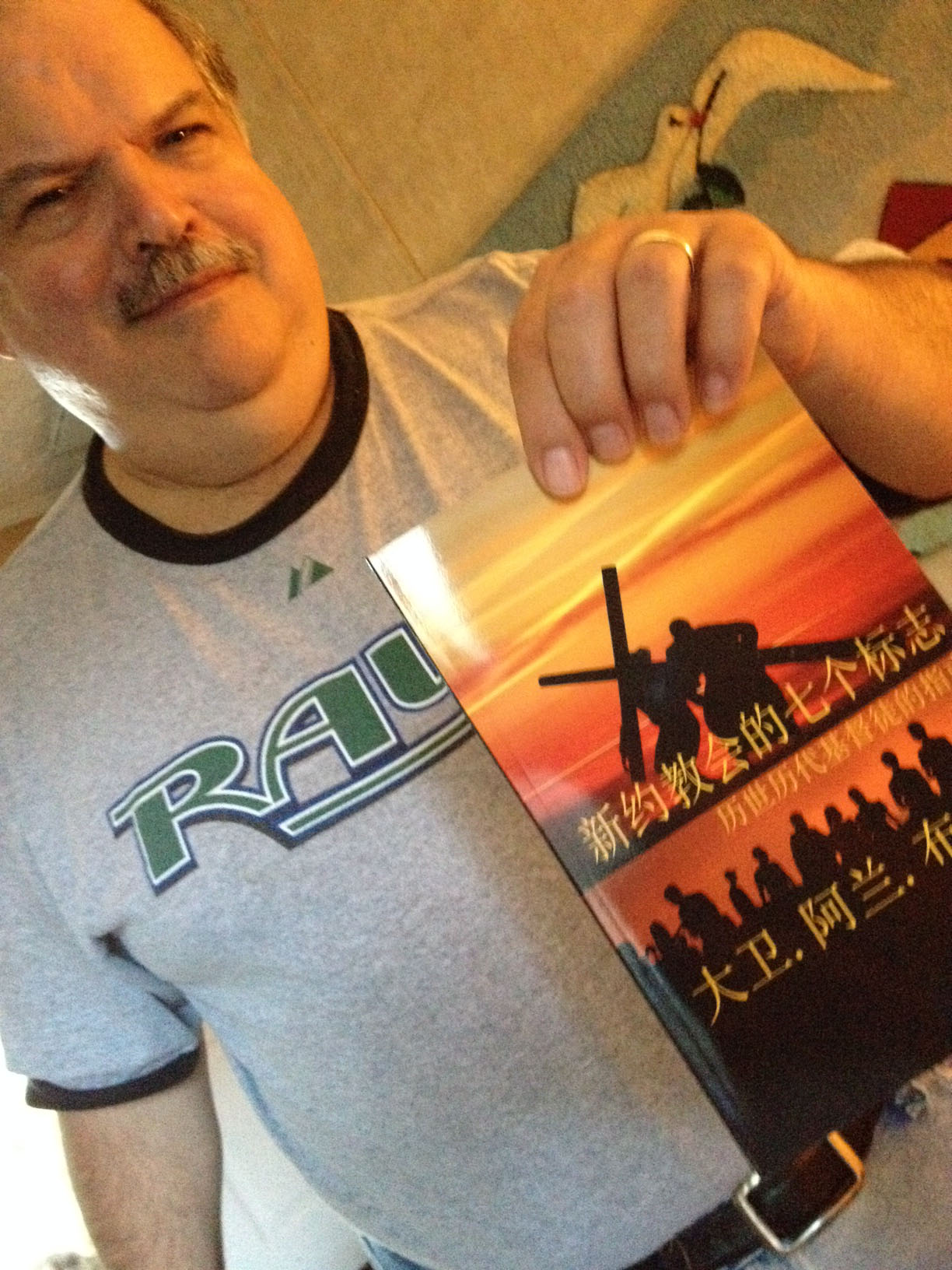
 I suppose it had to happen sometime. Well, not really. I could have said no. But I have now taken a step off the edge and published a book I can’t even read. It’s in Simplified Mandarin. I got the translation, did the layout, and then had it checked by the translator. I ran some of it through Google Translate and it came back resembling English.
Really, I’m delighted to have released this book, and hope that many will enjoy it. For those of you, I assume most of my readers, who don’t read Mandarin, the same book is available in English, Seven Marks of a New Testament Church by David Alan Black. I’ve been blogging about it, and will resume that series soon.
Tomorrow I head to Atlanta for the annual meeting of the Society of Biblical Literature where my company, Energion Publications, has booth 2110. I don’t know if this means I will blog less or more, but I suspect it means something. If you’re there, be sure to drop by and say hello!
-
Spectrums: Liberal to Conservative Is not Enough
Last weekend Dave Black was our guest here in Pensacola. I recorded some videos for promotional and educational purposes and Dave also preached and talked about missions (with plenty of pictures) at Chumuckla Community Church. I will be posting some of these videos soon, but they are not quite ready yet.Dave is a professor at Southeastern Baptist Theological Seminary. I’m a United Methodist with the dreaded ‘L’ word in my blog tagline (“Thoughts on biblical studies, religion, and living from a passionate moderate, liberal charismatic Christian”). Obviously this is some sort of liberal-conservative dialogue.
Not really. I’ve written recently about dialogue and why, as a publisher, I publish books from a variety of perspectives. In a video I produced in the early days of Energion Publications I used a triangle, with the points being charismatic, liberal, and evangelical. I would note that for this to work now it should be “conservative evangelical” as the label “evangelical seems to have lost some cohesion. This will happen to words, especially those that are perceived as positive labels.
But even those three points fail to catch some of the issues, and there’s a bit of a tendency to think of Christians grouped at the points of the triangle. One of the reasons many have trouble with labels is that people don’t fit into the center of the semantic range of a label. In addition, on different issues one may take different positions. I have political views on some subjects that seem very conservative, while on others I seem quite liberal. Similarly on theological issues I don’t try to fit all in one camp.
There are two points (I think!) in all this rambling. The first is that we don’t fit cleanly into one label on all issues. The second is that we may be able to connect with people in other camps on particular issues. In all cases (should this be #3?) this should suggest options for learning from one another.
For example, when many charismatics talk about modern revelation they use theological arguments that are also commonly expressed by liberal or progressive theologians. Not a few of those I’ve talked to want to deny any connection, but behavior and practice tell a different story. There is some theology to be learned here! Similarly many charismatics should—and do—learn biblical studies from their evangelical brethren.
Many liberals or progressives, on the other hand, don’t want to be linked to charismatics because of emotionalism or other extremes. Yet too frequently progressive biblical reflection tends to be more a matter of challenging the conclusions of evangelicals rather than developing a robust theology and application of scripture. Yes, this can be a stereotype. I have several authors in the Energion Publications list, such as Dr. Bob Cornwall, Dr. Bruce Epperly, and Dr. Drew Smith, none of whom fit the picture. And there are many more like them.
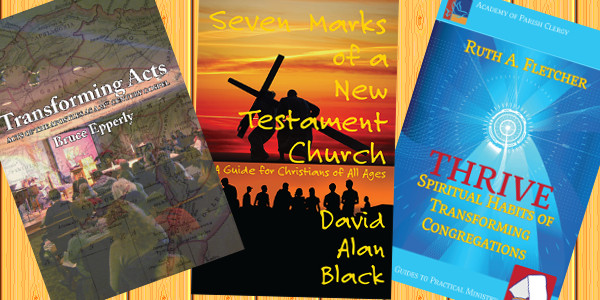
 One of the interviews I conduced with Dave was about his book Seven Marks of a New Testament Church. Dave goes back to the book of Acts for keys to how the church should behave now, in the 21st century. And this brings up a very different spectrum: church structure.
We could make a spectrum that runs not from conservative to liberal, but from strongly hierarchical to mutually submissive, from high church to low, from central control to local. Similarly we might look for a spectrum of views on who is in charge of the church, how much, and in what way. That could run from Jesus in charge directly to a highly hierarchical view of how the lordship of Jesus is implemented in the life of the church. None of these would exclude people from any liberal-conservative, charismatic-evangelical, or any similar ideological spectrum.
My plan is that as soon as I’ve posted my interview with Dave on his Seven Marks book, I’m going to start blogging through the Marks. As I do so, I’m going to bring in points from some other authors, such as Bruce Epperly, whose book Transforming Acts: Acts of the Apostles as a 21st Century Gospel also goes back to Acts to ask what we can do in the church today. Beside both of those I’m going to reference the book Thrive: Spiritual Habits of Transforming Congregations by Dr. Ruth Fletcher. There are definite differences of approach in these books, but there are also many points of contact.
So I’m going to ask two questions in my series:
- Can we find a way to apply these seven marks in other theological and ecclesiological traditions? (I fully believe we can, though there are places where our ecclesiology needs to change, and that’s a good thing!)
- More specifically, how can a United Methodist congregation look back to the New Testament and so become a more authentic witness for Jesus in the world today? There are those who would say many of these ideas are not possible under denominational rules, but I wonder. How much would a simple commitment to being “servant of all” on the part of those at the top of the organizational chart might change the reality without altering the paperwork?
So watch here over the next week. I’ll post the video and then begin the discussion. I hope I can find some people to discuss this with me vigorously. My comment policy is largely open. If you don’t threaten the family friendly nature of the blog, you can express yourself.
-
From My Editing Work: Neglecting the Gospel
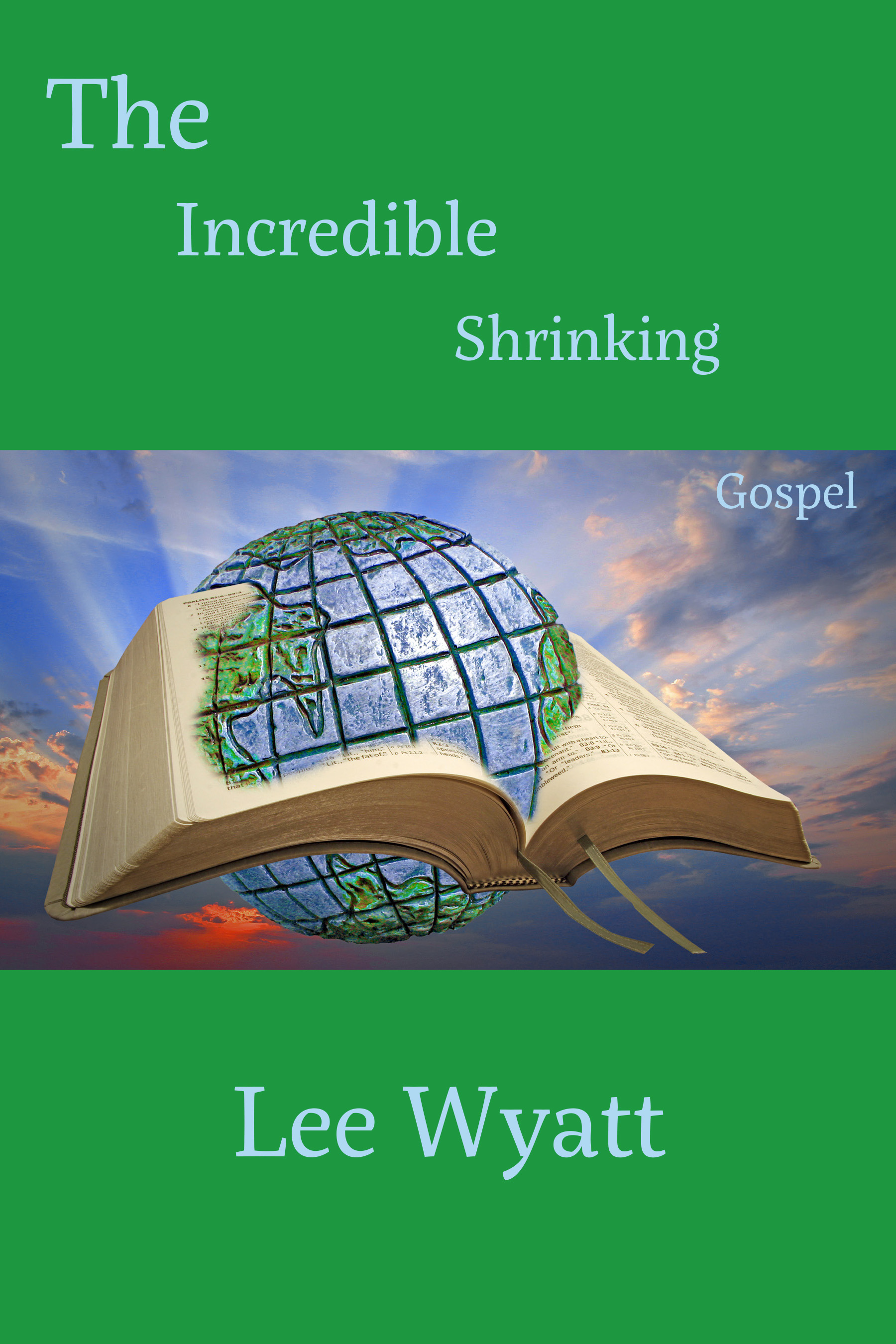
 This is from the forthcoming book The Incredible Shrinking Gospel by Lee Wyatt. Formatting progress doesn’t allow me to tell you the precise page number.
Oddly, his [Jesus’] ministry as we find it in our canonical gospels suffers considerable neglect in North American churches at present. Conservative churches tend to find their theological center in a view of Paul and his teaching largely shaped by the issues of the Reformation in the 16th century rather than the 1st century Jewish setting he actually lived in. Thus they work out their theology in a rather surprising neglect of the gospels. There is nothing wrong with Paul, of course, understood in his own setting. But he himself, by his own testimony, builds on the foundation which is Christ (1 Corinthians 3:10-11). So I believe we ought to return to that (oft neglected) foundation ourselves.
Liberal churches focus more on Jesus but tend to treat him largely as a moral example and inspiration for our own efforts to be faithful Christians in the world. But surely the Jesus we meet in the gospels is much more than, though certainly not less than, a moral example for us to follow. This reading misses the fullness and depth of the drama of the Jesus story. Thus, a rereading of the Jesus story certainly seems in order.
Followed by this comment in chapter 2:
What I am calling “The Incredible Shrinking Gospel,” got that way by virtue of both a “shrunken” biblical story and, in consequence, a truncated theology. Somewhat Esau-like, we have “despised (our) birthright” (the biblical gospel) in favor of tasty “red stuff” (the incredible shrinking gospel) that promises to slake our immediate hunger but will leave us thirsting to eat again very soon.
This book will be on pre-order on Energion Direct by tomorrow morning and I’ll publish a direct link at that point.