Threads from Henry's Web

Category: Bible Passages

  • Psalm 119:131 – Panting

    Psalm 119:131 – Panting

    With open mouth, panting,
    I long for your commands.

    This couplet poses some challenges in producing a readable translation, even though there’s little doubt of the meaning and feel of the verse. Even Mitchell Dahood, usually very creative, translates in a fairly straightforward fashion: “With gaping mouth I panted, / because I longed for your commandments” (Anchor Bible on Psalms, volume II).

    Another good translation is this:

    Parting mouth gaping I sigh heavily
    for to your commandments is my longing

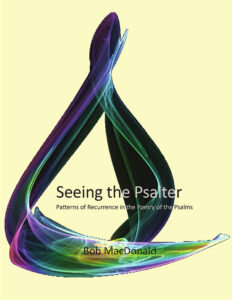
    Bob MacDonald, Seeing the Psalter, p. 386

    Now I haven’t mentioned before that Bob MacDonald translates Psalm 119 as an acrostic in English, which helps give it more of the feel of reading the Hebrew text. Some constructions in Hebrew are shaped by the acrostic form of the whole poem. Hebrew syntax is more friendly to the creation of an acrostic than English, with somewhat more flexible word order, but there is still more common ways of ordering words.

    In this case, a little bit of apparent discomfort is conveyed by the wording, and I think Bob has caught that. The feel of reading the poetry has the sort of discomfort that relates to the state of mind described in the text. Bob notes that: “parting gaping, פער (p`r) gape with desire as a ravenous beast but gape needs help for the acrostic” (p. 389). Yes, it helps the acrostic, but I think it also gives us the feel.

    Translation is interesting. A translator is always presented with the question of just what to transfer in translation into the new language. Bob MacDonald, for example, takes a rare path of transferring the acrostic, which presents a number of challenges, especially in conjunction with other goals he has in conveying the relationship of words in the Psalm. You’ll need to read his book, Seeing the Psalter, to get a full understanding of what he conveys.

    It might help us to understand this process if we consider communicating about an area of specialty to someone who does not share our specialization. I help people with problems on their computers frequently, and most of the people I help don’t share the language or often the concepts I tend to use. In ordering to communicate, I have to try to speak in terms that can be understood not just by the non-specialist, but by someone generally computer-naive, by which I mean they really aren’t sure what a web browser is. They get pretty close to panting, longing to know just how to get something done, or even how to explain to me just what it is that they are seeing.

    Many times I have either followed up a conversation by remote access to the person’s PC or even a visit, and found that what I had imagined the problem to be was not even close. They had a completely different problem than I imagined. I’ve gotten better at this over the years, but the gap still occurs.

    In terms of God’s commands, or just right and appropriate action we can have a similar problem. We have principles in mind. We want to get things right, but our understanding just doesn’t stretch. Applied to our situation, the translation of principle into action can take an amazing amount of effort.

    There is an inherent disconnect in our communion with God. We do not perceive infinity. As Paul says, we see partially, we await what is perfect, we do not have it in our possession. It’s a good idea to recognize this struggle for God’s commands. It’s an appropriate struggle. It’s one of the reasons that we are directed not to judge. We know partially; we judge partially.

    Let’s keep the desire and lose the judgment.

  • Psalm 119:130 – Light

    Psalm 119:130 – Light

    When your Word is revealed, light shines,
    giving understanding to the naive.

    This is a very important verse to me, and I think it is often misunderstood.

    I was raised on Bible-based materials. I studied that way in school. I spent a good deal of time with it in school. I had a disagreement with my mother about when I first read the Bible through. She said it was when I was around 9 or 10 years old. I recall reading it all the way through in my early teens. As an elementary student at a school with a Bible-based curriculum I memorized Bible passages in large quantities, including the chapter I’m writing about, all 176 verses of it.

    When I went to college and determined to study the Bible I majored in Biblical Languages, thinking this was the way to get back to the sources. With the weight I put on the value of scripture, I wanted to be as accurate in my knowledge as I possibly could because knowing the words contained in scripture was, I thought, of great value.

    It took me a very long time to get past the collection of words and data from and about scripture. I used the word “naive” in my translation of this verse, and I was naive in my approach to scripture. It was not only not possible for me to get to a 100% bedrock understanding, based only on my study, it was also not particularly desirable.

    That question drove me away from the church and from fellowship. I still enjoyed the study of and the text of scripture, but it was no longer a driving force as it had been. It was, instead, a bit of a hobby.

    Then I came back to it again. Marcus Borg wrote a book titled Reading the Bible Again for the FIrst Time. While I don’t agree with everything Borg teaches, I enjoyed the book. I empathized with the experience, because by the time I read his book, I had had a similar experience. The reading of the Bible became something very different to me.

    One very important change was that instead of looking for a simple, totally coherent system of beliefs about God, I began to seek to know God. When I began to seek to know God rather than about God I also began to see that the Bible points outside of itself to manifestations of God’s Word. By God’s Word were the heavens made (Psalm 33:6-9). This told me that God’s Word extended everywhere.

    I also saw in the Bible a great deal of diversity. Instead of seeing repetition of “sameness,” I saw God working in multiple ways in the stories of the Bible. I saw even more diversity in the way the stories of the Bible came to be presented as they were. I saw the way in which the Bible pointed to people who heard from God and who spoke for God. I saw a church in the New Testament where hearing from God and sharing were part of worship (1 Corinthians 14, for example).

    “Bible-based” no longer filled the requirement for me. “Based in the Word of God” came much closer, but only when we allow ourselves to understand that for those who are willing to listen, for those who are willing to see, for those who are willing to hear, and for those who are willing to imagine, God’s Word is everywhere.

    God’s word is just waiting for an opportunity to enter, an opportunity to make the naive wise.

    “I can never get away from your presence!” (Psalm 139:7b, NLT). No, for a God who is everywhere, that’s true. The problem is that we’re extremely capable of getting away from an awareness of God’s presence. The entrance of the data does not give light. The entrance of God’s Word creates knowledge and wisdom. It’s waiting for us to perceive the God’s presence.

    I’m amused by our common expression regarding an especially powerful meeting: “God was sure present in our worship service today!” That’s not how it works. God is definitely present. The question is whether the worship service is conducive to helping us perceive that presence.

    Similarly, a daily question, whether I’m in my home or my office, or traveling somewhere in my car, or taking a walk, or whatever I may be doing the question is whether I’m perceiving God’s Word in what I see. If I’m writing prose, poetry, or fantasy fiction, I can be perceiving God.

    Because God’s Word is absolutely everywhere.

    Are you going to perceive it today?

  • Psalm 119:129 – My Soul Keeps Them

    Psalm 119:129 – My Soul Keeps Them

    Your testimonies are wonderful,
    so my soul keeps them.

    The Revised English Bible uses “gladly keep” for “my soul keeps.” The image here is of keeping from inside, from what you are and desire. Non-formal English translations avoid the literal rendering of “my soul” in doing various things, but the idea there is “from the heart” or “from inside.” In this case the NLT uses “No wonder I obey them,” which doesn’t seem to me to quite get the intent of “my soul.”

    It’s interesting, however, that in the magnificat (Luke 1:46), the NLT does use “soul,” with “Oh, how my soul praises the Lord.” I think the idea of my soul praising the Lord comes more easily from tongue and pen to a modern writer or translator than the idea of having an inward love of the law.

    There’s another side to this. We tend to feel that it’s somehow more pious and holy to do something just because God said to do it. Similarly, we often praise children for obeying their parents without questioning. A child who hears a command, thinks about it, and then does it because they think it’s a good idea, doesn’t seem all that obedient.

    But ultimately God’s law should work out logically. That doesn’t mean we understand everything about it. It does mean that we should think about the ways in which God’s laws are wonderful. A good exercise is to take a law you accept by faith, for example, a command from your Bible, and work to present it as a good and rational thing to someone who doesn’t share your faith.

    You’re getting somewhere if you can do this without rationalization or special pleading. Ultimately, however, if we believe God’s word created the universe and ordains all those laws which provide order, we should be able to present them as a good thing. They are not just wonderful because we think they are God’s laws. They stand testimony to God by being recognizable as wonderful.

    Try looking at things you do today. Can whatever makes you do these be regarded as wonderful? Or are they a burden?

  • Psalm 119:128 – All

    Psalm 119:128 – All

    Therefore I completely keep all your precepts.
    I hate every false way.

    I think I say something about how many ways one could go in meditating on each of these verses, and I certainly could. Today I’m thinking about this line especially from a Christian perspective.

    I recall a young man coming to my door with his wife and his KJV Bible in hand, intending to convert me. It did not bother him that I was already a Christian. It was his duty to straighten out my theology in a hurry. Among the various things he told me was that the Sermon on the Mount did not apply to Christians in the “church age.” It was for the Jews and for a special transitional stage between the old covenant and the new covenant.

    Our discussion roamed through the New Testament. Passages from Hebrew Scriptures were not of importance to him. I think we spent more than an hour not communicating with one another.

    As he got up to leave he said he was worried about my salvation. “I have given you nothing but Scripture but you haven’t given me any scripture at all.” He paused. “Well, except for Matthew, and Hebrews, and James, and they don’t count.”

    Now when I read the Sermon on the Mount as recorded in Matthew, I find sentiments that fit with this passage. Not only is Jesus saying to keep all the law all the time, but he’s asking us to keep the law in our hearts. If one is angry at someone that person is guilty of murder.

    I can see why someone would want to dismiss the whole thing as applying to someone else. Big sigh of relief! It sounds pretty holy, but I don’t have to do any of it.

    We often talk and act as though the big problem with Israel was that they had too many laws or that they were too intent on keeping them. That misses the point that God gave Israel all those laws. God said they should keep all those laws. Leviticus (19:2 and other places) says to “be holy for I (the LORD) am holy.” Matthew 5 doesn’t back off from this, saying that unless your righteousness exceeds that of the scribes and Pharisees, you will not enter the kingdom of heaven, and then in 5:48 “Be perfect, as your heavenly father is perfect.”

    Old Testament or new, there is nowhere in scripture where God’s plan is not a plan to create a holy people. The thing we need to catch on to, and bluntly, that I think the psalmist has 100% is this: God’s call is for completely keeping all the commandments, while at the same time, he recognizes in many other verses that it is only through God’s power that this is accomplished.

    I’m again going to refer to the last verse, sort of a spoiler! “I have gone astray like a lost sheep. Seek your servant….” Note that it does not say, “I have gone astray like a lost sheep. Your laws are too tough, give me an excuse.” He does not say, “I have gone astray, please fix the map so it records that I am on course.

    There is a glorious purpose to which God calls us all, and to which only God can bring us. We can’t attain this, but God can. And God promises to do precisely that.

    Keep your eye on the goal. All * Completely.

  • Psalm 119:127 – Better than Gold

    Psalm 119:127 – Better than Gold

    Thus I love your commandments
    more than gold, than fine gold.

    I once told a group that if they wanted to find out if this is how people feel, leave some gold on the pew beside a Bible, and see which goes first.

    Of course, that misses the point in many ways. Just to start, I own a very large number of Bibles. They are in a variety of languages, including some I can’t read, and in various editions. I have study Bibles from different perspectives. I never have a problem laying hands on a Bible.

    But this doesn’t mean anything about my Bible knowledge or my commitment to my faith. Those Bibles sitting on my shelves may have a monetary value, but it’s not in comparing the book to some measure of currency that you can discover what is of value to me. The vast majority of these Bibles, in fact, represent something I accepted for some currency, a modern version of having some gold.

    And yet my paying for these books doesn’t tell you what value I place on God’s word. You may find God’s word in any of those volumes, but the question is whether, having access to it, and knowing what it is, you value it.

    For example, what amount of money would it take to persuade you, or persuade me, to violate one of the principles we would learn from one of those Bibles? Or, for that matter, one of the principles we might learn from God’s word manifested in the physical world around us.

    The question is rarely going to come in the form of some bars of gold, or a stack of printed currency with an instant choice. Rather, it’s going to come in day to day actions.

    What do you do, for example, if you have a choice of service versus wealth? Would it not be likely that you, or I, would choose the higher paying option and tell ourselves that we will contact the right people in that higher paying job? But supposing instead that the choice is between a higher paying and higher profile job that would let you serve, and because you, or I, don’t like the limelight we choose something a bit less?

    In each case the question is just what is driving us. Too often we take the simple path and assume that someone who is rich has sold out and someone who is not rich must be a true servant of God and others. Or we can take the simple path of assuming the rich person is the blessed person, and the one with less has missed God’s law.

    It is never that simple. The question we need to ask is where God’s commands will lead us. That might be to wealth, and it might be to poverty. On the other hand, wealth might be leading us to perdition, or on the other hand it might be leading us to a place of value in God’s kingdom.

    What values are driving you today?

    (Featured image generated by Jetpack AI and edited with Photoshop.)

  • Psalm 119:125 – Teach Me

    Psalm 119:125 – Teach Me

    I am your servant. Teach me
    and I will understand your testimonies.

    As I read this verse late last night, I had the feeling that I’d talked about just about every element of it. I’ve been pointing out repeatedly that every claim to have done something in some way reflects another when the psalmist acknowledges dependence on God. There are verses expressing thanks for the law and hope in God’s promises, and also those expressing the pain of waiting.

    This verse puts a great deal of the whole message of the psalm in a very few words. “Teach me and I’ll understand.” God is the source of law, testimony, and yes, history itself. And God is the best teacher.

    This led me to thinking seriously about the entire psalm. One of the things that can make scripture hard to read and understand is the variety of literature we find, not to mention history and background. We rarely have the patience for reading a passage as a whole. I recall once making a suggestion to someone planning worship that it would be nice to either use all four lectionary passages as part of the order of worship, or to imitate them by having the same variety.

    One of the most powerful worship services I have ever attended involved an extensive set of readings. I believe it was Year a, 3rd Sunday in Lent, with John 4:5-42, Romans 5:1-11, Exodus 17:1-7 and Psalm 95. The one I recall was the full scripture reading of John 4:5-42. I was already both impressed and blessed by the inclusion of all the readings in the service, but then the pastor began to preach, and he tied every one of those passages into his message, weaving a tapestry about God’s work of redemption from all of them together. He ended with the service of Holy Communion and as he spoke the words, he again wove material from all those readings. He combined the reading of scripture, the exposition of scripture, and the application of scripture in the form of worship into one single picture and message and then called the congregation to go forth and live it.

    This commitment to bringing these various elements together as a whole is very important in itself. Understanding some relationships, historical and liturgical, is very helpful in building a community that serves God and humanity. Tied into a message of hope and redemption, the service of Holy Communion can be an experience of spiritual renewal. Seeing an example of careful, thoughtful construction of a worship experience is a message in itself.

    That is what I feel when I read this Psalm. Yes, there are so many pieces. It’s easy to feel that it’s scattered. But if you have the patience to observe, to absorb it, and look for how everything fits into an expression of prayer, praise, worship, and instruction, you’ll find a very powerful piece of literature.

    If you have an opportunity to study this in Hebrew, you can add the craftsmanship of presenting it as an acrostic. This craftsmanship is also a form of praise and teaching. God can be worshiped in and with beauty, structure, imagination, imagery, and sound.

    One of the ways God teaches us today is by the preservation of this kind of literature by which we can learn. Poetry in the heart reflects God’s poetry of all creation.

    How will you join your heart and voice with this poetry today?

    (Featured image credit: zamrznutitonovi licensed via iStockPhoto.com

  • Psalm 119:124 – Grace

    Psalm 119:124 – Grace

    Deal graciously with your servant
    and teach me your statutes.

    I’m going to use the words of this verse, written long before there was such a thing as a Christian, to discuss a peculiarly Christian issue: Sanctification.

    Sanctification is a long word for becoming or being made holy, and “holy” is a word that we’re often not that sure about, though we act like we are. We can have a high concept of our own holiness, which usually manifests itself as self-righteousness. “Look how holy I am! I’m closer to God than you are!”

    We quote or paraphrase Ephesians 2:8, “For it is by grace that you are saved and not of works, lest anyone should boast.” But at the same time we have a picture of what a good Christian should be, and we’re quick to judge other people who don’t fit into our vision of Christian behavior.

    The result is that we’re often judging our salvation and that of others based on our perception of their holiness, or on what they have done. This is the unfortunate result of us being afraid to talk about works lest people think we’re basing our salvation on our works.

    But look at this verse. The word I’ve translated “graciously” is more literally (and commonly) translated “lovingkindness,” which is God’s love given to us. I think “graciously” gets the point. So when God deals graciously with us, what does God do?

    God teaches us statutes, rules to live by.

    You see, salvation is not just a gift of getting out of whatever nasty results we can expect in the next lives based on our behavior. It’s not a “get out of hell free card.” Well, actually it is, but it’s so very much more. And you can see the same divine approach with Israel. Israel is called to be God’s people. They become God’s people not because of something they’ve done. Passages from Genesis 12 when Abraham is called through Deuteronomy emphasize this.

    The rules come afterward. What is their purpose? Their purpose is to produce a holy people. That’s the plan. So I guess we ought to get busy and get this sanctification thing done, right?

    Not even close. Becoming a holy people is also God’s gift, which starts with the gracious gift of God’s law, carefully packaged to fit the circumstances of those who receive it. “Be holy for I am holy,” is repeated over and over in Leviticus. It’s a call, but the call is to receive the gift. When King David is called to be a man after God’s own heart (1 Samuel 13:14), it is not because he as done everything perfectly, or because he will lead a perfect life, but rather because he will be open to God and allow God to work in and through him.

    “Teach me your statutes” is a call to the one who empowers everything in the universe to empower one’s own life.

    What can God do in you today?

    (Featured image generated by Jetpack AI.)

  • Psalm 119:123 – Patience

    Psalm 119:123 – Patience

    My eyes have failed looking for your salvation,
    and for your righteous word.

    Any number of people have told me that I shouldn’t pray for patience. If I do, God will doubtless send me all kinds of trials and keep me waiting so as to teach me patience by experience.

    I think it doesn’t matter if you pray for patience or not. You’re going to get an opportunity to learn patience by experience.

    The psalmist is living, well, life! I think we can all relate. From childhood trips when we doubtless drove our parents nuts by asking “are we there yet?” to expectations of other people, to our hopes even in old age for new blessings to come–and even to looking for the end of long sentences–we have opportunities to practice patience.

    Usually we don’t. If you keep wondering why your patience is being tested so much, you might consider whether you are actually gaining patience or just repeating our experience of extended impatience.

    But one of the experiences of Christian life, and yes, the lives of people of other faiths, is that things we hope for, whether they are secular in nature or the result of a perceived promise by God is delay.

    One of the big ones for Christians is the wait for the second coming of Jesus. How are we doing with that?

    Well, I grew up as a Seventh-day Adventist. Back in 1844 (well, first in 1843), Adventists calculated that Jesus would return on October 22, 1844. The history books, not to mention we’re still hanging out on this planet, suggest that prediction wasn’t right.

    I don’t bring up SDAs in order to laugh at them, but rather to point out just how normal is this is. People continuously set dates for the second coming. Many more don’t set dates, but come up with various reasons to declare that the second coming is “really near” now. We’re obviously in the last days, because [list of things we don’t like about the world here].

    In growing up I remember evangelists coming by regularly, and in order to provide the appearance of an audience when really very few visitors showed up, we’d all attend. After a time I started to notice a problem. At one point I remember wondering why Russia (the USSR back then) wasn’t part of the prophecies of the end, considering how much the older folks talked about it. A couple of years later, Russia suddenly appeared in one of these evangelistic meetings as a really-truly sign that the end was really near.

    Our eyes just get worn out reading all the explanations of why the end hasn’t come yet and why we ought to keep hoping for it.

    There’s a good side to staying on the watch for God’s promises. I think that’s what the psalmist is pointing out. No matter what has happened, no matter how long he has had to look, he has kept hoping. That is a good thing.

    Trying to make up the result you want–not so much. Perhaps we would be better to “evangelize” about the good news that Jesus loves you now and invites you into his family, rather than trying to pin down the time when he appears in the clouds. Making new predictions can just be wearing on our eyes and our hopes.

    And as someone pointed out to me today, the one thing we can’t do is give up. Ultimately that is what patience is about. We practice patience when we keep moving forward and don’t give up.

    What opportunities will you have to practice patience today? Will you take advantage of them, or will you just demonstrate your skill at impatience?

  • Psalm 119:122 – Are You Beastly?

    Psalm 119:122 – Are You Beastly?

    Be the assurance for your servant’s well-being;
    Don’t let the arrogant oppress me.

    Do God’s rules for living actually work?

    This is one of those questions that usually gets a pious answer. “Of course they do!” But do we really mean it?

    When we see a crisis, do we turn to God or do we turn to human answers: human politics, human authority, self-reliance, and self-serving?

    I think these things we should each consider seriously. There are so many individual choices concerning which we can disagree. My father spent World War II in a camp in Canada, planting trees. He did not believe it was right for a Christian to bear arms, even in defense of his country. His government did not give him the option of serving in the medical corps. So he planted trees.

    I, on the other hand, served 10 years in the United States Air Force voluntarily. I was not in the medical corps. I believed then as I believe now that a democratic nation requires a military establishment that carries out the lawful orders of the civilian authorities.

    It would probably take some time to debate this, and I doubt that I would come to agreement with a pacifist. But I respect my dad’s position and I respect the position of even more committed pacifists. When they ask what Jesus would do, they can’t imagine participating in warfare as an option.

    The question I’m asking today is simply whether you have considered whether you are carrying out the vision of Jesus, or when things get difficult to you resort to the methods of the enemy?

    In a post I wrote on Revelation 12 & 13 some time ago, I made a list of “beastly attributes.” Here they are:

    1. Tears down others – 12:4, drawing 1/3 of the stars. Beasts and dragons rarely fall alone.
    2. Consumes and destroys – 12:4
    3. Is not the greatest power – 12:8. Note that verses 8 & 9 compile a great deal of what is now Christian belief about the Devil. The imagery hear draws on a number of passages in Hebrew scripture.
    4. Persecuter – 12:13
    5. Sweeps people/things away – 12:15. It’s humorous to note here that there is a single Greek word for “carried away by a river.” There’s got to be some history for that word!
    6. Angry with those not on his side – 12:17.
    7. Speaks blasphemy – 13:1,5.
    8. Though not the geatest power (see #3), operates with great authority – 13:2.
    9. Puts anger into action in war with the “other side” – 13:7.
    10. Wants all the attention and worship – 13:13.
    11. Deceives – 13:14.
    12. Applies force to get worship – 13:16-17

    I then (May 22, 2024) asked whether we, in the church, are making an image to the beast. Beasts want images.

    In that post I asked the question:

    So what image do we display through our churches? When someone looks at the reality, is the beast behind the image, or the lamb?

    I’d extend that question to this: When someone looks at your life, do they see an image being built to the beast, or to the lamb?

    Let God make the right image in you today. (Philippians 2:12-13).

  • Psalm 119:121 – Don’t Let Them Get Me!

    Psalm 119:121 – Don’t Let Them Get Me!

    I have done what is just and right,
    Don’t let my oppressors get me!

    My translation is a little more informal today. I get to do that since I’m not writing a translation of Psalm 119, but rather meditating on each verse.

    Do you sometimes feel like people are after you? I do!

    But for me it’s not people who are enemies or oppressors. It’s friends, clients, and customers, and even potential candidates for one of those relationships.

    I recall coming in a few days ago and telling Jody, “I could deal with people not needing me any more.” I had been answering computer questions, Bible questions, and questions about publishing for a couple of hours and hadn’t been able to get away from my phone and computer screen even for a moment of thought.

    When that happens, I start to wonder if I’m giving people useful answers or even understanding their questions. I begin to wonder if I’m giving the right person the answer. I come to a point where it’s imperative that I ignore the phone, the emails, and texts for a period of time and reorient myself.

    Not one of those people were actually enemies. They were, in fact, all people whose relationship I value.

    I wonder how often we drive ourselves, or more precisely I drive myself, to these lengths, not by what others expect of us but by our own unrealistic expectations of our own performance. I know at the moment that there are many things that it would be good for me to get done that I can’t. I am a caregiver as well as carrying on my business and doing some ministry work apart from that. That means some things don’t get done.

    I think our verse refers more to an appeal to God for protection based on one’s efforts to do right, protection from those who are hostile.

    But what about protection from friends? No, that’s not really it. How about protections from myself? Lord, don’t let me fall into my own oppressive hands!

    Yep, I’ve strayed from the verse, but I can’t resist another note advocating meditation. For me, the time when God speaks to me is when I’m meditating on a passage of scripture, and sometimes that meditation leads me well away from the direct meaning of the verse.

    Over the last few weeks I have more and more frequently been telling people that I can’t answer right now and then setting a time when I can. And you know what? Nobody has gotten upset about it at all. They’re all willing to work with me in order to fit their particular questions/needs into my schedule.

    Who is the oppressor? I am.

    Lord, deliver me from me!

    (Featured image generated by Jetpack AI, and very slightly edited by me.)