Threads from Henry's Web

Category: Bible Passages

  • Psalm 119:172 – Sing Some More!

    Psalm 119:172 – Sing Some More!

    I will sing praise of your word,
    for all your commands are righteous.

    Though I did not translate literally in either case, I will note that there is a succession of terms used here. Verse 171 has the lips doing the praising, and in this verse, it’s the tongue.

    Why do we praise laws?

    In general, I’d say, we’re inclined to praise laws that prevent other people from doing things we don’t like, but to chafe at laws that restrict our freedom to do what we want. A law is “righteous” if it applies to others, and oppressive if it applies to us.

    The Psalmist describes all God’s judgments as righteous. As I’ve noted before, the Psalm does not specific authorship, but if we look at the traditional Psalmist, David, we can see that while he might not recognize his own guilt easily, when confronted with it by God’s messengers, he was able to acknowledge it. He was a king, but he was also subject to the will of God. (For an example, see 2 Samuel 11, the familiar story of David and Bath Sheba.)

    The problem that many of us have in relating to laws is very simply a lack of empathy. We cannot imagine ourselves in someone else’s circumstances, and thus we often miss what various actions and rules might mean to that other person.

    One of the critical elements of God’s laws is the need to be concerned for others. In Leviticus 19:18, the Israelites are commanded to love their neighbor as they love themselves. Jesus picks this up in his statement of the two laws.

    One cannot carry this law out without empathy. One has to have some understanding of how to apply love to one’s neighbor if one is to actually love that neighbor. When Jesus gives the golden rule, “Do to others as you would have them do to you” (Matthew 7:12), he makes empathy even more important. You again have to be able to think about what your neighbor might want in order to carry out this law.

    Some leave out this empathy in expressing how to fulfill this law. They figure that if they would like something particular done to them, that must be good for their neighbor too. But if you think about it for a moment, you’ll realize that what you’d like is for your neighbor to do to you something that you would like done. That means that to reciprocate, you need to look for something your neighbor would like done and do that.

    Let me illustrate with a simple case. My wife and I are very different. When we were setting out to get married 25 years ago, many thought it would never work. It has. There are several reasons for this, but the key reason is that we recognize and celebrate our differences.

    Jody likes to make a big deal of birthdays. She likes lots of people around. She wants them to have fun. She wants to be part of the crowd. It’s a big show. I like to try to arrange as much of that as I can. Why? Because she likes it. That’s it. I don’t need any other reason. She enjoys that celebration.

    You may imagine that I also enjoy such a celebration, but you’d be wrong. If I could, I’d keep my birthday secret. I don’t mind a few greetings, and appreciate that friends notice, but I don’t want a party or any large gathering of people. I find the idea of getting a bunch of friends together for a meal with cake and all that stuff to be rather annoying. Please, leave me alone and let me enjoy my birthday!

    Jody recognizes what I like, and she will keep things toned down and low key. I really appreciate this.

    This is an example of doing to something else what we would want done to us. Step one is finding out what the other person would like, just as you would prefer that they find out what you would like.

    Let me bring this back to our text. All God’s judgments are proclaimed to be right, and that is praiseworthy. Those who don’t care about someone else wants only laws that work in their own favor. Those who do care, those who have empathy, want laws that work for the good of all.

    Leviticus expresses this “good of all” approach in 19:15, “Do not twist justice in legal matters by favoring the poor or being partial to the rich and powerful. Always judge people fairly.” Fair judgment requires seeing the whole context, something not possible to the self-centered and unempathetic.

    How about trying to really understand what one other person wants today?

    (Featured image generated by Jetpack AI.)

    I want to call attention to two posts on empathy from Energion authors. Idea Summary: Empathy is drawn from the book The God of the Growing Edge by Dr. Bruce Epperly. Empathy is Essential is by Dr. Dolly Berthelot. Both look at empathy and its impact on our actions in society. Dolly is also the author of PERFECTLY SQUARE, a fantasy fable about dealing with change and diversity, something that also requires empathy.

  • Psalm 119:171 – Sing Praise!

    Psalm 119:171 – Sing Praise!

    Let my lips sing your praise,
    for you have taught me your statutes.

    The underlying theme of Psalm 119 is praise to God for the law. The law is righteous. The law is good. Good things come of keeping the law, even though we have to ask God for the strength to do so.

    I find the relationship of may Christians to the law quite interesting. There quite an interesting theological/biblical discussion between various groups, particularly Lutherans, Calvinists/Reformed, and Wesleyans about the relationship between the law and gospel. As an introduction, let me commend the article on Wikipedia on Law and Gospel, though doubtless many, myself included, would pick at various points.

    In practice, however, we tend to simultaneously declare that we are saved by grace through faith, but then only apply this to the moment of salvation, of becoming part of God’s family. At that point, most of us would say that we are not saved by keeping the law. So we have a distinction here, because law is not the agent, even though law definitely has a role.

    But we turn from that and, whatever we may proclaim, we become people of rules. We want the ten commandments in schools, as though better morality will be achieved because of a display of the ten commandments.

    We aren’t really praising God for the law through all this. Rather, we’re considering that we have to have a stick to use to beat people into proper order. We ditch gospel and grace and become another behavior modification program.

    This is exemplified by the plea I have heard frequently from parents and friends, “Help me get my child/friend back into church.” The goal is to get them into the church structure and organization, such that their behavior can be made more … I’m not sure if it’s more Christlike or more Churchlike.

    I recall having this discussion in a church my mother attended, which she called, to their face, the church of the gottas. You gotta do this, you gotta do that. Having been saved by faith, or rather having been shoved across the starting line by grace received through faith, you gotta get busy running the race and making sure you get everything right.

    My own experience with teaching about tithing is an illustration. Is tithing a command applicable to Christians? For a long time I struggled with the fact that I couldn’t see that it was, yet as part of the leadership team of a church, I was afraid to say so, lest people give even less. I was already irritated by people who spoke of “tithing” 1% or 2%. “Tithing” refers to 10%, though 10% of what is subject to some controversy. But if you’re giving 1%, you’re not tithing.

    My concern, or to be honest, fear, was that if tithing was not a rule, then people wouldn’t give, and then programs of the church that I hoped would be well funded, such as children’s ministries and missions, would suffer.

    It took me a long time to realize that grace was the only thing that was ever going to bring sanctification, including sanctification of our wallets, doubtless the least sanctified of our possessions.

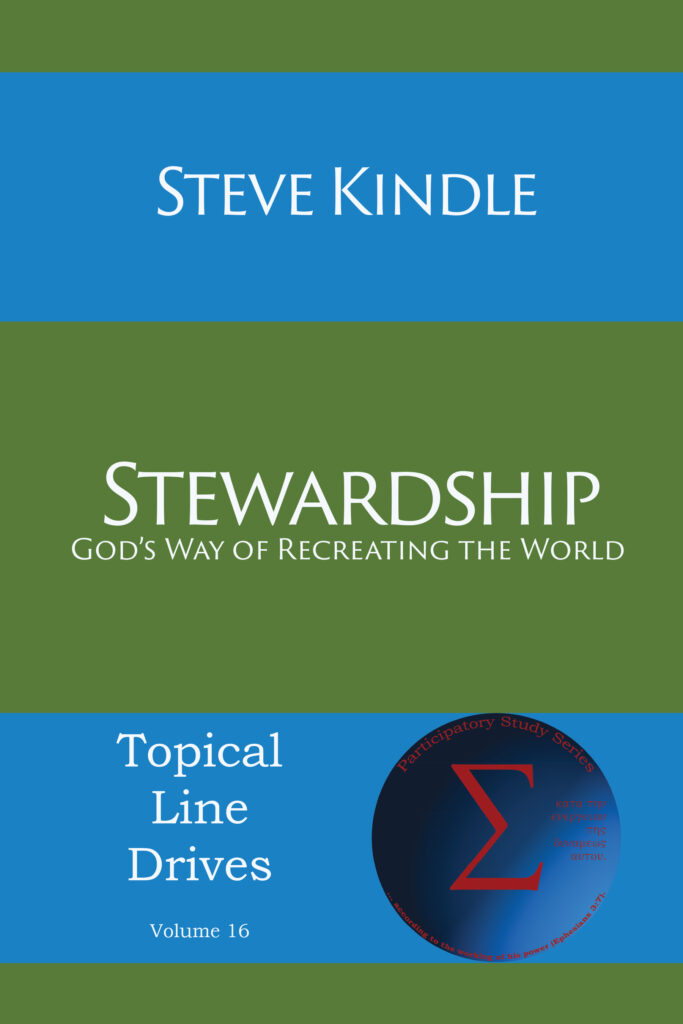
    The bottom line was that in Christ, everything is dedicated to Christ and we make our decisions on spending and giving based on that fact. I had come to this conclusion, but hadn’t expressed it all tat well until I read as an editor, and published the little book Stewardship: God’s Way of Recreating the World by Steve Kindle.

    Here’s a selection from page 25:

    The questions around how much to give are too often reserved for “Stewardship Drives.” So we compartmentalize our giving and tuck it away for another year. In all the talk of stewardship, seldom
    does it go much beyond the pocketbook. Whenever stewardship is reduced to a program, something is terribly wrong, and congregations and individuals continue to struggle.

    The apostle Paul revealed to us the key to successful fundraising in his appeal to the Corinthian congregation to assist in the collection he was taking up for the Jerusalem church. His formula:


    3For, as I can testify, they voluntarily gave according to their means,
    and even beyond their means, 4begging us earnestly for the privilege
    of sharing in this ministry to the saints— 5and this, not merely as we
    expected; they gave themselves first to the Lord and, by the will of God,
    to us,… — 2 Corinthians 8:3-5

    The Macedonians, in spite of their poverty, begged to give to the Jerusalem church—even beyond their means—because they first gave themselves to the Lord. Sure, it is possible to raise a lot of money using sophisticated methods based on psychological triggers and emotional appeals. These are too often resorted to as substitutes for the Macedonian way. A congregation that first “gives themselves to the Lord,” recognizes their stewardship partnership, and everything they do springs from that commitment. So let’s not encourage tithing, that’s about money. Let’s encourage
    seeing all we have as God’s and act accordingly.

    Steve Kindle, Stewardship: God’s Way of Recreating the World, p. 25

    This same approach applies to everything about Christian living, and it’s something we should pay attention to. If we could focus on that connection to God, and the motivation of love that is involved with it, better behavior, empowered by the Holy Spirit, would be the result.

    When we see the law in this way, as a gift, and as a description of what might be and what God is, we can receive it with praises. If it is a club to make people look and act like us, to be “churchy,” then it will always be a negative thing.

    But if we don’t focus on that core of being as the source of all we do, we will inevitably get back to a picky, rule-by-rule attempt at behavior modification, which is sure to fail in the end, not to mention causing a great deal of fiction along the way.

    How can you find joy in being and doing today?

    (Featured image is from Adobe Stock. Licensed, not public domain.)

  • Psalm 119:170 – Before You

    Psalm 119:170 – Before You

    Let my plea come before you.
    Save me according to your word.

    This sounds very similar to verse 169 and is closely related. My meditations, however, took a different turn.

    In Jeremiah 37:17-21, we have the story of Jeremiah being called to Zedekiah secretly. Jeremiah is confined in a dungeon in the house of Jonathan the Scribe, but nonetheless the king wants to know if there is a word from the Lord. Jeremiah tells the king that he, Zedekiah, will fall into the hands of the king of Babylon.

    At the end of their conversation, Jeremiah asks that his plea, using the same word for plea used in Psalm 119:170, come before King Zedekiah. This story illuminates the language, because Jeremiah is right in front of Zedekiah when he asks this. What he is asking for is that his plea be given a favorable hearing.

    I can turn now to the New Testament, Revelation 8:3-5:

    And another angel came and stood on the altar. He had a golden censer, and he was given lots of incense, so that he could offer it with the prayers of the saints on the golden altar which was before the throne, And the smoke from he incense arose with the prayers of the saints from the hand of the angel before God. And the angel took the censer and filled it with fire from the altar and threw it into the earth, and there were roars of thunder, and voices and lightning flashes and an earthquake.

    Revelation 8:3-5, my translation

    Here we have a divine answer to this standard plea. The prayers or pleas are not only coming up before God, but are combined with the incense of heavenly worship before God.

    Our plea is heard, according to God’s’ word.

    What is your plea today?

  • Psalm 119:169 – Understanding

    Psalm 119:169 – Understanding

    Let my cry come before you LORD.
    Give me understanding according to your word.

    This is the first verse of the last section of Psalm 119. There are 22 sections, each with 8 verses and all the verses start with the same letter of the Hebrew alphabet. We’re not at ‘tau’ or ‘tav’, the last letter. Just eight more posts to go in this series!

    Some translations (REB, for example) specify this as a cry of joy, but the Hebrew word used for “cry” can be either a cry of lament or of joy, and I see nothing in the context to indicate which it is.

    What I find most interesting is that when this cry comes before God, the request is for understanding. Many of us think we want understanding, but I think we often are less anxious for understanding than we might claim. Understanding is not always fun. There’s the humorous twist on a common saying, “The person who is not losing their head probably doesn’t understand the situation.”

    Complete understanding would likely be a burden. Since I don’t have complete understanding–at least I understand that much about the situation!–I can’t tell you for sure. But I’ve found that quite frequently more understanding doesn’t make it easier to deal with whatever’s going on. Sometimes what we’d prefer is an explanation that makes everything seem to make sense, even if it doesn’t actually do so.

    An example of this is “overthinking.” I’m personally and experientially acquainted with this phenomenon. It’s a serious problem for me. I’ll find myself unable to make a decision because I’ve spent too much time trying to understand all possible options and all possible errors. By the time I’m done, no option seems workable.

    Now overthinking does not necessarily mean “overunderstanding”. There’s no guarantee that extended time spent thinking will result in better decisions. In fact, in can be one way of not understanding. It also leads to one way of avoiding action and responsibility. One decides that the situation is so tangled that one cannot be expected to take rational action.

    One very difficult burden of understanding is that it can force us to realize that comfortable patterns of thinking and acting are not going to bring the desired results. I recall this in more than one business decision I’ve made. I’ve recognized that things were going badly and then gone to some trouble to analyze the situation. Often–very often–that results in discovering that some practice I’ve become comfortable with is simply never going to produce the desired results. But I like that way of doing things! It’s a project I don’t want to dump, or some other project I don’t want to give a higher priority.

    And then comes understanding in the form of spreadsheets and logical charts. The current course of action is never, ever going to work. I’ve been following it for weeks or months, but there’s no fixing it except to admit I was wrong and change course.

    I’m reminded of James 1:5: “If anyone lacks wisdom, he should ask God and it will be given to him …” Pretty clear and absolute, right? No condition stated. This prayer will be answered. “God give me wisdom.” “OK, you’ve got it.” And then we go stumbling on our way, or at least I do, still doing stupid stuff.

    Wisdom is a bit like the gift of a toolkit. You have to use it. You have to let it change you. And that’s not so easy. So God is a generous giver. Are you a generous receiver?

    Receiving wisdom is a great deal like repentance. You have to change. I believe repentance is not a one time event, but an attitude. It’s something that sticks with us. It comes from a realization that we are very often wrong and always need to be willing to examine ourselves, find the error, and change course. Repenting once doesn’t do it. You have to become a repenter.

    So what are you going to repent of today? Or how many whats?

    (Featured image generated by Jetpack AI.)

  • Psalm 119:168 – You Know My Ways

    Psalm 119:168 – You Know My Ways

    I have kept your precepts and testimonies,
    for you can see all my ways.

    Poetry is a good start for meditation because so much is left to the imagination. Poetic passages are like seeds that grow into thoughts.

    In this verse you can ask so many questions that will generate valuable thought. For example, is God’s view of all ones life and actions the motivation for doing right? If so, is it because of fear of judgment or the desire to please? Is this “big brother is watching me” or “I have such a knowledgeable and helpful companion that I’d like to do what he finds positive.”

    Another thought occurred to me, however, and that is simply that the person who sees everything can give good directions for attaining any goals I might be likely to have. I like that thought. It goes well with my view of the doctrine of creation, and particularly the creation of human beings.

    In Genesis 1, we have the expression of power. When it comes to the creation of the first human, it’s simply a story of God says “let’s make humans” and so God makes them. No fuss or bother. Simple power.

    This is followed by Genesis 2, in which we have God playing in the mud and personally getting involved in the making of the humans. God spends time with the first man, and moves on to make the first woman, taking time to introduce that first man to the animals..

    Then there is Psalm 104, which expresses the continuous care. God gives breath and creatures live. God removes breath and they perish. Everything is dependent on God and God’s power.

    But then we have Psalm 8, where we are told that humanity is made a little lower than God and is crowned with glory and honor. So humanity is not some throwaway project, but rather an important part of God’s activity.

    I hear all of these elements in the phrase, “for you can see all my ways.” God can see as the creator. God values us as the objects of care and attention, continuously. God plans to honor us, having a glorious purpose for each and every one.

    The invitation is to get with the program of the creative and powerful, caring, attentive God who hold us in high value.

    Does this sound like a good place to be?

    (Featured image generated by Jetpack AI.)

  • Psalm 119:167 – Keeping

    Psalm 119:167 – Keeping

    I keep your testimonies,
    I love them greatly.

    The first line here is formally “my soul keeps,” which is a way to refer to oneself. I does have the added connotation of keeping them from the heart out. That goes with the second line that says this comes from the love that the Psalmist has for God’s law.

    I couldn’t help today thinking about the difference in the way the various laws are presented here by the Psalmist. In Christian churches you rarely have positive references to the law as something to love and appreciate. We’ve taken pieces of Paul and used them to build the attitude that the law is very negative, so we want to avoid it.

    We have a major problem, however, in that we want to trot the law out to make other people behave the way we want them to. That again presents the law in a negative way, as we keep saying that salvation is by grace, meaning that “getting into heaven” is by grace, and then detaching that from Christian life.

    As a result we act as though God will take you to heaven, but we still need something to control things on earth before we get to heaven, so we have laws, and we enforce them. That tends to result in a loose and capricious application of standards of behavior, and soon the fires of hell will start sneaking in the other way.

    But both the law and grace come from a loving God. It’s not that grace is a way around the law. It’s more of a way through it. Ultimately, sanctifying grace says that God is going to get you in the end, which does not mean that God is going to discipline you into formal good behavior, but rather God is going to make you holy, and that “holy, just, and good” law will be part of you as well.

    Grace is the gift that keeps on giving. Even in Romans 7, which is often viewed as a “downer” chapter, Paul notes that he’d like to do God’s law, but he finds himself in a battle with the flesh which definitely does not want to keep the law.

    The answer is to live by the Spirit, at which point you do, in fact, love God’s law. You may (and should) still realize how much you fall short, and how much your flesh (to use Paul’s term) is at war with it, but it’s something that tells you where God is going to take you.

    As even the very next verse, which we’ll discuss tomorrow, the only reason anyone goes anywhere with any of this is that God is at work.

    Having trouble with keeping God’s law? Let God’s Spirit do the work.

    (Featured image from Adobe Stock. Licensed, not public domain.)

  • Psalm 119:166 – Hope

    Psalm 119:166 – Hope

    I put my hope in your salvation, LORD,
    and I put your commands into action.

    I’m thinking of this today from a distinctively Christian perspective, and less about historical meaning. I’m looking back at the text through another lens.

    In one of my favorite texts, Paul puts these two concepts together:

    … With fear and trembling work out your own salvation, for it is God who works in you both to will and to do his good pleasure.

    Philippians 2:12-13, my translation with the final word taken from the KJV

    This again brings together these two important concepts: Trusting and Doing. If one’s hope is in God’s salvation, then what’s the doing about? Paul makes it clear here (and I think it’s clear in the Psalm as well) that it all depends on God, and yet there is doing involved.

    The problem for us is mixing the two up, getting our hope from our efforts. For many, there is a fear that if we don’t demand effort, no effort will be made. So we try to make salvation, or many other lesser goals depend entirely on work that is simply not sufficient to support it.

    What would it do to someone’s morale if they are facing an impossible barrier, and are told, “You have to put your hope in your own efforts to get over this barrier”? The result is that hope dies and the person gives up. One human approach is to follow this up by calling the person a loser because they have failed to overcome a barrier that was, in fact, impossible.

    The book of Hebrews, also a favorite of mine, leads up to presenting Christ as the one God perfected on our behalf at the end of chapter 5, and then in 6:1 says, “let us be carried on toward perfection.” (I believe the passive, not middle is the correct translation of the verb here.) The idea being that having through Jesus we are now to be carried on to the kingdom.

    If we get this idea of identity, and of a hope provided by God, then the idea of putting God’s commands into action becomes something different. We are winners with every step, not because we have accomplished the goal, but because we are on the journey, being cared along to perfection.

    Given a couple of quotes recently, you might be aware that I’m reading Deanna Thompson’s commentary on Deuteronomy. I have another quote from that book:

    Moses’ act of remembering and retelling Israelite history, as Israel stands between its future and its past, makes an important theological point about Israelite identity: Israel’s relationship with the God who freed them from slavery is its identity, and after years of dishonoring that memory, it is time to remember, honor, and obey.

    Commenting on Deutereonmy 1

    The Bible is very much about trust and hope, but it is also very much about action. Our problem is often leaving one or the other element out, or getting them in the wrong order. Trust and hope make action possible. Knowing who we are is what frees us for action.

    So, after all, this verse of Psalm 119 is very clear and reminds us of the order. Trust in God and do. In that order.

    What will God free you to do today?

    (Featured image generated by Jetpack AI.)

  • Psalm 119:165 – Offense

    Psalm 119:165 – Offense

    Those who love your law have great peace;
    Nothing will offend them.

    I adjusted my translation a bit toward the KJV, which is the translation of this Psalm that I memorized when I was younger. I like the word “offend,” which is within the semantic range of the word used here. You’ll see that many translations use something like “make them stumble.”

    The verse got me thinking about things offend us. One connection between “offense” and “stumbling” is simply that offense makes us think about things around us in suboptimal ways. Offense makes us think about and respond to things that have really done us no harm.

    Why are we so often offended?

    1. We might be looking for an offense so as to divert our attention from our own failings.
    2. We might feel inadequate and find offense at someone else a good distraction from our own inadequacies.
    3. We might want to put someone down who seems to be getting more attention and support than we do.
    4. We might not actually have any idea why we’re offended. We just find it easy to be offended.

    Following God’s instructions is a good antidote to offense. If we are confidently acting in an appropriate manner, if we feel that we are following God, if we are acting with a clear mind and conscience, we are less likely to be offended by others.

    As an old song says, “Full of beauty is the path of duty / Cheerful we may always be!”

    What will build your confidence in God today?

    (Featured image generated by Jetpack AI.)

  • Psalm 119:164 – Seven Times

    Psalm 119:164 – Seven Times

    Seven times a day I praise you
    because of your righteous judgments.

    What’s with seven times?

    The number seven is used quite a number of times in scripture, and represents completion or wholeness. I thought today rather than discussing the number seven as I understand it, I’d provide some examples.

    There are some fairly well-known stories in the Bible that center around the number seven:

    • The conquest of Jericho, in which Israel marches around the city once a day for six days, but then on the seventh day they march around it seven times, following which, famously, the walls fall down. (Joshua 6).
    • Elisha heals the widow’s son, after he has stretched out on the child’s body, he sneezes seven times and opens his eyes. (2 Kings 4:8-37).
    • When Naaman is healed, he is told to dip seven times in the Jordan river, and is then healed. (2 Kings 5:1-19).
    • In 1 Kings 18, Elijah has his servant go look for signs of rain coming seven times.
    • Psalm 12:6 (7 in Hebrew) says God’s word, often thought of as promises, are purified seven times.
    • Proverbs 24:16 tells us that the righteous may stumble seven times and get up, but one stumble is enough for the wicked.
    • … and we should not forget the three group of seven–seals, trumpets, bowls of wrath–in Revelation.

    But Leviticus 14, discussing restoration of defiled buildings and objects, and 16, discussing the day of atonement are both very interesting in how many things are sprinkled seven times, and also the number of times waiting seven days is mentioned.

    I’m not going to try to discuss any of this in detail. I just found it interesting to enumerate these cases, which certainly do not exhaust the use of the number seven in scripture.

    How many times will you praise God today?

    (The featured image was generated by Adobe Firefly using a prompt based on one generated by Jetpack, and improved by Gemini.)

  • Psalm 119:163 – Falsehood

    Psalm 119:163 – Falsehood

    I hate and abhor falsehood,
    but I love your instruction.

    When I read something like this, I ask myself if I could say it and be truthful.

    That’s a tough question. With the rise of the internet and social media we’re more and more aware of the sheer quantity of falsehood that is spread around. Now falsehood is nothing new as the psalmist could have told us. False stories about others are nothing new. That’s why we have so many warnings against gossip and backbiting in the Bible.

    On social media, our gossip is preserved and available for public comment. Do we hate, even abhor, false stories? Or do we have quite a different reaction, such as hoping nobody will notice, because the story is negative about someone we don’t like.

    This reminds me of a saying I heard regarding lawyers: “Americans hate lawyers, but love their own lawyer.” We tend to hate falsehood that smears someone we like, but supposing it smears something we also hate. Do we hate it, or do we just reluctantly turn away from it?

    If we’re really going to love God’s instruction, we do need to hate falsehood. Otherwise, we’re merely loving convenient parts of God’s instruction. We’re not nearly so happy about the parts that tell us not to spread falsehoods about others.

    How will you respond if you hear or see something false today?

    (Featured image generated by Jetpack AI.)