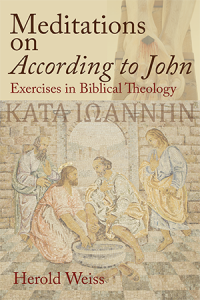
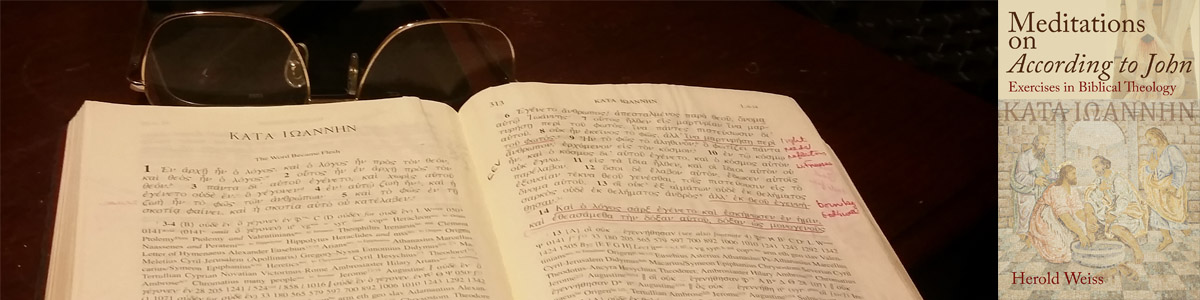
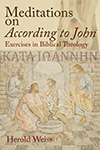
 At the beginning of the year I began a journey through the gospel According to John, using as my guide the book Meditations on According to John by Herold Weiss. I began this study largely for myself. I admit it. My motivation was selfish. I wanted to force myself to stick with the study week by week and to look into it more deeply than would be required just to satisfy my curiosity. I wanted to be able to present something based on each chapter of the book. (The entire study is now available as a playlist: https://www.youtube.com/playlist?list=PLdArFvZynbMDmk-CI_5EvufFIIxKfqxLN.)
The book is a bit alien to me. I stuck rigorously with the fundamentals of biblical studies, the languages, the history, the cultures, and the means of coming to some sort of idea of what that writer meant to say to his (or her) original audience. I avoided application because that is much harder to nail down, much less certain.
 I have frequently noted on this blog that I am not a theologian. That’s in the professional or academic sense. My training has not been in theology. I continue to maintain that. Teaching through one book does not make one a theologian. Nonetheless I do now have a much greater appreciation for the theological task.
What Dr. Weiss has done in this book is opened up in a practical way some approaches to connecting theology with what one reads in scripture without at the same time trying to force scripture to fit in with our creeds. We tend to see this as an either-or situation. Either the creed is scriptural or it is not. Either the trinity, for example, is scriptural, or it is not. But it is not quite so simple. One can pick up some pieces that eventually formed a part of the doctrine of the trinity without imagining that the particular text actually operated in a trinitarian framework. Indeed, one can believe the doctrine of the trinity without believing that it is actually taught in scripture. There’s a difference between being able to trace the roots to various texts and affirming that those text teach what grew out of interacting with them, with other texts, and with the experience of people living the faith.
Dr. Weiss made a valuable comment on that in his final interview for this study. (He graciously appeared twice to answer questions during the series.) He noted that very few of us really had the knowledge of philosophical language and categories of the time sufficient to really understand the results of those early councils that formulated the doctrine of the trinity. I would add that it is therefore not surprising that so many people, in talking about the trinity, fall afoul of one or another officially condemned heresy on the subject, without being aware that they have done so.
I am the publisher of Dr. Weiss’s book. One might suppose that my sole reason for using it was that I publish it and want to publicize it. I don’t deny that publicity was in my thinking. I do want to publicize the book. But for me editing this book was a profound experience. This is not because I believe that every view that Dr. Weiss expresses is set to become the new academic orthodoxy, but rather because he challenges us constantly to look at the text and what it meant and can mean.
One of the most critical issues is also probably the most controversial. Dr. Weiss challenges the common idea that the book is fundamentally sacramental. He believes that the view of operation of symbolic actions (and here I summarize a huge amount of text with some trepidation—I will provide a link to Dr. Weiss so he can correct me if I’m wrong) is more to be found in the washing of the disciples’ feet than in the traditional “sacramental passages such as the wedding at Cana, the discussion of eating Christ’s flesh and drinking his blood, or “born of water and the spirit” in John 3.
Participation was small during these studies. The most watched episodes, other than interviews, are in the 20s for views, and the least watched episodes are in single digits. I actually expected it all to be in the single digits. After all, I’m not truly an expert on this gospel.
This experience will impact my teaching in almost all areas. Some of the time I spent looking at the use of metaphors, of symbolism and how it can be layered, and the relationship between our experience, the text we read, the traditions we’ve inherited, and whatever creeds we follow will lead me to change the way I talk about almost any scripture. Of course, there are also many elements here that will remain applicable to this gospel alone. In fact, there are many ways in which I will be more wary of seeing symbolic meaning in something straightforward than I was before, because I have seen writers go a bit over the top with it.
I’m writing this both as a summary and to personally thank Dr. Herold Weiss for this book. I think it’s a great gift to the church. I think that a serious read of the gospel of John alongside these essays would be constructive for almost anyone interested in reading the Bible more seriously.
I’m now doing a preliminary read of Dr. Weiss’s next book, Meditations on the Letters of Paul, and I am also finding that they profoundly challenge me to think more and differently about that apostle. I’ll probably find occasion to use some of that material online in the future.
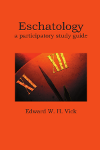 Next week, August 20, I will begin a study of Eschatology. The first couple of weeks I’m going to lay out a road map, looking at definitions of major terms used. In this, I’ll follow the study guide written by Dr. Edward W. H. Vick, Eschatology: A Participatory Study Guide. The study will continue indefinitely every Thursday evening at 7 pm central time.
Once I’ve drawn the road map with definitions, I will go into studying some specific passages and the way in which they are applied in eschatology. This study will be much more what I’m used to doing, as I look at the historical setting. At the same time, I will be pointing out how these passages are used in the various schools of thought about eschatology in the church today.
I’d enjoy having your input here in the comments or during the Google Hangouts on Air. Watch this blog for announcements and links to each event.