Threads from Henry's Web

Tag: wisdom

  • Wisdom – You’ve Got to Want It!

    Wisdom – You’ve Got to Want It!

    Wisdom cries out in the street.
    In open spaces she raises her voice. …

    My son, if you take my word,
    and store my commands within you,
    Bringing your ears close to wisdom,
    and stretching your heart to understanding.
    If you call for understanding,
    and use your voice for discernment,
    If you seek her as silver,
    And dig for her as buried treasure,
    Then you will understand the fear of the LORD,
    and find the knowledge of God.

    Proverbs 1:20 & 2:1-5, my translation

    In James 1:5, readers are told that if anyone lacks wisdom (and if you don’t think you lack wisdom, you probably do!) that person should ask God, and they will receive wisdom.

    It’s as simple as that.

    Well, maybe not quite that simple.

    There’s a military aphorism that states: “In war, everything is simple, but nothing is easy.” The two halves of that saying illustrate the change from chapter 1 to chapter 2 of Proverbs. We have wisdom calling out, seeking people, being as obvious as possible. Then suddenly we turn around, and we are being told to listen carefully, seek diligently, even dig for it.

    What’s going on?

    Wisdom is, in fact, simple. Yes, simple. It’s out there everywhere you look. Right and wrong actions have consequences. Success or failure can be found in recognizing and acting on these things.

    And wisdom is, in fact, available. You can discover wise ways of doing things. There are many places where wisdom is calling out, calling to you.

    It might be

    • An older person in your family who has a wealth of experience
    • An expert in their field who can pass on good information and outline courses of action and results
    • The physical world, where you can quickly learn about falling, living, starving, and even dying, and if you are observant, living!
    • Somebody from another culture who may have a different perspective than you do.
    • Somebody whose mind works differently than yours does.
    • The Holy Spirit, the Spirit of Truth, working in and through people and creation.
    • A younger person, viewing a situation with more innocent eyes.
    • A good book, written by someone with experience and knowledge you lack.

    Wisdom is everywhere.

    Wise people are much rarer. Why is that?

    You have to want it. Like the military aphorism, wisdom is simple. It’s out there. It’s available.

    But wisdom isn’t easy. It calls out to you, but it doesn’t force you to listen or to act on what it says. You have to be willing to make changes, to act in ways that may be unfamiliar to you. You have to be able to recognize where you’re wrong. Or more importantly where you may be wrong, so that you can correct your actions–or not.

    The problem is that wisdom is often uncomfortable. The wise thing to do is not what you perceive to be the fun thing to do. Following wisdom may hurt your pride. None of that is easy.

    Over the years I have frequently been called on to pray with people about decisions they are trying to make. I’ve found that most of the time, the person I’m praying with actually knows what they ought to do, but they really don’t want to do it. What they’re praying for is an excuse to take a different road, one that is easier, or more satisfying to their pride.

    When I reflect on those prayer times, I’m immediately reminded that I spend much time in prayer hoping that God will provide me with a different path, an easier path.

    Proverbs 2 gives us the unpalatable answer. Yes, you can have wisdom. No doubt about it.

    But you have to really want it.

    (Featured image generated by Jetpack AI.)

  • Wisdom Has Questions

    Wisdom Has Questions

    Wisdom cries aloud in the open air,
    and raises her voice in public places.
    21 She calls at the top of the bustling streets;
    at the approaches to the city gates she says:
    22 ‘How long will you simple fools be content with your simplicity?

    The Revised English Bible (Cambridge; New York; Melbourne; Madrid; Cape Town; Singapore; São Paulo; Delhi; Dubai; Tokyo: Cambridge University Press, 1996), Pr 1:20–22.

    Last week I discussed starting a study of Proverbs and noted a different way of receiving the text. This does not result from a prophetic vision, or from a prophet hearing a voice, but rather from collective (and collected) wisdom from a culture. This is life-time learning, rather than special, instant revelation.

    We like instant revelation. We like answers. We especially like answers that come quickly and fit in with our existing lifestyle and our prejudices.

    The “wisdom” we can gain in this way has another advantage. It can be formed into “ammunition sentences,” sentences that we can fling at other people to shut them up. Often such sentences begin with “the Bible clearly teaches.” We fill in with things we clearly see, largely because we failed to see the whole of scripture.

    I saw a sign in front of a church the other day. The first line read: “God has the answers!” And the second read “Are you listening?”

    That’s good. God does have answers. But sometimes God’s answers don’t match our questions, and the reason is that we’re not asking the right questions, or more specifically, we’re asking questions that limit the range of God’s answers. Sometimes we’re even asking questions in order to avoid God’s answers.

    Over the years I’ve prayed with many people who were seeking God’s guidance. Many of these people were genuinely uncertain, and were trying to seek God’s will. But more of them already knew what God wanted them to do, often because it was clear in terms of ethics, simple right and wrong, but who were hoping they could get a word from the Lord that would set them on a different path, one they preferred to what they already knew. Maybe God’s voice will allow me to take a different turn.

    When you approach things that way, it’s easy to end up believing you’re following God’s path, or the path of wisdom, just because you want so vigorously for that to be the right answer.

    I remember once having a conversation with a couple of friends about a business decision. Business decisions are hard for me. In this case I was discussing two options and trying to decide which was the next step. I had struggled with the decision for days. I don’t even recall now what the issue was, but suddenly in the midst of the conversation I held up my hand and said, “I’ve just realized I’m doing this wrong. Option A would result in behaving unethically.” My advisors hadn’t seen that, because they didn’t understand all the processes involved. As soon as I explained what would happen, they recognized what would likely happen, and so the decision was made.

    What slowed me down? I knew the process and should have recognized the problem immediately. But I didn’t. I wasn’t responding to the right questions. I was missing them because I wanted something to be true, but it wasn’t. No amount of wanting would make it true.

    “Wisdom is calling out in the street.”

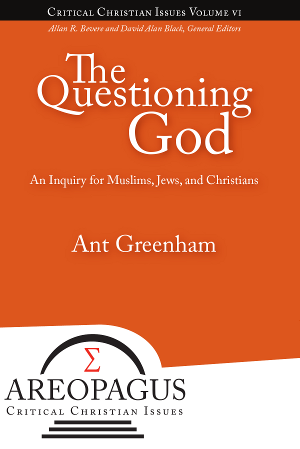
    Cover image of The Questioning God book

    And wisdom is often providing questions. Ant Greenham, in his book The Questioning God, says:

    Our foundational identity as human beings, female and male, is inextricably linked to questioning, to inquiry. The fall of humanity notwithstanding, people are repeatedly called to respond to God in the context of mental and spiritual engagement. And the centrality of a questioning approach is reflected throughout the Bible.

    Ant Greenham, The Questioning God, (Pensacola, Florida: Energion Publications, 2012), 4.

    Greenham goes on to point out the numerous ways in which God’s interactions with us consist of God questioning us. We may have questions of God, but God has even more questions to ask us. I’d suggest as a quick example that you check Job 38. After much discussion and complaint, God becomes active and what does God start with? Lots of questions!

    This approach suggests that God wants us to use our mental capacity. Here’s a famous verse, but let’s think about it again:

    The fear of the LORD is the foundation* of knowledge; it is fools who scorn wisdom and instruction

    The Revised English Bible (Cambridge; New York; Melbourne; Madrid; Cape Town; Singapore; São Paulo; Delhi; Dubai; Tokyo: Cambridge University Press, 1996), Pr 1:7.

    Too often this verse is used to contrast the supposed wisdom of the speaker, which the speaker supposes came from God, verses the use of human intellect. “Don’t trust in your education, your degrees, or your own experience. Do what God says instead!” That’s the common advice.

    I’ve received this advice from some as an admonition not to trust my study of Greek and Hebrew in interpreting the Bible, but just to let the Holy Spirit tell me what the text means. But the second half of the verse challenges that. “It is fools who scorn wisdom and instruction.” I can be listening for God’s voice in so many ways, while ignoring what I have already learned. Often when I’m searching for an answer, I’m directed (in various ways) to look at the scriptures and the wisdom of the community of faith over the centuries for an answer. I’m directed to, not away from, the sources involving intellect.

    I’ve written a few times before on the Wesleyan Quadrilateral. There’s lots of history and debate around that. But I like it a great deal. Today, I’m focused on one element: Reason. We like to put reason down in favor of more spiritual sounding approaches. But in the end, it is with your reason that you will comprehend the messages sent to you by God. That’s why God so frequently asks questions. God wants to awaken your reason.

    I want to note one final thing. Intellectual activity and engagement is not exclusively the product of academic instruction. In fact, a great deal of foolishness takes place in academic settings. Any group of people can become so inward looking that they lose site of the whole of creation. They can no longer hear wisdom calling in the street because they are in a room with the windows closed and their select set of sources.

    Intellectual activity is also the farmer learning to manage crops, run farm equipment, and take care of animals. God can and will speak wisdom in that setting. The Greek classroom is not more about wisdom and instruction than is the farm, or the corner grocery store. Wisdom is calling out in all these places and through all these processes.

    God is asking you questions about everything. Are you listening?

  • Starting a Study of Proverbs

    Starting a Study of Proverbs

    The Sunday School class I co-teach is beginning a study of Proverbs. I’m not leading this one. I’m relaxing a bit, I hope. But I have indicated I’ll do a bit of blogging on the material.

    The assignment before the beginning of the study tomorrow was to read introductions to the book, both from the resource text we’re using (The Daily Study Bible volume on Proverbs) and from various Bible editions. I’m not going to try to provide my own introduction, except to note that I read multiple introductions that seemed to me to provide an excellent launching point for a new reader.

    My interest is the place of Proverbs in the biblical canon. Why is it that we have a collection of proverbs in the canon of scripture?

    While we work with the canon of scripture all the time, we don’t often think about it as much. The “canon” refers to those books which are canonical, which means they’ve been accepted by church law as authoritative in the church. This is a fairly strict legal definition in the Roman Catholic and Eastern Orthodox traditions. In Protestantism, it’s a bit less fixed. The general concept remains.

    People often start talking about scripture with the concepts of inspiration and truth, and if a book is determined to be “inspired,” it is then scripture. That’s not precisely how this happened. There was a long process of history, tradition, discussion, and finally definitive determination. The determination can be better termed a determination that a particular set of books was and is authoritative rather than that these books were inspired.

    Now that may catch you a bit off-guard. Surely these books are inspired! In fact, I believe just that. But being inspired is not sufficient to make them scripture. I personally hold that God has inspired other writings which are not scripture, but I do not advocate that such writings become part of scripture. The key difference is that the selected writings were seen as authoritative.

    “Authoritative” involves the value of the material over time and space. For example, an ancient prophet might have sent a message to a particular individual that was specific to that individual. That message might have been from God, inspired by God, and sent by God’s authority, but if we discovered it today, as interesting as it might be, it would not be authoritative.

    In my view, accepting the value and authority of scripture today involves accepting the validity of the choices made over time, and the belief that we have the inspired scriptures that God intended as authoritative scripture. God can and does act through the events of history and the actions of groups in order to bring the message.

    So in Scripture we have the central authority. The question then becomes why does this particular passage, or in this case this particular book belong in the canon, and as part of the canon what is it supposed to accomplish.

    It’s almost cliché to talk about different types of literature and how we interpret those. But it is almost equally cliché that we expect the end point of this interpretation to be some specific doctrinal conclusion. In other words, we expect all of scripture to end up providing us with data.

    I would suggest (and have suggested) that while scripture is valuable for forming doctrine and guiding practice, this isn’t the main thing. In my book When People Speak for God, I suggest that we come to the Bible for information, but God comes to us in scripture for conversation. And eventually this conversation is to result in transformation.

    Wisdom literature as a whole, and Proverbs in particular challenges a couple of assumptions often held about how we get scripture, and I think in turn about what scripture is to do for us. Wisdom literature comes from living. It’s collected wisdom of a culture. It leads us to ways of thinking, rather than to provide set conclusions. It’s not just about the wisdom it passes on, but it’s about how that wisdom is collected. It doesn’t come in visions, dreams, or direct divine speech. It comes through the process of living.

    As an example, take Proverbs 26:4 & 5.

    Don’t answer a fool according to his folly,
    lest you become like him.
    Answer a fool according to his folly,
    or he’ll become wise in his own eyes.

    Proverbs 26:4-5, my translation

    So which verse do I follow?

    (Hint: James 1:5)

    (Featured image generated by Jetpack AI.)

  • Psalm 119:169 – Understanding

    Psalm 119:169 – Understanding

    Let my cry come before you LORD.
    Give me understanding according to your word.

    This is the first verse of the last section of Psalm 119. There are 22 sections, each with 8 verses and all the verses start with the same letter of the Hebrew alphabet. We’re not at ‘tau’ or ‘tav’, the last letter. Just eight more posts to go in this series!

    Some translations (REB, for example) specify this as a cry of joy, but the Hebrew word used for “cry” can be either a cry of lament or of joy, and I see nothing in the context to indicate which it is.

    What I find most interesting is that when this cry comes before God, the request is for understanding. Many of us think we want understanding, but I think we often are less anxious for understanding than we might claim. Understanding is not always fun. There’s the humorous twist on a common saying, “The person who is not losing their head probably doesn’t understand the situation.”

    Complete understanding would likely be a burden. Since I don’t have complete understanding–at least I understand that much about the situation!–I can’t tell you for sure. But I’ve found that quite frequently more understanding doesn’t make it easier to deal with whatever’s going on. Sometimes what we’d prefer is an explanation that makes everything seem to make sense, even if it doesn’t actually do so.

    An example of this is “overthinking.” I’m personally and experientially acquainted with this phenomenon. It’s a serious problem for me. I’ll find myself unable to make a decision because I’ve spent too much time trying to understand all possible options and all possible errors. By the time I’m done, no option seems workable.

    Now overthinking does not necessarily mean “overunderstanding”. There’s no guarantee that extended time spent thinking will result in better decisions. In fact, in can be one way of not understanding. It also leads to one way of avoiding action and responsibility. One decides that the situation is so tangled that one cannot be expected to take rational action.

    One very difficult burden of understanding is that it can force us to realize that comfortable patterns of thinking and acting are not going to bring the desired results. I recall this in more than one business decision I’ve made. I’ve recognized that things were going badly and then gone to some trouble to analyze the situation. Often–very often–that results in discovering that some practice I’ve become comfortable with is simply never going to produce the desired results. But I like that way of doing things! It’s a project I don’t want to dump, or some other project I don’t want to give a higher priority.

    And then comes understanding in the form of spreadsheets and logical charts. The current course of action is never, ever going to work. I’ve been following it for weeks or months, but there’s no fixing it except to admit I was wrong and change course.

    I’m reminded of James 1:5: “If anyone lacks wisdom, he should ask God and it will be given to him …” Pretty clear and absolute, right? No condition stated. This prayer will be answered. “God give me wisdom.” “OK, you’ve got it.” And then we go stumbling on our way, or at least I do, still doing stupid stuff.

    Wisdom is a bit like the gift of a toolkit. You have to use it. You have to let it change you. And that’s not so easy. So God is a generous giver. Are you a generous receiver?

    Receiving wisdom is a great deal like repentance. You have to change. I believe repentance is not a one time event, but an attitude. It’s something that sticks with us. It comes from a realization that we are very often wrong and always need to be willing to examine ourselves, find the error, and change course. Repenting once doesn’t do it. You have to become a repenter.

    So what are you going to repent of today? Or how many whats?

    (Featured image generated by Jetpack AI.)

  • Psalm 119:120

    Psalm 119:120

    I get goosebumps from dread of you,
    I’m afraid of your judgments.

    C. S. Lewis has a wonderful quote on this, which is fairly well known. I suspect, however, that many people don’t know the context.

    Sometimes this question has been pressed upon our minds with the purpose of exciting fear. I do not think that is its right use. I am, indeed, far from agreeing with those who think all religious fear barbarous and degrading and demand that it should be banished from the spiritual life. Perfect love, we know, casteth out fear. But so do several other things—ignorance, alcohol, passion, presumption, and stupidity. It is very desirable that we should all advance to that perfection of love in which we shall fear no longer; but it is very undesirable, until we have reached that stage, that we should allow any inferior agent to cast out our fear.

    C. S. Lewis, “The World’s Last Night” in The World’s Last Night

    This question is asked in the context of concern about the second coming or the end of the world, however you see it. Lewis argues that an emotion of fear would not be helpful in that case, because the valuable results of a rational fear cannot be sustained for a long time. I would argue that repeated claims that the end of the world is around the corner make fear ineffective.

    There is valuable fear. That’s the kind of fear that keeps us from doing stupid things. Well, sometimes it fails to keep us from doing stupid things. That’s what Lewis is talking about when he says that ignorance, alcohol, passion, presumption, and stupidity can cast out our fear. I recall quite a number of times I did stupid things. In fact, even though I have never been drunk, there were a number of times when I did stupid things with people who were drunk, because I was part of they group, and hey!, the stupid things were fun!

    I figure the Lord had to have angels working over time to allow me to attain maturity. Not necessarily intelligence and good judgment, but survival, at least!

    There’s another way in which fear can be destructive, and that’s when it’s random fear. A child who is abused by a parent and can’t find a way out is threatened with destruction by the fear. The fear is constant, whether the abuse is currently taking place or not.

    Evil is the source of that kind of fear. Effective fear is consistent with reality and helps direct our paths.

    Often, people try to remove “fear” from the “fear of the Lord.” There’s a good point to this. There are those who live in fear of God as they would fear an angry, abusive father. That is not the fear of the Lord. But there is a healthy fear. The God who made gravity made it such that gravity will get you at the bottom of a cliff. You should fear jumping off.

    In our verse today what strikes me is the personal closeness of this fear. There are several ways to translate the Hebrew words, especially of the first line. But what is clear is that the fear is producing a reaction in his body. He is reacting to the presence of God and the realization of who he is and who God is.

    But then, in the presence of God, there is the perfect love. Continuing in the presence of God will cast out that fear, replacing it with a realization of love.

  • Psalm 119:100 – More Understanding than the Elders

    Psalm 119:100 – More Understanding than the Elders

    I have more understanding than the elders,
    for I have kept your precepts.

    One of the difficult things to keep in balance is respect for one’s elders and at the same time the realization that those elders are not always right. In fact, those elders can be corrupt.

    Rather than my own discussion of this, I’m going to take a different approach. There are some Greek additions to the book of Daniel which are part of the Old Testament Apocrypha, accepted as scripture by Roman Catholics, Orthodox and some others. One of these additions is the story of Susanna.

    Susanna is a godly and beautiful women. Two elders develop lust for Susanna and contrive to catch her alone in her garden, as she has sent her maidens away. They tell her they will testify that they saw her with a young man if she does not yield to them. She stands firm.

    They take her before the other elders and testify that she is an adulteress and she is sentenced to death. A young man, Daniel by name (surprise!) is disturbed by the verdict and through his wisdom catches the men in a lie, finding that they contradict themselves about the type of tree under which they had encountered her with her supposed lover.

    As a result, Susanna is set free and Daniel becomes famous.

    The English Revised Version of this story is available online. The NRSV Catholic Edition is available on BibleGateway.com.

    Some time ago I created a retelling of the story on my Jevlir Caravansary blog.

    (Featured image credit: ID 193588715 © Nicoleta Raluca Tudor | Dreamstime.com)

  • Psalm 119:98 – Wiser

    Psalm 119:98 – Wiser

    Your commands have made me wiser than my enemies,
    for they are mine forever.

    There’s an interesting translation issue here as well, as there often is with poetry. The first part of the verse uses a plural “commands,” but the second half uses a singular. Most translations, starting way back with the Septuagint accommodate the first to the second, using a singular. I think it is more likely that the singular in the second half is intended as collective.

    One of the great values of God’s revelation to us is good ideas. This may sound weak. We want to make lots of pious statements about scripture and God’s law(s), such as that they are eternal, authoritative, beyond human capacity. All these things may be true, but in elevating the law we can also miss its simple value.

    I’m reminded of how I sometimes answer the question “How are you?” with “Functional.” Frequently I’m then asked, “Oh! What’s wrong?” Well, I thought “functional” was pretty good! It’s much better than not functional.

    Thus with God’s law. There are some great theological points to be made, but in some cases we need to just look at the value of law in general and of the order that allows us to function. I’ve been emphasizing the more general idea of revelation, beyond rules. But we should stop and consider the value of rules.

    Again I’m reminded of the humorous statement; 186,000 miles per second: It’s not just a good idea, it’s the law! The fact that there are constants like this in the universe is, to put it very mildly, critical! There are also things that are critical to living well and constructively as humans.

    Laws are wise when they prevent things from going wrong. Good traffic laws, for example, save lives, and facilitate people getting where they need to go in predictable lengths of time. When these things don’t happen, we’ll talk about bad laws or ineffective enforcement.

    It’s quite possible to have bad laws. Bad laws make things function less effectively. (Amazing, I know!)

    I’d suggest that when we properly understand God’s laws, we’ll find the laws that function best in the universe God created. This is the simple message of our verse. God’s laws are wise laws, and by making them ours we gain wisdom. It’s an eternal gift from God.

    Look today for ways to handle your life that reflect God’s law. You won’t attain this perfectly, but you’ll be blessed by looking in that direction.

    (Featured image generated by Jetpack AI.)

  • Psalm 119:34 – I Will Guard It with My Whole Mind

    Psalm 119:34 – I Will Guard It with My Whole Mind

    Give me understanding, and I will keep your Instruction (Torah).
    I will guard it with my entire mind.

    The heart, in ancient Israel, represented the mind or intellect. I have translated this as “mind.” This goes with the beginning of the verse, “Give me understanding.”

    There’s a basic principle here that I find repeatedly in scripture: God gives the power for all we do. God grants the intellectual ability, and with that understanding, the Psalmist promises to keep the entire law.

    But I allowed my own mind to wander again through scripture. The time I just spend on my treadmill, listening to Robert Alter’s translation of the Hebrew Bible, led me through the introduction to 1 Kings and then to the first couple of chapters. There are some interesting things that stand out from the story.

    Solomon was a wise man. Until he wasn’t.

    Solomon was a great king. Until he wasn’t.

    He was king of a united Israel, until he wasn’t and it wasn’t.

    There’s a lesson here. Intellectual ability is a useful thing. Until it isn’t.

    I can’t count the number of times I have figured out that something was utterly impossible, only the find the possibility opening up. More than 10 years ago I returned from a mission trip which had eaten up my resources. I knew I had to stick with my work and guard such money as was coming in to make it through the next few weeks.

    While I was thinking these thoughts, I was approached to join another mission trip. I didn’t want to go. I wearily explained that I had just returned from a month overseas and had used up my energy and my resources. But then I continued with the fateful words. “If the resources will be provided somehow, I’ll go. But I don’t expect it.”

    It was less than a week before someone had provided the entire cost of the mission trip. I had expected this not to happen, as the group going had a policy of not allowing full scholarships. They believed each person going on the mission should support themselves with at least half of the resources needed. Yet somehow nobody had the slightest objection.

    But God wasn’t yet done with me. After setting aside money for my family while I was gone, my pocket was literally empty. I knew food was covered, and I’d be OK, but it wasn’t the best feeling ever. The day before I left, a friend of mine who knew i was going asked me if I had anything for myself for the trip. I said I was tapped out with covering expenses at home. He took out his wallet and handed me $200.

    I hadn’t asked. I hadn’t even prayed for it. I had been convinced in my mind that it was impossible.

    Let me go back in history a bit to my parents. (I like the four generations idea expressed in the opening verses of Psalm 78. If you aren’t acquainted with that chapter, you could do worse than to stop right now and read it.)

    Back in 1971 my parents and I headed to Guyana, South America, not to be confused with Ghana, which is in west Africa, and regularly received our mail! Since I really love that little country, and many people don’t know where it is, here is a map and some information for you!

    Guyana world map polygon with a diamond pattern.
    By kameonline

    Within a couple of days of our arrival, my father, a physician, required major emergency surgery. The surgeon who performed this surgery stated that my father would never work again, and wouldn’t live more than 10 years.

    For two weeks this seemed to be the verdict. He was just not getting better. The mission board wanted to bring him home. In fact, they were starting to make the arrangements. My parents said that they had gone to Guyana to do a mission and they hadn’t done it yet. I was 14 years old at the time and was dismayed by the lack of progress.

    My parents chose to call for the elders of the church and have my father anointed with oil as they prayed for his healing. I was seriously disappointed with the results. There was no miraculous activity, such as him getting up off the bed and heading out to work.

    But that was the limits of human understanding again. Two weeks later my dad took over as the medical director of a 54 bed hospital and was on call 24/7 for the next year. He lived another 37 years. Later in his life, he and I had a little joke when I’d call and ask him how he was, and he’d say, “I think I’m xx years overdue to be dead!”

    Solomon exemplified this limitation. With many wonderful things taking place and with many demonstrations of wisdom, he still failed as a leader in the end, with the kingdom divided. Perhaps this line from Proverbs gives the right feeling: “In all thy ways acknowledge him, and he shall direct thy paths” (3:6, KJV). In fact, my mother wrote a book about her life experiences with the title Directed Paths.

    Where do you need God to give you understanding?

    (Featured image generated by Jetpack AI.)

  • Fear and …

    Fear and …

    Perfect love, we know, casteth out fear [1 John 4:18]. But so do several other things — ignorance, alcohol, passion, presumption, and stupidity.

    C. S. Lewis, “The World’s Last Night”

    Lewis took this in another direction, but I like the words to point out that, in certain circumstances fear can be a very good thing, and it’s absence dangerous.

    Featured image credit: Pixabay.com

  • Of Fog and Decisions

    My friend and Energion author Greg May writes about navigating in the fog today on Greg’s Waterin’ Hole. The post brought back a memory from the 60s, traveling with my family in Chiapas, Mexico, way off the main roads. We were in the mountains on a gravel road, with a cliff on either side, and we drove up into the fog at night. We were nearly at our destination and I guess my dad didn’t want to hang out where there was nowhere even to park. So my mom had her head out one window and one of my older sisters (I suspect Patty, as she was more likely to be navigating) had her head out the other. They’d yell if the car got too close to either side. We didn’t go over the edge, nor did we try to climb the mountain the most direct way, but it seemed to be a close run thing.

    I think that the image of waiting for the fog to lift that Greg uses is a good one, whether we’re thinking spiritually or just plain logically. (We often assume there’s a great gulf fixed between those two viewpoints, but I think not.) There’s the overconfident person, arrogant in his or her own knowledge and wisdom, who takes off before the fog has lifted, often blundering into ruin. On the other hand, there’s the fatally indecisive person, who waits for the last cloud to disappear from the sky before becoming certain that a decision is possible.

    I tend toward the second. Jody balances me. I think it often works that way if we learn to listen to the people around us.

    When there is no guidance a nation falls, but there is success in the abundance of counselors (Proverbs 11:14, NET).

    12 The words of a wise person win him favor,
    but the words of a fool are self-destructive.

    13 At the beginning his words are foolish
    and at the end his talk is wicked madness,
    yet a fool keeps on babbling.

    No one knows what will happen;
    who can tell him what will happen in the future? (Ecclesiastes 10:12-14, NET)