How shall a young man keep to a pure way of life? By keeping it in the bounds of your word!
I have a feeling that some would question the way I translated that verse. It’s OK. Poetry is challenging. In this case I was aiming more for meaning that being faithful to the poetic form. For those who read some Hebrew, let me recommend Psalm 119 as a good way to become more comfortable with these poetic forms.
There are all kinds of things that we could take from this verse, but through the day today my mind was repeatedly brought back to this: We need to teach sanctification, holiness, integrity in living, truthfulness, and the breadth and comprehensive nature of God’s Word.
Sanctification is by grace (there’s a big subject), or better, in the words of the Psalm, it’s a path of blessing. I think it’s no accident that Psalm 119 starts with “blessed.” We need to realize that this is God’s work. It’s worked in us, but it is about God both in goal and in method.
If we don’t talk about living a pure life in the church, people are likely to drift into perfectionism, legalism, arrogance, spiritual pride, and condescension. Those who avoid those issues usually wind up in cynicism and discouragement.
The one way to go, and I think it is the way of this Psalm, is to recognize that it’s all about God, the creator of all. God sustains us (see Psalm 104, for example) on a constant basis. The way to holiness without arrogance is a profound thankfulness and recognition of blessings received. The best antidote to spiritual pride is to keep our eyes on God’s law.
That will lead to being blessed and being kept in the pure path.
As I’ve meditated on these first eight verses of Psalm 119, I’ve opened up a number of topics. Let’s put them together, sort of!
Being blessed is a fairly broad and comprehensive thing. It doesn’t necessarily mean that we have everything we want, or accomplish everything we want. It’s being under God’s watchful eye, and that’s positive (God has a purpose/God believes in us), and also negative (if we go off track, there is God). Perhaps we need to redefine “negative.”
God’s law is a great deal more than a list of rules. God’s law is God’s self-revelation. We see this in Judaism in the centrality of the Torah, one of two broad words used in Psalm 119. (The other is Word/words.) When the Psalmist celebrates the law, as many English translations render it, he is celebrating being chosen as one of God’s people and God’s immanence in the self-revelation of the law. This carries over into Christianity (John 1:1-18, Hebrews 1:1-4) with Jesus as the Word, God’s message in human flesh.
There is a joy that shines through the text. This is not poetry written by someone who felt he was obliged to praise God for the Torah. He loves it. He’s thankful for it. He finds joy in it.
We start with blessing, and that’s important. Our temptation is to do things to seek blessing. The reality is that the ability to do and the motivation to do is itself a blessing, from which acts follow. Lead with the blessing!
Sometimes it’s OK to shout “Help!”
I hope you’re enjoying this journey as I am. Tomorrow morning, I’ll be posting the first verse in the second section.
I will praise you with an upright heart When I learn your righteous judgments.
What does learning about God’s righteous (right) judgments have to do with praise?
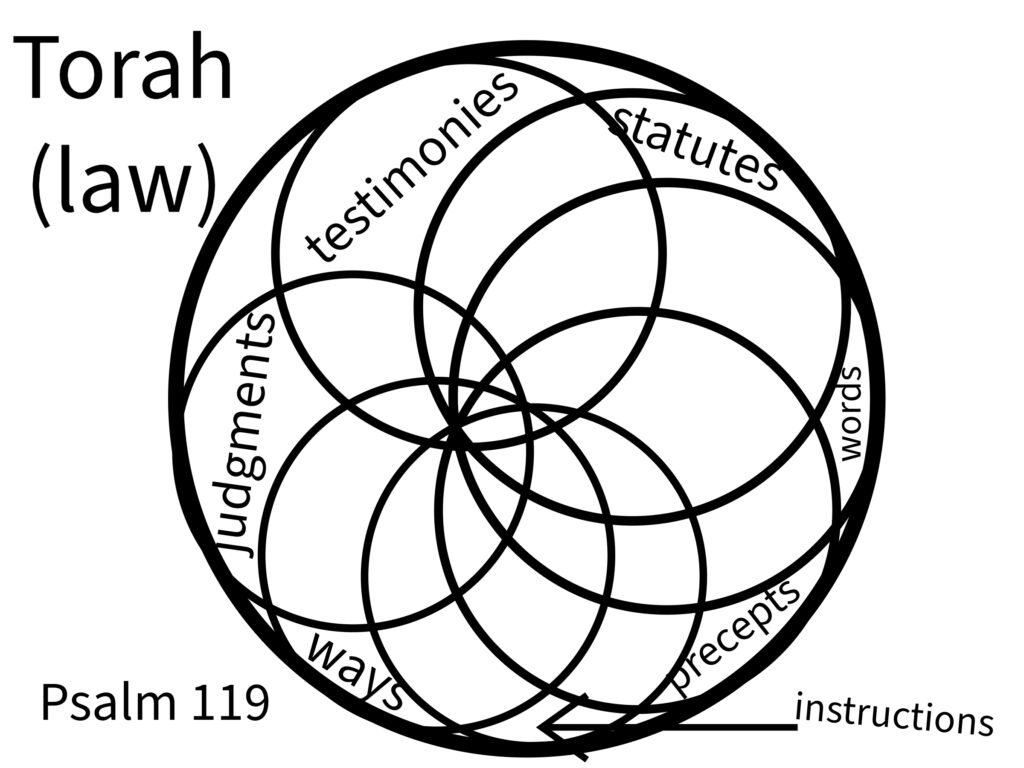
If we think of this Psalm as expressing joy over a list of rules, this might be a good question. If you haven’t yet, please read my earlier post on what “law” means in Psalm 119. To summarize, in Psalm 119 we heard one of God’s people praising God for God’s revelation in Torah. The various words for law direct us to the varied things that are present in this revelation of God.
This is important in terms of praise. Genuine praise results from looking at God’s self-revelation. We look at what God has done and the response is in praise. This is genuine praise.
There is also praise that is manipulative. “Lord, I praise you, and I want …” There is false praise. “Lord, I’m praising you because otherwise you might wipe me out. I hope you don’t notice that I don’t really mean it.”
This doesn’t mean that praise somehow results from knowing everything there is to know about God. We’re never going to do that this side of eternity. What it does mean is that genuine praise from us results from our observation of God’s revelation.
The more we observe, the more we praise. Not because God needs it, but because it flows from that knowledge.
In my current series on Psalm 119, I’m doing a daily meditation on each verse. These are, by design, short. At the same time, it’s difficult to cover certain nuances effectively in individual posts. One of these is the question of why I would write this particular series.
I’ve already included my video on the various uses of “law” and related terms in scripture. I’m embedding it here again.
God’s Eternal Law
To summarize this, I believe that God has an eternal law. That eternal law is not something that we can comprehend. It rules an entire universe. It is an absolute expression of who God is. Those of us who are not in that “space,” so to speak, are not going to comprehend or attain to this.
This law expresses not only who God is, but God’s ultimate and glorious purpose for creation, including us. As a starting point for understanding my own view of law and grace, I would point out that we have nothing that is not, in this sense, a gift. We can’t take our next breath without the physical laws, which are God’s creation. We bring nothing into this world that was not given to us.
But scripture (Psalm 8, for example), also quoted and directly applied in Hebrews 2, carries this concept forward into Christian thought. While everything is a gift, we are, in fact, gifted. Every one of us.
Various Laws
Now there are many laws expressed in scripture and in various human documents and institutions. God’s laws as delivered to us are always finite simply because we cannot possibly understand something infinite. When Paul notes (Romans 3:23) that we all fall short of God’s glory, I would take this as also that we cannot really comprehend God’s glory.
Individual laws or bodies of laws are relative. People are afraid of the word relative, because they think it makes something weak. But things and statements are always relative. We are neither able to make things absolute in all ways, nor would it be desirable to do so.
To illustrate from daily life, the rules a parent makes for a toddler do not necessarily apply to that same child as a teenager. That’s because the specific commands were related to that particular time and place.
When we look to biblical laws, we find many of the same things taking place. As Christians, we acknowledge that some laws were for specific times and places.
Note: Dispensationalism is based on this very real separation, though I think it has substantial problems in that it tries to make something relative more absolute than it was intended to be. In doing so, it both makes thing more rigid, and at the same time makes laws less applicable. Few dispensationalists would agree with a man with whom I had a discussion when he informed me that one clause in a verse in 2 Corinthians referred to a different dispensation than the rest.
The Torah and Israel (Very Briefly)
Now Israel’s religion centered more and more over time on the Torah, God’s revelation at Sinai, though many, myself included, would maintain that portions of it developed over a longer period of time. So when an Israelite referred to “the law” as Torah is often translated, he was referring to the core revelation of God to the people of Israel.
So when the Psalmist starts to celebrate the Torah in this poem, he is, in fact, celebrating both the fact that God made a self-revelation to Israel, and that this revelation was available to him personally. It was not just that this was a life-giving and life-affirming way of carrying out one’s life. It was not just a moral code. It was a revelation that gave meaning to all that was, is, or could be.
The Revelation of God in Jesus
We find Jesus portrayed in a similar way in the New Testament. John 1:1-18 is the classic expression. I am a great fan of the book of Hebrews. (I say that Leviticus, Ezekiel, and Hebrews are the three books that have shaped my theology.) Hebrews 1:1-4 is also a classic, though less known passage that expresses this idea explicitly. In the past, we are informed, God’s revelation came at various times and in various ways, but now it has arrived through one who is a Son, a complete portrayal of all that God is.
So Christian theology is, quite properly, centered in the person of Jesus Christ. I’m not here trying to argue about a “better” religion. I would like to point out that this is the source of a great deal of difficulty when Christians and Jews debate the meaning of Hebrew scripture. We are looking at it with different colored glasses. Rather than seeing the Torah as God’s final and ultimate revelation of God, we see Jesus in the same light.
But note that the book of Hebrews does not say that the revelation in Jesus Christ, a Son by nature, somehow meant that the other revelation was invalid or useless. It adjusts the center. It changes our viewpoint, and thus changes what we see, but it doesn’t say that the other viewpoint fails to inform.
I, as a Christian, could actually read Psalm 119 as a celebration of Jesus, though I would not hold that the author saw it or thought of it that way. We read this passage (and most others) very weakly when we consider the point to be one of how hard we should try to accomplish a set of ethical commands and precepts. It is rather a celebration of the God who chose Israel and provided to them the revelation of divinity that is contained in Torah.
The “Law Words” of Psalm 119
Psalm 119 uses a variety of words for the the law, including Torah. They are variously translated in various versions, but let’s consider Torah (instruction/law), testimonies, ways, instructions/procedures, statutes, commands, judgments, and words.
Each of these terms overlaps in their meanings, but all are included in the overall concept of Torah. Each has a different etymology and some differences in usage, but Psalm 119 seems to be simply using them to bring together the broadest concept of God’s law that is possible.
This celebration becomes possible for any of us as we celebrate God’s revelation, no matter where or how it is given. Psalm 19 celebrates the revelation of God in the created world, for example.
Conclusion
So reading and enjoying Psalm 119 is not just a celebration of commands and a demand for a particular behavior. It is a celebration of the God of law, revealed in Torah. As we see God in other ways and sources, it can become a celebration of those elements as well.
Yesterday I was recommending the chapters in Numbers, starting around 11, as “thinking fodder” regarding the way God works with people. But there’s some really good stuff there about how people deal with people as well.
Even though many won’t remember that it comes from Numbers 13, the most famous line from the chapter is some version of “we even saw giants there” (v. 28, NLT). It’s good to think of how we overcome the giants in our lives. I note that the Israelites were just fine until nearly the end. Some commentators object to the sending of the spies, citing Deuteronomy 1:20-23, but according to this passage, that was at God’s command. They looked, they evaluated, then they returned to the people in command.
Those who have worked in military intelligence will know that the guys who collect the information don’t make the decisions about what is to be done. Your job is to find things out. You report to competent authorities who then make the decisions as to what action to take.
The Israelite spies were asked to discover precisely the sort of things they reported. What they weren’t asked to do was determine whether an invasion was possible. They got ahead of the game. Now I know these guys weren’t professional spies. They were, themselves, leaders. But they didn’t separate themselves from the emotions of the moment and think the situation through.
But the interesting thing here is to read the actual report of the spies in verses 27-29 and then compare it to the rumor that is spread in verses 32-33. Have you ever observed something similar? A small financial problem mentioned in the finance committee, if leaked, can become an imminent closure of the church by Sunday. The results of that can be much like those in Numbers 14.
I’m skipping over the idea of divine aid in this case. The Israelites were defeated by their rumor before they’d even considered a strategy.
Finally, I’d just note that this is one of the things I find most interesting in Torah (or the Pentateuch). It reflects human ideas and attitudes in a very raw form. Often we allow the miracles, the environment, and the very different cultural background to overtake the simple human drama that is taking place.