Threads from Henry's Web

Tag: SDA

  • The SDA Chaplain of the Senate

    The Adventist review has a taste of Barry Black’s testimony, which makes excellent reading (HT: Dave Black Online).

    As an ex-Seventh-day Adventist I find his story very interesting. In his career, he was fighting not just racial but also religious discrimination. Some people thought he shouldn’t be in his positions because he was black. Others thought his faith was a problem. His story is well worth reading.

    I want to reiterate a few things I’ve said (perhaps too often) about being an ex-SDA. If you’re currently an SDA and you’re thinking of moving to another denomination, check your reasons. If, like me, you find your beliefs incompatible with your denomination, I consider it completely appropriate for you to find an organization you can support more wholeheartedly. In fact, I find it inappropriate for you to remain at that point!

    There are several things to avoid, however:

    1. Leaving the SDA, or any church, because of personal issues with people. Those will be with you no matter what organization you join.
    2. Being dishonest with yourself about your reasons for leaving. Often point #1 leads people to claim some other reason, perhaps without even realizing it. You’re going to find people problems in all organization that have people. I don’t like the people of the United Methodist Church better than I did those of the Seventh-day Adventist Church. What I like is that I am more free to carry out ministry in the UMC, and that I also find its doctrinal positions much closer to, though not identical with, mine.
    3. Living with a legacy of hate. People leave denominations or even local church congregations angry. That’s not good for you. You’re not sticking it to your former church by remaining angry. You’re sticking it to yourself.
    4. Don’t live your life as an ex. I call myself ex-SDA when I need to talk about the SDA church and my relation to it. I don’t think of myself that way on a regular basis. I’m a Christian who is now a member of a United Methodist congregation. I used to be a Christian who was a member of a Seventh-day Adventist congregation. Whatever any of the members of these congregations may think of me, I consider them all brothers and sisters in Christ. I’m not some sort of paragon of virtue who experiences no anger or resentment. I just do my best by God’s grace to confess it and leave it behind. I don’t enjoy being called an apostate, but I’m not going to let it define me or my attitude(s).
    5. Always go to, not away from. Find the place where you will be able to be what the Lord wants you to be and serve as the Lord wants you to serve. Then go there. The physical journey is the same, but spiritually it is a much different thing.

    These are just my recommendations. They were brought to mind by the story of Chaplain Black’s colleague who told him to change denominations as a career thing. I am impressed, though not surprised, by Chaplain Black’s response. He was absolutely right to stick with his convictions. I believe God honored him for that. I’m thankful for his testimony.

  • Confessional School vs. Freedom to Explore

    Peter Enns’ post, “If They Only Knew What I Thought” struck a chord with me and at the same time called up one of my concerns, or perhaps I should say areas of conflict.

    I lived through this growing up as a Seventh-day Adventist and being educated in Seventh-day Adventist schools. In fact, I made a significant transition twice, once when I moved from schools in the self-supporting movement to those in mainstream adventism, and then out of the Seventh-day Adventist. Most evangelicals I’ve discussed this with have been quite supportive of my move. To many of them I moved from at least marginal heresy to a more orthodox form of Christianity.

    But the same type of issues came up as I tried to decide what to do with my life after graduate school (at Andrews University, an SDA school), as I hear from evangelicals who go to secular schools. There were certain elements of my belief system that had changed, and others that I was still exploring. Could I be a Seventh-day Adventist? Could I be a Seventh-day Adventist teacher? I remember one professor saying to me during this period, “You don’t have to teach everything you know.” He was someone I respected, and still do. Yet I didn’t like his answer.

    But what do you do when you not only see the boundaries of the permissible playing field looming, but think that perhaps you have crossed them? Is it right to continue to be a member of an organization you do not fully support? Is it right to teach for such an organization? Can you conceal what you actually believe in order to stay within the boundaries permitted?

    We hear two sides of this conflict. The first is from people like me who have experienced changes in their understanding of scripture and doctrine, and feel the need of freedom to explore and to follow truth as they see it. We also feel the need to be honest with others. On the other side we have those institutional guardians who want to keep the faith pure. The former see the latter as barriers to truth, real spirituality, and scholarship. The latter view the former as persons who don’t fully care for the safety of the souls who gather in the pews.

    I have a certain empathy with both sides. I recall a conversation with my uncle, Don F. Neufeld, associate editor at the time of the Review and Herald, of the SDA Bible Commentary, and editor of the SDA Bible Dictionary. Several of the issues I had (and still have) with SDA theology, and even with much evangelical theology, came up. In some cases he agreed with me against the common SDA position. In others, he didn’t. But he suggested to me a certain pastoral concern, a sensitivity to the people he served, and I was to serve. He told me how carefully he wrote at times, leaving the door open to exploration while not cutting the people off at the knees. Theology didn’t occur in a vacuum, according to him, it was something we did in service of God’s people.

    While I couldn’t follow his advice at the time, and imagine I still would fail, I do understand what he’s talking about. A church community has to have some form of definition, and that definition will involve beliefs that are acceptable and ones that are not. If there are to be such institutions as confessional seminaries, schools operated by a religious community to support their needs and their people, there are going to be boundaries to the playing field.

    If this were a matter of social clubs or of businesses, it would be easier. If you find yourself outside the boundaries of one, move to another. Such a solution can still work for someone who is raised as an Arminian, for example, and becomes Calvinist. I’ve known a few of those (and the reverse) and they usually just end up moving from one denomination to another to solve their problem. I think we would have little difficulty suggesting that someone who can no longer consider themselves Christian would do best to teach in a secular institution. Yes, this is not complete academic freedom. But it is also not deception. If the institution is operated by the Roman Catholic church, it is likely to have certain positions. If it’s Seventh-day Adventist it will have a different core perspective. (If it’s Methodist, of course, it will be whatever it turns out to be!)

    My prayer would be that we set those boundaries as far out as we possibly can, to allow those who study and teach in church-related academic institutions to explore and challenge as much as possible. I think truth thrives in an atmosphere where it is challenged. Stupidity does not. For both those reasons challenge is good. But at the same time I would hope that all of us in our various churches would be prepared to gently help and encourage those who might need to find somewhere else to go.

    I’ve managed to handle the “apostate” label before from those SDAs who see nothing but a rebellion against God that could get me out of the SDA church. I think most of them should be delighted that I left. I wouldn’t be making their lives easy from the inside. Perhaps a better approach would be to encourage someone to try their walk with God in another community. Don’t do this with the “left foot of fellowship.” Be welcoming, but at the same time don’t condemn the move to find someplace else. Encourage the exploration of other traditions.

    There’s always going to be a tension between the need of the community to have cohesion and the need of scholars to explore. I believe that tension can be constructive rather than destructive.

    (And as a final commercial, let me recommend a book I publish, Crossing the Street by Bob LaRochelle. Bob grew up Roman Catholic, was ordained a deacon, and is now a minister in the United Church of Christ. No, he’s not telling all Catholics to follow him. Rather, he’s encouraging us to look across to other faith traditions, learn, and feel the freedom to explore.)

  • The Problem with Eschatology

    The Problem with Eschatology

    I grew up in the Seventh-day Adventist Church, which is very interested in eschatology. We didn’t learn the term all that early, but we were subjected constantly to sermons about it. SDA eschatology is one of the key reasons I’m not SDA any more, but when I first joined a United Methodist congregation, I was surprised to discover that nobody really thought that much about the end times. One pastor I know had even invited an SDA to come in and teach on Revelation. Why? “SDAs know something about eschatology.” Of course, the corollary to that was that Methodists did not.

    But SDAs were not the primary source for the congregation. Most of them picked up what eschatology they knew from television and other popular media, which meant some kind of futurist interpretation including a seven-year tribulation, usually a pre-tribulation rapture, and a pre-millenial second coming. This eschatology, while built on a dispensational view of biblical interpretation and theology, was held without necessarily accepting, or even knowing, its theological foundations.

    Most Methodist pastors that I encountered during this time didn’t really teach or preach about eschatology. They preferred to avoid it. They might say that Methodists weren’t really committed to a particular eschatology. Some accepted the “left behind” eschatology themselves. But in general there was, and is, a void in this area of theology.

    Let me warn readers at this point that this is one of my posts reflecting on a book I have published. There won’t be much of a commercial, however. I’m just giving some of my thoughts on eschatology and why we should pay attention to it in the church.

    I believe the reason many pastors and teachers don’t talk about eschatology is that it has a bad reputation amongst those theologically trained. There is so much craziness that goes on, such as setting dates for the end of the world, that people just don’t want to go there. The “left behind” theology and the futurist view of the interpretation of Daniel, Revelation, and other apocalyptic literature is popular because it is proclaimed almost in a vacuum. If people hear only one view proclaimed, they can perhaps be forgiven for thinking it is the way to think about eschatology.

    And I believe that groups with even more peculiar views of the last days find an opening amongst Christians simply because pastors and teachers haven’t addressed the issues at all. I recall a comment by my uncle on a sermon which he called “fearfully and wonderfully made.” He didn’t intend it positively. Most systems or programs about the end time are, in that sense, “fearfully and wonderfully made.” They are also houses of cards, to be blown over if anyone studies the texts themselves without the guide. I find the SDA interpretation of the seals and trumpets of Revelation to be ridiculous, and rejected them while I was still a college student in an SDA school. But if you hear just that view, and look at just the texts (and the emphasized portions of texts) than an evangelist or other presenter wants you to see, it can sound very plausible.

    But even more importantly, eschatology is critical. It’s where we’re going. It’s why we are the church. I don’t mean to diminish the importance of now, and there are views of eschatology that do not diminish that importance. That’s something to consider. But when you’re making a decision as to what to do and how to do it, knowing where you’re going is important. One result of bad eschatology is the idea that because Jesus is coming soon (and just what does “soon” mean?) we don’t need to take care of the planet we’re living on. Why bother, when it’s all corrupted by evil and about to be destroyed in the fires of hell?

    The answer is to take this subject on directly, and as frequently as necessary to counter popular Christian culture. It is also important not to just teach some alternate scheme of the end times. Too often we teach conclusions in the church (and even in seminary), and not how to come to those conclusions, and yes, how to challenge them.

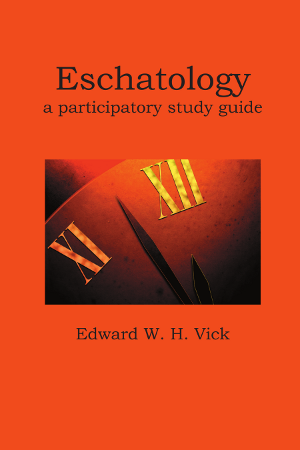
    9781938434105mThat is what Dr. Edward W. H. Vick does in his study guide, Eschatology: A Participatory Study Guide. Interestingly enough, Dr. Vick is a Seventh-day Adventist. But he isn’t teaching the SDA evangelistic message. He’s surveying the field of eschatology and teaching readers and students the terminology and the ideas they need in order to understand the discussion of this field. It isn’t a simple book, but it is direct and straightforward. You’ll need to study it carefully, lesson by lesson. You can’t jump in somewhere in the middle. It won’t tell you what you should believe about eschatology. It will provide you with the tools to study the topic and to understand what others are saying.

    I accepted this manuscript for publication because I think we need to think, study, and teach more on this topic. I am also convinced that on every topic we need to let people know not just what we conclude, but how we came to those conclusions. It builds on what Dr. Vick has already said in his books From Inspiration to Understanding: Reading the Bible Seriously and Faithfully, and The Adventists’ Dilemma. The latter volume will be of particular interest to SDAs who often wonder just what “soon” means when you’ve been proclaiming that Jesus is coming soon for a couple of hundred years. Don’t worry. The church has been doing it for 2000 years. But perhaps we don’t know what “soon” means.

    There are those who may be concerned about using a book on this subject written by someone from a group that has peculiar views on eschatology. Let me assure you that Dr. Vick treats eschatology as an academic subject. I’m not going to try to characterize his view of SDA eschatology. I’ll simply say that in this book he presents an overview of this topic that is broad, intense, and extremely helpful.


    (If you’re interested in pursuing a study of basic eschatology in that manner, this will be the book for you. If you’re considering this book for use in your church, remember that you can request a free evaluation copy simply by e-mailing Energion Publications with a note telling us your intended use and the size of the group you intend to use it with.)

  • Of United Methodists and Beth Moore

    From time to time various Methodists get very worked up about the idea that members of United Methodist congregations are using Beth Moore studies in their study groups and Sunday School classes. Via Facebook I encountered an older post regarding Methodists and Beth Moore. That article is actually quite restrained and gentle by comparison to some of the discussion I’ve heard. The author makes some good points, but I think, perhaps, not enough good points.

    My first thought is that if you are a United Methodist pastor or church leader and your worst problem is that your members are spending too much time listening to Beth Moore, you should spend some serious time thanking the Lord for your blessings.

    It’s not that I agree with everything Beth Moore says. In fact, I likely disagree with a good percentage. I really haven’t bothered to make a list. She’s probably more literal than I am, and we doubtless disagree on matters of biblical criticism. Besides, I don’t particularly like watching videos in a study group or class. I’d rather get together to actually study or listen to someone who is present. So my point is not to be an apologist or a critic — of Beth Moore, that is.

    What I’m wondering is why so many people in the church, and particularly the United Methodist Church (since I’m a member), think they can or should control what people hear.

    Oh, I know the arguments. We have a responsibility to teach good theology. We have a duty to teach sound biblical knowledge. We are Methodists (or whatever), after all, and that should mean something!

    Should it really? I find denominations useful, sort of. They could be a great means of getting us to work together for missions that are bigger than local church congregations. Ideally, they can provide some sort of accountability. I happen to like the United Methodist doctrinal distinctives, which is why I joined a Methodist congregation.

    Trouble is, I found out rather quickly that very few Methodists were aware of their doctrinal positions, if it’s proper to call these positions “theirs” if they don’t know what they are. Before I joined my first United Methodist congregation I asked for something that would tell me what Methodists believed, officially and clearly. The pastor gave me a copy of the United Methodist Discipline, clearly with serious misgivings. I loved it. Well, the first 100 pages or so. The rest is well nigh useless, and I’m convinced that most gospel work done by Methodists results from someone ignoring the rules.

    After reading that first part of the Discipline, I decided I could get on board with this new church, and so I joined. Then I discovered that Methodists weren’t really acquainted with their own history. The orientation to the church, in which one speaker explained that John Wesley had been influenced by Karl Marx (perhaps with the intervention of Dr. Who, though he made no mention of it), was biblically, doctrinally, and historically ignorant.

    The pastor invited me to teach a series on Sunday nights about the doctrine of Christian Perfection. I was interested to note that there are two full statements of this doctrine in the Discipline, and chose to start from that point. As I flashed up my overhead transparencies, I was disappointed to discover that nobody was interested in the fact that there were two statements (really a bit more complicated than that), because they hadn’t been aware that there was even one. I found that growing up Seventh-day Adventist, I had learned more about John Wesley and Wesleyan theology than I would find around the Methodist church.

    This was not a matter of personal pride. I had these things drilled into me as a child. I really couldn’t have avoided knowing them if I wanted to. Further, I’d be unlikely to complain about the problem, except for a related tendency I found as time went on.

    That related tendency was the idea that we needed to make sure to teach Methodists only Methodist doctrine, thus protecting them from all that other stuff that was flooding the world. If we could just keep them listening to only Methodist teachers, everything would be OK. Unfortunately, I suspect that most crazy ideas have a Methodist champion somewhere.

    Now there are a number of non-Methodist doctrines I would love to protect Methodists from. I wouldn’t mind protecting everyone else as well. The whole Left Behind series and related “prophecy” material would be a start. I don’t like it and I don’t even like to have to take the time to respond to it. It’s that bad. In my opinion, of course.

    But people are going to hear that point of view of the book of Revelation and other apocalyptic literature, and I’m going to have to respond. And despite any tendency to wish it would go away, I know I’m wrong to do so. The right response is to do better teaching on other views. If we get people studying for themselves and help them to learn to study well, they will find the flaws in these various trends on their own.

    Or they might come up with the arguments that would make me realize I’ve been wrong. Regarding the whole futurist/dispensational view of prophecy, I doubt they will, but they could. The point is that they should have the opportunity to do so.

    What’s more, with modern media and the internet, it’s ridiculous to think that you will protect your congregation from hearing things you’d rather they not hear. Telling people they can’t study certain things or hear certain speakers is likely to have the opposite effect.

    And then there’s the question of whether you really have anything better to teach at all. I’ve heard this type of complaint from people who couldn’t construct a sound biblical argument in a room full of commentaries (even if they ignored the commentaries!). They simply wouldn’t know. But they can tell whether a teacher’s denominational credentials are in order.

    I recall one church that had a young adult class that was growing and getting popular. There were young adults who didn’t even attend church who were coming to the class and enjoying the discussions. The church leadership, clearly dismayed at the success of this class, decided they needed to bring it under control. They were reading and discussing unapproved books. So they found a teacher who would follow the party line, and thus managed to reduce the membership of the class to zero in a mere four weeks.

    Another Methodist church wanted Methodist materials, but in their absence was prepared to gut some Southern Baptist materials, removing reference to such dangerous doctrines as salvation, so people would, at least, not hear the gospel message from a Baptist perspective, even if no Methodist perspective was to be offered instead.

    I’ve mentioned growing up in the Seventh-day Adventist Church. In the church I encountered censorship rather regularly. In order to keep apart from the world it was important to read SDA materials and to stick with the SDA agenda. I was watched when teaching to make sure I wasn’t leading people astray. I kind of expected that kind of censorship due to the nature of the denomination. Since other churches were leading people straight to the Mark of the Beast, we obviously shouldn’t be listening to anything they said, lest we too go whoring after the beast and his image.

    I’ve heard both liberals and conservatives claim that all censorship is done by the other camp, but my observation is that both have a tendency to decide that they’re correct. That’s actually not a bad thing. Surely if one thinks one is wrong one will change one’s view. The problem is that certain people decide that they have to impose their rightness on others. Not persuade, impose. And that’s going to fail.

    So my suggestion to a pastor who hears that a group in his church is using Beth Moore studies is to first rejoice that they care enough to study. Then if you object to some of the content you should first make sure you know what it is and what is being taught, and then teach what you believe is right. Do it vigorously, make it relevant, and show your love of scripture as you do so. One thing that came out clearly in the post I linked and in the comments is that people appreciate Beth Moore’s love of scripture. I know from experience that if you are teaching from your heart and you have paid the price in study and prayer time, people are going to listen when you teach.

    Do you, as a pastor, exhibit that same love? Can your congregation tell that you’re seriously studying, doing your best to understand, and sharing what you have learned? Do they detect that you have spent time on your knees when your preach or teach? Or is your only real response to point them to a list of Methodist (or other denominational) doctrines?

    There is a group in the Methodist church, as there was in the Adventist church in my youth (and friends tell me still is), and I suspect in every church, who consider “but it’s not Methodist!” a good argument. But there are less and less of these people. You need a better argument.

    I believe that there are plenty of people in the United Methodist Church (I wonder why I keep typing “untied” for “united” and having to correct myself) who love scripture and love to learn more. There are plenty more who are hungry to hear and want to learn how to study. You’re not going to draw them away from one source without providing another.

    But even more importantly, if they hear the scriptures taught in different ways, from different perspectives, by people who truly love to study God’s word, they’re going to be enriched by it. Even if they come to the conclusion that some of it is wrong.

    Especially if they come to the conclusion that some of it is wrong.

  • October 22 and Eschatology

    Eschatology: A Participatory Study GuideOctober 22 probably doesn’t mean much to most of my readers, but for someone who grew up as a Seventh-day Adventist (SDA), it has great significance. It was on October 22, 1844 that early Adventists (before they were Seventh-day Adventists) expected Jesus to return. It was actually the second time they had expected that. first came what is known as the “lesser disappointment” of 1843, when they had not set a specific date, but had set a deadline of a season. Of course, the day ended, and nothing happened.

    But as often happens with failed prophecies, after thought, consideration, and some manipulation of Bible texts, the Adventists decided that something had happened, it just wasn’t something visible here on earth. Adventists made a firm decision to set no more dates for the actual Second Coming, but they continued to preach that Jesus was coming “soon.”

    In an overall doctrinal sense, this is no longer the sort of thing I consider central. But it did play a pivotal role in my decision to leave the SDA church. First was my reading of Daniel. I studied Daniel at Andrews (the SDA Theological Seminary) under a professor who strongly supported the traditional SDA understanding of the passage. People often think those who change their beliefs in college or seminary do so because liberal or unbelieving professors brainwash them. My professor made every effort to convince me that the SDA interpretation of Daniel 8:14 (the famed 2300 day prophecy) made sense. But in the context of Daniel it did not make sense to me.

    Having decided that the time prophecy element was completely unfounded I turned to Hebrews and eventually decided that the very concept of an investigative judgment was also not good theology. Having spent a considerable time outside the Christian community, it was this second element that made it relatively certain that I would not return to an SDA community. People expect the seventh day sabbath to be the problem, but while I don’t agree with much of the supporting doctrine (the idea that it is the distinctive characteristic of the remnant, for example), I wouldn’t have a problem making the seventh day a sabbath. (That isn’t at all what SDAs mean by this, of course.)

    What’s interesting right now is that I have just completed proofs for a new book, Eschatology: A Participatory Study Guide, by Edward W. H. Vick, who would see similar problems with these various elements to the ones I do, but is a former professor at Andrews University. In addition, my company distributes his book The Adventist’s Dilemma, regarding the use of the word “soon” by Adventists. I had once thought these controversies were in my past. Now I’m editing and marketing books about them.

    October 22 can cast a long shadow!

  • Are You Preserving Holy Bricks?

    There’s an insightful article on the Spectrum Magazine web site titled Holy Bricks. This one deals particularly with Seventh-day Adventist bricks, but the principles discussed apply anywhere. I have yet to encounter a community that doesn’t have a few holy bricks to deal with. I particularly liked the point where a constituent in a meeting said, “I don’t care if we don’t have a single student left, you’re not going to close our school!” I suspect most church leaders have heard the equivalent.

    There is a time to move forward in faith, but I don’t think that time coincides with our desire to preserve holy bricks. In any case, read the whole article. There are some great thoughts there.

  • Trouble at My Alma Mater – Walla Walla University

    Over the last few weeks I’ve been following events at my undergraduate alma mater, Walla Walla University, largely via the Spectrum Magazine blog, starting with the news that Pastor Alex Bryan of the Walla Walla University Church had been recommended as president by a search committee. Now it has been a number of years since I was a student at WWU and I don’t know the players personally. But as the story developed (you can follow it by using the search box at the link shown above and searching for either Bryan or McVay), various groups got together to campaign against Dr. Bryan, and the board, while considering him sound enough theologically to pastor the university church, decided they didn’t want him as president of the university.

    If I had been leaving the SDA church for personal reasons, this would have been one of them, “this” being the tendency of various small groups to get together to guarantee the total orthodoxy of all selections. My lifelong missionary parents even saw their membership blocked at a local SDA church.

    But wait a minute … I said “if”.

    The reason I bring this story up is as the backdrop for saying quite clearly: If you’re thinking of leaving your church for personal reasons (solely or even primarily), don’t!

    If I had left the SDA church for personal reasons, I would long since have found an equal number of reasons for leaving every church in which I have held membership since. The specific issues are different, but human nature remains the same. It is so easy to start a rumor campaign. One doesn’t even have to plan it. But when you add a little fear, such as people thinking “maybe our church won’t be the same as it always was,” and you can have a full campaign going before you know it. Fight it where you are, because it may well happen elsewhere.

    Perhaps this is why gossip is considered such a serious sin in Scripture. Paul often includes it with his “sin lists.” It’s right there in Romans 1:28-32, but for some reason I’ve never heard a sermon preached from that passage that concentrated on gossip as a sin. If we have any sin in the church that we refuse to give up and that we tolerate openly in contradiction to Scripture, I’d suggest gossip for the title. And just because gossip is spread through Facebook groups or on Twitter doesn’t make it any less gossip.

    But this is the other side of the coin. I said don’t leave your church if your reasons are personal, including this one. I’d suggest that one’s choice of a church home should be based on where you can carry out your call to ministry as a member of the body of Christ. All of us are called to ministry, and our faith community should be helping us carry out that call. You may have to leave a more gossipy church for a less gossipy one, assuming you can find one. But consider that God may be calling you to stay where you are and try to make things better.

    I have doctrinal disagreements with the SDA church that make it impossible for me to be a member. But I continue to be a member of a very imperfect church, just an imperfect church where God is working through the efforts of many imperfect people–like me.

    If we’d think more about service and less about our own comfort and safety, I think things would go much better.

  • Have You Ever Crossed the Street?

    Crossing the StreetNo, I don’t mean this in the very literal sense, but either in the spiritual sense or in terms of affiliation. One of the defining experiences of my life involves crossing the street in this sense. I grew up as a Seventh-day Adventist. That involves quite a number of things, including keeping the Sabbath (Saturday) as a day of rest and worship, accepting certain ideas regarding the last days (eschatology), and rules for dressing, eating and drinking.

    In my case, I can easily see my life experience as multiple street-crossings. Most of my younger years were spent in the self-supporting organizations in Adventism. These formed, at the time, a sort of subculture within Adventism that was stricter in adherence to many of the teachings of the church. I moved from that to a more mainstream Adventism before I left the church entirely. I then spent time outside of any church and quite determined I would never be involved again. Finally, I found my way into a United Methodist congregation, where at first my feeling was that I had found a place of comfort. Then I got active and engaged in the work of the church again. Each of these experiences involved some aspect of “crossing the street.”

    Bob LaRochelle has just written an essay for Energion.net regarding the current controversy in the Catholic church regarding American sisters religious (nuns). It’s well worth checking out.

    I’m getting the crossing the street metaphor from a book my company recently published, titled—you guessed it!—Crossing the Street. That book, by Dr. Bob LaRochelle, describes his personal journey of crossing the street, moving from the Roman Catholic Church to the United Church of Christ. In it, he gives two reads of the metaphor “crossing the street.” The first is a negative one, in which one crosses the street to avoid what one believes is evil. “Don’t get too near the Catholics!” the protestant might say, or vice versa. But crossing the street can, as Bob makes clear, also be a positive experience.

    I have encountered the negative view of crossing the street many times in negative reactions to my own street crossing. Seventh-day Adventists find it hard to understand that I could leave their church. The more conservative of them regard me as an apostate, more to be avoided than even the ordinary non-believer. (To some SDAs, non-believers include most non-SDA Christians.) Others express understanding that I had problems with the church organization, but can’t imagine how I could have problems with the doctrines. Others assume that I’ve found a kinder, gentler organization in the United Methodist Church, and that must explain everything.

    Non-SDAs who know my background often wonder why I don’t go hammer and tongs against the horrible heresies perpetrated by the Adventist church. Surely I should use my extensive knowledge of Adventism (I’m a graduate of an SDA college with an MA from the graduate school at Andrews University, earned in conjunction with the SDA Theological Seminary) to rip apart all those wrong people.

    My approach is different. I value my experiences growing up as an SDA. I can reject certain elements of what I was taught without decided that the entire experience (or those I experienced it with) are horrible, without value, and not deserving of respect. In fact, I like to encourage SDAs to get into more dialog with the larger church and the larger church to get into dialog with them. There are things we can learn from the SDA experience. There are things they can learn from us.

    This street crossing is very much a part of who I am. It forms a lifelong defining experience.

    So when I got a proposal for a book titled Crossing the Street and discovered what it was about, I was excited. At the same time, I figured this experience would be different, because the author was moving from the Roman Catholic Church to mainline Protestantism. And, as I had learned thoroughly in growing up, there really is no organization less like the SDA Church than the Roman Catholic Church.

    Wrong! Bob’s experiences in crossing the street were very similar to my own. The authority issues in the Catholic church were similar to those I found in the SDA church. What was more, Bob had moved from the Catholic church to the United Church of Christ and still saw great value in his former tradition. Instead of seeing it as a change of sides in a war, he saw his move as a new opportunity to improve dialog.

    One of the things I like to emphasize to my SDA friends is that if you leave the SDA church, don’t do it because you think you’re going to find the perfect church, one without the problems in SDA churches. There are many things in the SDA church that I’ll criticize. I follow the news. I see some of the things being done currently, such as the rejection of the La Sierra University Choir by an SDA academy in Michigan, and they make me angry.

    But the United Methodist Church doesn’t get everything right either. Not even close! Many of these things are based on the same human emotions as those in the SDA or the Roman Catholic churches.

    I wish I had read Crossing the Street before I crossed the street. It wouldn’t have prevented the crossing, but it would have saved me time in terms of finding my balance. Yes, this book talks about a change from the Roman Catholic Church to the United Church of Christ, but it would have facilitated my own move from SDA to United Methodist just as well. In fact, I commend this to my SDA and ex-SDA friends as an example of a healthy attitude to take to such changes. I suspect that others will find similar help.


  • Seventh-Day Adventist vs Methodist on Family Guy

    As an ex-SDA who is now Methodist, I just have to share this video:


    Now my experience amongst Methodists is that most will just shrug their shoulders about worship on Saturday. They get a little more tense about soul sleep.

    I have encountered a few Methodists who are like the one in the video, generally those who really have no idea what SDAs believe.

    On the other hand, I’ve gotten some very interesting reactions from SDAs who discover I’m ex-SDA and now Methodist. At one meeting where I had brought one of our Energion authors who is SDA, I was cornered by someone at the book table afterward who said he simply couldn’t understand how one could ever have doctrinal disagreements with the SDA church. Take it from me—it’s really quite easty! It’s only fair to point out that our hosts at that church were embarrassed and apologized to me for his behavior, though I actually didn’t mind.


    (HT: Spectrum)

    Enhanced by Zemanta
  • No Apologies for Believing the Bible

    Mark Kellner (Adventist Review, Dec. 8, 2011) says he makes no apologies for believing the Bible. That’s great. Neither do I. (Jan M. Long responded to this at some greater length than I am on the Spectrum Magazine blog, to whom a tip of my hat.)

    I don’t usually pick on my former denomination (I grew up and was educated in the Seventh-Day Adventist Church), but in this case, Kellner seems to make a very common mistake. He fails to distinguish the way he understands the Bible to mean from what the Bible says.

    In this case, he’s particularly concerned with the creation story. Now I understand that this is a very controversial issue on which we can quite easily, and even reasonably disagree. (I note that I consider it much easier to disagree reasonably on the meaning of the biblical text than on the scientific evidence.) But here’s how Kellner phrases it:

    One of the more popular fallacies being floated these days is that the Creation account found in Genesis is an allegory, a “celebration,” much in the way the ancient Hebrews took seven days to mark the inauguration of a temple.

    Nonsense. Either the Creation account is true, or we can all sleep in next Saturday morning.

    But believing the creation story is something other than a historical narrative doesn’t make it less true. If that were the case, we would make many of the Psalms less true than the books of Samuel and Kings, for example, and the parable of the trees (Judges 9:8-15) would be a gross deception. Most of us would regard those other passages as quite true, but true in a different sense than a historical narrative.

    I regard Genesis 1:1-2:4a as liturgy. Liturgy is not less valuable than narrative history. It is valuable in a different way. It conveys different truths in a different way.

    Of course the line about sleeping in next Saturday morning applies particularly to SDAs, who worship on Saturday, and would, based on a number of scriptures, see this as a celebration of creation. On the other hand, an SDA who believed that Genesis 1 was liturgy could celebrate creation next Saturday with every bit as much validity as any other act of worship. I doubt that Jesus was born on December 25th, yet I won’t mind commemorating it on that date. The liturgy may not represent historical detail, but it commemorates a core element of my faith.

    So the Bible may be true or not, but the decision as to whether the Bible is true doesn’t guarantee the same result for my interpretation of it—or anyone else’s.