Threads from Henry's Web

Tag: Psalm 119

  • Psalm 119:31 – Holding God’s Testimonies

    Psalm 119:31 – Holding God’s Testimonies

    I have held tightly to your testimonies;
    Don’t let me be put to shame.

    It’s quite possible to translate the second half of this verse as “don’t put me to shame.”

    Have you ever felt that God was calling on you to take a certain stand, or act in a certain way, and you hope you’re right? Have you considered the prayer offered here? “Don’t leaving me hanging, Lord! I’m doing your work. I need you to make things work out here.”

    It’s easy to cover up my own concerns with concerns for God’s reputation. “Lord, if I do this and you don’t back me up, people will think You are not faithful!” But behind that are the more human thoughts. “If I step out in faith and God doesn’t perform a miracle, I’m going to look like at idiot.” Or simply, “If I take that particular moral stand, people are going to despise me.”

    Sticking with God’s plan can be unpleasant. Just look at the apostles. Being an apostle was not a life-choice conducive to longevity. The path of God’s instructions may not be easy. You don’t need to go that far back. Today, as I write, I know people who face persecution for the stand they take for their faith.

    And don’t imagine that all these problems come from non-Christians. You may be asked to take a stand in your own church, against those who should be your friends, supporters, and prayer partners. “Don’t let me be put to shame, Lord!”

    You’ll also find those whose claim to cling to God’s testimonies is just a pretense. Very likely you’ll be tempted along the same lines. There’s always a good cause, or a cause that appears to be good, and the temptation will be to jump on the bandwagon while claiming that you’re clinging to God’s testimonies. Don’t tell me that you don’t care about the opinion of other people in your church, or those from that “more successful” church down the road with more members.

    And then there’s the simple fact that no matter how hard you cling, sometimes you’re going to be wrong. Sometimes you’re going to be quite when you should speak, or you’re going to speak when you should be quiet. Probably lots of times, if you’re honest.

    It’s a very human prayer: “Lord I’m doing all I can, help me out. Don’t let me look like a fool. Don’t let me look like a hypocrite.”

    Then it’s time to remember that as God’s child, it all belongs to God. Your successes and failures both! The next breath, the next step, is in God’s hands.

    (Featured image from Adobe Stock. Not public domain.)

  • Psalm 119:30 – I Have Chosen

    Psalm 119:30 – I Have Chosen

    I have chosen faithfulness as my path.
    I’m in place1 with your judgments.

    1 There is considerable controversy about how this verb should be translated.

    A literal translation may make this clearer:

    Decided have I a way of faith
    with your judgments I have agreed

    D. Robert MacDonald, Seeing the Psalter, p. 382

    Let me commend again, Bob MacDonald’s treatment of the Psalms, and indeed is work with music of Hebrew scripture.

    As I meditated on this verse, I kept coming back to New Year’s resolutions and the fact that I don’t make them. I have done so in the past, but I haven’t for years. New Year’s resolutions are famous for their short duration. We determine to do things, but then we really don’t. Thus the broken New Year’s resolution has become a cliche. I heard this question recently on a Family Feud episode, and if I recall correctly, the #1 answer was two weeks. And that might have been optimistic.

    We joke about it, but then we tend to live our lives that way. So should we give up on making decisions? Should we cease to try to do right because we so often fail?

    About two years ago, I got the results of some blood tests that showed my glucose was way too high. The doctor already had a list of prescription medications he wanted me to take. I said, “I don’t think so. I’m going to do some lifestyle changes and see how that goes.” The look of skepticism he gave me was memorable. But he agreed with my process, and I graciously (!) didn’t tell him it wouldn’t have mattered if he hadn’t.

    Three months later the relevant numbers, including now A1C and blood glucose had dropped below levels of concern. They weren’t down to where one would like them, but he confessed that most of his patients who were on medications had trouble maintaining that good of numbers.

    I made a decision, and for the most part, I carried it out. Not nearly to perfection, but to my own benefit. My sleep is better, my productivity is better, I have more energy. The result is great!

    So what if I said, “Most people fail at these things. In fact, I usually fail at these things. There’s no point in making an effort”? I’d be taking more medications, and while my glucose level would likely be lower due to medication, the other benefits would not have occurred.

    Or, on the other hand, I could observe difficult moments, days on which I didn’t complete my exercise goals, or the time back in September when I was sick for a week, and then practically had to start over building up my activity levels.

    I don’t know if Psalm 119 is a Psalm of David, but David was “a man after God’s own heart,” (1 Samuel 13:14), and wrote some of the Psalms. I’ve just been listening to the stories of David including his behavior with Bathsheba and his murder of Uriah. We also have Psalm 51, which the superscription presents as David’s confession and determination to follow God’s way after God has forgiven and restored him.

    I think it’s important to recognize when decisions and resolutions are valuable and when they are not. Writing these meditations was a decision. I plan to write 176 of them. I may skip Christmas and New Year’s Day, but then again, I might not. I can tell you that while my statistics indicate readership is dismally low, simply taking the time to mediate on these verses as been a worthwhile resolution.

    Might I suggest that Hebrews 6:1 “be carried on to perfection” provides a similar resolution. I’ve summarized the message of Hebrews as this: “Get on the right train and stay on it till it reaches the destination.” With the author of Hebrews, I’m determined to stay on the train.

    But don’t let your value be determined by your resolutions or your success at carrying them out. You are “a little lower than God” (Psalm 8:5), you are a child of God, a brother of Jesus Christ (Hebrews 2:11). You are all that already.

    Make good decisions; rest in God’s goodness.

  • Psalm 119:29 – Grace Me with Your Instruction

    Psalm 119:29 – Grace Me with Your Instruction

    Deceitful ways turn aside from me
    and graciously give me your instruction [Torah].

    It’s hard to read this verse when we use “law” as the English gloss for Torah. Graciously give me your rules? Graciously let me live in your rules?

    But that none of those are actually bad translations. Law or instruction, and the Torah as instruction includes lots of rules, is a gracious gift of a gracious God. Further, any ability to walk in those laws is also a gracious gift of a gracious God.

    There is no plan for people, Jews or gentiles, in scripture that does not include the creation at some point of a holy people. Our problem is in trying to approach law without grace. Law seen as a hurdle, as the means by which we somehow work our way into God’s favor, is always negative. It shows us up, makes us feel bad, discourages us, and eventually destroys us.

    But God offers another way, which is simply to allow the operation of God’s grace in our lives.

    The Psalmist recognizes this. Repeatedly he talks about what he is trying to do. But also repeatedly he asks God to help him, or even to make him do it right. He has joy in the law only because he also has joy in the God of Israel.

    In New Testament terms, I could quote Philippians 2:12-13, “Work out your own salvation with fear and trembling. For it is God who works in you, both to will and to do his good pleasure.” I think the spirit there is much like the spirit of the psalmist.

    Another New Testament passage is also important. It’s quoted frequently by Wesleyans, but I translate it differently. “[L]et us go on unto perfection …” (Hebrews 6:1) is the KJV reading. But the verb is passive (or might be regarded as middle in meaning, which the KJV and many other versions do. I take it as passive: “Let us be carried on to perfection.” Perfection is the goal, but the route is different. The law is still the standard and still challenging, but instead of a hurdle to jump in one’s approach to God, it’s a glorious goal toward which God, in power and grace, is carrying us.

    I challenge you (and myself) to rest in God’s grace. It’s not that it’s the easiest or the fastest way. It’s the only way.

    (Featured image generated by Jetpack AI.)

  • Psalm 119:28 – Raise Me Up

    Psalm 119:28 – Raise Me Up

    My soul weeps from grief,
    Strengthen me according to your word.

    There are, as always, a number of directions I could go, and that I’d like to go, starting from this verse. I just want to mention one I’m not going to pursue. Recently I had occasion to discuss grief and suffering as discussed in the book of Job. This verse sums up what I see there. It’s not about finding the best way to handle the situation, or even having the situation explained, but about God noticing and responding, and the sufferer being able to realize that. I thought about translating thus: “I’m crying deep inside / restore me with your creative power.” That’s a bit paraphrased, but it’s more what I heard as I read.

    But I want to take a bit of a tour of what I look at and think about during the day regarding each verse. Meditating on a verse is very different from performing exegesis, or trying to prepare an exposition. I’m not trying to prove points of theology with couplets from this Psalm as prooftexts. It’s a spiritual activity where I intend to let the Spirit lead me through the day. That mental walk can take me very different places. In the end, I like to tie things to exegesis of some text(s), but the process is not formal.

    So let me start by looking at a couple of translations and some notes they provide.

    First, the well-known NIV, reading (and finding notes) from the NIV Study Bible. Here’s the translation:

    My soul is weary with sorrow;h
    Strengthen mei according to your word.j

    Psalm 119:28 (NIV)
    Image of the cross-reference notes on Psalm 119:28 in the NIV Study Bible.

    I’m providing a picture of the cross-reference notes, which are part of the edition, not the translation itself, and will leave you to follow those trails if you wish. But could I strongly comment Isaiah 51:11 as a path to follow? Click on the image to enlarge it for reading.

    The translation itself is not that different, though it’s taking a different. In fact, my own translation, done before I checked the NIV, uses the same translation for the second line of the couplet. A more usual gloss for the Hebrew word used here is “raise me up,” but “raising” can mean different things depending on context.

    The CEV translates this as:

    I am overcome with sorrow,
    Encourage me, as you have promised to do.

    Psalm 119:28 (CEV)

    The REB, one of my favorites, reads.

    Because of misery I cannot rest;
    renew my strength in accordance with your promise.

    Psalm 119:28 (REB)

    I don’t want to follow all the trails, but another thing I do is look for the same word in other passages. I’ll just do one passage for one word, the word for “grief” or “misery.”

    Stupid offspring bring sorrow to parents,
    and no father has joy in a boorish son.

    Proverbs 17:21 (REB)

    The word translated “sorrow” in this case is the same Hebrew word as used for “misery” by the same translation in Psalm 119:28. Something to think about, perhaps!

    In the end I notice that however much the psalmist talks about a variety of things he is making an effort to do, we frequently come back to simply calling upon God according to God’s word.

    What is your most frequent strategy in times of trouble? Do you call on God first, or is God your last resort?

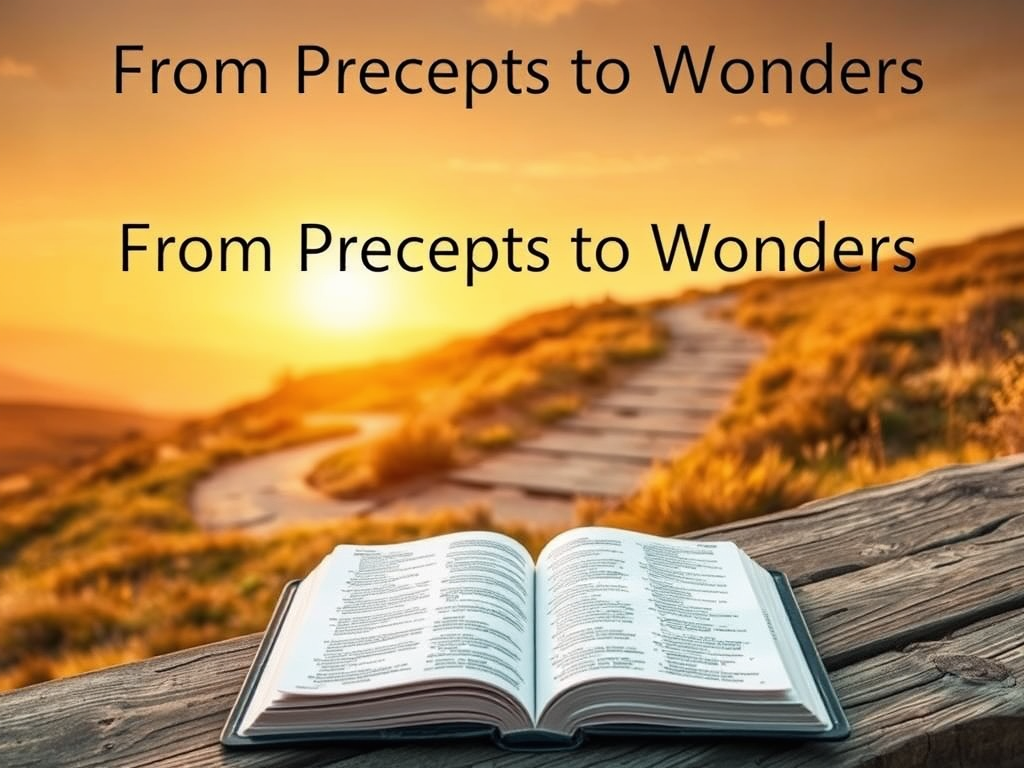
  • Psalm 119:27 – From Precepts to Wonders

    Psalm 119:27 – From Precepts to Wonders

    Explain to me the way of your precepts
    and I will tell of your wonderful acts.

    We tend to think of particular rules or principles for living as fairly boring, somewhat annoying, and often unreasonably restrictive. We seem to live in a debate between what we ought to do and what we actually do. Even the most law and order oriented people I know have rules they don’t feel they need to keep.

    As Christians, we come at law largely from the perspective of salvation. Our works cannot save us. Yet many of us are so oriented to law that we have to work that back into the equation again, such that eventually our Christian lives are taken up by the question of how to keep the rules and what might happen if we don’t. Some of the loudest voices I have heard with regard to grace and justification by grace through faith turn to the worst sort of works as they attempt to produce–and urge others to produce–the supposed fruit of that faith. (Hint: You can’t. God can.)

    Christianity becomes for so many of us a process of producing “good church-going people” who are “pillars of their community” and as such good people are surely going to heaven because they are keeping up with all the things their culture believes are the proper things to do.

    Well, right until these pillars fall down because they really aren’t such examples of everything that is good and right.

    And then we, as Christians, announce that the Hebrew scriptures are all about law and empty of grace because we can find examples in Israelite history of just such pillars of the community, and we can find rules that look a lot like they might describe the behavior of good “temple-going people” who are pillars of their community.

    Like David.

    Oops! For those who actually read the Hebrew scriptures (in translation is OK!), this image really doesn’t work. Not if you pay attention.

    I’m currently listening on Audible to the translation of the Hebrew Bible by Robert Alter as I walk on the treadmill. (I moved my after-dark walks and too-cold walks to the treadmill!) Tonight I was listening to the story of David and Bathsheba (2 Samuel 11-12). If David was a man after God’s own heart, I would imagine some grace was involved.

    But as we look at this passage, we are again looking at a much broader understanding of “law.” Note that in Psalm 119, we have at least two more general terms for law, Torah (instruction), and Word, as in God’s Word. Translating these as “law” gives modern English readers the wrong impression. As I read, I see in the term “Torah” a depiction of God’s guidance and interaction with people, i.e. an extended story of relationship. It’s about who God’s people are. In “Word” I hear the creator of the universe who is revealed in word and deed. Neither of these terms describes a code of law, such as Hammurabi’s code, or your state’s traffic code.

    What they do describe is a very deep relationship and an identity, God’s people, that becomes the key identity for those to whom it applies.

    In the New Testament book of Hebrews we have this same nature and identity, both Torah and Word, wrapped into the person of Jesus. I think it is worthwhile for us to know as Christians that when a Jew affirms loyalty to Torah, this is no more (or less) an affirmation of loyalty to a set of rules than ours is when we affirm loyalty to Jesus.

    Now Jews and Christians can both be legalists, forgetting Who it is they serve, and getting stuck on details, but this shouldn’t be blamed on scripture. We humans are like that. We like to get tangled up on the little things that we can understand and handle. Or at least that we think we can.

    But God is above and beyond that. God has a purpose for us that is so far above any of our thoughts that we can’t even imagine it.

    I’m drawn back again to Isaiah 55:

    For my thoughts are not your thoughts,
    nor are your ways my ways.
    This is the word of the LORD.
    But as the heavens are high above the earth,
    so are my ways high above your ways
    and my thoughts above your thoughts.

    Isaiah 55:8-9 (REB)

    And here in Psalm 119:27 we have the psalmist asking God to help him understand God’s precepts, and the result will be that he will speak of God’s wonderful acts. The reason is that everything God has to say points to God as God the creator and the author of all that is wonderful.

    And it all starts with trying to understand the little things, the precepts. Baby steps. Trembling, unstable, stumbling, hands reaching out along the path to wonder and amazement.

    What’s your next step?

    (Featured image generated by Jetpack AI.)

  • Psalm 119:26 – Just Talking

    Psalm 119:26 – Just Talking

    I tell you my stuff and you answer me.
    Teach me your statutes.

    I frequently comment that “always and everywhere there is stuff.” There is stuff to do, stuff not to do, stuff that I did, and stuff that I didn’t do. Not to mention the physical stuff to keep, stuff to get rid of, and stuff I have no idea how to handle. I used “stuff” here to translate “my ways.”

    One of the fascinating things about the psalms is the spiritual life that is reflected by the poetry. These are not the trite poems of people whose relationship with God is shallow, casual, or even easy. These poems come from the depths, and to reflect those depths, they must come from a heart with depth of experience.

    “Lord, I tell you my stuff and you answer me.” That’s powerful in itself. So many times when I’m talking about prayer, teaching about prayer, or discussing prayer in a group the entire conversation centers around things we ask for and whether or not we’ll get what we want. We talk about praise and thanksgiving, but often that’s largely as a thing that we need to do so our prayers are more effective. “Effective” is defined as getting what we want.

    This verse is talking about something really effective. It is prayer that works. It is prayer that is powerful. “I tell you my stuff and you answer me.” In theology-speak, I tell Almighty God what I care about and Almighty God actually talks to me about it. This isn’t about having the gift of prophecy, or getting messages to pass to colleagues with a “God told me” and a superior holy expression on my face.

    It’s having a conversation with something incomprehensibly beyond myself.

    I think the psalmist speaks from that experience, and that’s as important to me as the direct teaching of the text.

    And what does he want to know when he has this conversation with God? “Teach me your statutes.” Many of us would have different requests, but again, the psalmist is asking as profound a question as he can. “Maker of the universe, tell me how this works. Tell me who you are.” And bit by bit, he learns more.

    Some wonder how he can talk about the law for 176 verses. Why all this creative writing to tell about the law? But that is to misunderstand what he means by “law.” He’s talking about Torah. God’s actions. God’s commands. God’s relationship to God’s people. And another word used for it is Word. God’s Word that created everything.

    Inside our wedding rings, Jody and I had inscribed the reference Ephesians 3:14-21. Paul here reflects this same type of experience and the goal. Let me quote just verses 18-19:

    … may you, in company with all God’s people, be strong to grasp what is the breadth and length and height and depth of Christ’s love, and to know it, though it is beyond knowledge. So may you be filled with the very fullness of God.

    Ephesians 3:18-19 (REB, emphasis mine)

    Seek to hear ever more of what God can communicate to you.

    (Featured image generated by Jetpack AI.)

  • Psalm 119:25 – In the Dust

    Psalm 119:25 – In the Dust

    My soul is down in the dust.
    Give me life according to your word.

    Psalm 119 is an interesting–and biblical–combination of human action and dependence on Divine action. Verse 25, the first verse of the third section, is on the dependence side of the scale.

    If you’re trying to formulate theology, the variety here might be troubling. If you’re human, and having human struggles, they probably just sound realistic. I’ve had many days when I started out with determination, such as “I have kept” as in verse 22, and an hour or so later I’m at “I’m crawling around here in the dust, Lord!”

    God can and will work with either one. God is not limited by the ups and downs of human emotions.

    And the two Hebrew words of the second half of this verse are quite powerful: Give me life “according to your word.”

    “By the word of YHWH were the heavens made; by the breath of his mouth, all their host!” (Psalm 33:6) It’s the same word by which God gives life that God also created the heavens. The same breath that God breathed into the nostrils of a man made of dust–not just down in it, made of it–was the source of all that exists.

    When our determination to get everything done and to do it right falls afoul of our various weaknesses, interruptions, and weariness, we have all that to call upon.

    Will we remember that next time the load seems too heavy?

    (Featured image generated by Jetpack AI.)

  • Psalm 119:24

    Psalm 119:24

    Your testimonies are also my delight,
    My counselors [the men of my counsel].

    I like to say that we tend to go to the Bible for information, while God is there for conversation. I don’t mean that there is no information there. We tend to think in binary terms: Either the Bible is a source of data, or it tells stories. So many sorts of both information and conversation fall through the cracks when we think of it this way.

    I recall one gentleman at a church I attended who told us we should think of the Bible as something like the Boy Scouts Manual. I told him I thought that anyone who considered those two books to be similar must not have actually read either.

    There are certainly rules and procedures in the Bible. But the stories that surround those are even more important. For example, as Christians we don’t carry out the rituals of the tabernacle and temple service as outlined in Torah. But those rituals still have things to teach us, as do the stories in which they are embedded.

    As I was thinking about writing this meditation, I was reading some notes about a library and how one can be drawn into stories and worlds that are new, distant or even imaginary, and how those experiences found in the pages of books can enrich our lives.

    I long to help people find in the Bible a library of places distant and even just imagined, with that hope that imagined worlds may be more real than the ones that boring people assure us are “reality.” I would like to see us find that “reality” is more flexible and adjustable than even we can imagine if we just join the conversation that God has for us instead of just looking for answers for our rather ignorant and limited questions.

    I’d like to see people (including myself!) more and more find in scripture the real questions, the important questions, the ones that engage our minds more fully.

    The psalmist delights in the testimonies, but instead of calling them a rule book from which he learns a list of commands, he calls them counselors. To him they are alive and active (Hebrews 4:12). They are powerful.

    And this is not limited to the words contained in the book we call the Bible or scripture. God’s mind is displayed in the entire universe, and we can discover not final answers, but questions beyond any imagining.

    We might consider that our problem with God’s law isn’t, or isn’t just, an inability to do everything we are told to do absolutely correctly. It might be more that we can’t even grasp what it is.

    I think we’re invited on an infinite journey of learning and discovery. It’s not God who puts the limits on it. It’s our lack of imagination, especially of the ability to imagine a landscape completely outside of our current scope.

    Do you hear God calling you to glory?

    (Featured image generated by Jetpack AI.)

  • Psalm 119:23 – What Others Think

    Psalm 119:23 – What Others Think

    Prince sit around and plot against me,
    Your servant meditates on your statutes.

    To be honest, my first reaction to this verse was a laugh. Yeah, right, I thought. He really can sit meditating on God’s statutes while he knows people are plotting against him.

    That thought isn’t entirely wrong. This really is a high-minded, and potentially dangerous, approach. If this Psalm goes back to King David, it would be extremely dangerous, and the story of David’s life would tend to contradict the claim.

    On second thought, this isn’t a bad idea at all. Not that we’re likely to get it perfect. But it’s a good goal, and it can prevent a great deal of heartache along the way.

    There was a time in my adolescence when I was very concerned that people might be talking about me. I’m not sure why I got to thinking that way, but I really didn’t want people talking about be and not knowing what they were saying. I don’t recall any particular event that got me past this stage, but I do remember that very suddenly I realized that it was quite rare for people to be talking about me. Then I realized further that only a tiny portion of the times people were talking about me actually did me any harm at all.

    This was followed by a decision on my part that I didn’t really care to hear gossip. The inverse of my realizations about myself was that it was almost never of any value for me to learn things about others or talk about others, unless it was a specific, legitimate discussion.

    I don’t know that the Psalmist was thinking this way, or perhaps simply stating that his knowledge of God and God’s will was vastly more important than human plots and conspiracies. But I think this verse has insight beyond its simple words. Think about important things. Think about higher things. Think about useful things. And yes, think about fun things. Plotting princes don’t count.

    What should you be thinking about today?

  • Psalm 119:22 – Reproach and Contempt

    Psalm 119:22 – Reproach and Contempt

    Remove from me reproach and contempt
    for I have guarded your testimonies.

    Meditating on a single verse each day means I often get somewhat out of context. But while context is important, literature can easily suggest other lines of thinking. Folks in various classes I’ve taught have called me the king of the rabbit trail because I’m so quick to jump on ideas that are suggested by the text and not necessarily taught.”Meditating on a single verse each day means I often get somewhat out of context. But while context is important, literature can easily suggest other lines of thinking. Folks in various classes I’ve taught have called me the king of the rabbit trail because I’m so quick to jump on ideas that are suggested by the text and not necessarily taught.

    Psalm 119 certainly presents God’s commands as instructive, and keeping them as a good idea. So the connection of keeping and some sort of blessing is appropriate.

    But this passage reminded me of a frequent form of prayer, one that combines a reminder to God of all the good things we have done, and based on those things there’s a risk. “Because I’m good, bless me!” It’s a bargain with God.

    The problem, of course, is that it’s very difficult, indeed impossible, to make God owe us something. Why? Because as our creator, and the creator of all that is around us, we both exist, and live inside, gifts of God.

    I’m amused by suggestions that God is or has been inactive for various periods of time. If God was actually inactive, existence would end.

    Still, I think this is a natural, and even honest sort of prayer. It’s where we’d like to be. We want to approach someone for help who has some reason to help us. And I think that God honors such prayers, while hoping will come to understand God’s love and grace better.

    Spoiler alert: The Psalmist gets this completely, as indicated in the final verse. He asks that God seek him, even though he’s gone astray. He doesn’t really have a claim, except to ask God for what God does. God seeks.

    Of course, he still reminds God that he hasn’t forgotten, but in many ways I think that’s the thought of a lost sheep who wants to let God know he hasn’t forgotten the home pastures, the sheepfold, and the Shepherd.

    Do you remember your spiritual home?

    (Featured image generated by Jetpack AI.)