Threads from Henry's Web

Tag: Psalm 119

  • Psalm 119:52 – Finding Comfort

    Psalm 119:52 – Finding Comfort

    I remembered your judgments from ages past,
    Oh Lord, in them I found comfort.

    The division of this verse into two lines seems slightly odd. I’ve taken it as a chiasm, a b b’ a’: (a) I remember your judgments (b) from ages past (b’) Oh Lord, (a’) I found comfort. It’s interesting to watch for chiasms in the Bible, because it places emphasis on certain concepts. I may be wrong about the division, but if I’m right, the form places the emphasis on God’s eternal nature and God’s enduring judgments.

    And that format led me to think about human tendencies, and two opposite things that we tend to like, not always consistently. First, we like to think of stability. The idea that a practice or a law has been done for a long time and has been successful gives us a feeling of stability. We also have a drive to change, which challenges that stability. We’d like to have complete freedom combined with absolute stability.

    In the real world we can’t actually have both. Freedom and innovation always challenge safety and stability. We live with this sort of tension all the time, often resolving it by considering our own innovations as just natural developments, not threatening the fabric of society, while the innovations of others are clearly destructive and must be stopped!

    In scripture, God is presented as being on both sides of this. God is the creator, a continuing creative force. God is also ancient, reliable, providing comfort to those threatened by hostile changes.

    Am I speaking scripturally?

    “I am YHWH, I do not change ….” Malachi 3:6

    “Look! I am doing a new thing! …” (Isaiah 43:19)

    Sometimes when asked if I think there are contradictions in the Bible I say, “Yes! I think they’re the best part!”

    What exactly is God up to? Is it new or is it eternal? I like to think about this with what I call “orthodox Christian thinking,” by which I mean thinking formed by doctrines such as the trinity and the incarnation. “God is three, but God is one.” “Which?” “Yes!” … or … “Jesus is fully human and fully divine.” “Which?” “Again, yes!”

    God never changes. God is doing a new thing. It’s really a beautiful and powerful contradiction.

    “I am YHWH, I do not change. Therefore you sons of Jacob have not been finished off.” (Malachi 3:6)

    Because God is faithful to God’s promises, because having chosen, God doesn’t give up, Israel will not be destroyed.

    “Look! I am doing a new thing! Right now it’s springing up! Can’t you see it? I’m raising up a path in the wilderness, in dry places, rivers!” (Isaiah 43:19)

    Wonderful thing, context. Useful to read each verse completely.

    The end of each verse is this: God is redeeming Israel. God is not giving up. God is staying the same. God is doing something new.

    What new path does the unchanging God have for you today?

    (Featured image generated by Jetpack AI.)

  • Psalm 119:51 – Confidence

    Psalm 119:51 – Confidence

    The arrogant taunt me scornfully,
    but I do not swerve from your instruction.

    The most common reason people express to me for not talking about their faith to others is that someone may make fun of what they believe.

    Now I can’t tell you that people won’t do that to you. They will. And it’s more universal than you might think. I’ve found that many Christians are unaware of what their comments on atheism sound like to an atheist, or actually to anyone who doesn’t believe as they do. When we produce “zingers” or “mic drops” regarding people who do not share our beliefs, they may cause high fives among those who share the taunter’s viewpoint, but they don’t make friends, and they don’t convince.

    Actual confidence in your beliefs doesn’t require you to put others down. Confidence will, however, give you a defense against those who taunt you. You know that the snide remark doesn’t actually make your own beliefs wrong. It’s the result of under-confidence and over-expression.

    This doesn’t mean that you can’t have dialogue about your faith or even debate it. But the dialogue of a confident person doesn’t require demeaning one’s opponent or trying to get cheap, but ignorant laughs. Dialogue requires that one listen to an opponent’s point of view and respond to what that person actually believes.

    This also applies to debating with or having dialogue with Christians in other tradition streams. For example, the Calvinists I encounter don’t resemble the Calvinists described to me by fellow Wesleyans. On the other hand, the descriptions I often hear from Calvinists of Wesleyans don’t much resemble anything I believe.

    This verse gives us antidotes to all of these problems: Sticking to God’s instructions. Doing so will help you to withstand taunters and to avoid being a taunter yourself.

    Who in your world might you need to understand better?

    (Featured image generated by Jetpack AI.)

  • Psalm 119:50 – Experience

    Psalm 119:50 – Experience

    This is my comfort when I’m afflicted:
    Your word to me has given me life.

    What do you hold onto when living through difficult times?

    During times of great difficulty, theological conclusions, no matter how well thought out and firmly held, can let you down. It’s very difficult to continue believing in a God of love, when that love is not evident.

    I know this from experience. When our son James was dying of cancer, Jody and I had plenty of teaching to rely on. We were both teachers in the church who had taught weekend seminars on prayer. We had plenty of stuff in our heads. We did not teach that God always resolves problems in the way that we would prefer. If you’ve read Job, you can understand that God may call on you to remain a witness when things look as dark as possible.

    So what did sustain us?

    Our experience with God, experience that gave reality to what we had learned and what we taught. We knew that God could act, because we had experienced this. We also knew that the result might not be what we preferred, because we had the experience of the church and our own experience that matched again with what we taught.

    But even more, living through the experience required a continued sense of God’s presence, and a continued conversation with God. Knowledge could fail us. Friends could fail us. We could feel alone, beset on every side. But when we would spend time with God, when we would listen for the still small voice (KJV) or the sound of sheer silence (NRSV), a quietness in which you know God is there, we could find the strength to sustain us.

    Our comfort in our affliction was that God, through God’s powerful, creative Word, gave us life, sustained that life, and held that life in Divine care.

    How can you experience God’s comforting and empowering presence today?

    (Featured image is from Adobe Stock by By Romolo Tavani. Licensed. Not public domain.)

  • Psalm 119:49 – Remember!

    Psalm 119:49 – Remember!

    Remember your word to your servant,
    upon which you have caused me to hope.

    We have another imperative, but this one is addressed not to us, but to God!

    My wife sometimes is hesitant to remind me of things. She doesn’t want to say, “Henry, you forgot …” or “Please remember my ….” She especially wants to avoid nagging. That’s because she and I are both–shock!!!–human, and neither of us really likes to be reminded of something we remember. I’ve told her that it’s not nagging when I don’t remember the first time she said it, but she is still careful about this.

    God is not thin skinned. You can remind God of God’s own word. God’s ego is not fragile.

    One of the key things I like to say about prayer, and one I think is both true and important, is that you don’t need a particular format to talk to God. Often we’re afraid to express what we’re really feeling to God. Possibly, we imagine that a prayer that’s strongly worded might offend the Almighty. A good antidote to this is to read the Psalms, and this verse is one of the tamest examples.

    You can tell God you’re angry. You can tell God you’re sad. You can remind God of all the promises you’ve read. You can mention that you’re getting impatient. God already knows, so not only do you not need to hide it, it won’t do you any good.

    And in reminding God, it’s just possible you may actually remember those promises yourself.

    What promise do you need to call to God’s attention?

    (Featured image from Adobe Stock By Azovsky. Licensed. Not public domain.)

  • Psalm 119:48 – Meditating

    Psalm 119:48 – Meditating

    And I lift up my hands to your commands which I love,
    and I will meditate on your statutes.

    I haven’t been entirely consistent in how I translate the first word of each couplet in this section, but they begin with the Hebrew letter vav (or waw as is sometimes taught in classical Hebrew). This would be “and” or some sort of connective in English. Verse 48 is the end of the eight-verse section. Tomorrow we start on the letter zayin, which sounds like the English ‘z’.

    The first word in verse 49 is zekor, the imperative ‘remember’. Addressed to God. We’ll talk about that tomorrow!

    But the word ‘remember’ came to me as I thought about my project of meditating on this chapter. My practice has been to read the verse just before I go to bed, setting the subject for my mind for the following day. I read it again in the morning. It’s interesting to me how many times I can’t remember which verse I’m to meditate on when I get up, or how many times I might have to remind myself during the day. My mind doesn’t just wander. It charges berserkly from subject to subject and often doesn’t want to settle anywhere. I have quick practices I use to restore my focus.

    So what as it meant to meditate on these verses?

    First, because I intend to write something, I have had a focus for my thinking. What would it be good to say about this particular verse?

    Second, it has become part of the way I focus my activities of the day. If I find myself needing moment to refocus, reading the verse or remembering it and thinking about it provides me with a punctuation point for my day.

    I could have a worse way to restore my focus!

    This is also a different way of handling scripture, and I think it’s valuable. My normal focus is very factual. I started studying biblical languages because I wanted to get the meaning of scripture as precise as possible. I still value a precise reading of scripture and the attempt to understand what a passage meant to the person who first wrote it and those who first heard it.

    That process of exegesis, and critical analysis of every possible aspect of the text remains an anchor point. In studying these verses, I consult the original languages and ancient translations. I look at possible relationships between these words and those in other ancient languages. I always want to start with what the psalmist was likely thinking as he wrote these words.

    I cannot know that precisely. That’s one reason I call it an anchor point. It’s easy to conclude that if I can’t understand something perfectly and precisely I might as well not try. I compare this to the building of an aircraft. There are always tolerances in measurements. Nothing is perfect. But the builders can never forget working to those standards, or disaster will follow. History has shown us how that works!

    But scripture is not limited to being a source of data. It provides a way of thinking and a basis for thinking. That’s where meditation on scripture is so valuable. A scripture can shape your thinking about something that the original author didn’t even conceive. (I realize that God conceives of everything. I’m talking about the human author.)

    The process of deciding can point the way to how other decisions are to be addressed or to principles one can apply in many areas. The text can also simply provide the catalyst for other ways of thinking. Scripture is a written form of the powerful, creative Word of God, and that Word can empower things that previous readers or the original writers were unaware of.

    In reading from and meditating on God’s Word, you can provide the opportunity for you to hear God speak.

    What new approach could you take to benefit from God’s Word?

    (Featured image from Adobe Stock By Sensvector. Licensed. Not public domain.)

  • Psalm 119:47 – Taking Delight

    Psalm 119:47 – Taking Delight

    And I will take delight in your commands,
    which I love.

    Everyone who loves being commanded, raise your hands.

    Well, I can’t see the hands over the internet, but I’m guessing there aren’t many. There are only a few people who really enjoy dealing with regulations. We may consider them necessary, but we don’t generally get delighted about them.

    I’ve talked about many reasons that the law, as understood in Psalm 119, should be seen as much more than regulations. Yes, it includes regulations, but all of that is part of the self-revelation of God to a people (Israel) that he chose. There is a certain wonder in just the fact that God made such a choice. For those of us who are not descended from Abraham, Isaac, and Jacob, there is the fact that when God called Abram, he called him to be blessed and to be a blessing.

    Today, however, I’d like to suggest reading another Psalm as a tie-in for this verse and the next one. Psalm 19 also includes praise of the law in terms not so often used today. It also makes another connection, one which I consider very important, and one in which I take delight.

    Psalm 19:1-6 talk about the way God’s creation declares God’s glory. Some scholars think Psalm 19 is a combination of two prior songs, and it may be that, but I think the combination was very intentional. Because starting with verse 7, we here about the law, with “law” used here in much the same way as in Psalm 119.

    The law of YHWH is perfect, reviving the soul. (Psalm 19:7)

    This is followed by many of the same terms for various aspects of law that are used in Psalm 119, bringing out that full picture of God’s self-revelation to God’s people in the broadest sense.

    The power of the lawgiver is tied to the power of the creator. The reason God can give laws is that God made everything, and knows how it works, works best.

    This function of law relates closely to God’s grace, God’s giving. In Genesis 1 & 2, God creates, and then gives instructions. I regard the story of the tree of the knowledge of good and evil as very much symbolic. God creates and then sets boundaries.

    We see this order of affairs again with the ten commandments in Exodus 20. God notes this in the prologue to these commandments. “I am YHWH your God, who brought you up out of the land of Egypt, out of the house of bondage.” The grace, the giving, comes first.

    Now we experience this in reverse much of the time. We have to realize there’s a problem before we seek the problem solver.

    But when we come back to the grace, we realize that it was there, is there, will always be there, first.

    The heavens and the Law declare God’s glory in chorus.

    Are you listening?

  • Psalm 119:45 – Speaking Before Kings

    Psalm 119:45 – Speaking Before Kings

    I will speak of your testimonies before Kings
    and will not be ashamed.

    Do you speak of your faith to other people? For many, this is a question specifically about making religious statements. Can you attempt to “bring someone to Christ?” Can you make a new disciple?

    What I wonder is whether we can talk about the ways of God, the things we might study from scripture and from God’s world, before others. I’m not opposed to sharing our faith. I think we should. But right now I’m talking about something different: Sharing what we have learned outside of the context of faith and religious activity.

    Can you present things you learn from God in ways that will be valued in a non-religious context?

    In my Sunday School class there is a gentleman who is a master at this. I can present a spiritual idea and he’ll find and express how that applies in professional or business life. The things I will teach from scripture he can present as a part of simply doing one’s job well or helping to change the world around him.

    I really appreciate this input. I also appreciate people who can express their faith without being religious about it. One might call it good advice without sanctimony.

    Can you share something of value that you learned through Bible study with someone else without first trying to convince them that the Bible is the word of God?

    I’d suggest that’s a valuable skill.

    (Featured image generated by Jetpack AI.)

  • Psalm 119:45 – Walk in Liberty

    Psalm 119:45 – Walk in Liberty

    So I will walk in liberty
    for I seek your precepts.

    I must credit Mitchell Dahood in his 3 volume commentary on Psalms in the Anchor Bible (vol 1, vol 2, vol 3) for the word “liberty.” I was struggling for a translation that I felt lived up to the context. I think that one does. Mitchell Dahood was an interesting character. One of my professors in graduate school said of him that he was right no more than 20% of the time, but when he was right, he was so right that it made up for all the rest!

    This verse seems to express a contradiction, or perhaps more of a creative tension between rules and liberty. We generally think that the more rules there are, the less liberty, and vice-versa. But the Psalmist here is talking about walking, i.e., living his life in liberty precisely because he seeks God’s precepts.

    Our problem as humans is that we (or at least most of us) want to be in control. Some people are very controlling, and we often call them control freaks. But there are very, very few people who actually want to be controlled by someone else.

    The experiment in the United States with prohibition illustrates a problem with such control. When you make a law banning some sort of behavior, it’s critical that most people believe that rule is a good one, one that should be enforced. In the case of prohibition, too few people thought it was a good rule and too many wanted to control what they were imbibing themselves. This sort of attitude makes a law difficult to enforce. (Note that I don’t consider this a full exploration of the sociology of prohibition. It is just one aspect.)

    Consider as an easier case the 55 mile per hour national speed limit. Enforcing it was massively difficult, especially in the wide open spaces of the mid-west and northwest. Many people thought in the abstract that it was a good idea, but when they got out on the road, they drove a great deal faster.

    I remember one occasion when I was on leave from the Air Force and was driving on I-80 through Wyoming. There are some really long sections where you can see for miles, and driving 55 mph was unlikely. My speed crawled up to 70 mph. Soon I saw those flashing blue lights in the distance and I was pulled over. I was concerned, because 70 in 55 is quite a bit over the limit.

    The trooper was a nice guy. He took care of identifying me, and then said, “Young man, would it be possible for you to see your way clear to drive just a little bit slower across my state?” I said, “Yes sir, I imagine I could.” He grinned, wrote me a warning, and off I went.

    Neither of us were really seeing my rule-breaking as all that bad. Yes, he wanted me to slow down, but if he was a real stickler for the rules, things could have gone much worse. He could also have said something like, “The limit is 55 mph you idiot, and you didn’t get to 70 mph by mistake!” But he didn’t.

    But there is a best way of doing things. There’s a “safest” way of driving, a healthiest way of living, the most productive way of working, and the most effective way of relating to one another.

    I think that’s what the Psalmist is thinking about. If I can get on the same wavelength as the creator of all of this, it’s likely I’ll find that place where I find the best balance between all the various factors of my existence, a place where I really have liberty, but don’t suffer from falling into stupid.

    I once participated in an online discussion in which a Canadian cop commented that if he could eliminate stupid and drunk, he’d be out of a job.

    How about aiming for eliminating our own versions of stupid and drunk from our lives by finding God’s best alignment?

    Some resource books on the Psalms:

    (Featured image generated by Jetpack AI.)

  • Psalm 119:44 – Keep it Forever

    Psalm 119:44 – Keep it Forever

    And I will keep your instruction (Torah) continually
    forever and ever.

    For another sense of Hebrew parallelism, note the short 2nd line here, “forever and ever.” This is parallel with “continually” and suggests a combined “all the time for all time.”

    If we hadn’t just read a number of verses in which the Psalmist expresses dependence on and trust in God, this would sound somewhat boastful. As it is, I read it as an expression of determination. Now determination is not, in itself sufficient, but there is nothing wrong with it when combined with the other expressions of the Psalm.

    Here we again encounter the Hebrew word Torah, expressing God’s instruction. Again, I’m reminded of the variety which is contained in Torah, when that is interpreted as the first five books of the Bible, a variety which is only increased if we see God’s instruction extending past those books. In just those books we encounter poetry, genealogy, stories of divine action, stories of human action, human faults and failings, divine interventions, moral laws, ritual laws, teaching about government, prophecy (in the predictive sense as well), visions, dreams, conversations with God, and case law. And I have doubtless missed something.

    I think as Christians we should think of how we should apply this. What is it that we are to do continually? I’d suggest that a great deal can be learned from Torah understood as the first five books of the Bible. But for us, the actions and words of Jesus are also instruction. Just as Torah goes way beyond a list of regulations, as important as those are, so Jesus goes for us well beyond a set of teachings.

    I think a critical question for Christians today is this: Can we live according to the teachings of Jesus? Continually? Forever?

    Perhaps we need to make a determination, as did the Psalmist. And don’t forget to put your trust in God for the fulfillment of that determination!

    (Featured image generated by Jetpack AI.)

  • Psalm 119:43 – Power to Speak Truth

    Psalm 119:43 – Power to Speak Truth

    Never take the word of truth from my mouth
    for I place my hope in your judgments.

    Tomorrow morning I’ll be leading a discussion of John Wesley in my Sunday School class. The notes in the book we’re using point especially to Wesley’s view of prevenient grace and to Christian perfection. It’s interesting to take these two points together as the key to Wesley’s teaching.

    The first deals with God’s action before we ever turn toward him. In a sense, you can think of prevenient grace as God’s call to us. It is important to remember that it is an act of God that takes place before we take any action, including taking any thought.

    The second deals with God’s action after we have received prevenient grace. It is the work of God in us to lead us toward and prepare us for his glory.

    There is a key point here that is often missed, and that is that both of these, not just prevenient grace but sanctification, are entirely works of God. I find myself in disagreement with Wesley when he suggests that one might become wholly sanctified in this lifetime. But it is wrong to suggest that Wesley believed a human being might attain sanctification. Were a person to become wholly sanctified, that would be a work of God.

    One of the interesting things about humans is our ability to hear part of a message. Sometimes there is a genuine misunderstanding. But there is also the possibility, even the likelihood, that we will hear the things that fit in with our existing perception.

    I remember once hearing a sermon which, in my view, strongly took a certain point of view. I heard this at the early service, and was teaching a Sunday School class immediately afterward. The members of the class were discussing the sermon and concluding something that the preacher had explicitly stated was wrong. In fact, most of the sermon was intended to say that was wrong.

    I went through a 10 minute explanation of what I had heard, following which one of the class members said, “Yes, precisely, he said …” and repeated the misunderstanding.

    This led me to wonder whether I had heard the sermon correctly. I had a chance to chat with the pastor during the week and I asked him. He affirmed what I had heard in the first place. Then he said, “You know, sometimes I wonder why I bother.”

    Now this is not about my great hearing. Rather, I was quite inclined to hear the message the pastor was presenting, while most members of the class preferred something else. Then they heard something else.

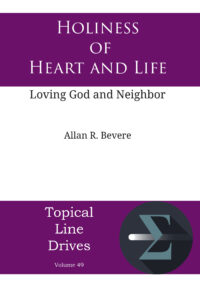
    For a modern view of Wesleyan holiness doctrine, read Allan Bevere’s short volume.

    We do that with scripture. This first, for example, is a balance of asking for God’s grace and favor while also pointing to ones own action. “I’m hoping real hard for this, like I ought to. Make it work!” It’s a very human prayer.

    But the easy thing to do with a great deal of Hebrew scripture is to hear what we expect to hear. We’ve been told this is all about rule keeping and our personal diligence in doing what God wants. As Christians, we look back at benighted writers of Hebrew scripture as not knowing about grace. But the writers of Hebrew scripture were well aware of God’s action and of the need for God’s action.

    We can come to Psalm 119 as a drumbeat of legal requirements and a super-pious, self-righteous expression of the wonder of all these rules. But that’s a bias of our superficial thinking.

    We generally like rules. We like to congratulate ourselves for obeying them. We like to feel powerful and express our personal sovereignty by disobeying them. We like to be in control of what we do about them. So we tend to read that into religious texts.

    But the Psalmist is very human individual looking with awe, hope, and wonder at a Creator God. He knows it’s God’s action, God’s life in him. I commend Psalm 104 as an indication of human dependence of God as understood in Hebrew scripture.

    Similarly, modern followers of John Wesley often take the doctrine of sanctification and treat it as a potential accomplishment of each person, and the attainment of it (supposedly) as a badge of honor and greatness. Getting into heaven is up to God, but being a good, church-going pillar of the community is an individual accomplishment.

    That’s false. The dependence on God starts not at birth, but at the first movement of the first subatomic particle that makes up part of your body. With the Psalmist, we put our hope in God and ask that God takes us to these places.

    Remember that whatever it is, it’s God’s.

    (Featured image generated by Jetpack AI.)