Threads from Henry's Web

Tag: Proverbs

  • Reading Hebrew Poetry in English (Brief Edition)

    Reading Hebrew Poetry in English (Brief Edition)

    As my Sunday School class is studying Proverbs, I thought I’d provide them with a bit of an explanation of Hebrew poetry. If you’re someone who reads Hebrew and has done any study of Hebrew poetry, this is not for you. Don’t bother to tell me about all the things I’m leaving out. I already know.

    This actually started from my intention to explain a difference in translation, so let’s start with the verse in question.

    8 Attend, my son, to your father’s instruction
    and do not reject your mother’s teaching;

    Proverbs 1:8 (REB)

    Or …

    8 Hear, my child, your father’s instruction,
    and do not reject your mother’s teaching;

    Proverbs 1:8 (NRSV)

    Or … and here’s where the problem is revealed …

    8 My child, obey the teachings
    of your parents,

    Proverbs 1:8 (CEV)

    So how can the Contemporary English Version come up with the translation they did? Though I think we all can recognize that the overall meaning is essentially the same, one might wonder why the CEV would alter the way in which it is expressed so much. For a discussion of various approaches to Bible translation, see my book What’s in a Version?, or the site MyBibleVersion.com that I maintain.

    But here my interest is how the difference is enabled by the nature of Hebrew poetry. In English, we use various combinations of rhyme and meter for most poetic expression, though there is also much less formal free verse or even poetic prose.

    Hebrew poetry does have meter. While there are many arguments as to detail, what I was taught back in ancient times when I was in school was counting accented syllables. While there are some valid objections to this, I think it generally allows one to get a fairly clear picture of the form. Unfortunately, this method is unavailable to most English readers.

    Hebrew poetry is primarily characterized by parallelism of thought, so as an English reader, if you divide a sentence in Hebrew poetry into elements, you can get an idea of how these elements work in meaning. Once you divide the poetry into these elements, you can look for parallels between them.

    These parallels usually come in one of three forms: synonymous, antithetical, or synthetic. In synonymous parallel, two elements essentially express the same thought. In antithetical, the elements express the thought, but in an opposite way. In synthetic parallelism, the two elements go together to express a single idea more comprehensively.

    In the prior paragraph I’m bypassing a great deal of literature and also probably confusing my readers. Let’s take it to our example verse. I’m going to translate it from Hebrew as literally as possible.

    _____ | Obey ________________ | my son | exhortation of your father
    and | don’t leave unheeded |_________ | the instruction of your mother.

    Proverbs 1:8 (my literal translation)

    Now in analyzing Hebrew poetry, we would generally not separate the conjunction, which is not a separate word in Hebrew, but rather a prefix.

    Multiple things are illustrated here. First, one could call this synonymous parallelism, except that the verbs are stated antithetically, “obey” versus “do not disobey,” while the instruction is synthetic, combining the teaching/discipline of parents into “exhortation (or discipline) of your father” and “instruction of your mother.” In addition, you can see how an element can be left out of one or the other line, yet it applies to both.

    You get the full impact of the verse by seeing the way these two lines stand side by side. In some cases you can get a false impression when you fail to realize that two lines are not expressing the same thing, and you will generally understand a verse, usually 2-3 lines, better if you let them work together to bring their message.

    The reason I chose the REB, NRSV, and CEV is that the REB and CEV are considered functional equivalent translations, while the NRSV is a formal equivalence translation. Functional equivalence means to try to find English words for the Hebrew that have the same impact on the English-speaking audience that the Hebrew would have had on the original audience. Formal equivalent translations try to keep the forms as close as possible in a more word-for-word translation.

    You can pick out the elements I identified from either the REB or the NRSV. The CEV, however, is translated primarily to be read by people whose first language is not English. It has departed from the form in order to convey the function to its audience.

    Why doesn’t the REB do so? Generally because it is written in a more formal variety of English and finds the continued repetition of the Hebrew to be quite comprehensible.

    Again, I have quite obviously over-summarized some things and left many out, but I hope this will help.

    (Featured image generated by Jetpack AI, and modified by me using Photoshop.)

  • Wisdom – You’ve Got to Want It!

    Wisdom – You’ve Got to Want It!

    Wisdom cries out in the street.
    In open spaces she raises her voice. …

    My son, if you take my word,
    and store my commands within you,
    Bringing your ears close to wisdom,
    and stretching your heart to understanding.
    If you call for understanding,
    and use your voice for discernment,
    If you seek her as silver,
    And dig for her as buried treasure,
    Then you will understand the fear of the LORD,
    and find the knowledge of God.

    Proverbs 1:20 & 2:1-5, my translation

    In James 1:5, readers are told that if anyone lacks wisdom (and if you don’t think you lack wisdom, you probably do!) that person should ask God, and they will receive wisdom.

    It’s as simple as that.

    Well, maybe not quite that simple.

    There’s a military aphorism that states: “In war, everything is simple, but nothing is easy.” The two halves of that saying illustrate the change from chapter 1 to chapter 2 of Proverbs. We have wisdom calling out, seeking people, being as obvious as possible. Then suddenly we turn around, and we are being told to listen carefully, seek diligently, even dig for it.

    What’s going on?

    Wisdom is, in fact, simple. Yes, simple. It’s out there everywhere you look. Right and wrong actions have consequences. Success or failure can be found in recognizing and acting on these things.

    And wisdom is, in fact, available. You can discover wise ways of doing things. There are many places where wisdom is calling out, calling to you.

    It might be

    • An older person in your family who has a wealth of experience
    • An expert in their field who can pass on good information and outline courses of action and results
    • The physical world, where you can quickly learn about falling, living, starving, and even dying, and if you are observant, living!
    • Somebody from another culture who may have a different perspective than you do.
    • Somebody whose mind works differently than yours does.
    • The Holy Spirit, the Spirit of Truth, working in and through people and creation.
    • A younger person, viewing a situation with more innocent eyes.
    • A good book, written by someone with experience and knowledge you lack.

    Wisdom is everywhere.

    Wise people are much rarer. Why is that?

    You have to want it. Like the military aphorism, wisdom is simple. It’s out there. It’s available.

    But wisdom isn’t easy. It calls out to you, but it doesn’t force you to listen or to act on what it says. You have to be willing to make changes, to act in ways that may be unfamiliar to you. You have to be able to recognize where you’re wrong. Or more importantly where you may be wrong, so that you can correct your actions–or not.

    The problem is that wisdom is often uncomfortable. The wise thing to do is not what you perceive to be the fun thing to do. Following wisdom may hurt your pride. None of that is easy.

    Over the years I have frequently been called on to pray with people about decisions they are trying to make. I’ve found that most of the time, the person I’m praying with actually knows what they ought to do, but they really don’t want to do it. What they’re praying for is an excuse to take a different road, one that is easier, or more satisfying to their pride.

    When I reflect on those prayer times, I’m immediately reminded that I spend much time in prayer hoping that God will provide me with a different path, an easier path.

    Proverbs 2 gives us the unpalatable answer. Yes, you can have wisdom. No doubt about it.

    But you have to really want it.

    (Featured image generated by Jetpack AI.)

  • Wisdom Has Questions

    Wisdom Has Questions

    Wisdom cries aloud in the open air,
    and raises her voice in public places.
    21 She calls at the top of the bustling streets;
    at the approaches to the city gates she says:
    22 ‘How long will you simple fools be content with your simplicity?

    The Revised English Bible (Cambridge; New York; Melbourne; Madrid; Cape Town; Singapore; São Paulo; Delhi; Dubai; Tokyo: Cambridge University Press, 1996), Pr 1:20–22.

    Last week I discussed starting a study of Proverbs and noted a different way of receiving the text. This does not result from a prophetic vision, or from a prophet hearing a voice, but rather from collective (and collected) wisdom from a culture. This is life-time learning, rather than special, instant revelation.

    We like instant revelation. We like answers. We especially like answers that come quickly and fit in with our existing lifestyle and our prejudices.

    The “wisdom” we can gain in this way has another advantage. It can be formed into “ammunition sentences,” sentences that we can fling at other people to shut them up. Often such sentences begin with “the Bible clearly teaches.” We fill in with things we clearly see, largely because we failed to see the whole of scripture.

    I saw a sign in front of a church the other day. The first line read: “God has the answers!” And the second read “Are you listening?”

    That’s good. God does have answers. But sometimes God’s answers don’t match our questions, and the reason is that we’re not asking the right questions, or more specifically, we’re asking questions that limit the range of God’s answers. Sometimes we’re even asking questions in order to avoid God’s answers.

    Over the years I’ve prayed with many people who were seeking God’s guidance. Many of these people were genuinely uncertain, and were trying to seek God’s will. But more of them already knew what God wanted them to do, often because it was clear in terms of ethics, simple right and wrong, but who were hoping they could get a word from the Lord that would set them on a different path, one they preferred to what they already knew. Maybe God’s voice will allow me to take a different turn.

    When you approach things that way, it’s easy to end up believing you’re following God’s path, or the path of wisdom, just because you want so vigorously for that to be the right answer.

    I remember once having a conversation with a couple of friends about a business decision. Business decisions are hard for me. In this case I was discussing two options and trying to decide which was the next step. I had struggled with the decision for days. I don’t even recall now what the issue was, but suddenly in the midst of the conversation I held up my hand and said, “I’ve just realized I’m doing this wrong. Option A would result in behaving unethically.” My advisors hadn’t seen that, because they didn’t understand all the processes involved. As soon as I explained what would happen, they recognized what would likely happen, and so the decision was made.

    What slowed me down? I knew the process and should have recognized the problem immediately. But I didn’t. I wasn’t responding to the right questions. I was missing them because I wanted something to be true, but it wasn’t. No amount of wanting would make it true.

    “Wisdom is calling out in the street.”

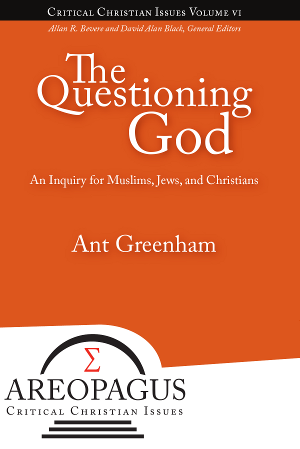
    Cover image of The Questioning God book

    And wisdom is often providing questions. Ant Greenham, in his book The Questioning God, says:

    Our foundational identity as human beings, female and male, is inextricably linked to questioning, to inquiry. The fall of humanity notwithstanding, people are repeatedly called to respond to God in the context of mental and spiritual engagement. And the centrality of a questioning approach is reflected throughout the Bible.

    Ant Greenham, The Questioning God, (Pensacola, Florida: Energion Publications, 2012), 4.

    Greenham goes on to point out the numerous ways in which God’s interactions with us consist of God questioning us. We may have questions of God, but God has even more questions to ask us. I’d suggest as a quick example that you check Job 38. After much discussion and complaint, God becomes active and what does God start with? Lots of questions!

    This approach suggests that God wants us to use our mental capacity. Here’s a famous verse, but let’s think about it again:

    The fear of the LORD is the foundation* of knowledge; it is fools who scorn wisdom and instruction

    The Revised English Bible (Cambridge; New York; Melbourne; Madrid; Cape Town; Singapore; São Paulo; Delhi; Dubai; Tokyo: Cambridge University Press, 1996), Pr 1:7.

    Too often this verse is used to contrast the supposed wisdom of the speaker, which the speaker supposes came from God, verses the use of human intellect. “Don’t trust in your education, your degrees, or your own experience. Do what God says instead!” That’s the common advice.

    I’ve received this advice from some as an admonition not to trust my study of Greek and Hebrew in interpreting the Bible, but just to let the Holy Spirit tell me what the text means. But the second half of the verse challenges that. “It is fools who scorn wisdom and instruction.” I can be listening for God’s voice in so many ways, while ignoring what I have already learned. Often when I’m searching for an answer, I’m directed (in various ways) to look at the scriptures and the wisdom of the community of faith over the centuries for an answer. I’m directed to, not away from, the sources involving intellect.

    I’ve written a few times before on the Wesleyan Quadrilateral. There’s lots of history and debate around that. But I like it a great deal. Today, I’m focused on one element: Reason. We like to put reason down in favor of more spiritual sounding approaches. But in the end, it is with your reason that you will comprehend the messages sent to you by God. That’s why God so frequently asks questions. God wants to awaken your reason.

    I want to note one final thing. Intellectual activity and engagement is not exclusively the product of academic instruction. In fact, a great deal of foolishness takes place in academic settings. Any group of people can become so inward looking that they lose site of the whole of creation. They can no longer hear wisdom calling in the street because they are in a room with the windows closed and their select set of sources.

    Intellectual activity is also the farmer learning to manage crops, run farm equipment, and take care of animals. God can and will speak wisdom in that setting. The Greek classroom is not more about wisdom and instruction than is the farm, or the corner grocery store. Wisdom is calling out in all these places and through all these processes.

    God is asking you questions about everything. Are you listening?

  • Starting a Study of Proverbs

    Starting a Study of Proverbs

    The Sunday School class I co-teach is beginning a study of Proverbs. I’m not leading this one. I’m relaxing a bit, I hope. But I have indicated I’ll do a bit of blogging on the material.

    The assignment before the beginning of the study tomorrow was to read introductions to the book, both from the resource text we’re using (The Daily Study Bible volume on Proverbs) and from various Bible editions. I’m not going to try to provide my own introduction, except to note that I read multiple introductions that seemed to me to provide an excellent launching point for a new reader.

    My interest is the place of Proverbs in the biblical canon. Why is it that we have a collection of proverbs in the canon of scripture?

    While we work with the canon of scripture all the time, we don’t often think about it as much. The “canon” refers to those books which are canonical, which means they’ve been accepted by church law as authoritative in the church. This is a fairly strict legal definition in the Roman Catholic and Eastern Orthodox traditions. In Protestantism, it’s a bit less fixed. The general concept remains.

    People often start talking about scripture with the concepts of inspiration and truth, and if a book is determined to be “inspired,” it is then scripture. That’s not precisely how this happened. There was a long process of history, tradition, discussion, and finally definitive determination. The determination can be better termed a determination that a particular set of books was and is authoritative rather than that these books were inspired.

    Now that may catch you a bit off-guard. Surely these books are inspired! In fact, I believe just that. But being inspired is not sufficient to make them scripture. I personally hold that God has inspired other writings which are not scripture, but I do not advocate that such writings become part of scripture. The key difference is that the selected writings were seen as authoritative.

    “Authoritative” involves the value of the material over time and space. For example, an ancient prophet might have sent a message to a particular individual that was specific to that individual. That message might have been from God, inspired by God, and sent by God’s authority, but if we discovered it today, as interesting as it might be, it would not be authoritative.

    In my view, accepting the value and authority of scripture today involves accepting the validity of the choices made over time, and the belief that we have the inspired scriptures that God intended as authoritative scripture. God can and does act through the events of history and the actions of groups in order to bring the message.

    So in Scripture we have the central authority. The question then becomes why does this particular passage, or in this case this particular book belong in the canon, and as part of the canon what is it supposed to accomplish.

    It’s almost cliché to talk about different types of literature and how we interpret those. But it is almost equally cliché that we expect the end point of this interpretation to be some specific doctrinal conclusion. In other words, we expect all of scripture to end up providing us with data.

    I would suggest (and have suggested) that while scripture is valuable for forming doctrine and guiding practice, this isn’t the main thing. In my book When People Speak for God, I suggest that we come to the Bible for information, but God comes to us in scripture for conversation. And eventually this conversation is to result in transformation.

    Wisdom literature as a whole, and Proverbs in particular challenges a couple of assumptions often held about how we get scripture, and I think in turn about what scripture is to do for us. Wisdom literature comes from living. It’s collected wisdom of a culture. It leads us to ways of thinking, rather than to provide set conclusions. It’s not just about the wisdom it passes on, but it’s about how that wisdom is collected. It doesn’t come in visions, dreams, or direct divine speech. It comes through the process of living.

    As an example, take Proverbs 26:4 & 5.

    Don’t answer a fool according to his folly,
    lest you become like him.
    Answer a fool according to his folly,
    or he’ll become wise in his own eyes.

    Proverbs 26:4-5, my translation

    So which verse do I follow?

    (Hint: James 1:5)

    (Featured image generated by Jetpack AI.)

  • Proverbs 3:13-20 from the Daily Bible Study

    Proverbs 3:13-20 from the Daily Bible Study

    Continuing my notes on the daily passages from this week’s lesson, I’m looking at Proverbs 3:13-20. I assume it’s clear to all that the subject is creation.

    13      Happy are those who find wisdom, 
            and those who get understanding, 
    14      for her income is better than silver, 
            and her revenue better than gold. 
    15      She is more precious than jewels, 
            and nothing you desire can compare with her. 
    16      Long life is in her right hand; 
            in her left hand are riches and honor. 
    17      Her ways are ways of pleasantness, 
            and all her paths are peace. 
    18      She is a tree of life to those who lay hold of her; 
            those who hold her fast are called happy.
    19      The LORD by wisdom founded the earth; 
            by understanding he established the heavens; 
    20      by his knowledge the deeps broke open, 
            and the clouds drop down the dew.  (Prov. 3:13-20 NRSV)

    We again find ourselves looking at God’s revelation through God’s work. I like to emphasize the importance of not just reading words from the Word of God, as we do in scripture, but also receiving the Word of God as revealed in God’s acts in history (as well as our own lives) and in Jesus.

    This passage is logically extracted from the chapter, which is not always the case, as I noted yesterday. You can see a simple inclusio which ties the passage together. In verse 13, the ones who are fortunate are those who find wisdom and get understanding. This is reflected again in verse 19 when these same to things (the words in Hebrew are the same just as they are in the NRSV). The tie between these two verses emphasizes the message. It is divine wisdom and understanding that the happy, or fortunate, ones have found.

    But I think one can further deduce that real wisdom (and not all claimed wisdom really is) and real understanding derive, just as does all creation, from God. It’s interesting how often we try to discover those things that God does. That is, as opposed to things that just happen. But the scriptural view of creation would say rather than all things depend upon God and function because it is God’s will that they do.

    As a believer in free will, I also note that my ability to choose along with the ranges of choices available all derive from God’s action and God’s will. There is no real independence. Everything derives in some way from God. I believe in free will, but each act of my will happens because God has permitted it and also set the bounds on it.

    Today’s scripture is very positive. It emphasizes the good things: Long life, pleasantness, peace, happiness. Yesterday’s passage was taken from a cry of deep despair. Job was facing just how unlikely it was that God would respond to him. The wise person is not always fortunate in everything. Job, called righteous, suffers. The season of his life reflected in the book that bears his name was anything but pleasant and peaceful.

    Is this a contradiction in scripture? Is it inappropriate to say of wisdom that “her income is better than silver, and her revenue better than gold”? (v. 14). Actually, I think that the contradiction, or better the tension, is in the nature of reality itself.

    We tell young people not to text and drive. A young driver collided with my car while probably texting. So we say, “Don’t text and drive. It’s safer.” There’s that hedging. But no matter how safely one drives, bad things can happen. When the other car collided with mine, I was driving within the speed limit and obeying all traffic laws. Indeed, I was paying quite close attention. Yet from a side street came something I was not prepared for.

    In life as well, unpleasant things can come upon us from a side street and smash our lives to pieces. It’s just the nature of reality. No matter how careful you are, there are things that happen that are beyond your control. As I write, people in Puerto Rico are awaiting Tropical Storm, likely to become Hurricane Dorian. Wisdom is useful. Good preparation is helpful. But there are some things that storm will do that nobody could have prepared for well enough.

    We don’t abandon preparation just because storms come when they come no matter what. We don’t abandon safe driving because someone else may be driving while impaired or sending an essential text at just the wrong moment. These things help, but nothing is certain.

    As a Christian, however, I believe that God has set a boundary. God permitted Job to be stricken by disaster, but God also set limits. I could definitely wish those limits were more, well, ummm, limiting! But odds are that when I want to see some flexibility in the boundaries, I will be less happy with the limits.

    Perhaps God thinks of that as well, noting how unhelpfully we beat against the limits set on creation.

    Featured Image Credit: Image by PublicDomainPictures from Pixabay

  • 17th Sunday After Pentecost, 2003

    September 14, 2003

    17th Sunday after Pentecost

    The following are the suggested passages:


    Proverbs 1:20-33 and Psalm 19 or Wisdom of Solomon 7:26-8:1

                Or

    Isaiah 50:4-9a and Psalm 116:1-9


    James 3:1-12

    Mark 8:27-38

    Proverbs 1:20-33

    This hymn to Wisdom personified is both beautiful and very important to the balance of the church.  Wisdom is personified as a woman, and so the references are feminine.  Much has been made of this in church debates.  On the one extreme we have people creating liturgies to ?Sophia? the Greek equivalent of Hebrew wisdom (chokma), also feminine.  On the other hand we have people who complain about any feminine references to God.

    (more…)