Threads from Henry's Web

Tag: perfection

  • Psalm 119:159

    Psalm 119:159

    Look how I love your precepts!
    In your lovingkindness, LORD, give me life.

    Reading this Psalm drives me frequently to meditate on the nature of life, and particularly spiritual aspects of it. In this verse, for example, we have two lines that could be connected in at least two distinctive ways.

    First, we could see the first as a boast, as calling attention to one’s incredible goodness, which the Lord should reward by granting life. We are sometimes put off by this approach, because it sounds self-righteous. But I wonder how many of us can claim that we have never called on God to take note of various good things that we have done as we request something else. We believe that we don’t really have anything that gives us a claim on God except that lovingkindness of the second half of the verse, but at the same time, we just can’t help putting ourselves in a good light.

    Second, however, we can take this quite differently. “Look Lord, how I love your precepts, but I know that isn’t going to do the trick. In your lovingkindness, the one thing that gives me any hope, give me life.” This is also a very common prayer, I think. It’s the one that says, “I’ve really put everything into this, but it’s all in your hands, Lord.”

    I’m not sure what relationship the Psalmist proposed between the two lines, though from reading the Psalm I gather he is well aware that he needs God to get him through the trials of his life. He’s well aware of what he owes to God, and the things he can only expect to receive from God.

    This is one of the more interesting elements of the Bible story. Most countries or cultures record the best possible things about their ancestors and founders. They present stories of heroes who accomplished great things. These are to be a source of pride for the nation, and also an example of what the true citizen should really be.

    The Bible does not take this approach. We get the good, the bad, and the ugly, and little enough of the first sometimes. The characters are all seriously flawed. God isn’t working with championship material, at least as presented in the text. We get full descriptions of the failings of prophets, priests, kings, and people in general.

    Take, for example, the lawgiver and hero of the exodus, Moses. I referenced Deanna Thompson’s excellent commentary on Deuteronomy yesterday. Here’s a quote:

    Theological reflection on Moses as paradigmatic of the spiritual life, a life devoted to God, and at the same time a flawed, limited life with tragic dimensions to it, offers profound insight into the human condition. In the pages of Deuteronomy we find the dramatic conclusion to one of the most powerful stories of the Bible, one that speaks to the deeply human issues of limits, brokenness, and incompleteness along with evidence of faithful obedience to “choose life,” as Moses implores the people to do in his final speech to them. Moses is not an ideal character; indeed, that his human failings mix with his successes is what draws us to his story and to the wider story that is Deuteronomy. Deuteronomy 30:14 implores us to keep the story in our mouth and in our heart as we strive to live in faithful obedience to God’s living Word. May our reading and reflecting on Deuteronomy help us choose life in the midst of the constant threat of death.

    Deanna Thompson, Deuteronomy, BELIEF Commentary Series, p. 35

    As Christians, we maintain that Jesus was perfect. He was and is God, after all! But if we look at the stories of the apostles, we find the same pattern. They are portrayed in the gospels with all their faults and failings.

    It’s good to do right as much as we can. But it’s also good to remember that we have a heavenly parent who is ready to work with us as we are and take as far, or not-so-far, as we can go. We’d love to be that great person. Look, Lord, how much we want the life you have for us.

    In your lovingkindness, carry us!

  • Psalm 119:128 – All

    Psalm 119:128 – All

    Therefore I completely keep all your precepts.
    I hate every false way.

    I think I say something about how many ways one could go in meditating on each of these verses, and I certainly could. Today I’m thinking about this line especially from a Christian perspective.

    I recall a young man coming to my door with his wife and his KJV Bible in hand, intending to convert me. It did not bother him that I was already a Christian. It was his duty to straighten out my theology in a hurry. Among the various things he told me was that the Sermon on the Mount did not apply to Christians in the “church age.” It was for the Jews and for a special transitional stage between the old covenant and the new covenant.

    Our discussion roamed through the New Testament. Passages from Hebrew Scriptures were not of importance to him. I think we spent more than an hour not communicating with one another.

    As he got up to leave he said he was worried about my salvation. “I have given you nothing but Scripture but you haven’t given me any scripture at all.” He paused. “Well, except for Matthew, and Hebrews, and James, and they don’t count.”

    Now when I read the Sermon on the Mount as recorded in Matthew, I find sentiments that fit with this passage. Not only is Jesus saying to keep all the law all the time, but he’s asking us to keep the law in our hearts. If one is angry at someone that person is guilty of murder.

    I can see why someone would want to dismiss the whole thing as applying to someone else. Big sigh of relief! It sounds pretty holy, but I don’t have to do any of it.

    We often talk and act as though the big problem with Israel was that they had too many laws or that they were too intent on keeping them. That misses the point that God gave Israel all those laws. God said they should keep all those laws. Leviticus (19:2 and other places) says to “be holy for I (the LORD) am holy.” Matthew 5 doesn’t back off from this, saying that unless your righteousness exceeds that of the scribes and Pharisees, you will not enter the kingdom of heaven, and then in 5:48 “Be perfect, as your heavenly father is perfect.”

    Old Testament or new, there is nowhere in scripture where God’s plan is not a plan to create a holy people. The thing we need to catch on to, and bluntly, that I think the psalmist has 100% is this: God’s call is for completely keeping all the commandments, while at the same time, he recognizes in many other verses that it is only through God’s power that this is accomplished.

    I’m again going to refer to the last verse, sort of a spoiler! “I have gone astray like a lost sheep. Seek your servant….” Note that it does not say, “I have gone astray like a lost sheep. Your laws are too tough, give me an excuse.” He does not say, “I have gone astray, please fix the map so it records that I am on course.

    There is a glorious purpose to which God calls us all, and to which only God can bring us. We can’t attain this, but God can. And God promises to do precisely that.

    Keep your eye on the goal. All * Completely.

  • Psalm 119:71 – The Blessing of Hardship

    Psalm 119:71 – The Blessing of Hardship

    It was good for me to have suffered hardship
    so I could learn your statutes.

    We tend to complain a good deal over hardship. We don’t like it. We ask why God allows it, or perhaps does it.

    But hardship is worked into the basic structure of the universe. That’s where we get the law of sowing and reaping. Our standard condition has us destined to work hard for many things. This is, in fact, how we learn most things.

    Two stories from my childhood and youth come to mind. When I was just eight years old I announced that I wanted to learn to use a typewriter. This launched a family debate. Would I ever learn to write? Could I actually learn to use the typewriter at that point. At that time “typewriter” meant a manual machine and took a certain amount of energy to use.

    My dad made the decision. I’d be allowed to learn to type, but only if I would complete every single lesson in the Typing Made Simple workbook perfectly. There was no number of allowed errors. I could redo the lessons as many times as I wanted to, but I couldn’t move forward until I had completed it without error.

    I honestly don’t know whether my dad expected me to succeed or not. There was no pressure other than the one requirement. That was a hardship! I had to do some of those lessons several times. But I learned something that has served me all my life. In high school, I attained a top typing speed of over 120 words per minute without error.

    Again, when I wanted to raise goats, my parents simply made sure I understood the work involved. There would be no morning when I didn’t have to get up early to milk. There would always be things that I needed to do at various inconvenient times. I understood, and I got the goats.

    Now raising those goats was hard! In my spare time I had to install an electric fence. Then I had to deliver the milk to customers up to a mile or so away, which I did either on foot or by bicycle.

    The point of these two experiences is that they are not extraordinary. Nobody was trying to make my life difficult. The hardships involved were not that terrible. Some people have told me the “perfection” requirement was outrageous, but I disagree. It gave me a goal and a standard, and it was attainable. The work done to attain that goal contributed to much of my work since, including the speed with which I am typing this.

    We can make a distinction between causing trouble or allowing trouble. I think that is a distinction of limited value. If someone is picturing God sneaking about looking for ways to make their life difficult, that might be theologically problematic. But God has created a universe in which everything from stars and planets to human beings are shaped by things that put pressure on them.

    And what do we suppose is necessary to make us ready for eternity?

    “But grace!” you say.

    Yes, God’s grace saves us. Yes, God’s grace is sufficient. It brings us into the family. But that is the beginning of a journey, not the end.

    “And grace will see us through,” you say.

    Yes, indeed it will. But it’s going to see you through the process of growing you up, of preparing you for eternity in the presence of God.

    Be “carried on to perfection” (Hebrews 6:2) for a few more steps today!

    (Featured image generated by Jetpack AI.)

  • Psalm 119:43 – Power to Speak Truth

    Psalm 119:43 – Power to Speak Truth

    Never take the word of truth from my mouth
    for I place my hope in your judgments.

    Tomorrow morning I’ll be leading a discussion of John Wesley in my Sunday School class. The notes in the book we’re using point especially to Wesley’s view of prevenient grace and to Christian perfection. It’s interesting to take these two points together as the key to Wesley’s teaching.

    The first deals with God’s action before we ever turn toward him. In a sense, you can think of prevenient grace as God’s call to us. It is important to remember that it is an act of God that takes place before we take any action, including taking any thought.

    The second deals with God’s action after we have received prevenient grace. It is the work of God in us to lead us toward and prepare us for his glory.

    There is a key point here that is often missed, and that is that both of these, not just prevenient grace but sanctification, are entirely works of God. I find myself in disagreement with Wesley when he suggests that one might become wholly sanctified in this lifetime. But it is wrong to suggest that Wesley believed a human being might attain sanctification. Were a person to become wholly sanctified, that would be a work of God.

    One of the interesting things about humans is our ability to hear part of a message. Sometimes there is a genuine misunderstanding. But there is also the possibility, even the likelihood, that we will hear the things that fit in with our existing perception.

    I remember once hearing a sermon which, in my view, strongly took a certain point of view. I heard this at the early service, and was teaching a Sunday School class immediately afterward. The members of the class were discussing the sermon and concluding something that the preacher had explicitly stated was wrong. In fact, most of the sermon was intended to say that was wrong.

    I went through a 10 minute explanation of what I had heard, following which one of the class members said, “Yes, precisely, he said …” and repeated the misunderstanding.

    This led me to wonder whether I had heard the sermon correctly. I had a chance to chat with the pastor during the week and I asked him. He affirmed what I had heard in the first place. Then he said, “You know, sometimes I wonder why I bother.”

    Now this is not about my great hearing. Rather, I was quite inclined to hear the message the pastor was presenting, while most members of the class preferred something else. Then they heard something else.

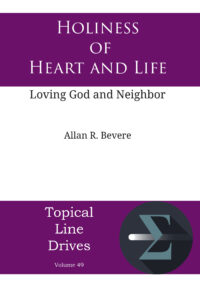
    For a modern view of Wesleyan holiness doctrine, read Allan Bevere’s short volume.

    We do that with scripture. This first, for example, is a balance of asking for God’s grace and favor while also pointing to ones own action. “I’m hoping real hard for this, like I ought to. Make it work!” It’s a very human prayer.

    But the easy thing to do with a great deal of Hebrew scripture is to hear what we expect to hear. We’ve been told this is all about rule keeping and our personal diligence in doing what God wants. As Christians, we look back at benighted writers of Hebrew scripture as not knowing about grace. But the writers of Hebrew scripture were well aware of God’s action and of the need for God’s action.

    We can come to Psalm 119 as a drumbeat of legal requirements and a super-pious, self-righteous expression of the wonder of all these rules. But that’s a bias of our superficial thinking.

    We generally like rules. We like to congratulate ourselves for obeying them. We like to feel powerful and express our personal sovereignty by disobeying them. We like to be in control of what we do about them. So we tend to read that into religious texts.

    But the Psalmist is very human individual looking with awe, hope, and wonder at a Creator God. He knows it’s God’s action, God’s life in him. I commend Psalm 104 as an indication of human dependence of God as understood in Hebrew scripture.

    Similarly, modern followers of John Wesley often take the doctrine of sanctification and treat it as a potential accomplishment of each person, and the attainment of it (supposedly) as a badge of honor and greatness. Getting into heaven is up to God, but being a good, church-going pillar of the community is an individual accomplishment.

    That’s false. The dependence on God starts not at birth, but at the first movement of the first subatomic particle that makes up part of your body. With the Psalmist, we put our hope in God and ask that God takes us to these places.

    Remember that whatever it is, it’s God’s.

    (Featured image generated by Jetpack AI.)

  • Look to Jesus (Hebrews 12:2)

    Look to Jesus (Hebrews 12:2)

    The other day I was just waking up and realizing that I faced a challenging day. I decided to do a little scripture reading before even getting up. I chose to read a language I read only very slowly and with difficulty (Syriac), because that usually gives me more time to meditate. I have a tendency to rush.

    I started in Hebrews 12, and got to verse two, which begins: “Look to Jesus.”

    This seemed to me to be good advice. I stopped there for a bit and marked those two words. (Yes, two words in Syriac.)

    If I had chosen to read it in Greek, the impact would have been a bit different, as the word order goes approximately thus: “Looking to the author and finisher (perfecter) of our faith Jesus.” Not a difference in meaning overall, but it was those first two words that stopped me for a moment, and that was helpful that morning. Good advice, as I said.

    Then I went on to “the head (or beginning) and finisher (perfecter) of our faith.”

    Now that’s a profound statement. This passage (Hebrews 12:1-3) is frequently used a works and behavior modification passage. “You have all these great, holy, and faithful witnesses watching you, so get on with the work of being a Christian. Jesus has saved you, and he expects you to act like it.”

    But that’s not what the passage says. Yes, there is a call to follow, but that call is put in its context right here. It’s Jesus all the way. He begins, he finishes.

    What about all those faithful witnesses?

    Here’s where I get into Bible contradictions. People ask me whether there are contradictions in the Bible and I say, “Yes! They are the best part!”

    Hebrews 11:27 tells us that Moses left Egypt by faith, “not fearing the wrath of the king.” Exodus 2:14 tells us that Moses was afraid and fled. If that isn’t enough, we’re told that Israel passed through the red sea “by faith.” Have you read the story? Not all that much faith was on display!

    Day after day there is not that much faith on display in my life. I worry about everything. I shouldn’t do that, but I do.

    But Jesus is the author and the perfecter of my faith.

    Jesus rewrites the stories of those witnesses’ lives from a grace view. He is doing the same thing for you. It may be very slow, but it’s happening.

    That crowd of witnesses? They’re not people who lived perfect lives and are looking down on you to criticize your every mistake. They know you’re going to make mistakes. They did. They know your faith can be pretty weak at the most difficult moments. Theirs was.

    They’re there to remind you that God saw them through and God will see you through. The grace filtered view of your life is going to make your story heroic.

    Look to Jesus, beginning to end.

  • The Danger of Making Things Tougher

    The Danger of Making Things Tougher

    I don’t spend a great deal of time talking about it, but following my MA in Biblical and cognate languages, I took one quarter in a MA in Theoretical Linguistics program. I had a full ride fellowship with a stipend, but after one quarter I resigned the fellowship and headed for more interesting places and activities.

    In my introduction to linguistics course, the midterm test was made up of a short set of essay questions. I believe we had to answer three of four, though I can’t remember precisely. One of them had to do with comparative linguistics—right up my alley! So I filled it with examples from multiple languages and just plain had fun. More fun, in fact, than I’d had in the class up to then.

    I hadn’t realized that the professor would choose to read what he thought were the best answers to the questions to the entire class. He chose mine. I wasn’t embarrassed by my content, but the context was totally wrong. The university had a strong TESOL program, and the vast majority of the students were in that. They were not pursuing theoretical linguistics. As a general rule, they probably had at most a minor in one foreign language.

    One student responded immediately afterward with a question: “How are we supposed to write something like that when we don’t know all those languages?”

    Her question was absolutely valid. My particular skill set was not that relevant to them. One can be superior at TESOL without knowing, say, Ugaritic. By presenting something not relevant, the professor had actually done something to discourage other students. If they had to do that, well, they couldn’t.

    It wasn’t because I was superior to them. It was because my skill set was different.

    Now let’s make a completely bogus argument. Why not? People do it all the time. Here it is. Knowing more is better. If those students learned more languages, they would have more sources of examples. Why should they not be required to learn all those languages? They’re probably just too lazy.

    A parallel argument might be made about my high school education. Why not require him to take more credits in science and math? Why not require Algebra II, Trigonometry, maybe some Calculus? After all, he will know more!

    Well, in response. I’ll go ahead an be lazy. In fact, I’m a high school dropout. It wasn’t for the normal reasons. I was overseas and enjoying running around the country. But the thing is that I was able to succeed without all those credits, including not having the credits normally required in English. In fact, I have just 2.5 high school credits, and one of those is in typing.

    Yet we make this kind of argument all the time. For the things I find easy, it’s also easy to suggest that others should have to fulfill those requirements. Why not? It’s good knowledge and they might need it. I recall the surprise of some people trying to develop a two year ministry program when I suggested that requiring Greek was not a good idea. There are many reasons for this, including the fact that in a two year program you can’t learn enough Greek to be that useful unless you steal time from other necessary activities.

    But let’s look at the church. We often operate on the same basis. Why not suggest people do it? Why not make the standard higher? We even talk this way in churches that hardly have any standards at all, because as members we want some.

    Whether it’s modest dress, giving, mission work, church activities, or other moral issues in our lives, the solution is generally to suggest doing more. And yes, again, I realize that we rarely enforce those standards, but that makes it even worse. We push people to higher performance and assume they won’t make it, but we figure if we just push a bit harder—you’re giving one percent, how about two?—we’ll get a bit more out of people. When they don’t live up to the implied standard, well, we tried!

    And they may have tried and failed, and added to whatever else they may have been dealing with, they now feel that they are not living up to what their pastor, Sunday School teacher, small group leader, deacon, elder, or generally picky person round the church expects of them.

    It’s like telling (or rather, implying that) those people who were learning how to teach English to speakers of other languages ought to get down to it and learn a few more languages like the theoretical linguist down the row. (Or rather, the guy who had learned a number of ancient languages. I never did get a degree in linguistics!) It won’t help them do their job, but one can hope it will make them feel smarter.

    Actually it won’t. Setting up higher standards doesn’t help one to fulfill those standards, whether or not they’re relevant.

    But there’s another problem in church. When we require those “higher” standards, we also imply that the standards are what church is about, and we can suggest that other people, those who don’t accomplish those standards are not good enough.

    I think this is a good part of what Paul is talking about in Romans 12-14, especially 14. It’s possible to read Paul’s toleration as an acceptance of just anything. I think Paul’s focus is on the message of the gospel. He’s giving up disagreements and minor points of behavior in favor of the message of the gospel.

    I’m not going to do this verse by verse, but try reading those three chapters with this in mind. No, that’s not the only theme, but I think it is uppermost in Paul’s mind. How are we going to witness best to the message of the gospel? So then, “Don’t destroy God’s work over food” (Romans 14:20) the point is to put one’s focus back on the gospel. Forcing one’s detailed rules doesn’t make people better. It detracts from the gospel.

    Being stricter, always trying to be better, will not necessarily make you better. It is often, instead, the road to more complete failure.

    (Please check out the article FROM DOBE TO BEDO by Pat Badstibner on Energion Direct’s From Our Authors.

  • Grace and the Book of Hebrews

    Grace and the Book of Hebrews

    In my experience, Hebrews has provided a wealth of texts for sermons that call for works and human effort. Pride of place, perhaps, should be held by the Wesleyan doctrine of Christian perfection, for which one of the central texts is Hebrews 6:1. No matter how many times Wesley affirmed Christian perfection as a gift of grace, he was unable to prevent this becoming a basis for performance based salvation, judgment, and self-righteousness. (While I believe in sanctification, and will mention it below, I don’t accept the idea of perfection in this life.)

    Hebrews 6:4-6 follows, which is often treated as teaching that if we commit some particular sin or other, we will lose our salvation for doing so. I’ve written about this recently, and I disagree, but I’ve heard it preached.

    Then there’s Hebrews 10:26-31, starting with the warning against continuing in sin and ending with what a terrifying thing it is to fall into the hands of the living God.

    Or Hebrews 11, so often preached as a litany of great accomplishments and presented against the lack of accomplishments in the congregation. We must, of course, become faithful like these heroes of ancient times and hold up our end of the deal. After all, God needs us and demands our service.

    Hebrews 12 starts with the clouds of witnesses, which I’ve heard preached as the “encouragement” of having all these wonderful people watching you from heaven, so you had better not mess up. Don’t want all these holy people watching you mess up, do you?

    Of course, you aim to accomplish all of this in fear of the God who is a devouring fire (12:29).

    James may be seen as an epistle of works (not an accurate portrayal, in my view, but Hebrews may well have been the source of more sermons on performance righteousness.

    But is this approach justified by the text of the letter itself? I don’t think so.

    Let me make a couple of assertions that I’m not really going to justify. Knowing that I believe these may help you understand the rest of what I’m saying. The first is that there was never a plan for salvation presented in scripture that did not have as its goal the creation of a holy people. From the invitation to the first couple to walk in the garden with God, to the call in Leviticus to be holy as God is holy, to Jesus asking disciples to follow him, to Paul inviting everyone to put their faith in Jesus, the anointed one, all the plans are part of one plan aiming at that point. The second is that grace is one of the, of not the, most difficult things to accept, because if grace is true, we are not in control. We humans like to be in control.

    Hebrews is a book about God making a holy people, and it’s a book about how none of us are in control.

    Hebrews starts with the description of God’s gracious gift, himself, in the person of Jesus. Hebrews 1:1-4 lays out this presentation. The one who is sent is sufficient to the task. As we move through the book, we see Jesus presented as one of us, tested as we are, and sharing in our experience. I have been asked whether I see Hebrews as teaching substitutionary atonement. If this is a question of whether Jesus died for us and for our sins, then the answer is surely “yes.” But if we mean “penal substitutionary atonement,” as in Jesus taking our punishment in a judical context, I think the answer is “no.”

    In Hebrews, Jesus is presented as becoming one of us. The necessary elements of the sacrifice is that it must be perfect, i.e., fully connected to God, and also fully ours. Then the form of “dying for” is incorporation. We are in Christ who is our king, our parent, and our priest, and we are incorporated in his death. He dies and we die “in him.” It is not a judicial substitution, but rather that the one dies for the nation (John 11:50) as one of the nation, indeed, as the king. The key here is that we become incorporated into that kingdom, that community, and are thus buried in his death and raised into his life (Romans 6). I think Hebrews is closely aligned with this Pauline theological presentation. Everything we are called to accomplish in the book is accomplished in Christ. That’s why Christ is presented first in the book and his superiority is established. (Refer again back to my post on Hebrews 6:4-6 for some backup for this idea.)

    So when we are called to perfection, we are called to be carried on to perfection. This is not the perfection of a person who lives a perfect life, and certainly not something we accomplish on our own. That’s clear through the arguments on why Jesus is the perfect high priest. In order to make that argument, one must establish that we are not capable of this on our own. The perfection to which we are called and to which we are carried is not ours, but the perfection of Jesus (Hebrews 5:9). He, Christ, is the source of salvation.

    Of course it is a terrible thing to fall into the hands of the living God, but we can instead be in the hands of the living God through the high priest who is sympathetic to our weaknesses. Of course, there is no more sacrifice for sin. If Jesus has opened a “new and living way” (Hebrews 10:19-20), then the only options are to go through it or not. If we are offered complete access to God and incorporation into his redemption and sanctification, what other option is needed? What other option could possible work?

    Then there’s Hebrews 11, which I think provides the key to the view of the message of Hebrews I’m presenting here. Contrary to those who preach Hebrews 11 as a triumph of the saints, it is, in fact, a triumph of grace in action. We err if we read this without adequate consideration of the stories from the Hebrew scriptures of these great heroes. Moses doesn’t fear the wrath of the king in Hebrews 11, but he flees in terror in Exodus. Sarah is rewarded for faith, but in Genesis she laughs. These people were not those who tried to obtain perfection, but those who were carried on to perfection. In 11:40 we are told that God’s plan was that they should attain perfection “with us.”

    That perfection, I believe is found in Jesus, and only in Jesus.

    These are the witnesses of Hebrews 12. We are being watched as we are carried on by those who have been carried before us. The question is truly simply whether we will truly be carried on. We can miss this both by thinking that we are going to do it ourselves, or by missing that it needs to be done at all. I’ve used the metaphor of a train for the theme of Hebrews. Get on the right train and stay on it until it reaches its destination. You can equally fail by sitting at the train station by never getting on the train, or if you set out to run alongside the train on your own power. Neither one will work. But if you get on the train you’ll move forward. (As with all metaphors, this one has its weaknesses!)

    In this view of grace, it is not put against faith. It is not faith vs. works, as though there were two approaches and one was better. It’s not a balance between faith and works. No amount of running, even combined with train-riding attempts, is adequate. But sitting in the station is also not a real option.

    What I think Hebrews makes clear is that the grace is available. Jesus opens the way to God. This is grace in action. But rather than being the enemy of true works, works of faith, grace is what opens the door and makes any works, any holiness, and any approach to God possible. Sanctification occurs only on the train, i.e., only when we are being carried on toward perfection in Jesus, our brother, our sacrifice, our high priest, and our king.

    That’s why I see grace as the critical key to the entire book of Hebrews, but I also see the book as providing a critical view of grace, a grace that is active, even more, that is God’s action taken in our lives.

    In this post I have not provided nearly enough scripture and logic to back this up fully. This is just an introduction. My recommendation is that you consider these ideas while reading the entire book to see what you find.

    (Feature image credit: Openclipart.org.)

  • Repentance in Hebrews 6:4-6

    Repentance in Hebrews 6:4-6

    When I talked about structure, I mentioned that I’d write a follow-up after my Wednesday night class. Here’s the rundown, though I plan to keep it brief. I’m indebted to David Alan Black for the basic note about the participles in this passage, and in a scholarly article I would need to cite a number of additional sources. The structure of the passage followed my own take on it in the context of Hebrews and made the argument easier. I include this discussion in my book To the Hebrews: A Participatory Study Guide, which is currently under revision for a second edition. (The main problem with the current edition is that I created it with readings, exercises, and questions, along with several appendices with discussion. I’m putting some discussion in the lessons!)

    There are a number of passages I referenced in class, but there are three passages before 6:4-6 that I see as key, and then one after. The reason is that the author of Hebrews signals new topics well ahead of the main discussion and then ties them in to later discussion.

    So if you look at Hebrews 2:1, “drifting off course.” This is an early signal of what I think is the key theme of the book, one that is further developed in 6:4-6 especially. At this point, the author has presented Jesus as the true representation of God and is now ready to open up the door to the result. God has spoken in these last days through a Son, which sounds good, even exciting, but what does it mean?

    Frequently Hebrews is read as a book with a message of works and perfectionism. In fact, as someone with a Wesleyan background, I’m used to starting there in my thinking. But the more I study the book, the less I think that is the correct reading. The warnings in Hebrews are not about human performance of good actions, but rather of total confidence in the one who has been presented here in chapter 1. Verses 1-4 present the Who, while the rest emphasizes that Jesus is greater than the angels. There will be more emphasis on precisely who Jesus is, but we have this pause in the first few verses of chapter 2 so we can get a preview of the theme.

    Through the rest of chapter two and into chapter five, but especially in 4:12-16, we’ll develop the things that make Jesus ideal as our priest, even though we aren’t quite sure what such a priest will accomplish.

    In 5:8-9 we get the second key connection, as we are told that Jesus learned obedience through suffering (and a rich passage that is, even though I’m just going to touch on it only briefly. Verse 9 tells us that he was perfected. It is this “perfection” that I think is the key object of Hebrews, the perfection of Jesus, not the perfection of any human being.

    I see 5:11-14 as a bit of reverse psychology, challenging the readers/hearers with their dependence on milk just before he goes ahead and introduces some meat anyhow.

    The third key passage is Hebrews 6:1, and “going on toward perfection.” It’s my understanding that United Methodist pastors are still asked this question on ordination, and I believe not a few have their fingers crossed when they answer. Figuratively speaking, of course! But though few translations do it, this can be taken as a passive, and thus be translated “carried on toward perfection” rather than “going on toward perfection.” I would go further and argue that the perfection that we are to go on toward is Jesus, and is only to be attained “in Christ” and not by us or as something possessed by us.

    Having jumped from signpost to signpost, this leads to 6:4-6. I have noted previously that I don’t take this as a “once out always out” passage, but rather as a warning against rejecting the voice or urging of the Holy Spirit. Paying closer attention to structure and the participle tenses helped back that view up and expand it.

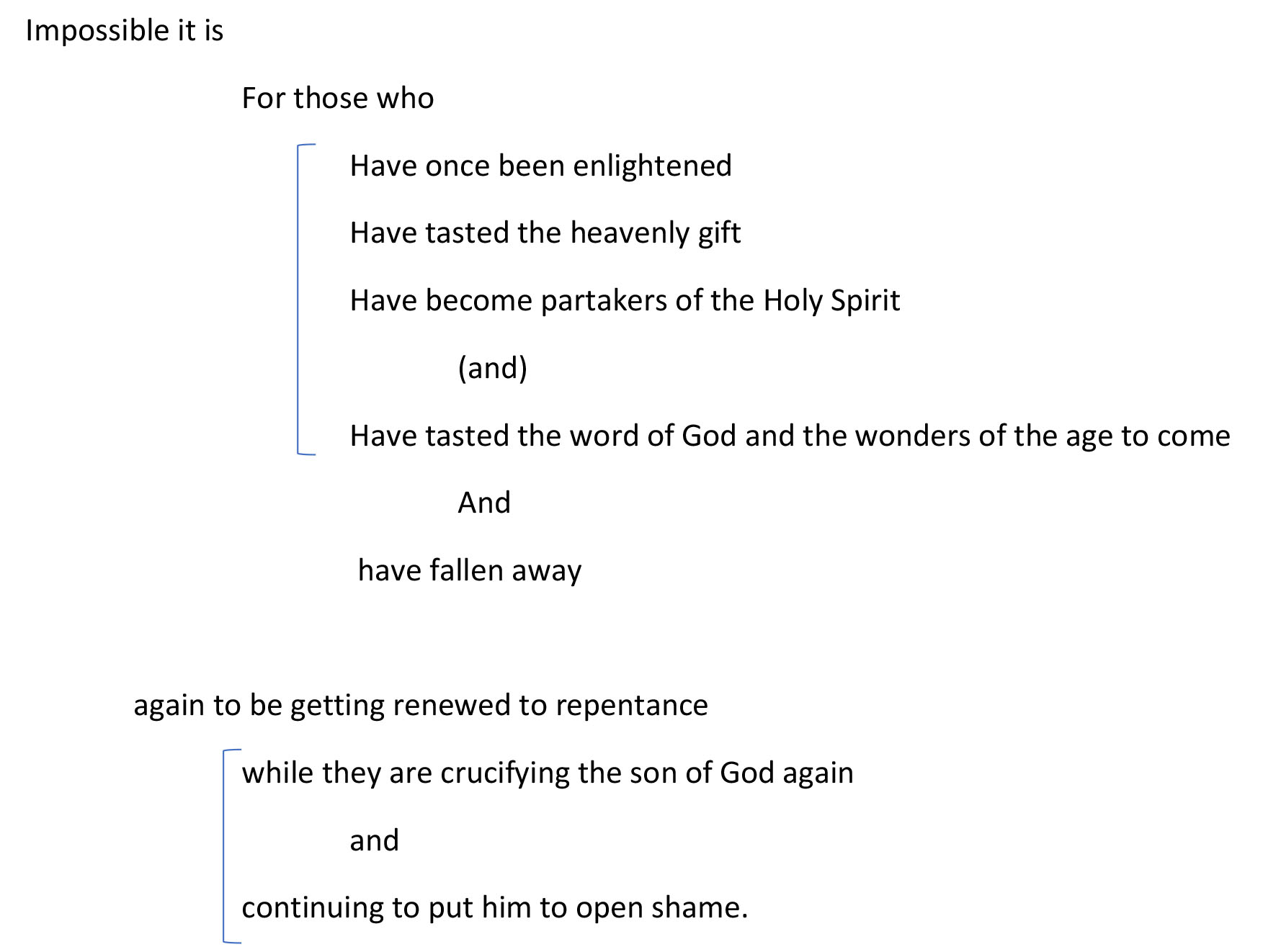
    Here’s my translation with structure:

    I have summarized the theme of Hebrews as “get on the right train and stay on it until you reach the destination.” The key is that if you have the best, the greatest, or even the only hope of rescue and you don’t take it, rescue escapes you. That’s why I have the temporal sense here. If you are rejecting the final sacrifice of Christ, according to the concepts developed in the preceding five chapters, what option is there? Jesus, the Christ is sacrificed once-for-all, and cannot be sacrificed again. If we continue to fail to accept the finality, we are crucifying him afresh.

    But it’s even more simple than that. You can’t accept while you reject.

    Does that make it too simple? Actually, I think it makes it a clear statement of precisely the point of Hebrews. You have two choices: This train or no train.

    And that leads to the final passage I want to use, Hebrews 10:26-27. Here we have no sacrifice for sin after Jesus. It’s often used in sermons to threaten people with how seriously they should take New Testament commands. But that’s not the point at all. There is no more sacrifice because the sacrifice has been offered. If you don’t accept the sacrifice, there isn’t another one. You can’t redo it or substitute it.

    The whole message centers on confidence in the grace that has opened this “new and living way” (10:20), in the perfection of our High Priest, and in the necessity of placing our full confidence in Him.

    Let me add that I believe that the “cloud of witnesses” in Hebrews 12:1ff should be seen as those who are cheering us on because they have experienced the weaknesses and the failings that we have and know the grace of God and the final reward. It should not be used as a club as I have heard it preached, in the sense of: “Look at all these holy people who are watching you. Don’t screw up!”

    (Featured Image Credit: Openclipart.org.)


  • Wanting to Be Right Theologically

    Wanting to Be Right Theologically

    I work on a heavy schedule, and as someone who is self-employed, with two distinct lines of business, I very rarely see a blank to-do list. In fact, now that I think about it, it has been several years since I finished a day and could say I was done.

    I identify a couple of goals here. First, I’d like to be done at some point. “Now I can go on vacation,” I would say, “because everything is done.” Second, I want to get as much done as possible, not to mention a few impossible things. In reality, I’m not going to be satisfied on either of those points.

    Quoth Paul, “Oh wretched man that I am! Who will deliver me?”

    You may think I’m being irreverent to use that quote, in which Paul is referring to his own inability to do what he knows is right and wants to do, but I think it’s closer to the mark than most suspect. So let me first illustrate what I’m talking about with my work, and then get back to the spiritual lesson.

    No, that’s not quite right. Getting done with my work is physical, mental, and spiritual process. One of our problems is that we spiritualize spirituality until it has nothing to do with daily life. Ideally (another interesting word), we’ll see the physical and the spiritual working together. Everything from doing the dishes to writing a book to running a marathon (as my friend Dave Black is about to do) is both physical and spiritual; above all, real.

    Thus I start with the illustration of how I can attack my day. There are two extremes I can take. The first is my natural inclination. That is, I get up in the morning, come to this computer (most of my work resides in its chips), and start attacking my list. I’m not really a list person, but reality has forced lists on me. If I find myself failing to accomplish the list, I add hours at the end of the work day, all the while wishing I could add hours to the physical day.  This process is direct, measurable in effort and results, and easy to understand. More work = more accomplishment.

    Before I go to the next option, let me tell you about the problem I have with leaving the first. Mary Heaton Vorse (I believe she originated the saying) said that writing was the art of applying the seat of the pants to the seat of the chair. She was absolutely right. The arts of editing, designing, and marketing are much the same. So if chair meets backside for more hours, more will get written. Authors (and editors, designers, marketers, and perhaps all humans) have many excuses for not having seat meet seat, one of the most common being that you can’t force creativity. Editors, who like to disembowel the excuses of authors, like to point out that you’re not being all that creative outside of the chair either. Writing great novels in your imagination is perhaps not all that likely to bring either fame or fortune!

    So having written one or two books myself, and having published around 170 by other authors, I have a strong tendency to stick with Mary Heaton Vorse.

    Not so fast!

    I also know that creativity will demand its pound of my flesh. One of my techniques for planning out a cover or the chapter headers for the interior of a book is to put them on a computer screen I’m not using and walk by them every so often. This is a way of forcing me to become so disillusioned with the current state of the object that I will come up with a new look just to preserve my sanity. Put less bluntly, I look at it, think about it, and suddenly come up with an idea. Then I apply back side to chair and implement, generally followed by more looking.

    Now we turn to the second approach to my day. In this approach I ask what makes me productive. I could list a number of things, such as getting enough sleep. Staying up late to finish a project can get it out the door on schedule, while actually making me further behind overall. I am less efficient on insufficient sleep. Failing to spend time in daily devotions makes me less efficient. It’s easy—almost irresistibly easy—to decide that I’m too busy for that devotional time and simply jump into work. In fact, as I write, I must confess that this morning other than prayer time before I got out of bed, I am writing without devotional time. But this blog post struck me as I prayed (no, I’m not telling you this is God’s word; it’s just my musings), and here I am, drawn to the keyboard and the chair.

    Walking is also important for my efficiency. If I don’t get active, I’ll find myself accomplishing little. Walking can be done at any time of the day, and therein lies another problem. Can I stop working and take a walk? Can I stop working inside and go out and clean up branches in the yard? The second is easier than the first. Why? Because it feels like I’m working toward a goal. What is walking but time when the seat of my pants does not connect with the seat of my chair and thus is wasted? At least cleaning the yard produces stacks of broken branches and piles of leaves!

    But, and this is a serious “but,” thus gaining the initial point in this paragraph. But, I say, this impression is an illusion. Yes, I need to work. I need to accomplish things, but I also need to do things that keep me functional. There is a balance here that is not helped by my tendency to think in extremes. If I could just work 16 hours straight, the book would be done, I think. But that doesn’t work. There is a balance, a place where things work best.

    But, another serious “but,” I want to be able to say how hard I work. If I rest, in order to be more efficient, I can’t say I worked 16 hours, thus impressing other people with my diligence and dedication. Saying that I ordered my day to preserve mental, physical, and spiritual health, and thus actually accomplished more work than I would have if I had gone with Plan A just doesn’t have the same ring. Deep inside me is this little voice telling me that approach sounds lazy. Somewhere in there is another voice that tells me it is lazy. The voice that tells me it’s lazy lies like a rug. The one that tells me others will think it’s lazy is just irrelevant.

    I’m so programmed for work that I tend to listen to those voices anyhow. “Oh wretched man that I am! Who will deliver me?”

    Can you perhaps see some of our problems with spiritual things? In our minds there is a God out there demanding this ultimate perfection, incredibly wonderful holiness, and the attainment of unreasonable standards. We’ve even made a theology of it. We’re so desperately wicked and God is so holy that we are without hope. Jesus comes in and makes up the difference. That’s fine, except that we don’t really buy it. So we come up with new ways to try to attain “rightness” with God.

    Way, way back in the ancient days, it was by offering enough of the right sacrifices. Then we weren’t sure, so we offered more, all the while letting actual righteousness get lost in the scramble to offer the right sacrifices. Then we got hold of Jesus, so to speak, but since we couldn’t really believe that things were taken care of, we had lists of works. We’d try to make sure we got the lists done, and we were afraid that if we didn’t quite manage that, we’d be lost. (This isn’t a critique of Catholic theology, but of human existence. I don’t think the change of theology does nearly as much as people hope.)

    Come the reformation, we renewed the idea that God had taken care of it. We ended all the sacrifices with Jesus and now the reformation wanted to end all that checklist work being righteous enough to get to heaven. But we really didn’t want to believe that either, so we came up with righteousness by correct theology.

    I personally think the demands of theological correctness are much greater and much more sinister than the demands of correct living. The farmer in the field or the construction worker laying bricks could hope to live with integrity and carry out acts of charity. But now we have details of theology that must be learned but that many people don’t really get. There are those who demand, however, that they be understood. I was told once that if I didn’t realize that Christ had died for my sins and that I was thus “once saved, always saved” irrespective of any future event, I was not in fact saved at all. In this man’s view, my understanding of the theology was critical to my salvation. I might be incapable of doing one righteous thing (he made sure to quote scripture on that), but I must be capable of righteously (and rightly) understanding his view of the atonement, else Christ died in vain.

    We replaced the vanity of gaining righteousness by performing the right ritual with the vanity of performing the right set of deeds. Then we replaced the vanity of the deeds with the vanity of our understanding. All the while our lives continued to do very little to reflect righteousness by any standard.

    “Oh wretched people that we are! Who will deliver us?”

    Jesus, I think, if we’ll listen. Matthew 5:48 says to be perfect, but Matthew 7:1 says not to judge. Interesting that we try to apply that to others (while missing “by their fruit” a few verses forward), but not necessarily to ourselves. Earning the favor of God by doing things that are, really, the best things for ourselves and doing them perfectly is, of course, impossible. We can’t attain this. We might as well hope to reach the pole star by walking north!

    But here comes grace, ready to take that burden from you. To quote Paul again, “Thanks be to God through Jesus Christ our Lord!” It’s the realization that you don’t have to reach the pole star, but you can walk north. You can go ahead and have times of rest in your spiritual life. Why? Because you live in grace. You can work on your own sanctification. Why? Because God has given you the space.

    If you spent your time trying to attain the pole star, you would have serious problems getting over the next hill. In an article titled North Star Closer to Earth than Thought, I found the estimate that it’s only 323 light years to Polaris, the current pole star. I also found an estimate that it would take 225 million years to walk one light year at 20 miles per hour. (I think the writer has a problem with the concept “walk.”) But even at that clip, Google tells me that 225 million times 323 light years is seventy-two billion six hundred seventy-five million. Of course that is shortened from ninety-seven billion six hundred fifty million by the new measurements (323 light years to Polaris rather than 434)!

    That shortening is sort of like saying, “No, you don’t have to accomplish all these deeds, just make sure you get the right set of beliefs. Then it will take only a bit under 73 billion years longer than you’ll live instead of 97 billion. Rejoice! Sing Hallelujah!”

    We need to let grace free us from the need for judgment, and then we can seek God without the constant worry that our experience and understanding are inadequate. Of course they’re inadequate! But God …

    You were dead through the trespasses and sins in which you once lived, following the course of this world, following the ruler of the power of the air, the spirit that is now at work among those who are disobedient. All of us once lived among them in the passions of our flesh, following the desires of flesh and senses, and we were by nature children of wrath, like everyone else. But God, who is rich in mercy, out of the great love with which he loved us even when we were dead through our trespasses, made us alive together with Christ[a]—by grace you have been saved— and raised us up with him and seated us with him in the heavenly places in Christ Jesus, so that in the ages to come he might show the immeasurable riches of his grace in kindness toward us in Christ Jesus. For by grace you have been saved through faith, and this is not your own doing; it is the gift of God— not the result of works, so that no one may boast. 10 For we are what he has made us, created in Christ Jesus for good works, which God prepared beforehand to be our way of life. (Ephesians 2:1-10, emphasis mine)

    Perhaps we should give up the works and the judgment, especially self-judgment, and live.

  • Hebrews: Authorship and 6:1-8

    Thomas Hudgins links to a post in which someone supports Luke as the author of Hebrews. The post to which he links indeed supports Luke, but I find a number of other things somewhat more interesting. The topic is Hebrews 6:1-8, one of the more controversial passages in scripture, and the title is An Enduring Call for Christian Maturity: An Exegesis of Hebrews 6:1-8. I find the suggestion of Luke as the author of Hebrews quite plausible, though I remain agnostic on the subject, but I found a great deal to disagree with in the exegesis. I need to write something more detailed on this topic. My disagreement shouldn’t be too surprising, as I come at this from the Arminian perspective. I hope, however, that I am also faithful to the text of Hebrews.

    On the other hand, the more I have looked at this passage, the more I have begun to think that the term that ties this passage to the previous (and Chilton rightly starts with Hebrews 5:11 which gives clear indication of moving forward), is the various forms/cognates of the word teleios, a verbal form being found in 5:9, referring to the completion of perfection of Jesus, particularly, as verse 10 notes, leading up to Jesus as the Melchizedek figure, which will be the focus of chapter 7.

    Contrary to my Wesleyan roots, I’m thinking less and less that the perfection/maturity involved is so much that of the believer as what the believer is brought into in Christ. I agree with Dave Black (you can find some of his comments in his blog archives; search for Hebrews 6) that we should allow the passive force of the verb, “be carried along” to come forth in translation. Now in the overall message of Hebrews, this does mean that something is accomplished in the believer’s life, but the believer’s activity is to continue to be carried.

    As I said, I would like to discuss this further, but I don’t have time this afternoon. In fact, I will doubtless spend many more days working with this passage. In the meantime, despite my disagreement on some points, I really appreciate seeing such thorough analysis of this passage. It’s often neglected.