Mark Twain said, “Good decisions come from experience. Experience comes from making bad decisions.” Or something like that. I’ve found a number of variations, all attributed to Twain.
The prayer, “Teach me!” is one that is pretty much guaranteed an answer, positive at least in the sense that learning will take place. The psalmist asks the Lord to teach him.
It’s a bit of a dangerous request, looked at from one direction, but then from another, you might as well pray this pray, because God’s gonna get you in any case! The universe can be an unforgiving place, and most of us have some pretty clear places where experience came from bad decisions.
This is where I like to note that the entire created world informs us of its creator. The person who studies quantum physics studies God no less than the person who meditates on theology. Perhaps even more.
One big reason to be thankful for Torah in the broad sense–God’s instruction–is that it is evidence of God’s care, a gift that teaches.
With my whole heart I have sought you. Don’t let me wander from your commands.
The word here translated commands is mitsvot, which is often thought of as good deeds, but Jewish commentators use this primarily of the 613 commands in Torah. In this way, the mitsvot can be considered another way to refer to the entire Torah.
When I read Leviticus alongside the three volume Anchor Bible commentary on Leviticus by Jacob Milgrom I was struck by his comment that the commands of Torah, and in this case specifically commands regarding the temple ritual were clearly intended as a training ground for Israel.
And history shows us that in at least one way, this training worked. Israel built up an identity that was difficult to destroy. We can still identify Israelites today, unlike the vast majority of the cultures that existed at that time and for centuries before and after.
There were two aspects to this identity. One is simply those aspects of behavior and lifestyle that identified one as first Israelite, and in later times as a Jew. This identity kept Jews distinct from the surrounding culture. But there is another identity inherent in Torah, which we can infer from many specific statements, such as the opening for the ten commandments. “I am YHWH your God who brought you up out of the land of Egypt, from the house of slavery” (Exodus 20:2). God claimed the Israelites as his own before giving any law.
In this verse, we have the two sides of this equation, but not necessarily in historical or logical order. The psalmist has sought God with his whole heart, doing everything he can. But he recognizes the part of that identity that can be summarized as “God’s own person/people.”
If we belong to God, a claim also made by Christians, we need to be identifiable as people who belong to God.
As I’ve meditated on these first eight verses of Psalm 119, I’ve opened up a number of topics. Let’s put them together, sort of!
Being blessed is a fairly broad and comprehensive thing. It doesn’t necessarily mean that we have everything we want, or accomplish everything we want. It’s being under God’s watchful eye, and that’s positive (God has a purpose/God believes in us), and also negative (if we go off track, there is God). Perhaps we need to redefine “negative.”
God’s law is a great deal more than a list of rules. God’s law is God’s self-revelation. We see this in Judaism in the centrality of the Torah, one of two broad words used in Psalm 119. (The other is Word/words.) When the Psalmist celebrates the law, as many English translations render it, he is celebrating being chosen as one of God’s people and God’s immanence in the self-revelation of the law. This carries over into Christianity (John 1:1-18, Hebrews 1:1-4) with Jesus as the Word, God’s message in human flesh.
There is a joy that shines through the text. This is not poetry written by someone who felt he was obliged to praise God for the Torah. He loves it. He’s thankful for it. He finds joy in it.
We start with blessing, and that’s important. Our temptation is to do things to seek blessing. The reality is that the ability to do and the motivation to do is itself a blessing, from which acts follow. Lead with the blessing!
Sometimes it’s OK to shout “Help!”
I hope you’re enjoying this journey as I am. Tomorrow morning, I’ll be posting the first verse in the second section.
I will praise you with an upright heart When I learn your righteous judgments.
What does learning about God’s righteous (right) judgments have to do with praise?
If we think of this Psalm as expressing joy over a list of rules, this might be a good question. If you haven’t yet, please read my earlier post on what “law” means in Psalm 119. To summarize, in Psalm 119 we heard one of God’s people praising God for God’s revelation in Torah. The various words for law direct us to the varied things that are present in this revelation of God.
This is important in terms of praise. Genuine praise results from looking at God’s self-revelation. We look at what God has done and the response is in praise. This is genuine praise.
There is also praise that is manipulative. “Lord, I praise you, and I want …” There is false praise. “Lord, I’m praising you because otherwise you might wipe me out. I hope you don’t notice that I don’t really mean it.”
This doesn’t mean that praise somehow results from knowing everything there is to know about God. We’re never going to do that this side of eternity. What it does mean is that genuine praise from us results from our observation of God’s revelation.
The more we observe, the more we praise. Not because God needs it, but because it flows from that knowledge.
Then I won’t be ashamed, When I keep my eyes on all your commands.
I didn’t get the poetry in my translation. It’s hard to get everything into it at once.
This verse strikes at one of our most serious problems. Our identity. Our ability to live with ourselves.
You’ve surely heard stories of people going on various pilgrimages to find themselves. Others go through their lives with a continuous question of whether they are important, or contribute, or make a difference of some kind. Who are we?
Often this comes as shame. We are ashamed of things we have done. Let me confess that there are things I have done in my life of which I am not proud. Even more, I have rarely (almost never) done my work to what I consider a high level of quality. There are always things in what I do that I want to apologize for, even to myself.
But when we get our eyes on God, in this case the God revealed in the commands he gave, we can begin to find our identity. The God who did these things actually cares about us.
7 “It was not because you were more numerous than any other people that the Lord set his heart on you and chose you, for you were the fewest of all peoples. 8 It was because the Lord loved you and kept the oath that he swore to your ancestors that the Lord has brought you out with a mighty hand and redeemed you from the house of slavery, from the hand of Pharaoh king of Egypt.
Deuteronomy 7:7-8 (NRSVue)
For a New Testament quote,
1 See what love the Father has given us, that we should be called children of God, and that is what we are. The reason the world does not know us is that it did not know him.
In my current series on Psalm 119, I’m doing a daily meditation on each verse. These are, by design, short. At the same time, it’s difficult to cover certain nuances effectively in individual posts. One of these is the question of why I would write this particular series.
I’ve already included my video on the various uses of “law” and related terms in scripture. I’m embedding it here again.
God’s Eternal Law
To summarize this, I believe that God has an eternal law. That eternal law is not something that we can comprehend. It rules an entire universe. It is an absolute expression of who God is. Those of us who are not in that “space,” so to speak, are not going to comprehend or attain to this.
This law expresses not only who God is, but God’s ultimate and glorious purpose for creation, including us. As a starting point for understanding my own view of law and grace, I would point out that we have nothing that is not, in this sense, a gift. We can’t take our next breath without the physical laws, which are God’s creation. We bring nothing into this world that was not given to us.
But scripture (Psalm 8, for example), also quoted and directly applied in Hebrews 2, carries this concept forward into Christian thought. While everything is a gift, we are, in fact, gifted. Every one of us.
Various Laws
Now there are many laws expressed in scripture and in various human documents and institutions. God’s laws as delivered to us are always finite simply because we cannot possibly understand something infinite. When Paul notes (Romans 3:23) that we all fall short of God’s glory, I would take this as also that we cannot really comprehend God’s glory.
Individual laws or bodies of laws are relative. People are afraid of the word relative, because they think it makes something weak. But things and statements are always relative. We are neither able to make things absolute in all ways, nor would it be desirable to do so.
To illustrate from daily life, the rules a parent makes for a toddler do not necessarily apply to that same child as a teenager. That’s because the specific commands were related to that particular time and place.
When we look to biblical laws, we find many of the same things taking place. As Christians, we acknowledge that some laws were for specific times and places.
Note: Dispensationalism is based on this very real separation, though I think it has substantial problems in that it tries to make something relative more absolute than it was intended to be. In doing so, it both makes thing more rigid, and at the same time makes laws less applicable. Few dispensationalists would agree with a man with whom I had a discussion when he informed me that one clause in a verse in 2 Corinthians referred to a different dispensation than the rest.
The Torah and Israel (Very Briefly)
Now Israel’s religion centered more and more over time on the Torah, God’s revelation at Sinai, though many, myself included, would maintain that portions of it developed over a longer period of time. So when an Israelite referred to “the law” as Torah is often translated, he was referring to the core revelation of God to the people of Israel.
So when the Psalmist starts to celebrate the Torah in this poem, he is, in fact, celebrating both the fact that God made a self-revelation to Israel, and that this revelation was available to him personally. It was not just that this was a life-giving and life-affirming way of carrying out one’s life. It was not just a moral code. It was a revelation that gave meaning to all that was, is, or could be.
The Revelation of God in Jesus
We find Jesus portrayed in a similar way in the New Testament. John 1:1-18 is the classic expression. I am a great fan of the book of Hebrews. (I say that Leviticus, Ezekiel, and Hebrews are the three books that have shaped my theology.) Hebrews 1:1-4 is also a classic, though less known passage that expresses this idea explicitly. In the past, we are informed, God’s revelation came at various times and in various ways, but now it has arrived through one who is a Son, a complete portrayal of all that God is.
So Christian theology is, quite properly, centered in the person of Jesus Christ. I’m not here trying to argue about a “better” religion. I would like to point out that this is the source of a great deal of difficulty when Christians and Jews debate the meaning of Hebrew scripture. We are looking at it with different colored glasses. Rather than seeing the Torah as God’s final and ultimate revelation of God, we see Jesus in the same light.
But note that the book of Hebrews does not say that the revelation in Jesus Christ, a Son by nature, somehow meant that the other revelation was invalid or useless. It adjusts the center. It changes our viewpoint, and thus changes what we see, but it doesn’t say that the other viewpoint fails to inform.
I, as a Christian, could actually read Psalm 119 as a celebration of Jesus, though I would not hold that the author saw it or thought of it that way. We read this passage (and most others) very weakly when we consider the point to be one of how hard we should try to accomplish a set of ethical commands and precepts. It is rather a celebration of the God who chose Israel and provided to them the revelation of divinity that is contained in Torah.
The “Law Words” of Psalm 119
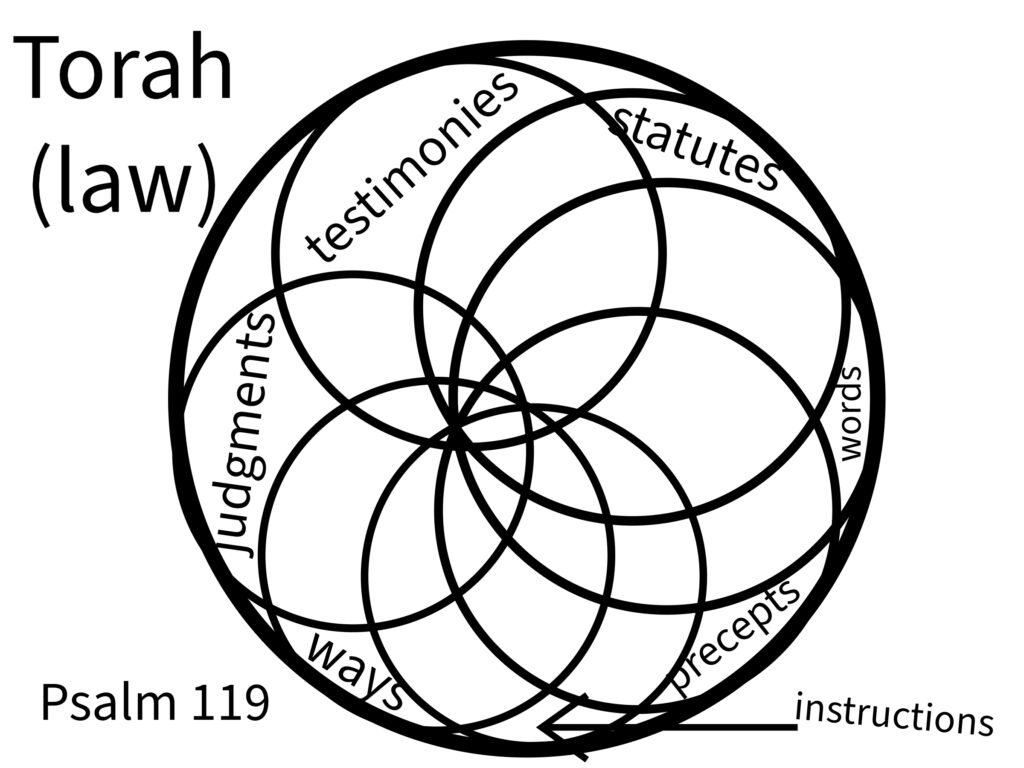
Psalm 119 uses a variety of words for the the law, including Torah. They are variously translated in various versions, but let’s consider Torah (instruction/law), testimonies, ways, instructions/procedures, statutes, commands, judgments, and words.
Each of these terms overlaps in their meanings, but all are included in the overall concept of Torah. Each has a different etymology and some differences in usage, but Psalm 119 seems to be simply using them to bring together the broadest concept of God’s law that is possible.
This celebration becomes possible for any of us as we celebrate God’s revelation, no matter where or how it is given. Psalm 19 celebrates the revelation of God in the created world, for example.
Conclusion
So reading and enjoying Psalm 119 is not just a celebration of commands and a demand for a particular behavior. It is a celebration of the God of law, revealed in Torah. As we see God in other ways and sources, it can become a celebration of those elements as well.
Oh that my ways were steady, Keeping your statutes.
Any time we’re looking at a set of standards, it’s well to be realistic, especially with ourselves. As we go through this Psalm, we’ll be celebrating God’s law in many ways and places, but there are a number of instances where the author admits his limitations and calls for help from the lawgiver.
It would all be very good if …
I sure wish I could, says the Psalmist. He knows it’s good. He’s glad to know it. But can he?
I feel this. There are things in my daily life I wish I could do better. Some days are better than others.
There’s a balance here, and we can see that balance in the rhythms of the Psalm.
The praise is a prayer. I’m going for it! Please help me!
About your precepts you commanded, “Keep them diligently!”
Sometimes things are tough. You wonder what’s coming next.
I’m meditating on these passages one at a time. I read the passage in the morning, and then I write these in the evening. During the day, I keep coming back to that verse. In deciding to do 176 daily meditations (that’s how many verses there are in this Psalm), I knew that some would be more encouraging than others.
This one is just tough. God says to do this diligently. Don’t just pretend. Don’t follow these precepts sometimes. Seventh percent is not a passing grade.
I’m reminded of choosing a Sudoku puzzle. How spiritual is that? Well, I like to pick the hardest level in the app I use. Sometimes I’m tempted to do an easier one. If I give in to that temptation, I’m drawn to watch the time and try to complete it as rapidly as possible. Most of the time, however, I choose the hard one.
Is the call of the toughest “right” living just as strong for me? Do I want to take the hard, but right path whenever possible?
The bad news, which I notice even in a sparse verse such as this, is that I don’t get there. Not ever. I have a desire, but it’s often a fairly week desire. The good news is that God is working on me, and the fact that he has such high hopes is very encouraging.
I think the Psalmist shares some of my feelings. But that’s the next verse!
They also don’t act with malice In God’s ways they walk.
This verse could be translated in many ways, but the basic message doesn’t change.
We’ve had too verses talking about blessed people and what it is that they do. This verse introduces an “and one more thing” moment. They also don’t act maliciously. The KJV, a bit more literal than I am, says “They also do no iniquity.”
I may just have a problem getting into this elite group!
But let’s keep a couple more verses in this very section of the Psalm in mind, such as verse 5: “Oh that my ways were steadfast, to keep your statutes.” and the plea in verse 8: “Don’t forsake me completely!”
The Psalmist sees a glory in the law, a glorious challenge. This is something he would like to do. The one keeping the law is in a blessed state.
Yet he knows he’s not perfect. In verse 176, a long ways down the road from where we are, he says, “I have gone astray like a lost sheep.” That can seem like a real downer of an ending for a lengthy poem celebrating the law. But it’s nothing of the sort. It comes from the heart of someone who appreciates the beauty of God’s law, and trusts in God to seek him.
There are two ways we tend to dodge God’s law. First, we can trim it down to size. We make it something we can do easily. We create a relaxing law of God, an undemanding law. We aim low, and generally we end up even lower than we aim.
On the other hand, we can say, “This law is much too hard for me to keep. Forget it! It’s no good.”
The Psalmist makes neither error. He realizes God’s law is glorious, that it is a high standard, and he’s glad of that. He also realizes that he needs the God who welcomes the seeker (119:2) is, in fact, the seeker. In this he finds great joy and great comfort.
From a Christian perspective, this reminded me of this song, which probably dates me just a bit! Note “the buyers and the sellers were no different fellers than what I confess to be.”
(Featured image generated by Jetpack AI. This post is part of a series on Psalm 119. For all entries to date, see tag Psalm 119. For a deeper look at the language and poetry of the psalm read Bob MacDonald’s series, starting here.)
At the end of the class, one of the members commented that he was very glad to have studied the entire sermon, because he could see how it fit together and how the various parts built on others. He commented that we often read the Beatitudes and the Lord’s Prayer, while not continuing to cover the rest of the three chapters.
Over the years I have read and studied this sermon many times, and I never fail to find something new with each adventure in it. There are three (well, maybe four) general approaches to it.
First, let me dismiss my “maybe four.” I had one young man come to my house to try to get me saved. That I already professed Christianity was not important to him. I needed to understand it the way he did. One of the things he wanted me to understand was salvation by faith, which in his view eliminated anything having to do with works. He specifically told me that the Sermon on the Mount does not apply to Christians. I found it interesting that the longest collection of the teachings of Jesus we have was regarded as not applicable.
Dismissing dismissal, I have found three general approaches, with the first two covering most and the third as a sort of supplement based on sermons I’ve heard.
The sermon is a description of righteousness, designed to let us know we can’t attain it, and drive us to the cross.
The sermon contains the central ethical teachings of Jesus which we are expected to follow.
The sermon is descriptive of ways in which our behavior impacts others and our own social environment, and provides a guide to more effective functioning of society.
I’ve intentionally made these as distinctive as possible. One of the things that struck me as I studied this time was that the sermon truly can function in all three ways. You might expect a Reformed theologian to embrace something like #1. Wesleyans might tend more toward #2. I’ve only heard a few people who go purely one way or another, though they often sound like they do! The third option is more often exhibited in preaching broadly based on the sermon when the speaker is trying to make applications in the social gospel.
It struck me this time through that all three elements are present. There are repeated indications that the expectations expressed are well beyond our ordinary capabilities. Loving your enemies is well beyond most of us, though I’ve heard people cut the command down to size to make it possible. Consider, however, that Jesus’ own demonstration of this command involved requesting that the Father forgive those who were in the process of crucifying him.
In the class we all commented on how potentially frightening it was to sincerely pray, “Forgive us our trespasses as we forgive those who trespass against us.” Do you really want to be forgiven as you forgive? Perhaps you are a paragon on virtue in the matter of forgiveness, but I suspect not many of us are.
Then there is the simple matter of most of chapter five, which sees all these things as expressions of what’s in the heart. I shocked some in the class by explaining that I had been a murderer during the prior week. I had been on the phone with a customer “service” rep who whose ignorance was exceeded only by his arrogance. (Can you perceive me despising him even now?) I told them that if I’d been physically with him, I’d likely have strangled him. Jesus isn’t giving me points for not being able to carry this out.
Thus I think that the Sermon on the Mount very much calls us to realize that we are quite imperfect, and also directs us to an unattainable standard. That’s where grace comes in, and grace is reflected in some of those very passages on forgiveness. God is more forgiving than we are.
At the same time, there is a great deal of value in the second way of looking at this. However unattainable the standard is, it is a good one. That is, it tells us about things that are good to do. The problem with perfection is that you fail to attain it, and end up apathetic. I can’t do what I’m supposed to, so why do anything? Perfectionism has created a large number of failures.
The problem is that each time you lower the standard, you end up aiming lower. If you’re headed north following the north star you know you’re unlikely to get to that north star, or even the north pole. But if you decide that unattainability makes it unimportant, you’re likely to get nowhere. That’s where keeping a high standard and incredible grace together does well.
I can’t resist quoting one of my favorite scriptures: “Work out your own salvation with fear and trembling, for it is God who works in you both to will and to do his good pleasure” (Philippians 2:12-13). We often hear that preached by halves. I can’t count the number of times I’ve heard “work out your own salvation with fear and trembling” from someone who was only vaguely aware of the next verse, if at all. Similarly, we can say, “It’s God, so don’t bother to do anything.” Neither of these is effective.
And that leads to the third point. I wouldn’t use the third option alone, but in many cases this sermon shows us how society works. “Forgive and you will be forgiven,” speaks of God’s forgiveness, but also points to a way of life. The one who is unforgiving builds an atmosphere of unforgiveness. “Judge not, lest you be judged,” is also a very good principle in society. The verse, Matthew 7:1, is one of the more abused passages in scripture with some destroying it by overapplication and others essentially dismissing it by referencing exceptions.
Jesus himself provides some clarification in Matthew 7:15-20. Thus we wind up with those who avoid 7:1 by calling every judgment “fruit inspection” and those who eliminate fruit inspection by calling it all judgment. Both passages are right there and both apply. There’s some wisdom needed, and doubtless we will not attain perfection!
I enjoyed reading these passages and looking for the variety of applications. I’m grateful for grace in all circumstances. I’m grateful for a standard, which tells me that God’s glorious purpose is greater than I can imagine. Finally, I’m grateful for wisdom in looking at how we can better live with one another.
It’s an error to treat everything as an answer to the question of whether one is going to heaven. Some things are about a better life here as well.