Threads from Henry's Web

Tag: James

  • Thoughts on James 2

    Thoughts on James 2

    Our Sunday School lesson, which I’m not teaching this week, is from James, focusing on chapter 2. I’m not teaching, but in studying, I looked at a book I publish, Holistic Spirituality: Life Transforming Wisdom from the Letter of James.

    Bruce Epperly makes a number of important comments. I’m going to do a bit of quoting from his chapter 3, pp. 15-21.

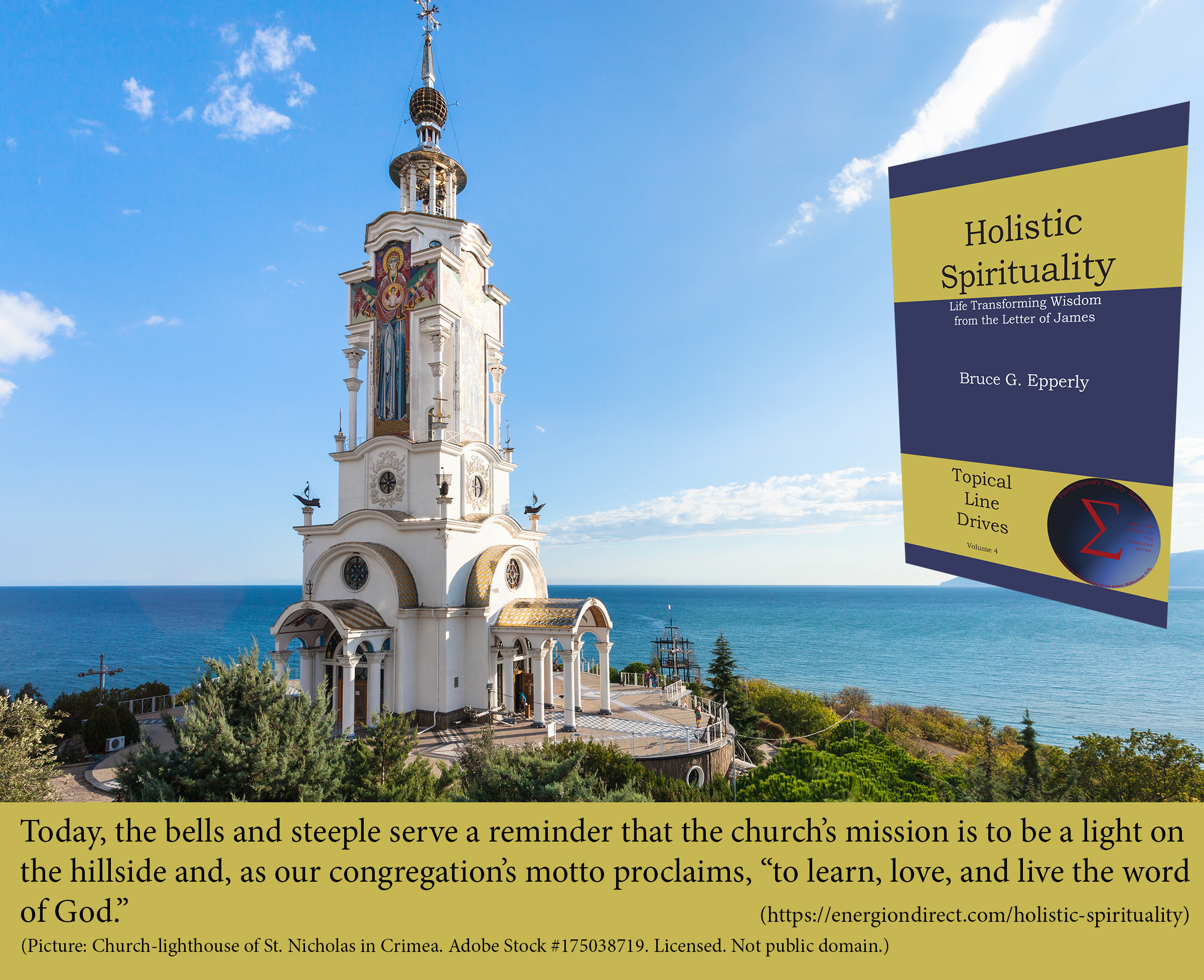
    One of my great joys is my first glimpse of the steeple of South Congregational Church, when I round the bend toward home. In earlier times, the church’s steeple guided mariners safely to shore. Today, the bells andsteeple serve a reminder that the church’s mission is to be a light on the hillside and, as our congregation’s motto proclaims, “to learn, love, and live the word of God.” (p. 15)

    I like that motto, “learn, love, and live.” I think it may go the other way as well, we learn from what we live, especially when we’re trying to live the word of God.

    Faith means nothing unless it lights the way of pilgrims and seekers, providing guidance, comfort, and nurture. (p. 16)

    Here Bruce combines faith in action and faith in witness (and our action is, I think, our best witness) in a way of which I think James would approve. We are not Christians, or Jesus people, for our own benefit alone. We receive grace to share grace. That’s why grace cannot be a passive thing. It erupts in action.

    … The Apostle asserts that because God loves us, our vocation is to love one another, even if this means crossing the barriers of race and ethnicity. Grace makes us all first-class Christians, worthy of respect regardless of ethnicity or economics. This is the essence of James’ message as well.

    James believes that a holistic faith brings together belief and action. In the spirit of the Quakers, what is important to James is to “Let your life speak.” … (p. 17)

    I think that the tendency of many interpreters to see James and Paul as opponents is misguided. They do have a different emphasis, but it is not because Paul hated or devalued action or that James thought beliefs were unimportant. Each had an emphasis, but these emphases are compatible or complementary.

    Loving Jesus means loving your neighbor. And if James is right, it means standing aloof and becoming counter-cultural in
    relation to socially-acceptable, but life-destroying, values – “being unstained by the world” – that put profits ahead of people, neglect the needy, and blame the poor for their poverty. We are all created in the image of God and we all deserve to be loved, to have a place to call home, and an opportunity to live out our gifts and talents as God’s beloved daughters and sons. (p. 19)

    That’s were it will start to get with us. Sanctified wallets are the hardest of possessions to acquire. Or, looked at the other way, the wallet is the hardest thing to give up. How much stuff must we have? What is first in our life? Putting God first will result in also putting our neighbor first.

    But what can you do? Maybe all you have to spare is coins in your pocket.

    In the realm of God, no deed is too small, for with one action at a time we can become God’s companions in healing the world. Let your life speak. (p. 20)

    This is a great little book, just 40 pages of text from Energion’s Topical Line Drives series, for accompanying a study of James. It might just be, as the subtitle suggests, life transforming!

    Read Now


  • James and a Living Gospel

    James and a Living Gospel

    Our pastor at Chumuckla Community Church started a sermon series on the book of James. This provoked me to look again at Bruce Epperly’s little book Holistic Spirituality: Life Transforming Wisdom from the Letter of James. Here’s a sample:

    Despite Martin Luther’s misguided dismissal of James as “an epistle of straw,” due to James’ emphasis on agency and lifestyle rather than receptive grace as central to Christian experience, James is good news for congregants and seekers. It is the gospel lived out in everyday life, not by words alone or doctrinal requirements, but by actions that transform the world. This is the good news of Jesus Christ who shows us the pathway to abundant life, and not a dead letter or a soul-deadening creed or abstract doctrines about the divinity of Jesus unrelated to daily life. James invites us to be companions on the pathway of the living Christ. (p. 4)

    Dave Black quoted today from Gordon Fee’s commentary on the epistles to the Thessalonians, discussing the connection between believing and living. I’m going to link to Dave’s post again tomorrow, when I briefly discuss Bible commentaries, but Dave’s post is worth reading in this connection as well.

    Bruce Epperly comments again on the supposed contrast between James and Paul:

    While Paul’s theology is often contrasted with the Letter of James, both Christian leaders believed that faith without works is dead (James 5:17).8 Paul affirms “the only thing that counts is faith working through love” (5:6). (Galatians: A Participatory Study Guide, p. xxvii)

    I think we frequently see contrasts when we should see differences in emphasis and even in circumstances.


    Read Now


  • Faith Made Active through Love

    Faith Made Active through Love

    despicableWhat groups of people do you think it’s alright to look down on?

    Because in Christ neither circumcision or uncircumcision matters any more, but instead faith made active through love. – Galatians 5:6

    Which, in turn, reminds me of:

    Thus faith, if it has no works, is dead by itself. – James 2:17

    It is possible that the conflict between James and Paul has been overstated.

    But my key reason for pulling this text out of my morning reading, as I prepare for my online study tonight which I’ll post about later, is that it represents a broader principle. Sometimes we’re afraid to read between the lines, or better, to discover principles which apply in other circumstances.

    These days, circumcision or not is a medical discussion for most people. Yes, it is still a mark of Judaism, but many are circumcised who are not Jews. So what is Paul talking about here? I believe he’s referring to the distinction in God’s favor between Jews and Gentiles. That was the church conflict of his time. Did one have to become a Jew first in order to be a follower of Jesus? Was entry to the family through circumcision?

    In the prior four chapters of Galatians Paul has argued that this is not the case. Grace is open to all and is the way one becomes part of the family. Christians have read these four chapters and then either failed to continue reading, or treated chapter five as though it was some sort of advice tacked on to an otherwise theological letter.

    That is not the case. The final chapters are a clear continuation of the intent of the earlier ones. My seminary class in Galatians only made it to chapter 4. We were supposed to read the rest, but we never discussed the latter part of the book in class. I don’t know if it was just time or if the professor intended it that way. But Paul wrote it as one document. For him, there was more than becoming part of the family, though that was important, demonstrated by four very heated chapters dedicated to talking about it.

    Paul’s concern continued with living as part of God’s family. How do we live now that we’re “in”? That’s where we get to this verse.

    Historical understanding is important. Historically this verse was about the distinction between Gentiles and Jews before God, i.e., as part of the family. (Don’t come to conclusions about other aspects of the relationship without reading Romans 1-3 & 9-11.) But it also expresses a principle.

    We humans are good at creating distinctions and barriers. In fact, such distinctions are necessary to life. I hate “labeling” yet I must do it in order to talk. This post is filled with labels. If I label someone as “poor” so that I can despise that person and distinguish him from his betters, I’m creating a barrier. I might use the same label, however, to set that person aside as the one who should receive my help. The distinction between Jew and Gentile does still exist, as Paul would acknowledge. It just doesn’t mean that God loves Jews (circumcised) and hates or ignores Gentiles (uncircumcised). The distinction was necessary (and is necessary) for certain purposes (“God’s messages were entrusted to them” [Romans 3:2]), but is not to be used to distinguish those God loves and those God does not love.

    Now what distinctions might you and I be using to divide people into acceptable and unacceptable groups? People loved by God and those who can be despised?

    Here’s how Eugene Petersen renders Galatians 5:6 in The Message:

    For in Christ, neither our most conscientious religion nor disregard of religion amounts to anything. What matters is something far more interior: faith expressed in love.*

    Can I hear “ouch” instead of “amen”?


    *Peterson, E. H. (2005). The Message: the Bible in contemporary language (Ga 5:6). Colorado Springs, CO: NavPress.

    Elements of the illustration I used were taken from OpenClipart.org.

  • Quote: Theology Moving from the Classroom

    This is another quote from my editing work:

    James is a theologian, but his theology moves from the classroom and the study to the street corner and the soup kitchen.  James is a “practical theologian,” whose beliefs motivate his actions and whose actions transform his beliefs.  Theological reflection and worship find their fulfillment in faithful action. — Bruce Epperly, Holistic Spirituality: Life Transforming Wisdom from the Letter of James (forthcoming)

    I’ll probably be posting more of these than I have in the past, as I really enjoy the work of editing and often find nuggets to share!

  • From My Editing Work

    9781938434761sChristianity involves following the path of Jesus in its embrace of the least of these,   discovering God’s presence everywhere.

    — Bruce Epperly, Holistic Spirituality: Life Transforming Wisdom from the Letter of James (forthcoming)


  • Proper B20 – Gutting another Passage

    There are times when I understand why we select verses to read in the Lectionary, and there are times when I don’t. In this case, I don’t. We have James 3:13-4:3, 7-8a. I don’t see adequate reason not to read 3:13 – 4:10 as a whole, and if I were to preach/teach on this passage I would definitely include the other texts. I do appreciate the inclusion of the buildup (3:13-18) which tells us the importance of 4:1-10.

    This isn’t too long to read as a whole. Verses 4-6 provide additional understanding as to why these conflicts take place and what to do about them. Version 8b-10 tell us something about how to get away from the problem.

  • Free New Testament Commentary Ebooks

    The regular Kindle prices are great, but Baker is offering selected commentaries free for one day on Jan. 9 (past, alas!), Jan. 16, and Jan 23. Today’s is on James. More at Evangelical Textual Criticism.

  • Righteousness of God Redux

    Just over three years ago I wrote a bit about the New Perspective on Paul, and particularly the interpretation of the righteousness of God in 2 Corinthians 5:21. I would still call my understanding of this a work in progress. There are many things I should read and assimilate yet.

    At the moment, however, I’m working my way through the Zondervan Exegetical Commentary on the New Testament volume on James and I came across this same phrase in James 1:20. The authors comment:

    … when James talks about the “righteousness of God” … he may mean something quite different than Paul’s characteristic subjective genitive (“the righteousness produced by God”; cf. Ro 1:17; 3:5, 21, 22, 25, 26; 10:3; 2Co 5:21; Php 3:9). Here the genitive “of God” … seems objective, because James is insisting that human wrath does not create the righteousness that can be offered or directed to God, the righteousness that we are called to live out on earth and that he demands from his followers (86, Greek text left out).

    Now “may mean something quite different” is not an extremely strong statement, but if Wright is correct on the meaning of “righteousness of God” in 2 Corinthians 5:21 (and I have correctly understood him), “covenant faithfulness” might work quite well on both sides. God’s righteousness is his covenant faithfulness, and the righteousness to be produced in us is also faithfulness to the covenant. Thus we can “become” the righteousness of God, or become the bearers of God’s covenant faithfulness in the world, and that righteousness can be produced in us. The theology of James and Paul would not, on this point at least, be as far apart as often assumed.

    I would add the note that in either case, we should not be talking about human-produced righteousness. James 1:5, receiving God’s wisdom, should be as clear on that point as are the many statements by Paul regarding righteousness by faith. I have been impressed in my current study of James with the parallels between receiving God’s wisdom and receiving the Spirit. I might write a few notes on that later.

  • James 1:13 – Tempted by Evil?

    In the Zondervan Exegetical Commentary on the New Testament on James (my review) the suggestion is made that apeirastos kakwn should be translated as an objective genitive, as “tempted to do evil.” They oppose this to a subjective genitive (“tempted by evil”) or one alternative which does not involve a new way of reading the genitive (67, 70-71).

    It’s interesting to note that nearly all translations choose “by evil.” (I say “nearly” because all the translations I have in my library do so.) This is a time when I feel the limitations of my library, but Wallace (125) uses it as an example of a genitive of means, Robertson calls it ablatival (515-517), and Blass-deBrunner-Funk discusses it in a passage covering other cases of the genitive following an adjective, including examples that could have different translations, such as 1 Corinthians 9:21 (anomos theou/ennomos christou). The BDAG entry on apeirastos suggests “tempted to do evil” (and also cites the same passage from Blass-deBrunner-Funk that I have).

    As I look at this passage it seems to me that the more natural translation is “tempted by evil,” while I don’t deny the possibility of the alternative. At first glance, the context seems to suggest something more like “tempted to do evil,” since this then forms the basis for the claim that God does not tempt anyone.

    But I would suggest a logical connection to another phrase, James 1:17 “no inconsistency or shifting shadow” (ISV). Yes, this phrase is separated from the phrase in question, but it appears to me that James entwines multiple topics together as he relates them throughout the book. His point in 13 is that God is reliable and cannot be moved, a point which is actually supported by either translation.

    Thus my second reflection is that the traditional translation of this passage actually fits the logic quite well.

    Any thoughts?

  • Quote of the Day – on Genesis 15:6

    … In the Tanakh, faith does not mean believing in spite of the evidence.  It means trusting profoundly in a person, in this case the personal God who has reiterated His promise.

    (from The Jewish Study Bible: featuring The Jewish Publication Society TANAKH Translation, page 35.)

    I think that’s an excellent statement of what faith is and is not, and might also tie the usage of faith between James 2:23 and Galatians 2:15ff as it relates to Paul’s use of Genesis 15:6 starting in Galatians 3:15.