Threads from Henry's Web

Tag: interpretation

  • Psalm 119:83 – Burned Up (and Out)

    Psalm 119:83 – Burned Up (and Out)

    For I am like a wineskin in smoke,
    yet I do not forget your statutes.

    It’s not entirely clear what’s happening to the wineskin here (REB translates “though I shrivel like a wineskin in the smoke), I think this continues this series of verses on being out on a limb, out of options, and wondering what’s going to happen next.

    Mitchell Dahood states (correctly) that there really isn’t a satisfactory explanation for the “wineskin in the smoke” simile. We can think of ways to understand it, as I did in the previous paragraph, but it’s hard to be really convincing. Dahood proposes the translation “For I have become like one weeping from smoke.” Yet his linguistic explanation leaves me thinking, “Nice, but still just a suggestion.”

    Sometimes in translating the Bible, especially in Hebrew scriptures, we find passages like this. It’s truly difficult to determine precisely what the meaning is. So I’m stopping a moment to discuss uncertainty in reading scripture.

    We’re generally unhappy with any possibility of doubt as to the meaning of a particular verse. Surely God’s Word should give us a precise understanding! There are those complain about notes in their English (or Spanish) translations because these notes might give people doubts about the accuracy of their Bibles.

    But however much you may try to avoid it, the evidence is there. There are textual variations. There are verses where we are uncertainty of the translation of particular words. Or, as in this case, the definitions seem pretty clear but we don’t get the simile, or perhaps it’s a euphemism. We don’t know absolutely.

    We need to get used to this sort of variation simply because God has chosen to provide scripture in that form. It comes written by humans, copied by humans, and interpreted by humans. And guess what! Humans make mistakes. Even if none of these variations existed, you and I, as readers, would still be fallible.

    Now the fact is that the vast majority of the text of scripture is not in any real doubt. It’s only a small portion of the words that make us stop and scratch our heads. But if we take a broad look at scripture, and don’t just depend on a single verse, we’ll be able to figure things out.

    Sometimes doubt about meaning makes us feel like that “bottle in the smoke,” whatever that experience means. But if we listen for the story, and the message in the story, we’ll find that while we are not capable of certainty, we are capable of hearing God speak through these passages. It’s not that God can’t provide an accurate message. It’s that we, with our limited minds, can only understand in our limited way.

    That makes it a good idea to listen closely, and read more of scripture so we have a broader understanding. But mostly it means continuing to realize our dependence on God.

    Do you depend on God to lead you to truth?

    (Featured image generated by Jetpack AI.)

  • Literal Problems, Literally

    Literal Problems, Literally

    I found Should we read the Bible literally via Facebook, and want to commend it to my readers. I can’t tell for sure, but I suspect the writer is perhaps more conservative than I am, yet he makes many points I frequently try to make. I think he may be a bit too optimistic on the hope of recovering the word “literal” from popular abuse.

    I’ve often said that if I could take one saying away from Christian conservatives it would be, “The Bible plainly teaches …” Our frequent disagreements as Christians seem to challenge that idea. It’s always possible that the teaching is plain and we just want to work around it, but who has the right view and who’s working around? It would be better to just bring forth the arguments in favor and let someone else decide how plain it is.

    On the other hand, the phrase (regarding the Bible) that I’d most like to take from liberals is “We don’t take that literally.” The problem is, how do you take it? The meaning of the word “literally” is “literally” not that settled. Biblical scholars and theologians use it differently than the general population. So whether you’re telling someone to take it literally or not, the odds are they’re going to understand it differently.

    For example, I regard Genesis 1 as never having been written with the intention of developing a sequential, historical, scientific view of origins. Rather, it speaks in the context of its current cosmology and gives God’s role in creation. Contemporary readers would likely have perceived it in those senses, but there’s no necessity that one do so, and the elements the stories are trying to convey are not harmed by changing chronology or method of creation. (In my view, at least!) I do not doubt the reality of God’s action. Is that literal or not? It’s a bit more difficult to answer that question than the example of calming the sea in the referenced article. But that’s why I suggest that “not literal” is also not helpful.

    What we have to do is specify how we do read the text. For example, I read Genesis 1:1-2:4a as liturgy and the rest of Genesis 2-3 as myth, in the best sense of that word. “Myth” frequently becomes a synonym for “not true” when, in terms of literature, it speaks to the foundational function of a story in a society. A myth might not be a true story, in the sense of narrative history (we often use “literal” here), but it also might be. Historical events do become myths in functional terms.

    Ian Paul makes that point in the referenced article with regard to the story of calming the sea. There is extended meaning. One can take the sea and the boat allegorically, but the allegorical meaning is built, for many at least, on the idea that the underlying story really happened. I would disagree that one can’t get allegorical meaning if one doesn’t take the story as historically real, but there would be a difference in that meaning.

    All of which simply leads back to the first point. We need to be careful with our use of language. I think that too many Bible students use their own definition of literal, by which I mean the one understood by most Bible scholars, and tell people they should interpret the Bible literally. People in turn believe they are being told to make the Bible concretely applicable no matter what. Which problem is not helped when someone like Tim LaHaye says to take the Bible literally if at all possible, and then applies it by making all the symbols of Revelation apply in a concrete sense to future physical events. Some of the words in Revelation do refer to such things. Others refer to spiritual things. There is a variety of usage. It’s a vision; expect some variety in the author’s (and Vision-givers) intent.

    Most importantly, try to be aware of how you are taking a passage. Literal/figurative is not adequate. What type of figure is it? What time of reality does it reference?

    In answering those questions, you may well discover why I so dislike hearing that “the Bible plainly teaches.”

  • Eschatology: They Remembered Him

    Eschatology: They Remembered Him

    9781938434105sI had hoped to do a bit more writing on how we interpret the Bible before tonight’s discussion. In diving into teaching a bit on eschatology, I have come to feel a bit like someone who has encountered one of the versions of the certification test for senior generalists, or the ultimate final exam. (You’ll find a few different versions and titles.) The extra credit question, “Define the universe. Give three examples,” is a bit of the right feeling.

    There does not seem to be any aspect of biblical studies that is not important or even critical in understanding eschatology. Some of the best examples of how not to interpret an be found in the way people handle this subject. There is always the problem of background information. How much must the student know before tackling a topic? But in eschatology, those background items become even more critical.

    Tonight I’m going to work from Dr. Vick’s second chapter, “They Remembered Him,” and discuss what is the core of explicitly Christian eschatology. It’s quite easy for people to predict the end of the world. It may take some time, but eventually somebody is likely to be right! But does a particular outline of the end times make this doctrine Christian?

    We frequently neglect eschatology in teaching and preaching. But how well does the gospel work when do this? Is it possible just to ignore this issue? Even when we talk eschatology in an individual sense, not when will the world come to an end (if it will), but when will you personally come to an end and meet God? And the latter question may not be quite as simple as it seems either. Are these events simultaneous? Do I go to heaven when I die or not?

    So join me tonight as I discuss these issues and also the foundation for what Jesus said in his little apocalypse. You can find in on its Google+ Event Page or using the YouTube embedded below.

  • Book Extract: Interpreting Experience

    The following is an extract from Philosophy for Believers by Edward W. H. Vick, pp. 122-123. I’m the publisher. I was reading this section as I was thinking about my study in According to John tonight (Jan. 22, 2015). How does experience relate to the development of religions doctrine?

    8   Experience and Interpretation

    Question: How shall we decide between interpretations of something that happened, whether unique public experiences e.g. a thunderstorm, or private ones e.g. visions, inner voices?

    You and your friends are given a sheet of paper on which a lot of lines have been drawn. You are each asked what it is you see in the jumble. Replies will be different. One will see a horse drinking. Another will see cloud formation. Yet another will see the lines as a jumble of graffiti. We see things differently.

    There has been murder in the town. Those people who are aware of it will have very different experiences. The relative, the detective, the editor of the sensational newspaper, each has his different view point of the event based on his unique experience of the event. Since they each experience the same event in different ways, let us call the phenomenon ‘experiencing as’. One experiences it as a personal loss, another as a case for investigation, another as the prospect of sensational front page headline and report.

    Now think of different ways of experiencing the same events. As the Chaldeans approached Jerusalem and threatened its destruction, the Jews in the city experienced it as intense fear of coming catastrophe. The prophet experienced the events as the prospective judgment of God on the city. The Chaldean soldier experienced it as prospect for slaughter and booty. The experiences are different because each brings their own immediate background into the process of interpreting the meaning of the event.

    So there is an analogy between ‘seeing-as’ and ‘experiencing-as’. Believers see the world as a world where God is present. Non-believers see the world as a series of purely natural events. We must consider that (a) there can be alternative characterisations of the event of ‘seeing’, ‘experiencing’. (b) Something more than the fact that I experience X as Y is required to establish the validity of my interpretation. For when I try to establish my belief in its significance I must explain both what the experience was and in addition contend that it has the significance I give it. This means that I must make explanations, use arguments, give reasons. When others have similar experiences to mine and do not interpret them as I do, it appears that it is the argument I produce to support my interpretation that is the important thing. So the notion of the existence of God can collapse into something that looks like the notion of being convinced by an argument. But the argument is to be seen as the instrument leading to an interpretation. That interpretation makes possible the belief in and so the assertion of the reality of God. It also, when articulated, enables the believer to give some account of his belief.

  • My Own Custom Bible

    I have in my inbox an e-mail sent on behalf of the American Bible Society. The subject line reads: “Create your own Custom Bible from American Bible Society.”

    I suspect some folks are thinking I’m going to draw the obvious lesson that we shouldn’t have our own custom Bible. After all, the correct Sunday School answer, whenever it’s not Jesus, is “everything it says in the Bible.” Others are probably thinking that if I do so I’ll be horribly unfair, as indeed I would. What the American Bible Society (an organization I strongly support) is doing is offering the option for organizations to get Bible bindings for particular situations. This is simply an application of modern printing technology. In many churches you’ll find Bibles with dedication labels. Some evangelism efforts have Bibles with contact information added. Modern technology lets you build all of that into the printing. I don’t have a problem with such editions.

    But the line still intrigued me, not because I think it’s so wrong, but because I think that taken out of context, it describes what pretty much all of us do with the Bible. We have our own custom Bible. Not only am I not writing to criticize us for that; I’m actually going to suggest it’s impossible for us not to have our own custom Bible. Why? Because we are such very custom individuals. Often we don’t even realize what we are bring into the text.

    I remember once discussing the issue of oaths with a someone who believed that Matthew 5:33-37 meant that one could not swear to tell the “truth, the whole truth, and nothing but the truth” in court, whether or not one added “so help me God.” Now my issue is not with his view of that text. He could be right. Rather, the issue is with the basis of that interpretation. He stated to me that his view was that we should take a scripture passage to mean what an average American high school graduate would understand from it. Thus, “don’t swear” would, he told me, mean “don’t swear” to this average American high school graduate. I then pointed to Matthew 5:29-30, which says we should pluck out our eye or cut of our hand if it offends. He immediately told me that this meant that one should be prepared to give up everything, even our lives, through martyrdom. I, being the mean, obtuse, and twisted person I am, asked him immediately if that was how the average American high school graduate would read it.

    He had a tradition that suggested how he should read these various texts. His tradition customized his Bible. In fact, tradition commonly customizes our reading of the Bible, and we rarely can escape that completely. We can be so certain that a text means a certain thing, that we don’t even consider alternative readings. I’m often annoyed by the extent to which modern commentaries cite every which possible reading and understanding of a passage before coming to any conclusion. It results in commentaries of 500+ pages on five page books. But there’s a good reason why scholars are taught to look at other commentaries: It forces them to think about approaches to the text that are different from their own.

    Tradition isn’t the only way we filter the text. When I first saw the e-mail subject line I though immediately of our favorite verse, chapter, book, and so forth. I remember one class I was teaching. After a couple of weeks they would laugh whenever I used the words “one of my favorite,” simply because I had designated so many passages as “favorite.” But that doesn’t exempt me from having a custom Bible. I still have passages I read more than others. I tend to avoid some of the favorites. I know more about Hebrews than Galatians or Romans, for example. I know more about Leviticus than Isaiah or Jeremiah. This is because of my personality, which tends to avoid well-trodden paths.

    Should we try to make our Bibles less custom? I think it’s a good idea to do so, but only so long as we remember that we won’t get there completely. When we forget the things that influence our own interpretation we tend to get arrogant.

    Commercial note:

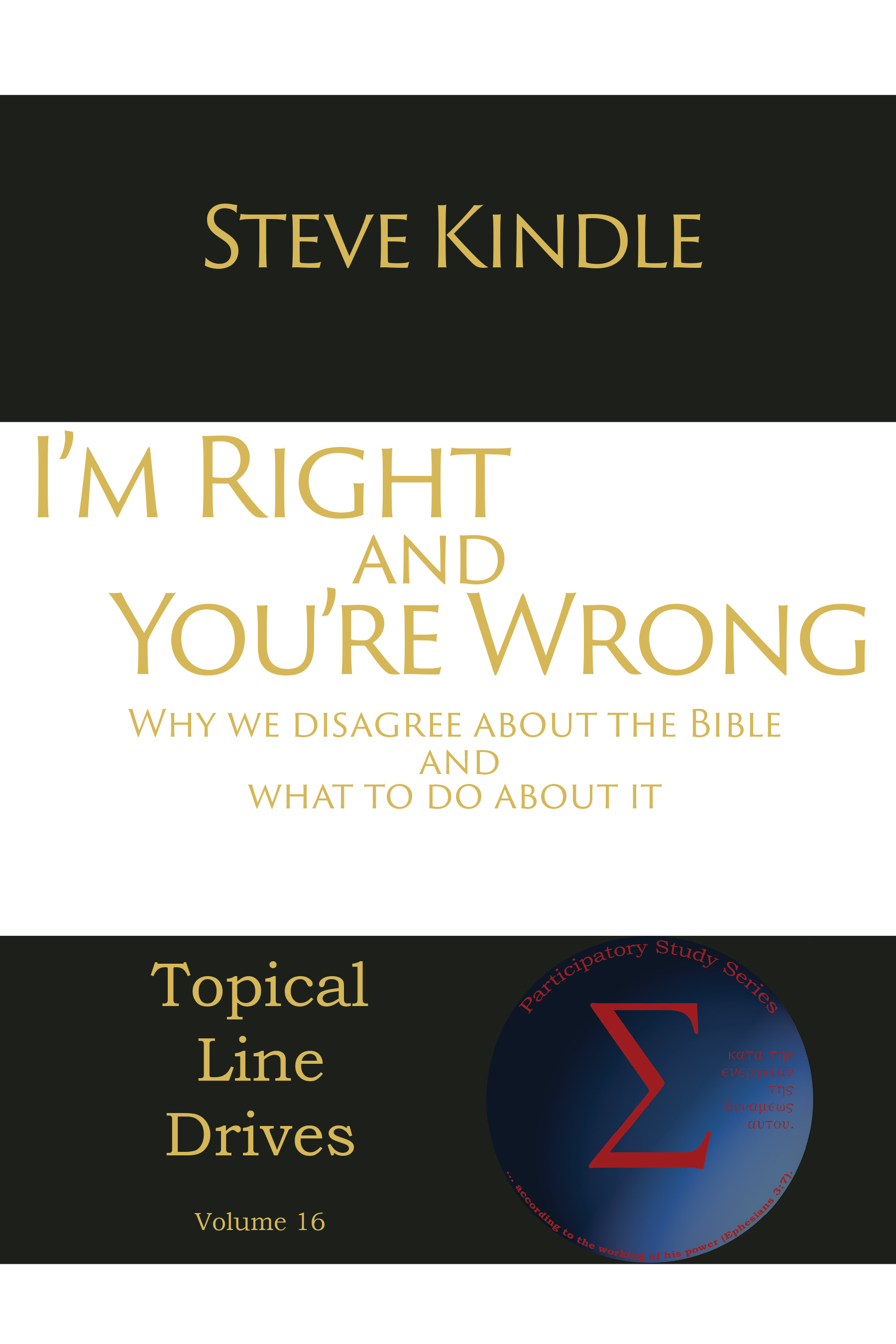
    My company, Energion Publications, will be releasing a book early next year. I’ve already had a chance to read the manuscript, and will be announcing it as forthcoming within the next couple of days. In the meantime, look at this cover and especially the subtitle:

    9781631990991I believe I shall enjoy marketing this book!

  • Book Extract: Discerning Interpretations

    1893729389sMany teachers and preachers speak with great authority and then say, “This is not me speaking. I’m only telling you what the Bible says.” But that assertion is always dangerous. When we apply the Bible to any particular situation we are interpreting. This is another case when one’s words can seem very pious, but actually border on sacrilege. What could be more pious than simply speaking God’s words and never adding anything of your own to them? But there is the problem. You and I are not capable of speaking “just what the Bible says.” There is always something of our own thinking and interpretation in what we have to say.

    The honest thing to do is to admit that what we say is our interpretation, and leave the accuracy of our interpretation open to discussion and discernment. At the same time, no matter how
    forcefully someone says that what they say is simply God’s truth, whether they claim that they got it by hearing directly or by reading and interpreting sacred documents, discernment is always up to the individual hearer.

    A word of prophecy must be tested. An interpretation of scripture must be tested. Everything must be tested using the intelligence God gives you and the wisdom he promises (James 1:5).

    When People Speak for God, p. 78

  • Revelation Requires Interaction

    In my book When People Speak for God I used the story of the one-ended telephone cord. Edward Vick makes the same point in much more profound language than I used.

    But even should someone intend to make known to me what I would otherwise never come to discover by myself, I shall not in fact know it unless I respond. The intention to reveal oneself, and the intention to know the other are not sufficient in themselves. Revelation takes place when there is giving and responding, an interaction between agents who are both free and purposive. Revelation is communication. Revelation takes place when what is ‘provided’ is grasped, what is ‘offered’ is ‘taken’, what is spoken’ is ‘heard’ (From Inspiration to Understanding, 174 [in advance copy]).

  • Can One Be a Bibleist?

    I received a link to the following video in a tweet from @TheActiveWord.  It seems so closely related to my last post that I’d include it here:

    There are several things I agree with here.  First, I do believe that the Bible has the sovereignty of God and the responsibility (of which some sort of free will seems to be a corollary) of humanity.  Second, I also find labels confining.  Yet the very act of using language involves assigning labels, and I note that Rev. Coy is unafraid to apply labels to the editors of Christianity Today.

    But the bottom line again is the idea, presented right toward the end, that one can be a “Bibleist” and believe “the Word of God” without “man’s interpreations.”  Yet even the statement that the concepts of sovereignty and responsibility exist together in some sort of tension is an interpretation.

    I don’t understand why so many Christians are afraid to admit that they are interpreting and then they are following their interpretations.  It sounds so pious to claim that one is following just the word of God without any human involvement.  But by the very fact of recognizing it as God’s word, reading it, and applying it, you are interpreting it.  It’s nothing to be ashamed of.  It’s just a fact.

  • Interpreting the Bible VIII: Biblical Literalism, Attitude, and Avoidance

    This is a continuation of my series on interpreting the Bible. The first post in the series is Interpreting the Bible I: Obvious Exegesis, while the most recent one was Interpreting the Bible VII: Christians Contribute to Confusion.

    As a reminder, my starting point was a number of comments that suggested that those who take the Bible less literally are thereby less serious Christians. These suggestions were not coming from conservative Christians, but from non-Christians. In some cases, I question the motivation of such suggestions. I believe that Richard Dawkins, for example, prefers to debate hard-line fundamentalists, and so would like to dismiss the rest of us from the Christian faith.

    What I believe I have done so far is to show that interpreting the Bible, broadly called hermeneutics, is a bit more complex than these folks would like, and that just taking the Bible literally, as best as I can understand what they mean by “literally,” is not the way Christians have read the Bible historically. I have further noted that even basic exegesis, which I define as looking for the text as it was intended to be understood by the original audience, is more complex than these folks let on.

    Those who are eagerly waiting for me to solve issues such as the violent passages in the Bible or gay and lesbian marriage will still have to wait. While I will discuss those issues, my primary purpose here is to look at the method. I believe that our discussions of the Bible would be much more profitable if we would simply think and talk more about how we come to our understanding, rather than simply trying to defend that understanding. Two people may mean very different things by saying that a concept is “Biblical.”

    Let me reiterate here, as I believe has been demonstrated previously with the help of commenters, that the issues I’m discussing do not hinge on belief in inerrancy. Belief that the Bible is inerrant does not limit one with reference to determining what type of literature a particular passage is.

    I want to clarify this further by using a couple of examples. Two controversial books amongst conservatives are Jonah and Job. There are quite a number of people, even conservatives, who will claim that these books are fiction. To make that claim doesn’t mean that the books contain error. Rather, it means that they intentionally present whatever it is they present in fictional form. Now there are those who regard fiction itself as evil, but that is a different argument.

    Let’s say you have a historical novel, written with the intent of accurately portraying a certain place and time in history, but doing so using fictional characters in a fictional narrative. What would constitute an error? Well, if one introduced an historical event connecting to the story, and placed this event at the wrong time, it might be an error. Suppose one had an historical building, and it didn’t exist at the time in question. That might be an error as well.

    The key in all of these points would be the author’s intent. Such an author might well introduce a house or a small street that was not historical, but wouldn’t presumably introduce a new city hall. There are things that the historical novel wishes to convey that are facts, and there is a story to be enjoyed along the way. Similarly, C. S. Lewis is not in error in the Screwtape Letters if there is no demon named Screwtape, nor is he in error in the Chronicles of Narnia if there is no Narnia.

    I find this comparison to be of interest in the books of Jonah and Job, because I think we often get to argument about little houses and back streets in the story, while missing the big things.

    In Jonah, I frequently hear discussions of two major issues: First, was Jonah really swallowed by a “great fish” or a “whale”? Second, was Nineveh really so big it would take three days to walk across it. (Those who know some Hebrew may laugh a bit at the particular rendering there–I’m using the form in which I normally hear the question.) But are those really the questions?

    I would suggest several themes in the book of Jonah:

    1. God can call you to uncomfortable places and missions on which you would rather not go.
    2. Even when you’re going the other direction, God is likely to take note.
    3. Intervention may be uncomfortable–note how Jonah ends up on shore.
    4. God offers repentance even to people I may hate.
    5. God is gracious and merciful, even to the worst of sinners.

    … and a few more, none of which are really impacted by whether the story is fictional. All of these points have annoyed someone at some time, and indeed according to the story, they annoyed Jonah, and presumably were controversial amongst the readers of the book. I am not here trying to argue these points. I’m simply saying that finding fiction in the Bible is not the same thing as finding error.

    I consider Job even more interesting. If the book is historical, then we have an individual who suffered because God allowed him to be attacked and tormented. This may, of course, be extended by analogy or in principle to others. On the other hand, if the story is fictional, then one would have to assume that Job is presented as a type of sufferer, and that it is quite possible that God might call on me–or you–to suffer to make a demonstration for him. Are you concerned that bad things seem to happen to good and bad people alike? Here are some bad things that happen specifically to good people.

    Now you can get that second idea while reading Job as historical, though I have heard some folks argue that this is something that happened only once (they forget about Jesus, apparently), but I think that if you read it as a fictional account, you are forced to the conclusion that it applies broadly in principle–God’s servants may be called to suffer in the fight against evil, and they may never know just why. Note that Job never receives an explanation of his suffering.

    So you note here that the issue is not whether the text is in error or not, or whether one takes it literally or not, but rather just what are the literary characteristics, what is meant by them, and just how that might apply. If I could delete one statement from the vocabulary of Christian conservatives it would be: “I take the Bible literally.” If I could delete one statement from the vocabulary of liberal Christians: “I don’t take the Bible that literally.” Both are misleading. (As I note in my review of his book How to Study the Bible for Yourself, Tim LaHaye makes this his first rule of hermeneutics. Needless to say, I disagree; in fact, I regard it as one of the worst rules.)

    If I might pound this point into the ground a bit, some interpreters, including LaHaye, have applied this to the book of Revelation. But just what should one take “literally” in the book of Revelation? Personally, I tend to take the introduction quite literally when it uses a variety of literary indicators to show that John saw a vision. Once we’re in a vision, I take things as a vision, which may have varying degrees of attachment to physical things, and I believe that is the correct way to take them. Even where there are likely literal connections, such as with the churches, or with a number of symbols, the vision context warns us to look for more than meets the eye. Revelation 12 & 13, for example, while containing symbols that may be attached to specifics, also provide a very good general appreciation of the battle between good and evil, and numerous principles for living in the midst of such a battle. The literal/non-literal dichotomy is terribly inadequate to the task of understanding such a passage.

    Some may be wondering how one would take the vision framework non-literally. There are many commentators who would treat the “vision” as a literary device used to present a set of symbols. It is quite possible to understand it in that way, though I disagree. In fact, I think assuming an ecstatic state, in vision, for some of the writing of Revelation will explain some literary and linguistic peculiarities, but that is a completely different topic.

    Now I would maintain that conservatives, liberals, and those between are all susceptible to coming up with ad hoc interpretations that allow one to avoid the impact of a text, or to make a text have an inappropriate impact. Let me start with a controversial one.

    Leviticus 18:22 is commonly presented as a text demonstrating that homosexuality is sin and unacceptable. (Note that “I don’t take it that literally” doesn’t seem to work here. It’s pretty literal.) I like to present people with Leviticus 19:33-34, which says to treat an alien living among you as one of your own citizen. Now I’m not arguing what applies here and what doesn’t. Both are literal commands given in the same general body of law. A valid approach would be to ask just how commands given to Israel in Leviticus apply to others.

    But avoiding all of those issues, it’s very interesting to watch people’s responses to this connection. First, it is almost universally assumed that simply because I present Leviticus 19:33-34 I believe that Leviticus 18:22 is not applicable. Liberal audiences often assume that because they want to; conservative audiences assume that because they can’t imagine why I would present them with such an alternative text if it isn’t to undermine the impact of the first text.

    But the real question here is why and how either text should apply. I would suggest that there are similar tasks of interpretation and application that need to be used in both cases. In actuality, however, with most lay audiences I find that these two texts apply according to cultural inclinations. Those who favor gay and lesbian inclusion exclude 18:22 and very often the same people are delighted to include 19:33-34. Those who oppose homosexuality accept 18:22 as applicable, but will explain that 19:33-34 was for a different time and place.

    I would suggest that the processes of interpretation and application for both are complex, and that in neither case is the best approach simply trying to interpret the individual text. If your question is how should our nation treat aliens residing in the country, I doubt you will find clear direction as to what the law should be. If the question is how you, as an individual Christian, should treat aliens, I think you will find many scriptures that you can group together in finding the proper principles to guide your behavior. Similarly with homosexuality, I think the approach that says, essentially, “How many texts are there that forbid homosexual acts, and how can I (or can I not) explain them,” is precisely the wrong approach. A better approach to any question is to try to discover God’s ideal, and then look at how we might approach that.

    To continue with my examples, however, let me look at another passage:

    32Now the whole group of those who believed were of one heart and soul, and no one claimed private ownership of any possessions, but everything they owned was held in common. 33With great power the apostles gave their testimony to the resurrection of the Lord Jesus, and great grace was upon them all. 34There was not a needy person among them, for as many as owned lands or houses sold them and brought the proceeds of what was sold. 35They laid it at the apostles’ feet, and it was distributed to each as any had need. — Acts 4:32-35

    Here again you have a verse that can split interpreters right in the middle! Out of the characteristics of the early church just what are we supposed to apply today. Many of my more liberal brethren are pretty happy with the common ownership thing, and there being nobody in need in the church. They will take various attitudes toward the rest, such as whether this should be done entirely by the church, testimony to the resurrection, and so forth. There are many who would make Christianity a matter of the distribution of wealth, without any regard for the testimony to the resurrection.

    On the other hand, I can cite my own uncle, Don F. Neufeld, an interpreter in the Seventh-day Adventist Church, associate editor of the SDA Bible Commentary and editor of the SDA Bible Dictionary. In a personal conversation he was quick to point out to me that this practice was quickly abandoned by the church and didn’t appear to be the norm in Paul’s congregations, for example. This strikes me as an example of finding trajectories in scripture, something I think is quite appropriate, yet is often criticized as too subjective.

    I have heard many other explanations for common ownership, most aimed at keeping the early church from being too socialist. So here we have otherwise conservative interpreters finding the exit ramp in the middle of this verse. But liberals need not crow, because Christian unity, power, and mutual support is inextricably linked to the testimony of Jesus risen from the dead, and I think it would be difficult to build a case that the author of Luke-Acts would think it possible for it to be any other way.

    (I am aware that liberals do not necessarily deny the resurrection, though many do deny a physical resurrection. I am called liberal, and I personally accept a physcial–or bodily–resurrection. Nonetheless I believe that it is a liberal weakness to attempt to separate good works from the incarnation, and that is a weakness I see as ultimately fatal to Christianity.)

    The issue, I think, is our attitude in approaching scripture. There can be quite a variety of approaches to understanding scripture, and none of them are necessarily related to whether we take scripture seriously. What I would say characterizes a distinctly Christian approach to (Christian) scripture is the attitude of openness to correction. Each approach to interpretation can be used as a means of avoiding things I don’t like, i.e. of making scripture simply the excuse for what I wanted to do anyway.

    Liberal and conservative Christians don’t differ so much on the basic desire to avoid certain passages as on which passages they avoid and how they go about avoiding them.

    (I will continue next time by trying to look faithfully at some of the violent passages in the Old Testament. Don’t get impatient–this series will go on for a long time. Apologies to those who want a quick answer; I don’t believe in quick answers.)


  • The Bible, Christianity, and Me (Briefly)

    I have seen a few comments lately from both sides of the spectrum about just where the Bible should stand in relation to Christianity and to a person’s personal beliefs. It seems that not only are Christians willing to define the role of the Bible for other Christians, but non-Christians try to explain to Christians, especially those who are not conservative, just how they should view the Bible.

    Basically, if I don’t take a very literal and direct view of scripture, these folks believe that I am not sincerely and really a Christian.

    Now the first answer to that, of course, is that it’s really not their decision to make. I don’t have to prove to anyone else that I’m a Christian. To the extent that I do so, I do so to the congregation of which I’m a member, and none of them are in any doubt on the matter. But ultimately, the only person to whom I must give account for my spiritual state is God.

    But there are a couple of simple facts involved as well. First, there is no Bible without a community. The Bible doesn’t define and create the community. The community defines the Bible. Inspired by God, in fact, the community creates the Bible. There are really no Biblical Christians, just a Christian Bible.

    There is no external way to determine just how one should take the Bible. One has to look into the Bible, as well as at the communities that have formed and interpreted it to discover that. Modern fundamentalism has tried to pretend that they are somehow historical Christianity, but they are not. They’re just another community using the Bible in their own way.

    Nobody does everything the Bible says. Nobody can. It is a document that reflects and in some cases records a history of belief, not a systematic belief system. Nobody can make good use of it without intelligently applying experience and their own reason. Unreasonable people with a Bible will tend to become more unreasonable. It really helps much more with the process of asking questions than in finding final answers.

    Some will suggest that only the extreme literalist approach is valid. I hear this even from those who have left the Christian faith entirely after rejecting that approach. I understand how they could reject that approach, I do not think such an approach has any hope of making sense out of scripture at all. I fail to see where they imagine that they get a mandate to take that approach. Normally, they present me with texts interpreted their way to prove that I should interpret the Bible their way. Having rejected their way, however, I am unimpressed. My preference is to discover from scripture just what it is and how it has come to be, and to learn from both the experience it records, and the experience it reflects in the history of its text.

    It’s what makes sense to me, and that is all it really has to do.