Threads from Henry's Web

Tag: Hebrews

  • Exhortation Does Not Interrupt Exposition

    [ncs_ad pid=’0664239013′ float=’left’ adtype=’aer.io’]On page 238 of his NTL commentary on Hebrews Luke Timothy Johnson uses the word “interrupt” to describe the transition between exposition and exhortation starting in Hebrews 5:11. In a way I’m nitpicking here, and because I am, I must also note that overall I find Johnson’s commentary nearly the most useful I’ve read, and if I were just talking about theological reflection, I would call it the best.

    I have a couple of objections to use of the word “interrupt,” however. First, it seems to me that calling the transition an interruption divides the text without consideration for the author’s purpose in writing. There is no exposition here which stands alone, and which can then optionally be applied to the hearers via an exhortation. Rather, the intention is exhortation and the exposition underlies the exhortation and is illustrated and illuminated by the nature of that exhortation.

    Second, the exhortations also help raise questions for the further exposition that follows. In the case in question (Hebrews 5:11-6:12), the question of the faithfulness and reliability of God is raised, which will be answered in Hebrews 6:13ff. This is also the critical question of the entire book. God has provided the final High Priest (logically and temporally), who will offer the final sacrifice, and will provide the way back to the presence of God. Since this is all final, human beings are presented with this final choice, in the view of our author. If you reject this, what means can God provide for you?

    Without exhortation, the exposition would be dry, pointless, and incomplete. The exhortation is an integral part of developing the topic.

    I emphasize this because of some of my experience in studying Pauline epistles in college and graduate school. We would make it through the theological exposition in the beginning of the book, but when we got to the practical admonitions, those were treated as something of an afterthought by Paul. “Here’s your theology of salvation, and oh, by the way, there are a few things it would be a good idea to do …”

    But for Paul those admonitions grow out of the theology he has presented. The practical elements are not appendices to letters that are otherwise theological treatises. It would be better to call the theological exposition introductory matter to the practical sections. Perhaps this explains why Galatians and Romans seem to get so much more treatment from a theological viewpoint than 1 & 2 Corinthians.

    Sometimes I think the worst thing about biblical scholarship is that it is carried out by biblical scholars. Their interest is in extracting theological propositions and historical data. The writers, especially Paul, are writing pastorally. The two don’t always work well together.

    At least that is the view from someone who took Romans (through chapter 8!) and Galatians (through chapter 4!) in school. As far as I could tell, the professors were happy with that.


  • Hebrews 4:12 – ὁ λόγος τοῦ θεοῦ

    Hebrews 4:12 – ὁ λόγος τοῦ θεοῦ

    What a mess my office is!
    What a mess my office is!

    I want to make a short comment on this, and the use of λόγος again in 4:13. I’m not going to go through all the arguments. I’ve just re-read David L. Allen (New American Commentary), Luke Timothy Johnson (NTL), James Moffatt (ICC), and Craig R. Koester (Anchor Bible), and the combined number of references and arguments is really quite astonishing and excellent.

    They differ on the referent of ὁ λόγος τοῦ θεοῦ. There are good arguments for using this as the “personified word,” and for not reading it as a reference to Jesus, but again, as I have time and again over the years, I end up disagreeing. I think this forms an excellent tie back to the prologue, which clearly outlines a high Christology. Now we have definitely been reading arguments taken from the written word, and references to spoken word (Hebrews 2:1-4). But the prologue points us to Jesus as God’s ultimate communication with humanity.

    This, in turn, points us to Hebrew 4:14-16, which summarizes one side of the coin of the high priesthood of Jesus. Here we are told, based on the arguments of chapters 2 & 3, that we have a high priest who is able to sympathize with our weakness. He is our brother (2:11). This will be brought together with the other side of the coin in Hebrews 7:26-28, which tells us that his brotherhood with us does not diminish his status in all ways with God. But right here it’s the one who is our brother, who can sympathize with our weaknesses, who is the one to whom we must give account.

    And there you can see how I think λόγος should be rendered at the end of verse 13. I think we do have a play on words, but we should also look beyond a gloss or even a simple dictionary definition, and note that Jesus is giving an account to us of God, while we give an account of ourselves to God. Except not so much. Because we have such a high priest who is able to take us all the way in to the throne of grace.

    This doesn’t take the written word of God, nor the word of God spoken by the prophets or apostles out of the equation. Wherever God’s word is, it is “alive and active,” but its ultimate representation is in the person of Jesus. To the question, “Is this the written word of the prophets or is it Jesus?” I’m saying “yes.” But mostly Jesus, because that’s where our author is pointing us everywhere.

    Jesus does not replace the written word. Rather he completes it. The New Testament doesn’t supersede the Old. It builds on it. If you’ve read Hebrews thus far, getting to the end of Chapter 4, you’ve experienced the work of someone whose respect for the Hebrew Scriptures is very great and shows clearly through. One should remember this when one gets to passages that talk about something old vanishing, such as Hebrews 8:13. The very foundation of his argument is not vanishing.

    He’s going to make the case that Jesus is the perfect High Priest (and we see functions of that priest in 12-13, God->Us, Us->God), that Jesus is the perfect sacrifice, and subtly, by the texts used in making those cases, he will let us know that Jesus is the perfect King.

    Yep! I read Hebrews 4:12-13 Christologically.


  • A Note on Revelation, Christology, and the Prologue to Hebrews

    Yeah, this will be a short one. Really!

    [ncs_ad pid=’0664239013′ float=’right’ adtype=’aer.io’]As I’m reading through another commentary on Hebrews (Luke Timothy Johnson, Hebrews, New Testament Library), I can’t help but write a few notes. One might get the idea from a couple of my recent posts that I find a great deal to argue with in this commentary. Actually, it’s one of the best I’ve found. Johnson is both clear in his exegetical notes and challenging in his theological reflections. Of recent commentaries I find David Allen (Hebrews: An Exegetical and Theological Exposition, New American Commentary) more helpful on exegetical details, with his great summaries of the various positions and evidence for them, but I am finding Johnson more helpful thematically.

    The prologue to Hebrews is critical. Unlike many of the Pauline epistles (though I don’t exclude Pauline authorship), this isn’t the introduction to a letter. Rather, it’s a launching pad for the theological discussion. In the train analogy I used yesterday, it’s a large signpost telling you what train you’re supposed to get on and why. I would add a quick note that the structure clearly makes Hebrews 1:1-4 a unit, not Hebrews 1:1-3. The argument is picked up with the first supporting scripture in verse 5.

    [ncs_ad pid=’0805401350′ float=’right’ adtype=’aer.io’]It’s important in any book of the Bible, but especially in Hebrews, to look at how a thought is carried forward and concluded before determining for certain the meaning of a specific proposition. One claim regarding Hebrews is that it teaches supersessionism, a claim I find more often in superficial studies of the book than in serious commentaries.

    There’s a good reason for this. In reading the prologue quickly, you might get the idea that the argument is that Jesus is good, and the partial, earlier revelation is bad. As you read through the book you can find passages such as Hebrews 8:13 you have explicit statements that have led some to such a conclusion. But in 8:13, the author is referencing a specific passage of Hebrew scripture and founding his argument in the thing that is made “old.”

    The image that comes to my mind is of a house being built. In working on some software for a home designer, I toured a building site. There we saw the frame of a house. It was not finished. I could see where the nails, braces, tie-down straps, and so forth were. Later, siding would be added and many other elements that would finish the house. The old, the framework, would be put out of site, but not eliminated. It wasn’t that the framework was bad. In fact, our whole purpose was to make sure the framework was good, and ready for hurricane force winds. But to live in the house, to consider the house complete, more was needed.

    Look at 8:13:

    ἐν τῷ λέγειν καινὴν πεπαλαίωκεν τὴν πρώτην· τὸ δὲ παλαιούμενον καὶ γηράσκον ἐγγὺς ἀφανισμοῦ

    (Nestle, E., Nestle, E., Aland, B., Aland, K., Karavidopoulos, J., Martini, C. M., & Metzger, B. M. (1993). The Greek New Testament (27th ed., Heb 8:13). Stuttgart: Deutsche Bibelgesellschaft. Accessed from Logos Bible Software.)

    In saying “new” he makes the first old. That which is being declared old and is aging is close to disappearing.

    Yes, the old is being declared (or made, but I prefer “declared”) to be what it is. It’s going to disappear. But the author’s argument here is built on precisely that “old” revelation. We’re about to finish out that house, put on the frame and the trimmings and call it complete. The revelation of God in Jesus Christ truly brings God and man together, a theme that we’ll revisit in discussion the priesthood and why Jesus is considered the great high priest.

    So while in the prologue the author argues that Jesus is much superior to that which occurred at many times and in various ways, as he proceeds he builds his argument on the scattered revelation which is being “superseded.” Those older revelations still have their value, but for the Christian, all is seen through the ultimate revelation in the person of Jesus Christ. God has spoken to us through “a son,” which, absent the definite article in Greek emphasizes the nature. Through the prophets, but through a son. I tell my Sunday School classes that this involves putting on our “Jesus-colored glasses.”

    While individual statements may seem to support an idea of supersession, the fact that the author builds his argument, an argument made after the resurrection, on those same supposedly superseded passages means that we need to look closer. He is telling us to change our focus, to look at the greatest revelation and to see other revelation through it.

  • Biblical Culture Shock?

    Biblical Culture Shock?

    From OpenClipart.org
    From OpenClipart.org

    Before I went overseas with my parents at 14 years of age we were all required to be briefed about culture shock. Sometimes people have very negative reactions to encountering cultures different than their own. We saw this happen with people who went to Guyana (where I was for three years and my parents for seven), who would come to really despise everything Guyanese. It was hard for me to comprehend, because the Guyanese people, while they did things differently than Americans, were not really all that shocking. You adjusted slightly to the local norms, and life went on.

    We saw this happen with people who went to Guyana (where I was for three years and my parents for seven), who would come to really despise everything Guyanese. It was hard for me to comprehend, because the Guyanese people, while they did things differently than Americans, were not really all that shocking. You adjusted slightly to the local norms, and life went on. My parents were accused of letting me go too “native,” whatever that meant.

    Since then I’ve seen this happen to people experiencing different regions of the United States. It doesn’t take huge differences to cause some shock. It really doesn’t have as much to do with the amount of difference, but rather with how one reacts to the differences. To live with those differences you don’t actually have to change your values or your personality. You just have to recognize who the other person is. You can even disapprove, if you keep it in bounds, and especially if you recognize that the person from another culture has every bit the right to their cultural norms as you have to yours. If you’re visiting, they have more!

    Sometimes visiting the worlds of Bible writers can result in culture shock. The cultures of biblical writers were quite different from ours, more different than anything we’d likely experience in traveling in the modern world. I would suggest that the goal must be not to get so shocked by the differences in culture that we fail to hear the people behind these events.

    In fact, I find that frequently our tendency to stand in judgment on the characters in stories and even the authors often diminishes our ability to truly experience the value of the story itself. And even many didactic passages are, in essence, story.

    Since I’m talking so much about Hebrews, let me apply this to that book. I’ve been searching for metaphors to express two things: 1) The overall message and 2) The role of sacrifice in the book. Here are some ideas. I’ll refine them as I go.

    For the overall message, I’ve been using the train. I recall in my first visit to Germany I was met at the Frankfort airport by my translator, who was about 20 years old and one of the few people I’ve encountered who walk faster than I do on a regular basis. We had to catch a train, and to do so we crossed numerous tracks, passed numerous trains, and finally jumped on one at the last minute, just before it started to roll.

    My German is good enough to read signs and follow directions, but I couldn’t keep up. By the time we got on the train I was thoroughly lost and couldn’t have told you the destination. I was completely dependent on my translator. After we left the station, for a disturbing moment, she thought she had gotten on the wrong train, but then she determined we were head to the right place and we settled down.

    I think I could translate much of the message of Hebrews into a train metaphor. It’s all about getting on the right train and staying on there until it reaches the destination. You have doubts, perhaps, along the way, but you double check (as the author of Hebrews is doing) and you realize you’re still headed in the right direction. There’s nothing more to be done. Just stay on the train. It will take you where you’re going.

    I’ll apply this metaphor in a number of texts, though I will note that there are rough edges. Still, I’m finding it more helpful than not.

    Second is the metaphor of sacrifice, particularly animal sacrifice. I have discussed atonement and the death of Jesus elsewhere and will doubtless do so many times more. Here I’m referring only to animal sacrifice as part of a general cultic experience. This is something that modern minds find difficult to embrace, or even to observe from a distance. What can all those slaughtered lambs, goats, rams, and bulls have to do with a positive experience?

    There are two directions in which I think we fail in relating to sacrifice in scripture. The first is to reduce sacrifice to blood atonement for sin. There are sin offerings, and sacrifices did relate to sin, but blood atonement for sin was not the exclusive view. To see sacrifice as just about blood atonement is just as much a misunderstanding as to dismiss it entirely, which is the second direction in which we often fail.

    My metaphor here is community, specifically mutual support and communication in community. The cultic system involves the divine in the activities of the community and the sacrifices relate to the various aspect of this set of relationships. Atonement (and I’ll discuss various words at some later time) doesn’t just involve dealing with specific sinful acts, but rather with a restoration of those relationships and those communications.

    We tend to separate prayer and hearing God speak from the activities of the cult. Prophet and priest have different roles, never to meet. But the priest also had a role in communication and the cult supported community.

    I think that without this fuller aspect of sacrifice we are likely to misunderstand Jesus as the perfect sacrifice. He is not just a bigger, stronger, better blood sacrifice for sin. He is the only one who can by nature perfect the lines of communication between God and humanity.

    Much more on that later as well!

  • Modern Barriers to Understanding Hebrews

    [ncs_ad pname=’hebrews-ntl’]

    Despite my somewhat snippy comments in my last post, I found reading Luke Timothy Johnson’s introduction to Hebrews in his volume in the New Testament Library (pictured at left) quite helpful. In particular, he looks at reasons why modern people may have a hard time reading and understanding this book. Along the way, it becomes clear that some of the same points may have made it difficult for people in past centuries as well! One of his points is one I frequently emphasize: our lack of understanding of sacrifice in the ancient world and particularly in Israel.

    But to take his points in order:

    1. It challenges the value of the historical-critical method. I would note both that this is true also of many other books, especially in the Hebrews scriptures. Historical methodologies need to be practiced with a certain humility and willingness to admit ignorance. On the other hand, if we are going to view a piece of literature as having an historical setting, we must look for the setting to whatever extent we can determine it. Which, in fact, Johnson proceeds to do. I prefer “historical-critical methodologies” (emphasizing the plural), because while I think that the critical approaches have opened up some avenues, they do not stand alone, the do not stand or fall as a body, and one can derive value from them even while doubting the basis on which some were created.
    2. We have no understanding of sacrifice (as noted above). I have two notes, even though I agree. First, this is not just a problem for understanding Hebrews, but also for understanding the entire New Testament. A failure to understand the sacrificial system will result in a superficial understanding of New Testament allusions to it, at best. Hebrews is just a concentrated example of the problem. Second, however, I think many who would claim to understand sacrifice narrow it by looking back from the New Testament to the Old. They see sacrifice as being purely about atonement and thus fail to see the broad spectrum of theology that underlies the various sacrifices. Just last night I was reading Numbers 28 & 29 and was struck again by the variety of sacrifices. The original readers of Hebrews, I suspect, had a view of sacrifice that couldn’t be covered in a paragraph or so.
    3. It “… challenges our construction of the world, our image of Jesus, and our understanding of discipleship …” I’m afraid I had to do some chopping to get a short quote, but I also believe I’m faithful to Dr. Johnson’s intent in that paragraph. This is also a good point. Hebrews is very theological, but at the same time as it challenges our view of Jesus and salvation, it also calls to action and does so in a very severe way. My own impression is that we have misread this a bit, but nothing I see diminishes the level of the call. Along with the call is also a message of grace, that the means of answering the call is now available.

    My own theological has been formed as I started with Ezekiel, moved back from there into Leviticus and the Torah in general, and forward to Ezekiel. I frequently see the author of Hebrews bringing in big ideas by alluding to passages with which his audience would be familiar. Unfortunately, we are not.

    So I would add a fourth point: Our serious lack of knowledge of the Hebrew scriptures, and particularly Torah, means that we have a hard time understanding Hebrews. We don’t have the right questions, so we don’t recognize when the answers appear before us!

  • Hebrews and the Problem of Writing Introductions

    [ncs_ad pid=’0664239013′ adtype=’aer.io’]

    I’m reading through Luke Timothy Johnson’s commentary in the New Testament Library and have just completed the introduction. I have a couple of thoughts today, not least of which is to note the problem with writing introductions.

    For a reader to truly follow an introduction, it would best come after the commentary and some serious time reading the book, but (catch-22), the commentary is best understood in light of the introduction. For me this has often involved reading the introduction, then the commentary, and then reading the introduction again as a sort of conclusion.

    But often the introductory material is still quite illusive, if not illusory, and the author is left to construct the sort of fantasy realm in which the study will take place. This isn’t a particular criticism of Johnson, who is an excellent writer and makes some quite profound points about Hebrews and Bible study in general in the course of his introduction. His arguments on the dating of the book (45-68 CE) are interesting but not conclusive and he admits as much.

    [ncs_ad pname=’the-authorship-of-hebrews’ adtype=’aer.io’]

    On authorship he expresses the strong conviction that it is right that modern scholarship has abandoned the idea of Pauline authorship of the book. He gives us notice that this is coming a couple of times earlier in the introduction. And he provides a quite good set of reasons for why he believes this to be the case, though I cannot read references to Origen and “God only knows” with the same confidence after seeing Dave Black’s discussion of it in The Authorship of Hebrews (full disclosure: I’m the publisher).

    Then he begins to make his case for his own candidate as author, Apollos. Here he provides affirmation of my rule of biblical introduction: Authors are much better at critiquing the proposals of others than they are at establishing their own. I can’t quite say that there is no evidence whatsoever to support Apollos as author, but someone proposing Apollos should restrain himself from critiquing too vigorously the proposal of Priscilla as author (Johnson lays into it, admittedly with quite good arguments).

    The line I like regarding Priscilla is: “… the fact that everything supporting her candidacy would apply equally to her male partner, Aquila.” Just so. And further, pretty much every argument advanced in favor of Apollos would apply to any Greek speaking Jew who met Paul at some point. Some may object that Apollos was considered a good orator, and there is the elevated language of Hebrews, but if such an argument were advanced about a modern book (the book is well written, and so-and-so is a good writer), it would be laughable.

    I can, of course, leave the laughing to others more qualified than I, and there are plenty who will take up the cause. The fact is, that if you abandon Paul, you pretty much need to abandon naming the author. There is so little known about the candidates. Other than Luke, we lack any written material from them which can be used to compare to the text of Hebrews, and their biographies are so short that one can make up whatever story one wants.

    But such is the hardship of writing an introduction. How many paragraphs does it take to say “I don’t know”?

  • The Apologetics of Hebrews – Can You Defend a Dead Church?

    In Hebrews 2:1-4 I believe the author of Hebrews provides a basic apologetic outline, and I think it’s a very useful one to follow. After the first two verses, which start from a platform that was already accepted by the audience, the author emphasizes the importance of the decision. If he is right in what he says, the decision is critical in an eternal sense. The elements are these: 1) It was delivered by the Lord, 2) Affirmed by the testimony of those who witnessed, 3) Given divine witness through (a) signs and wonders and (b) the gift of the Holy Spirit.

    Looking first from the viewpoint of process, this argument, and indeed the general argument of Hebrews, is based on ground that will be accepted by his audience. They believed that the Torah was firmly established, and many, at least, believed that it was delivered by angels. Throughout the book, we have this focus on sourcing material from the Hebrew scriptures. Those who argue a simple supersession should pay attention to the form of the argument. At the same time as the author argues that Jesus is greater than, he also argues that the revelation in existing scripture is great and should be honored. Too often we fail to found what we have to say on what we already hold in common, when that can be supported.

    The first element of his argument has two parts, the words spoken by Jesus, and the affirmation of those words by witnesses. For someone who tends fideistic like myself, this is a bit of a rebuke. It’s not that I don’t believe that Jesus spoke, or that there were those who heard. I’m even optimistic that we can get a picture of Jesus from the gospel record. But I tend to ignore that part of the argument and go straight to the experiential second part. This argument says that the faith is founded on historical realities, and that this is worthy of our attention.

    The second element of his argument again consists of two parts, the signs and wonders that follow the gospel, and the gift of the Holy Spirit, delivered as God wills. I’m of course more comfortable here, as my experience (in particular) has much to do with experience (in general).

    I was reading this from The Learning Bible (CEV) this morning, and saw that their note refers these signs and wonders (semeiois kai terasin) refer to past events (from the viewpoint of the readers), such as the exodus from Egypt. I would disagree. That is an element either of the first part, or more properly of the commonly accepted foundation of the Hebrew scriptures. Rather, this is the miraculous events/signs that followed the apostles as we read in the book of Acts, for example. It was by acting on behalf of his apostles that God affirmed their witness of Jesus, both in terms of the truth of the stories they told, and in terms of its continued relevance to those who heard.

    The second part is the gift of the Holy Spirit, which is, I believe, the life of the church. We can see how critical this is in 1 Corinthians 12-14, for example, and I see this as a loose, but nonetheless real point of connection with Pauline theology.

    It’s this last point that I think is the most important in the church today. I believe all these elements should be part of our apologetic, yet having a faith that truly takes hold of hope and makes it possible for one to live differently is, I think, the most important element, and is also the key point of Hebrews. If the church does not show evidence of the gift of the Holy Spirit I think that all the other elements will tend to fail. It is sort of like one builds a machine to accomplish a particular task, explains the science behind it, then the technology that goes into producing the device, and then finally applies the power. But the machine doesn’t accomplish the task.

    By “evidence of the Holy Spirit” I don’t mean speaking in tongues, as many in the pentecostal movement believe, but rather in terms of bringing people together and empowering new life in the one God has anointed forever. As Paul points out in 1 Corinthians 14, we can do without speaking in tongues; it doesn’t build the church. But we can’t do without building.

  • Translating Hebrews 2:6-8 – Gender, Number, and Breaking the Discourse

    Translating Hebrews 2:6-8 – Gender, Number, and Breaking the Discourse

    dreamstimefree_235996_smI’ve written about this a couple of times before, though using the NIV1984 and NIV2011, in A Gender Neutral Example – Hebrews 2:6-8 and Quick Follow-up on Hebrews 2:6-8.
    I covered most of the key issues in those two short posts, but to summarize quickly, I note the questions of how one should translated the quotation of Psalm 8:4-6 as it is presented in Hebrews 2:6-8. One of the questions is the text. In some cases translators have “corrected” New Testament quotations of Hebrew scriptures by using readings from the Massoretic  text even when the NT writer is quoting from the LXX. In this passage “for a little while” gets a footnote to the MT in some translations.

    The question for the translator is whether to reconcile the texts, in this case make Hebrews 2:6-8 correspond to the text of Psalm 8:4-6, so that a reader is not confused (or even challenged) by the difference, or whether the texts should be translated faithfully in each instance. In the case of either decision, what should be indicated in the footnotes?

    I was reading this passage today in the NRSV, immediately after having read it in Greek. Here it is:

    6 But someone has testified somewhere,
    “What are human beings that you are mindful of them,
    or mortals, that you care for them?
    7 You have made them for a little while lower than the angels;
    you have crowned them with glory and honor,
    8 subjecting all things under their feet.”

    In this case there is a footnote (one of several), which reads: ”

    Gk or the son of man that you care for him? In the Hebrew of Psalm 8:4-6 both man and son of man refer to all humankind

    In fact, the plural continues into the remainder of verse 8, which is not quoted: “Now in subjecting all things to them, God left nothing outside their control.” It is not the authors argument here that everything is placed under the command of humanity in general, but rather of one human being, Jesus. I fully agree with the translators (and their footnote), that Psalm 8 is referring, in its original context, to humankind in general, and our relationship, as a whole, to God—our place in creation.

    By translating the quotation “accurately,” as it occurs in a different text and location, the translators have disrupted the discourse of this passage. So while I will not call this an error (it’s certainly intentional, and I can formulate the arguments for doing it, even though I find them dismally unconvincing), I do think it’s a very unfortunate approach. One could let readers know that the quoted text, in its historical context, refers to humanity as a whole, but that it is being used here specifically of one particular human male, Jesus.

    In fact, one could argue that acknowledging “humankind” in Psalm 8 need not be inconsistent with the usage here, as we will shortly see the author of Hebrews continue with the argument that Jesus must very much be one of us (humankind) in order to be able to redeem us. One could discuss the idea of being “in Christ,” though that is not the language of Hebrews. In Hebrews the language is one of kinship and community.

    I do think that this makes it harder, though not impossible to follow the flow of the authors argument in this passage.

  • Identifying Extremes – Examining Everything (An Example)

    Identifying Extremes – Examining Everything (An Example)

    book cross-hatchThis morning Dave Black posted some things about reading Hebrews from the Good News Bible (TEV) and also on authorship and canonicity. I’m not posting to enter into a debate on this point, but rather to note an attitude.

    Dave says:

    The undeniable reality is that questions of canon and authorship matter. Of course, both sides demonize the other. Proponents of Pauline authorship are dismissed as obscurantists, while proponents of Hebrews’ non-Paulinity are accused of succumbing to the spirit of the age. But why should we tolerate this kind of judgmental divisiveness? Maybe we need another conference on campus to discuss the issue!

    Good points! I am deeply concerned when people who are treated with intolerance by one group, move to another, and then treat their former group with intolerance. Is there justification for some reaction? I know many people personally who have been treated badly and many of them have been deeply hurt. There’s some justification here for anger. I publish books by authors who have lost their jobs over theological positions.

    But is the justification enough? I don’t think so. Our response to intolerance needs to be greater tolerance. That doesn’t mean we have to accept and approve behavior. What it means is that we need to look for a freer exchange of ideas and better treatment of people.

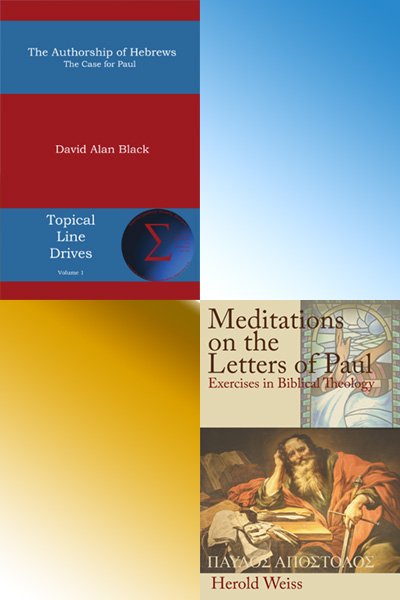
    There are those who wonder why I publish a book like Dave’s The Authorship of Hebrews. Not only do I publish that book, but I requested it. Dave didn’t push it on me. I don’t accept Pauline authorship of Hebrews. I don’t believe we can know the author’s name with any confidence. Yet Dave’s work on this topic shifted my position from one that excluded Paul from the list of possible authors to accepting that his authorship is a possibility. More importantly, Dave demonstrates how to challenge an academic consensus—with detailed, careful scholarship.

    Now let me provide a contrast and a comparison. In the lower right of my little graphic today we have the cover for the forthcoming book from Dr. Herold Weiss, Meditations on the Letters of Paul, which I’m currently editing. First, the contrast. Contrary to Dave Black’s acceptance of Pauline authorship of Hebrews, not to mention the pastorals, Dr. Weiss accepts a minimal Pauline corpus. He even rejects Colossians. So his meditations are on a substantially smaller set of writings that Dr. Black’s would be. Now for the similarity: Besides the fact that I enjoy and have learned much from both writers and both books, neither of these men has ever asked me to accept something because it’s in their tradition, or just because they said so. They are both willing to debate and discuss.

    I can give you numerous reasons why I publish books from a variety of perspectives, and I’ve done so before. But there’s a personal reason. I like them and I benefit from them. I have published some books that I really wish had been better. I do not claim any sort of editorial infallibility. In fact, I would claim feet of clay. But I have learned from and benefitted by reading each and every book I have published.

    Let me suggest a response to Dave’s little book. How about looking at some of the vocabulary comparisons excluding the pastorals, or even working from a minimal Pauline corpus? I’d like to play with that. I don’t know if it would be meaningful, but somebody could look at it.

    Just a thought …

  • Yet Again Hebrews Authorship

    9781938434730sIn September of 2013 I published a book titled The Authorship of Hebrews: The Case for Paul by David Alan Black. It has been interesting to read material on this topic since. I would note that while I believe Dave’s case is well presented, and was convinced by it to give more room to the idea of Pauline authorship, I have not been convinced to abandon my agnosticism on the authorship of Hebrews.

    Today my attention was drawn to two more posts. The first is by Dave Black, which I copied to the Topical Line Drives site to create a permanent link (Dave’s blog doesn’t support this). It’s a short comment, but makes clear Dave’s view that Hebrews is not so anonymous as one might think.

    The second post is by Kyle O’Neill (HT: Thomas Hudgins), who favors Apollos or Aquilla and Priscilla.

    There is a broad consensus among scholars that Paul did not write the book of Hebrews. There is no similar consensus about who did write the book. There’s an easy explanation, however, for the difference between these positions. It’s simply the view of the authors in question of the external evidence. Is the testimony of the early church fathers reliable on matters of authorship? While there are some disagreements about precisely what each church father said (Dave Black provides his own translations of many of these references in his book), in general if one is prepared to accept the testimony of the early church fathers, one is likely to accept Paul as the author of Hebrews.

    On the other hand, if one favors internal evidence over this external testimony, one likely will not favor Paul. Note that I do not mean here a simple differentiation between how one favors internal over external evidence, such as one might have in textual criticism. In this case, we’re looking at specific testimony with specific issues. How much could each witness have known? To what extent are they reporting hearsay? To what extent might they be trying to shore up the claim of Hebrews to be scripture? So one can have a general position favoring external evidence on many other topics, but nonetheless not have the same emphasis with regard to authorship.

    In my view, if we did not have the testimony of the early church fathers, nobody (or almost nobody) would assign Hebrews to Paul based on the internal evidence. But I also believe that if you don’t accept the testimony of the early church fathers on this point, there is no basis to claim any particular author for the book. The problem with determining authorship based on internal evidence is that you must have a body of material with known authorship with which to compare the book. Of the proposed authors of the book of Hebrews, only three have a significant body of written material, Luke, Paul, and Clement. For others, such as Apollos or Aquilla and Priscilla, we have no written material, and precious little biographical information. It is always possible that one of these many candidates wrote the book, but the evidence just isn’t there.

    That’s why, having decided that there is enough internal evidence in the book to question Paul’s authorship, I do not propose an alternative. I don’t know who wrote it. I realize there are answers to the difficulties with Pauline authorship, but in my view it seems that there’s just a bit too much to explain away. It could be Paul, but then again, not so much.

    It’s interesting how strong the consensus against Pauline authorship has become. I would think that there would be a greater body of argument in favor of the testimony of the early church fathers. A very slight swing in favor of that testimony would probably shake the consensus quite substantially.