Threads from Henry's Web

Tag: Grace

  • Wanting to Be Right Theologically

    Wanting to Be Right Theologically

    I work on a heavy schedule, and as someone who is self-employed, with two distinct lines of business, I very rarely see a blank to-do list. In fact, now that I think about it, it has been several years since I finished a day and could say I was done.

    I identify a couple of goals here. First, I’d like to be done at some point. “Now I can go on vacation,” I would say, “because everything is done.” Second, I want to get as much done as possible, not to mention a few impossible things. In reality, I’m not going to be satisfied on either of those points.

    Quoth Paul, “Oh wretched man that I am! Who will deliver me?”

    You may think I’m being irreverent to use that quote, in which Paul is referring to his own inability to do what he knows is right and wants to do, but I think it’s closer to the mark than most suspect. So let me first illustrate what I’m talking about with my work, and then get back to the spiritual lesson.

    No, that’s not quite right. Getting done with my work is physical, mental, and spiritual process. One of our problems is that we spiritualize spirituality until it has nothing to do with daily life. Ideally (another interesting word), we’ll see the physical and the spiritual working together. Everything from doing the dishes to writing a book to running a marathon (as my friend Dave Black is about to do) is both physical and spiritual; above all, real.

    Thus I start with the illustration of how I can attack my day. There are two extremes I can take. The first is my natural inclination. That is, I get up in the morning, come to this computer (most of my work resides in its chips), and start attacking my list. I’m not really a list person, but reality has forced lists on me. If I find myself failing to accomplish the list, I add hours at the end of the work day, all the while wishing I could add hours to the physical day.  This process is direct, measurable in effort and results, and easy to understand. More work = more accomplishment.

    Before I go to the next option, let me tell you about the problem I have with leaving the first. Mary Heaton Vorse (I believe she originated the saying) said that writing was the art of applying the seat of the pants to the seat of the chair. She was absolutely right. The arts of editing, designing, and marketing are much the same. So if chair meets backside for more hours, more will get written. Authors (and editors, designers, marketers, and perhaps all humans) have many excuses for not having seat meet seat, one of the most common being that you can’t force creativity. Editors, who like to disembowel the excuses of authors, like to point out that you’re not being all that creative outside of the chair either. Writing great novels in your imagination is perhaps not all that likely to bring either fame or fortune!

    So having written one or two books myself, and having published around 170 by other authors, I have a strong tendency to stick with Mary Heaton Vorse.

    Not so fast!

    I also know that creativity will demand its pound of my flesh. One of my techniques for planning out a cover or the chapter headers for the interior of a book is to put them on a computer screen I’m not using and walk by them every so often. This is a way of forcing me to become so disillusioned with the current state of the object that I will come up with a new look just to preserve my sanity. Put less bluntly, I look at it, think about it, and suddenly come up with an idea. Then I apply back side to chair and implement, generally followed by more looking.

    Now we turn to the second approach to my day. In this approach I ask what makes me productive. I could list a number of things, such as getting enough sleep. Staying up late to finish a project can get it out the door on schedule, while actually making me further behind overall. I am less efficient on insufficient sleep. Failing to spend time in daily devotions makes me less efficient. It’s easy—almost irresistibly easy—to decide that I’m too busy for that devotional time and simply jump into work. In fact, as I write, I must confess that this morning other than prayer time before I got out of bed, I am writing without devotional time. But this blog post struck me as I prayed (no, I’m not telling you this is God’s word; it’s just my musings), and here I am, drawn to the keyboard and the chair.

    Walking is also important for my efficiency. If I don’t get active, I’ll find myself accomplishing little. Walking can be done at any time of the day, and therein lies another problem. Can I stop working and take a walk? Can I stop working inside and go out and clean up branches in the yard? The second is easier than the first. Why? Because it feels like I’m working toward a goal. What is walking but time when the seat of my pants does not connect with the seat of my chair and thus is wasted? At least cleaning the yard produces stacks of broken branches and piles of leaves!

    But, and this is a serious “but,” thus gaining the initial point in this paragraph. But, I say, this impression is an illusion. Yes, I need to work. I need to accomplish things, but I also need to do things that keep me functional. There is a balance here that is not helped by my tendency to think in extremes. If I could just work 16 hours straight, the book would be done, I think. But that doesn’t work. There is a balance, a place where things work best.

    But, another serious “but,” I want to be able to say how hard I work. If I rest, in order to be more efficient, I can’t say I worked 16 hours, thus impressing other people with my diligence and dedication. Saying that I ordered my day to preserve mental, physical, and spiritual health, and thus actually accomplished more work than I would have if I had gone with Plan A just doesn’t have the same ring. Deep inside me is this little voice telling me that approach sounds lazy. Somewhere in there is another voice that tells me it is lazy. The voice that tells me it’s lazy lies like a rug. The one that tells me others will think it’s lazy is just irrelevant.

    I’m so programmed for work that I tend to listen to those voices anyhow. “Oh wretched man that I am! Who will deliver me?”

    Can you perhaps see some of our problems with spiritual things? In our minds there is a God out there demanding this ultimate perfection, incredibly wonderful holiness, and the attainment of unreasonable standards. We’ve even made a theology of it. We’re so desperately wicked and God is so holy that we are without hope. Jesus comes in and makes up the difference. That’s fine, except that we don’t really buy it. So we come up with new ways to try to attain “rightness” with God.

    Way, way back in the ancient days, it was by offering enough of the right sacrifices. Then we weren’t sure, so we offered more, all the while letting actual righteousness get lost in the scramble to offer the right sacrifices. Then we got hold of Jesus, so to speak, but since we couldn’t really believe that things were taken care of, we had lists of works. We’d try to make sure we got the lists done, and we were afraid that if we didn’t quite manage that, we’d be lost. (This isn’t a critique of Catholic theology, but of human existence. I don’t think the change of theology does nearly as much as people hope.)

    Come the reformation, we renewed the idea that God had taken care of it. We ended all the sacrifices with Jesus and now the reformation wanted to end all that checklist work being righteous enough to get to heaven. But we really didn’t want to believe that either, so we came up with righteousness by correct theology.

    I personally think the demands of theological correctness are much greater and much more sinister than the demands of correct living. The farmer in the field or the construction worker laying bricks could hope to live with integrity and carry out acts of charity. But now we have details of theology that must be learned but that many people don’t really get. There are those who demand, however, that they be understood. I was told once that if I didn’t realize that Christ had died for my sins and that I was thus “once saved, always saved” irrespective of any future event, I was not in fact saved at all. In this man’s view, my understanding of the theology was critical to my salvation. I might be incapable of doing one righteous thing (he made sure to quote scripture on that), but I must be capable of righteously (and rightly) understanding his view of the atonement, else Christ died in vain.

    We replaced the vanity of gaining righteousness by performing the right ritual with the vanity of performing the right set of deeds. Then we replaced the vanity of the deeds with the vanity of our understanding. All the while our lives continued to do very little to reflect righteousness by any standard.

    “Oh wretched people that we are! Who will deliver us?”

    Jesus, I think, if we’ll listen. Matthew 5:48 says to be perfect, but Matthew 7:1 says not to judge. Interesting that we try to apply that to others (while missing “by their fruit” a few verses forward), but not necessarily to ourselves. Earning the favor of God by doing things that are, really, the best things for ourselves and doing them perfectly is, of course, impossible. We can’t attain this. We might as well hope to reach the pole star by walking north!

    But here comes grace, ready to take that burden from you. To quote Paul again, “Thanks be to God through Jesus Christ our Lord!” It’s the realization that you don’t have to reach the pole star, but you can walk north. You can go ahead and have times of rest in your spiritual life. Why? Because you live in grace. You can work on your own sanctification. Why? Because God has given you the space.

    If you spent your time trying to attain the pole star, you would have serious problems getting over the next hill. In an article titled North Star Closer to Earth than Thought, I found the estimate that it’s only 323 light years to Polaris, the current pole star. I also found an estimate that it would take 225 million years to walk one light year at 20 miles per hour. (I think the writer has a problem with the concept “walk.”) But even at that clip, Google tells me that 225 million times 323 light years is seventy-two billion six hundred seventy-five million. Of course that is shortened from ninety-seven billion six hundred fifty million by the new measurements (323 light years to Polaris rather than 434)!

    That shortening is sort of like saying, “No, you don’t have to accomplish all these deeds, just make sure you get the right set of beliefs. Then it will take only a bit under 73 billion years longer than you’ll live instead of 97 billion. Rejoice! Sing Hallelujah!”

    We need to let grace free us from the need for judgment, and then we can seek God without the constant worry that our experience and understanding are inadequate. Of course they’re inadequate! But God …

    You were dead through the trespasses and sins in which you once lived, following the course of this world, following the ruler of the power of the air, the spirit that is now at work among those who are disobedient. All of us once lived among them in the passions of our flesh, following the desires of flesh and senses, and we were by nature children of wrath, like everyone else. But God, who is rich in mercy, out of the great love with which he loved us even when we were dead through our trespasses, made us alive together with Christ[a]—by grace you have been saved— and raised us up with him and seated us with him in the heavenly places in Christ Jesus, so that in the ages to come he might show the immeasurable riches of his grace in kindness toward us in Christ Jesus. For by grace you have been saved through faith, and this is not your own doing; it is the gift of God— not the result of works, so that no one may boast. 10 For we are what he has made us, created in Christ Jesus for good works, which God prepared beforehand to be our way of life. (Ephesians 2:1-10, emphasis mine)

    Perhaps we should give up the works and the judgment, especially self-judgment, and live.

  • Questions and Parables: Grace in Luke 17

    Questions and Parables: Grace in Luke 17

    From openclipart.org
    From openclipart.org
    Today Pat Badstibner of World Prayr published a post on the World Prayr Devotional blog picturesquely titled The Law Is Not Soggy Cornflakes. In it, Pat finds a number of purposes for the law, even, and perhaps especially, for those living under grace.

    If we look to the law as the means of making ourselves perfect (or even better), or perhaps as a guide to what we must be in order to win God’s favor, it’s going to be bad news. The rules don’t make one good. Making rules doesn’t cause people to live by them.

    The law doesn’t change when it is seen as a mirror. It is our perspective that changes. For one living under grace, the law can be very good news indeed.

    I used this in a sermon two weeks ago at my home church (Chumuckla Community Church), when I preached from Hebrews 12:1-3. I have frequently heard this passage presenting in sermons or Sunday School lessons as a sort of big stick to persuade us to work harder. In my sermon I called this the “Santa Claus gospel.” By this I don’t mean a Jesus who comes down chimneys and leaves gifts, but rather the picture of Santa who is “gonna find out who’s naughty or nice,” who “sees you when you’re sleeping, and knows when you’re awake,” “knows if you’ve been bad or good, so be good for goodness’ sake!” (Pardon me for ripping the song up a bit!

    This view suggests that all the saints of the past are watching, and Jesus did a good job, so we should get with the program and do a good job as well. They’ll see us if we don’t! (My wife summarized some of the message in a blog post if you want more. I titled the message “How Chumuckla Community Church Can Be Perfect.”)

    The very same day my Sunday School lesson was from Luke 17. When I read Pat’s post, I was struck by the viewpoint issue. I think a number of these parables are commonly read and taught in a “law as bad news” mode.

    Luke 17 starts (vv. 1-3a) with talking about anyone tripping up any of these little ones. Bad news in action. But it’s followed (3b-4) with the injunction to forgive.

    Next we have the request for more faith (5-6). How many times have I heard from this verse that because I cannot tell a Mulberry tree to be planted in the sea, I must have a truly minute amount of faith? You’ve heard it. Don’t worry. The preacher can’t do it either.

    Then we have the “we’re worthless slaves” passage (7-9). After a whole day of working, we should call ourselves worthless. We’ve only done what we were asked to do.

    Now in the Sunday School curriculum, that was the last passage for the week, but I think it’s important to note that the very next passage is the healing of the ten lepers. Luke claims to present things in some sort of order, and I think this positioning is important.

    So we could summarize one set of messages as:

    1. Watch out! If you trip somebody up, God’s going to get you.
    2. You better forgive your brother or sister.
    3. Your faith is miserably small.
    4. No matter what you do, you’re just a worthless slave.

    But let’s try changing our viewpoint here. Go to the cleansing of the 10 lepers and work backwards, then forwards again.

    What precisely did the lepers do to receive healing/cleansing? All they did was ask. Let’s put aside what happened to the one leper for a few moments. All the lepers are cleansed.

    So no matter what you do, you can’t earn God’s favor, because doing good things is just that. You’re doing what you were supposed to do. I’m surprised that we often think we should somehow earn God’s favor. If God doesn’t want to do something God doesn’t have to. In what way would it be unjust, for example, for God to create creatures whose life is limited to the frame of their mortal existence? We don’t like it, but what is inherently wrong with it?

    Yet, without doing anything, the lepers were cleansed.

    We have so little faith. Yet without demonstrated any more faith than was needed simply to ask, the lepers were cleansed. Perhaps Jesus was telling the disciples that the quantity of their faith wasn’t the key. (And yes, I’m aware of the cases where Jesus commends faith and of the one leper.)

    We should forgive, yes, but is it not possible that our heavenly Father is capable of forgiving much more than we are able to forgive one another? God’s grace is greater than ours.

    And perhaps the biggest scandal, as we’re back at the beginning of the chapter, is to push someone away from God by telling them they need more faith, greater ability to forgive, or more diligent effort in order to come to God.

    All ten lepers were cleansed, even the ungrateful ones. Yet one came back to Jesus and he gained something more. Seen from within God’s grace, faith, action, gratitude, and yes, the law, can be good news. But the grace came first.

    The call was to bathe in it.

  • Doctrinal Standards – The New Works

    I’ve had some interesting conversations about God’s grace recently, and especially about its limits.

    Most people these days seem to firmly resist the idea that we need works in order to earn God’s favor, but many seem to think that we need to have correct beliefs. If we don’t believe the right things about the way grace is sufficient for all our sin, then, well, it won’t really be sufficient. Because, while grace can apparently handle murder, lying, cheating, stealing, and adultery, it is not up to dealing with a failure to discover the correct doctrine about grace. Amazing, isn’t it, that God could be so easily stopped? We seem to have replaced justification by works with justification by correct belief.

    I think it’s hard for us to believe that grace is actually sufficient. We want to insert ourselves in there somewhere. Having been told that we can’t work our way in, we still find a distinction, this time about whether we have come to a correct doctrinal understanding.

    Now two points:

    1) I’m not saying that beliefs are not important. In fact, while I have no difficulty thinking that God can accept a person who is completely wrong in their understanding of grace and how it works, I do think that many people suffer a great deal by not understanding just how gracious God is. Misunderstanding can hurt. It doesn’t make God hate you, but it’s uncomfortable nonetheless. I know many people who live their lives worried that an angry God is going to send them into eternal torment because they forgot to confess one deed or failed to understand some command. That’s sad. Personally, I think grace is sufficient not just for my sin, but also for my stupidity.

    2) I’m not a universalist. I think there is real evil in the world and that people sometimes take a turn that way. I know there are those who think there is good in the worst of us, but I think there are those who are just evil. The problem is, with our ability to mask evil with a pretense of goodness, and our ability to obscure goodness through just plain bad judgment, I suspect we aren’t up to figuring out who actually is truly evil.

    I could be wrong about any of that. I think it’s important to recognize my potential to be wrong. I think it’s also important for me to try to be as right as I can. But no amount of my wrongness can actually limit God.

  • Why Not to Tithe

    Why Not to Tithe

    9781938434129The word “tithing” has undergone quite a substantial change in meaning over the course of my life. Growing up as a Seventh-day Adventist, it meant giving precisely 10% of one’s income to the church. This money had a special use in the SDA church, supporting pastors. For my parents, the tithe was just the starting point of their giving. They put aside an additional 10% and gave that to various other activities of the church. They called this offering. They had an additional fund, I believe around another 10%, that they used to help people personally.

    When I started attending Methodist churches, I found that the term “tithe” had a somewhat different meaning. I think I ran into this first in a stewardship campaign, in which people were encouraged to begin to “tithe” at 2%. The idea of a “2% tithe” was somewhat puzzling to me, as I knew the Hebrew word was derived from “10” and was used pretty much exclusively in that sense. (Not 10%, as not every instance of 10th turned out to be precisely 10%, but always related to 10.)

    So tithing had the meaning of giving, rather than a specific type of giving, and the number was no longer considered relevant. There was a sort of goal at 10%, but the other amounts were still considered tithing. If one needed to distinguish them, one might say “full tithe” but I rarely heard that.

    In my own view, however, there was no obligation for Christians to follow the tithing laws from the Pentateuch, and even SDAs were not doing so. There was a more substantial effort on the part of SDAs to translate, but it nonetheless was not the same thing. It was not that Christians should be less generous. It was just not a law addressed to us. At the time, however, I was afraid to say that I didn’t believe in tithing. Why? I was afraid people would start giving even less, and the giving in Methodist churches (and many others) is rather dismal as it is.

    In other words, I didn’t really believe in grace. I didn’t trust grace.

    I believe that tithing can be a good starting point or guideline. I don’t believe Christians are called to give less. Rather, we are called to give more. I also don’t believe that we are necessarily called to give all to our local church. But we are called to give it to the kingdom of God, whether in the form of helping our neighbor in trouble, feeding the homeless, carrying out acts of love and mercy, supporting missionaries and all who are working in service to God and others. I believe this should be a response to grace, not a price we pay or a duty we fulfil. All giving, whether to support your local church, your local food pantry, or world missions, should be a joyful response to God’s grace.

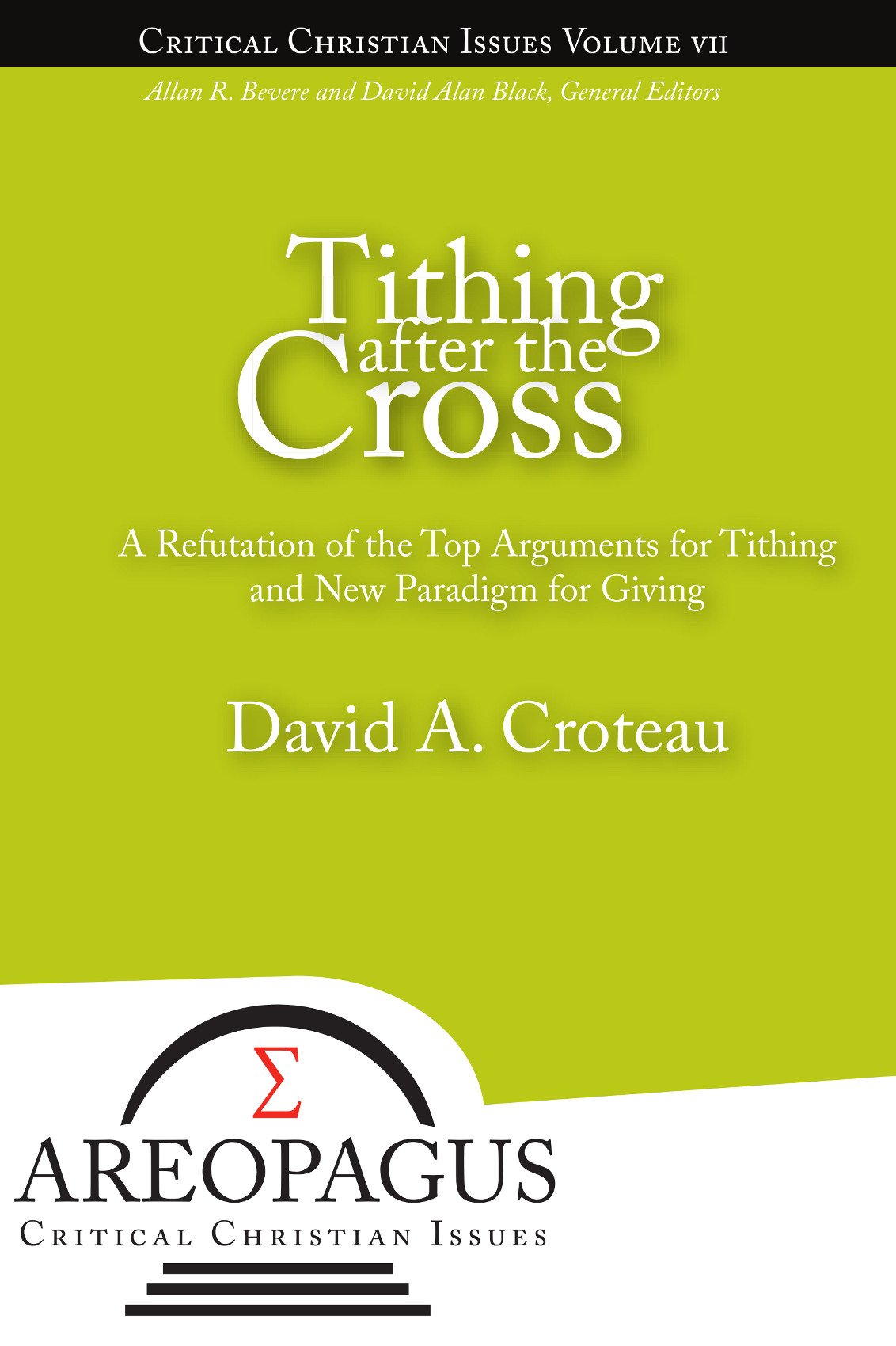
    Recently I had the opportunity to publish a small book on tithing, titled Tithing after the Cross by David A. Croteau. He says boldly what I failed to say, and backs it up with a large amount of additional research. While he has written larger works, in this book he distils it into a short volume that anyone can read. Don’t worry! He didn’t “dumb it down.” He made a concise version.

    This afternoon he’ll be on the Janet Mefferd show with an interview on the topic. Show time is 4:00 PM eastern time. I invite you to listen and then check out his book, Tithing after the Cross, on Energion Direct.

  • What Could Be More Dangerous than Liberalism?

    If you let your eyes wander up to the header you’ll see that my tag line includes the word “liberal” and not in a negative light. I’ve even written about being a liberal charismatic believer. So if you’re wondering how I can use both labels at once, follow the link. But in certain circles, “liberals” make good enemies, you know, the kind of enemies that you know will help make other people your friends—the enemy of my enemy is my friend, right?

    And so Adrian Warnock points to a post by Micah Fries, titled simply Fighting with Scripture. In this post he speaks of the joys of being Southern Baptism following the conservative resurgence, and how nice it is to know that those around him embrace infallibility and inerrancy. In this portion of the universe, the old enemy, liberalism” has been laid to rest and it is easy to ridicule, at least in these sanitized domains. Now my point here is not to beat up on Southern Baptists. I do not consider those who believe in biblical inerrancy to be either worse Christians or scholars than those who do not. In fact, I hope that more moderate and liberal theologians will read and engage with conservative scholarship. I do like to make the point that those of us who see biblical inspiration differently are not the enemies, and may have something to contribute as well.

    Just a couple of lines from the post:

    Liberalism, of course, reduces God’s word, and in doing so attempts to make a mockery of those who would dare take that word at face value. It assumes a position of great authority, in fact it could be argued that it assumes a position of greater authority than scripture itself as it attempts to “rectify” the “errors” found in the bible.

    When I see “of course” in a sentence like that I must confess that it gets under my skin a bit. You see, I don’t think I “reduce God’s word.” Rather, I attempt to understand God’s word as clearly as possible. I don’t “make a mockery of those who would dare take that word at face value,” in fact, I try to avoid mockery. (There are those who assume that disagreement, especially vigorous disagreement is mockery. I’ll just have to live with that.) But still, the issue here is not whether to take “God’s word” at face value. The question is just what that face value is.

    Let’s illustrate this for a moment from Genesis, the great controversy these days. I’ve just edited, and my company has published, a book titled Creation in Scripture by Herold Weiss. It takes a look at the various ways in which creation is discussed in scripture. What it taught me as I edited it was how much more there was to the “face” of what the Bible has to say about creation than most people realize. There are major texts in scripture that are rarely part of this discussion. Many people who try to discuss creation see a “face” of God’s word that is like viewing a large mountain through the trees. You see a little bit of the mountain where light gets between all the trees. But the mountain is more than what you see in that way.

    And how do I get the face value of scripture? Do I read Genesis 1 & 2 as a 21st century citizen of a scientific era? Do I try to get into the perspective of someone from the ancient world? The face looks considerably different depending on which of those perspectives I take.

    My intent here is not to demonstrate what particular view is better, but rather to show that the simple statement that “liberalism reduces God’s word” is somewhere between inadequate and false. It’s inadequate in the sense that it doesn’t do justice to what moderate and liberal students of scripture do when studying. It’s false because very often the liberal interpreter is actually seeing more of the “face” from which the “value” is derived.

    This reminds me of my discussions with KJV-Only advocates. They refer to any word or phrase that is present in the KJV but not in a modern version as something that has been removed from scripture. In vain does one point out that the best Greek manuscripts do not have the word or phrase in question, and that one might just as well say that the KJV added it to scripture. What are you taking as your standard? More importantly, how are you using and applying that standard?

    In order to have valuable discussions of these points we need to state the questions a different way. Conservatives, moderates, and liberals understand scripture differently. We need to discuss passages on that basis, and examine our hermeneutic first. It’s often valuable to take a passage that is slightly less controversial and ask how we look at that passage. We may well continue to disagree (doubtless in many cases we will), but perhaps we would have a better understanding of why and how.

    I share the concern of the authors I linked with reference to legalism, though I don’t think the accusation that it is “adding to scripture” is the best way to address it. I suspect legalism is more a matter of where we place things in our thinking and acting. Having just taught from Ephesians 2 and done preparation to teach from Ephesians 3, I see a fairly clear relationship between grace and action. It’s not that legalists do too much, though some do, it is that they place rules and their actions in the wrong place in their relationship to God. Grace, God’s grace, comes first.

    In pursuing correct theology, I think we often fall into the same danger. We make theology our works and become legalistic in terms of what people should believe. But placing barriers of knowledge and belief ahead of grace is just as damaging as placing barriers of action. We can get into the position of earning God’s favor through getting things right just as easily as through doing things right, and often with even greater damage.

    Legalism will not be defeated by making sure people’s theology of grace is thoroughly correct and orthodox. Legalism is defeated by grace in action. God’s grace, and yes, God’s grace displayed through God’s people.

  • On Faith Preceding Works

    Some time ago I wrote an essay titled A Fruitful Faith, in which I maintained that there is a pattern of grace before law that is consistent throughout scripture, both Old Testament and New.  One can also express this idea as call before response, or, as I’ve been thinking today especially, faith before works.

    Frequently faith and works are seen as contradictory, and there is, of course, an approach to works that contradicts faith.  There is also an idea of faith as abstract belief that divorces it from any form of works.  I’m reminded, however, of the reformation formulation “by faith alone, but not by the faith that is alone.”

    I found two quotes in my reading on Hebrews today (Hebrews: Ancient Christian commentary on Scripture, New Testament X).  The first is from Athanasius, Festal Letters, 11.3, and is found on page 178:

    [Paul] deemed it necessary to teach first about Christ and the mystery of the incarnation.  Only then did he point to things in their lives that needed to be corrected.  He wanted them first to know the Lord and then to want to do what he told them.  For if you don’t know the one who leads the people in observing god’s commands, you are not very likely to obey them.

    I like the way this is expressed.  Works done to earn God’s favor or to learn about God are very different from works done because one know and loves God.  The former are futile; the latter rewarding.

    Again, St. John Chrysostom, On the Epistle to the Hebrews, 22.4, on page 179:

    How was it “by faith” that “Enoch was taken up”? Because his pleasing God was the cause of his being taken, and faith the cause of his pleasing God.  For if he had not known that he should receive a reward, how could he have pleased God?  But “without faith it is impossible to please” God. How? If a person belives that there is a God and a retribution, that person will have the reward.  (emphasis mine)

    God’s grace, received by faith, is the cause of doing good, and doing good pleases God.  But clearly none of that comes from us; it all proceeds from God and comes to us because God has called us.

  • Church Sign: An Eye for an Eye

    An Eye for an Eye church sign
    An Eye for an Eye Church Sign

    At first glance, this is a good sign for a Christian.  After all, Jesus replaces “an eye for an eye” with “Do not resist the one who is evil” (Matthew 5:38-39).

    But I think it illustrates the way we fail to understand certain phrases as they were intended.

    “An eye for an eye” or lex talionis was originally also a way to keep the whole world from going blind.  It was intended not to mandate revenge, but to limit it.  Modern Christians understand it as some sort of command to mass mayhem, and are thankful that Jesus overruled it.

    But in fact Jesus simply moved us further along the same path.  Limiting revenge was good.  Forgiveness was even better, though in justice we still find some value in the idea of proportional penalties.

    This sign demonstrates a quite frequent response to the Old Testament, and in many cases to other things that are old.  In seeing the New Testament as good, these Christians have to see the Old Testament as bad.  It is almost as though there was no grace for thousands of years and then suddenly at the appearance of Jesus God’s grace came into being.

    But in fact the grace that Jesus taught was also taught in the Old Tesament, with the teaching accommodated to time and place.

    So yes, I think Jesus improved on the attitude of “an eye for an eye.”  But “an eye for an eye” was, in its time and place, also a forward looking measure of justice.

  • A Calvinist Complementarian defines Arminian and Egalitarian

    … and does so very well. Not surprisingly (to me, at least), this is from C. Michael Patton on Parchment and Pen. To quote his definitions of “complementarian” and “egalitarian”:

    Complementarianism: Belief in essential equality, but functional hierarchy in the sexes. This hierarchy is by God’s design and is not due to the fall. Man is to be the leader in the church and home. Women are not to be in positions of authority over man in the church or home, but are honored due to their role in the same way as men.

    Egalitarianism: Belief in the essential and functional equality of the sexes. All role distinctions which imply leadership belonging to the man is due to the fall, not by God’s design. Therefore, women can serve in positions of authority over man in both the church and the home. Role is assigned by individual giftedness, not gender.

    While I would say that many in each group take things a bit further, for paragraph length definitions, I would describe those as fair, balanced, and even accurate. The same goes for the definitions of “Arminian” and “Calvinist.”

    The whole post is worth reading, especially as he discusses how a church can show, and not just teach, grace.