Threads from Henry's Web

Tag: David Alan Black

  • Identifying Extremes – Examining Everything (An Example)

    Identifying Extremes – Examining Everything (An Example)

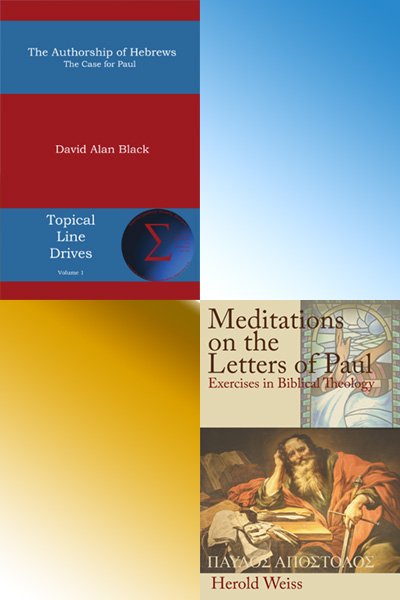
    book cross-hatchThis morning Dave Black posted some things about reading Hebrews from the Good News Bible (TEV) and also on authorship and canonicity. I’m not posting to enter into a debate on this point, but rather to note an attitude.

    Dave says:

    The undeniable reality is that questions of canon and authorship matter. Of course, both sides demonize the other. Proponents of Pauline authorship are dismissed as obscurantists, while proponents of Hebrews’ non-Paulinity are accused of succumbing to the spirit of the age. But why should we tolerate this kind of judgmental divisiveness? Maybe we need another conference on campus to discuss the issue!

    Good points! I am deeply concerned when people who are treated with intolerance by one group, move to another, and then treat their former group with intolerance. Is there justification for some reaction? I know many people personally who have been treated badly and many of them have been deeply hurt. There’s some justification here for anger. I publish books by authors who have lost their jobs over theological positions.

    But is the justification enough? I don’t think so. Our response to intolerance needs to be greater tolerance. That doesn’t mean we have to accept and approve behavior. What it means is that we need to look for a freer exchange of ideas and better treatment of people.

    There are those who wonder why I publish a book like Dave’s The Authorship of Hebrews. Not only do I publish that book, but I requested it. Dave didn’t push it on me. I don’t accept Pauline authorship of Hebrews. I don’t believe we can know the author’s name with any confidence. Yet Dave’s work on this topic shifted my position from one that excluded Paul from the list of possible authors to accepting that his authorship is a possibility. More importantly, Dave demonstrates how to challenge an academic consensus—with detailed, careful scholarship.

    Now let me provide a contrast and a comparison. In the lower right of my little graphic today we have the cover for the forthcoming book from Dr. Herold Weiss, Meditations on the Letters of Paul, which I’m currently editing. First, the contrast. Contrary to Dave Black’s acceptance of Pauline authorship of Hebrews, not to mention the pastorals, Dr. Weiss accepts a minimal Pauline corpus. He even rejects Colossians. So his meditations are on a substantially smaller set of writings that Dr. Black’s would be. Now for the similarity: Besides the fact that I enjoy and have learned much from both writers and both books, neither of these men has ever asked me to accept something because it’s in their tradition, or just because they said so. They are both willing to debate and discuss.

    I can give you numerous reasons why I publish books from a variety of perspectives, and I’ve done so before. But there’s a personal reason. I like them and I benefit from them. I have published some books that I really wish had been better. I do not claim any sort of editorial infallibility. In fact, I would claim feet of clay. But I have learned from and benefitted by reading each and every book I have published.

    Let me suggest a response to Dave’s little book. How about looking at some of the vocabulary comparisons excluding the pastorals, or even working from a minimal Pauline corpus? I’d like to play with that. I don’t know if it would be meaningful, but somebody could look at it.

    Just a thought …

  • Seven Marks: Apostolic Teaching

    Seven Marks: Apostolic Teaching

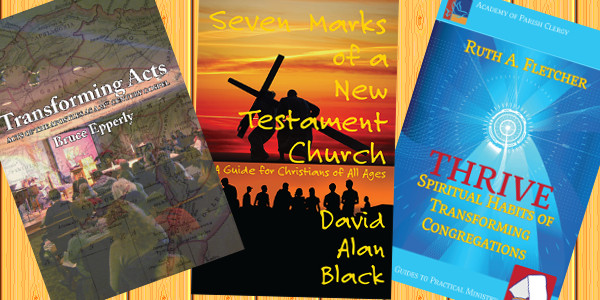
    nt church booksIn the video, Dave calls this simply “The Word of God.” I’m embedding it at the end of this post.

    9781631990465mOne of my observations in talking to people about their churches and church programs is that they find the first moment when a book or program differs from their situation and take one of two approaches. First, they might discard the entire thing. This is fairly common. That won’t work for us. It doesn’t matter that what we’re doing isn’t working either. Second, they try to follow the program precisely, despite any differences, because if it worked for the expert who wrote the book, it has to work for them.

    Neither of these is a strategy that is likely to succeed. Each person, community, church congregation, denomination (or jurisdiction within a denomination) is different. Each one will have different opportunities and perhaps a different call from God. I am passionately convinced that sharing the good news about Jesus with the world is our general calling. Whether that is going to involve a food pantry, classes, involvement in broader community outreach, collecting money for projects across the globe, or any one of a myriad of other possibilities, is wide open.

    Especially in protestantism we tend to downplay tradition, but our church tradition has a role. The way you will carry out certain missions is going to depend on the history of the church congregation. We don’t all get her in the same way, and we’re not going to move forward in the same way. Dr. Ruth Fletcher, in her book Thrive: Spiritual Habits of Transforming Congregations devotes an entire chapter to choosing, to the necessity of discerning the right path and making and carrying out decisions.

    The reason I wanted to emphasize this right now is that quite frequently we think we cannot benefit from something like “apostolic teaching” or “the Word of God” unless we absolutely agree on what it is and how we’re going to deal with it. But just amongst the books that I publish, we have Dr. David Alan Black, a Southern Baptist Greek teacher (and full-time missionary, he’d insist!) and Dr. Bruce Epperly, a United Church of Christ pastor, seminary professor, and a process theologian who are both going back to the same place: Acts of the Apostles. Now I’ll tell you that if you read both of their books, something I urge you to do for reasons beyond the fact that I publish both, you’ll find quite a number of things they disagree on and quite a number of points of different emphasis. But in a church that is often drifting and dying while repeating the same behaviors that led it to its current malaise, that one similarity is enormous. Let’s look back at the early church. Let’s ask what made Christianity what it is. Perhaps there is something there that would help us.

    Now one interpreter might be looking for a definitive, apostolic pattern to apply and follow. Another might be looking for a series of commands that one can carry out. Another might be reading the story and asking how are stories might relate. Yet certain things come out of such a study, and certain things result from going to the source.

    I’m very protestant in ethos. I’m not at all interested in things like apostolic succession, in the sense of a series of people who had hands laid on them by a person who had hands laid on them leading back to the apostles. But I’m very interested in seeing what those early apostles did. I’m very interested in connecting my story to theirs. There is nothing about that process that is mechanical or that allows me to depend totally on someone else’s work.

    Dave makes this point in the interview as he talks about us teaching one another. Why am I comparing what Dave has said with what two other authors have said? Is it so that I can sell more books? Of course I want to sell more books. I’m never going to lie to you and tell you I don’t care about selling books. But that’s not the key reason. I started publishing to do this. I wanted us to teach one another, to do on a broad scale what Dave is talking about in the local church (where I also want to see it done). I want is to help one another learn. I hope we find ourselves challenged.

    There is nowhere that I want to see this more than in our use of the Bible. How is it that we can begin to see more of this individual Bible study in the church? And let me specify here by “individual” I mean “individual in community.” Let’s avoid two serious errors: 1) That Bible study is individual without any community control or involvement, and 2) That Bible study is a communal affair that can be handled by an expert passing out information. The reason I named a series I publish “participatory” in spite of the number of people who thought that word was too long, is that it is individuals participating in community who have the best possibility to find the message for themselves, their churches, and their communities.

    Ruth Fletcher comments on this. Note how she doesn’t propose the same type of study for all types of churches.

    Even though this is an age when people care more about what the church does than what it believes, transforming congregations know they must lessen the gap between people’s experience of God and the church’s teaching about God if the church is once again to become a reliable source of wisdom. Beliefs matter. Transforming congregations that are creedal churches help individuals discover a deeper truth in the words they recite; those that are non-creedal churches create safe space where individuals can work out their own guiding beliefs. They create space within their own tradition where people have the freedom to honestly express doubts, to say what they do not believe, to ask questions that don’t have predetermined answers, and to wonder about the mysteries of the universe. (Thrive, p. 91)

    Bruce Epperly has a similar idea:

    The first followers of Jesus “devoted themselves to the apostles’ teaching and fellowship, to the breaking of bread and the prayers.” They were a church whose spirituality was truly holistic. They prayed and they studied, and discovered study was a form of prayer. We need thinking Christians, who take theological reflection seriously, who ask serious questions, and challenge unhealthy and superficial images of God and human experience. (Transforming Acts, p. 48)

    If you think the various visions are distant from one another consider this: What would happen to the church in America if we were to focus on studying the early church looking for insight into how to be a church following Jesus in the world today? I think that a number of wonderful things might happen despite how we decided to approach the question and the hermeneutical principles we took to the effort. Do I want us to debate such hermeneutical principles? Absolutely! The do make a difference. I think one of the greatest things we can do is to consider and discuss that issue seriously. But if we started at that point, we’d already be devoting ourselves, in our own limited ways, to the apostles’ teaching. Wouldn’t that be a good thing?

    The section on this mark in the video begins about 15:30. I’m not setting the video to the starting point, as I suspect most who are willing to invest time in the video will watch it as a whole once.

  • Seven Marks: Baptism

    Seven Marks: Baptism

    nt church books(This continues a series that started here, and continues with part 2, part 3, and part 4.)

    The second mark of a New Testament church according to Dr. David Alan Black is Christian baptism. He explains why he explicitly uses the term “Christian” with baptism. There’s a distinction there that’s important and Dave discusses it. Here’s the video. The discussion of Christian baptism begins at about 08:45.

    There are several things that Dave says about baptism that I fully agree with. He believes in baptism by immersion of believers, i.e., people who make the choice to be baptized. He also believes baptism should immediately (or very closely) follow the decision. I also, however, believe that this is an area on which there should be a great deal of tolerance for differences.

    For example, I attend a United Methodist congregation. The norm is to baptize infants and then confirm them as youth. I grew up in a church (Seventh-day Adventist) where one dedicated children as infants and then baptized them when they made their own decision. I made my decision to be baptized at age 9.

    While I strongly prefer one option, and many of my reasons are the same as Dave’s, I am quite able to be a member of a church where the practice is different. I would note that the United Methodist Discipline does allow for baptism by immersion, so a United Methodist pastor can practice believer’s baptism by immersion. He or she could not, however, refuse to perform infant baptisms, at least as I understand it. I know that some Methodist pastors are quite dogmatic on the point. My preference would be to see a quite open choice. For example, if a family prefers some kind of baby dedication, where is the problem? Again, I also know a number of Methodist pastors who would go along with that.

    I’m going to refrain from arguing the biblical material on this. I think Dave has gone over that quite well, and in this case I am substantially in agreement.

    Let me bring in short quotes from our other two authors.

    Ruth Fletcher brings in a completely different issue that may cause some concern to United Methodist readers, or those from any other church that has a fairly high view of sacraments. I’m quoting from Thrive, page 141:

    As the church finds its way into the future, the role of clergy will shift even more than it already has. Although some ministers will preach and lead worship, many will give their time to training lay people as worship leaders and small group facilitators. Although some will offer pastoral care, that care will extend beyond the members of the church into the neighborhood. Although some will teach, that teaching will focus on equipping individuals to serve in various roles both inside and outside the church. The sacramental tasks of baptizing, leading in communion, presiding at weddings and funerals increasingly will be shared with people beyond those who are ordained.

    Here I would have to say two things. First, I personally don’t see that baptism should require an ordained person. Second, as a member of a community that requires that an ordained person carry out any baptism, I will not put my first belief into practice. That is a matter of submission to the community. While I would forcefully argue for and even insist on using the community’s permission with regards to the method and time of baptism, I would also argue that where my community has a firm position, I should, as a member, live in accordance with that rule. Nevertheless I do believe that every member should be in ministry, and that ordination should not be reserved for one gift or set of gifts but should be for all. We should lay hands on and commission every member to minister using their gifts.

    Let me continue with a slightly longer quote from Bruce Epperly in Transforming Acts (p. 85):

    Such dramatic experiences – whether evangelical or mystical in nature – are not normative for all Christians. Some of us are born Christian. As cradle Christians, we are dedicated or baptized as infants, and then grow in grace not by drama but through a gentle, day to day walk with God. Nevertheless, most of us eventually face moments in which we have to say “no” to one way of life – or certain behaviors or lifestyles – to say “yes” to another.

    Providence is both gentle and dramatic. We can experience God, while we are playing with our children and looking across the table at a beloved spouse or friend; we may also discover God in the storms of life, helpless yet saved by a power beyond ourselves.

    Third, Paul’s Damascus road experience invites us to connect our spiritual experiences, whether at worship, at camp, or on the road, with discovering our vocation and mission in life. Paul is clear that his mystical experience was not an end in itself, but an invitation to a new self-understanding and vocation as God’s messenger to the Gentile world.

    Bruce is talking about the dramatic conversion experience of Paul, which relates in some ways to baptism. Numerous times I’ve encountered people who do not remember a time when they did not know Jesus. They don’t recall a particular decision moment, because they were believers from as early as they can remember. In some ways, my own view of baptism as a thing to be chosen by believers relates to my own experience. I grew up in a Christian home, but I distinctly remember the time when that belief became mine rather than someone else’s. It was no longer my parents’ faith. It was mine. That was at my baptism.

  • Yet Again Hebrews Authorship

    9781938434730sIn September of 2013 I published a book titled The Authorship of Hebrews: The Case for Paul by David Alan Black. It has been interesting to read material on this topic since. I would note that while I believe Dave’s case is well presented, and was convinced by it to give more room to the idea of Pauline authorship, I have not been convinced to abandon my agnosticism on the authorship of Hebrews.

    Today my attention was drawn to two more posts. The first is by Dave Black, which I copied to the Topical Line Drives site to create a permanent link (Dave’s blog doesn’t support this). It’s a short comment, but makes clear Dave’s view that Hebrews is not so anonymous as one might think.

    The second post is by Kyle O’Neill (HT: Thomas Hudgins), who favors Apollos or Aquilla and Priscilla.

    There is a broad consensus among scholars that Paul did not write the book of Hebrews. There is no similar consensus about who did write the book. There’s an easy explanation, however, for the difference between these positions. It’s simply the view of the authors in question of the external evidence. Is the testimony of the early church fathers reliable on matters of authorship? While there are some disagreements about precisely what each church father said (Dave Black provides his own translations of many of these references in his book), in general if one is prepared to accept the testimony of the early church fathers, one is likely to accept Paul as the author of Hebrews.

    On the other hand, if one favors internal evidence over this external testimony, one likely will not favor Paul. Note that I do not mean here a simple differentiation between how one favors internal over external evidence, such as one might have in textual criticism. In this case, we’re looking at specific testimony with specific issues. How much could each witness have known? To what extent are they reporting hearsay? To what extent might they be trying to shore up the claim of Hebrews to be scripture? So one can have a general position favoring external evidence on many other topics, but nonetheless not have the same emphasis with regard to authorship.

    In my view, if we did not have the testimony of the early church fathers, nobody (or almost nobody) would assign Hebrews to Paul based on the internal evidence. But I also believe that if you don’t accept the testimony of the early church fathers on this point, there is no basis to claim any particular author for the book. The problem with determining authorship based on internal evidence is that you must have a body of material with known authorship with which to compare the book. Of the proposed authors of the book of Hebrews, only three have a significant body of written material, Luke, Paul, and Clement. For others, such as Apollos or Aquilla and Priscilla, we have no written material, and precious little biographical information. It is always possible that one of these many candidates wrote the book, but the evidence just isn’t there.

    That’s why, having decided that there is enough internal evidence in the book to question Paul’s authorship, I do not propose an alternative. I don’t know who wrote it. I realize there are answers to the difficulties with Pauline authorship, but in my view it seems that there’s just a bit too much to explain away. It could be Paul, but then again, not so much.

    It’s interesting how strong the consensus against Pauline authorship has become. I would think that there would be a greater body of argument in favor of the testimony of the early church fathers. A very slight swing in favor of that testimony would probably shake the consensus quite substantially.

  • I Know Less about Prayer than I Used To

    Today I extracted a paragraph from David Alan Black’s blog (I have his blanket permission), just so I could comment on it. He notes:

    I often ask myself, How can I write anything about prayer? I’ve still got so much to learn about it!

    I am in sympathy with his comment. My wife and I have taught seminars about prayer, and we’ve both written about it as well, both on our blogs and in print. But the more I’ve taught about prayer, the more convinced I’ve become is that the most important thing to do is to unlearn things that I think I already know. Communion with God is not something that can be reduced to science. You won’t have a good prayer life because you follow a formula, however complex and all-encompassing that formula may be.

    This doesn’t mean that you never learn anything from others. I’ve learned many things from others about prayer. Yet in most cases, that learning has involved unlearning something else, removing the limits that I have placed on the way God can and will work.

    Abraham had a mighty interesting prayer life. He argued with God about Sodom. When asked to sacrifice his son, he didn’t argue with God, and I wonder if he was supposed to have done so. He tried to lie his way through various situations, and God worked with him despite that. Abraham, of course, had no concise printed guides to how to pray. Amazing how well that worked.

    I’ll keep teaching about prayer. I may even write more about it. But at the same time, I hope what we all do is clear away all the barriers we have to just getting in touch with God.

    I look forward to seeing Dave’s chapter on prayer. I know the furnace in which it is being forged, and I expect the Lord to do great things through Dave’s pen (and keyboard).

  • Speaking of Dying Churches

    Speaking of Dying Churches

    9781893729568sWhat should a church that grows out of the New Testament witness look like? Dave Black posted a list of items on his blog today, and I, with his blanket permission, extracted the list to the Jesus Paradigm web site. (The site supports Dave’s book The Jesus Paradigm, which I publish.)

    I hope you will go read, think about, and then discuss the ideas Dave presents. They’re similar to the ones he presented in his book. I’d love for you to read the book as well. It’s available in print as well as for Kindle, Nook, iBooks, and Adobe Digital Editions. My greatest disappointment as a publisher is not when a book doesn’t sell or sells poorly, though I want books to sell well, but when a good, challenging book doesn’t reach as many people as I think it should. The Jesus Paradigm is a book that I think has reached far fewer people than it should.

    Now when I say reached, I don’t just mean that people have bought the book, or have read it, or even have agreed with it. What I mean is that people have thought about it. Do you disagree with some of Dave’s points? Fine. Discuss! Much more importantly, do! If a few of us in the church would do more and talk less, it would be great. Talking and listening, writing and reading are great and essential. But action based on good listening, reading, and thinking is better.

    My fundamental idea in choosing what I publish for Energion Publications is to ask whether it will drive people to think and study, and then hopefully to put something into action. I think the most important element of learning to study the Bible is actually doing it. I think the most important aspect of mission and ministry is doing it. That’s why I’m delighted that so many of the Energion authors are active in ministry. One of my authors (my mother) is 94 years old and is still active in the mission of her local church. She gives the children’s stories and she’s involved in sewing, knitting and quilt making in service for the poor. Incidentally, she’d agree with the point Dave makes about having all ages together in the church. What about you?

    9781938434648sIn addition, this is why I have a diversity of authors. Contrast Dave Black with Bruce Epperly. I publish books by both. They both are or have been seminary professors. One is a Southern Baptist, the other United Church of Christ. But Dave wrote The Jesus Paradigm and Bruce wrote a study guide to Philippians that actually has the audacity to suggest we should be applying a bunch of what Paul says to what we do in our local congregations. With that start, I’m hooked on both. Now I’m editing Bruce’s forthcoming book Transforming Acts, in which he again has the audacity to suggest looking back at the early church to see how we can transform the church now.

    Do these books or these authors agree on everything? No. But they’re both taking the step I would like to see readers of this blog or of their books take: They’re looking to the source and listening to the Spirit and asking what this means for the church today.

    This post has a somewhat commercial sound to it, and I don’t deny I hope to sell books. But these aren’t the only people thinking about this and taking action. Our pastoral staff at First United Methodist Church in Pensacola have decided to focus on preaching from acts for the seven weeks leading up to Pentecost. What a wonderful way to spend the season of Easter and prepare for Pentecost! Dr. Wesley Wachob is teaching Wednesday evening classes from Acts. He’s preparing a study guide to the book for me to publish. I’m excited about that opening as well.

    And I suspect each of you have Bibles as well. Turn to the book of Acts as a starting point, read it, and ask yourself how you can build God’s kingdom. Let me suggest that it wouldn’t be a program, a system, or a denomination. Perhaps it will be people on fire, speaking in many languages, in many ways, in many places.

  • Of Evangelism, Missions and Other Bad Words

    The tragedy of the American church is that we have the greatest resources ever in the history of Christianity and for the most part we’re sitting on them, doing nothing. When we are doing something, most of what we do is for ourselves.

    The question, I’m told, is what we should be doing and how we should be doing it. A close second is how we motivate people to go into action and do whatever it is we should be doing.

    But I think that’s the wrong question. If we’re going to be Christians, we know what we’re supposed to be doing, and it falls somewhere amongst the bad words I use in the title. The gospel commission in Matthew tells us to go and make disciples. It is repeated elsewhere in the New Testament in different words, but the essentials remain.

    This is why I continue to insist on using the words “evangelism” and “missions” no matter how bad they may sound to some people. I’ve been told that I will turn people off by doing so. I’m well aware that there have been many things done under the heading of these words that have likely driven people away from Christ rather than drawn them to him.

    There have been missionaries who spread a “gospel” of American culture rather than the Gospel of Jesus. There are been those who were very destructive to those with whom they came in contact. I’ve seen the occasional distant look, or heard the silence when I tell people my parents were missionaries. But I can tell you that my parents carried medical care and the love of Christ where they went, not American culture. The word (“missions” or “missionary”) is not the problem.

    Similarly I continue to use the word evangelism, proclamation of the Good News. There have been many whose “good news” was that the hearer should come to my church, follow the norms of my “church culture,” and pay tithes into the church budget, thus avoiding hell. But that isn’t the Gospel, and we know it, whatever we may practice.

    I have had a number of conversations with pastors who told me their churches looked good on paper. They had the right numbers. But at the same time, these pastors told me, things were not going well. The church wasn’t carrying out its mission. People were not becoming active.

    There’s a great debate amongst Christian scholars as to whether missions should consist mostly of care for the physical needs of people or whether it should be primarily about their spiritual needs. The big problem here is that the debate is often conducted between people who are actually doing neither one. More importantly they represent groups and denominations who, in overwhelming numbers, are doing neither.

    I would like to suggest that we don’t need a change of words. I want to say we need a change in the way we understand those words, and that our understanding should turn back to scripture. But that would be to get back into the very same debate. What I really think we need to do is replace the words with actions.

    We often think we need to straighten out our beliefs first, and then base our actions on right beliefs. I believe that in many cases this process needs to be reversed. Obey the obvious commands, and the more obscure ones will begin to fall into place.

    I was showing a pastor from overseas around the Pensacola area. He was a very activist evangelist in his homeland. He had planted many churches. He had built orphanages and schools. He had carried out both the mandates of caring for people’s physical needs and also addressed their spiritual needs. As we were driving he suddenly said to me: “You know, Henry, how you can hear the voice of God more often?” “How?” I asked. “Just obey what you’ve already heard and you’ll hear more from God.”

    I think that could apply to following the commands of God received through Scripture. How can I learn more of God? Act on what I have already learned.

    That isn’t a command for pastors, teachers, or for those who own publishing companies. It’s a command for all Christians. I often tell people that all Christians are witnesses. The question is what type of witness you’ll be. Will you be a good witness or a bad one. Even if you just warm a pew you are a witness. The testimony you give in that case is that Jesus is really not that important, and can be ignored by people who have serious things to do.

    To be a missionary you have to go. It may be a few feet. It may be a few thousand miles. If you’re a missionary, you’re also going to be an evangelist. You’ll be proclaiming good news. It’s a commission you get when you accept Christ in the first place. If you’re part of the church, you’re called.

    Will You Join the Cause of Global Missions?Because of this, I’m delighted that my company, Energion Publications, has just released a new book, Will You Join the Cause of Global Missions? by David Alan Black. I try to write a few notes on each book I publish. I view my business as a ministry, and there is a reason for the manuscripts I choose to publish, a reason beyond whether I think I can sell them. In this case I wanted to give some of my own thoughts on missions before discussing the book.

    For this book I’ve worked closely with the author and planned the way we’d publish and market it to make sure we can offer it for the lowest price possible, especially in quantity. It’s just 32 pages including front and back matter. Quantity prices at Energion Direct get this down to $3.24 each if you’re ordering 50 or more copies. (I’ll tell you why you want to order in quantity below.) But right at the moment you can beat that price through B&N, which is still (February 9, 2012) offering the book for just $2.57.

    Why do I emphasize the price? Because we’ve pared this price to the bone to make the book as accessible as possible. Over the next few days watch for a Kindle edition, and we’ll follow that shortly with one for the Nook. The Kindle edition will be sold for just 99¢.

    So why buy this book in quantity?

    To put it simply, this isn’t a book for you to read and put on your shelf. It’s a challenge to action, and it’s a tool for Christians to use in leading other Christians to become active. Let me quote a few lines:

    “If churches in America were truly committed to the Great Commission, it would show in a lifestyle that matches our response to a lost and dying world” (8).

    “The most important principle to keep in mind is to employ material things for the kingdom of God rather than for ourselves” (9)

    “Kingdom Christians have found the pearl of great price. Like Jesus, they refuse to separate doctrine from practice, word from power” (10).

    “Under God’s great grace, we are called to be one with one another. What can create this kind of community? Community cannot be preached. It can only be practiced and the place to start is with oneself” (16).

    Now those are little snippets taken out of the context of a carefully planned presentation, but I think they give a taste.

    But the book ends in an unusual way. It asks you, the reader, to sign on the dotted line. Will you join the cause of global missions? If so there is a specific commitment, and a place to sign and date your commitment.

    Dave is a Baptist, and I’m a Methodist. I’m sure someone will find something “Baptist” about this book and point it out to me. That will be an excellent sign that they haven’t gotten the point. There is nothing in the commitment requested in this book that I, as a Methodist should not already be committed to. Dave doesn’t tell you in this book just what mix of social, physical, and spiritual you’re supposed to try for.  The Holy Spirit will guide you in that. And I’m convinced that, as that visiting pastor once told me, if you obey the clear things you already know, other things will become much clearer.

    This isn’t about denominations or the numbers on church rolls. It’s not about the amount of money in the offering plate. I believe all of those things will be impacted by our obedience to the gospel commission, but I believe it is dangerous to make material things the goal. This is about being sent into the world as the Father sent His Son.

    If you need a copy of this book to evaluate, let me know. If you’d like a copy to review, let me know that as well.

    But above all, act on what you know.

    Enhanced by Zemanta
  • Dave Black on Greek Study Resources

    Dave Black suggests ten books for studying New Testament Greek during 2012. Four of these are on my regular list and a couple more are on my reading list. I might work on a list of my own when I’m back in Pensacola with my library. I’ve extracted the list onto The Jesus Paradigm since one can’t link to a particular post on Dave’s blog.

    One book I’m reading currently is Dave’s Linguistics for Students of New Testament Greek: A Survey of Basic Concepts and Applications. Thus far I highly recommend it. I’ll review it here when I’ve finished reading it.

  • Equipping is not Delegating

    I just put an extract from Dave Black Online on The Jesus Paradigm. (I have permission to do this.) Unfortunately, Dave’s blog doesn’t allow linking to a specific entry, so I’m linking to the extract. All I want to say here is “Amen!”

  • Dave Black Has a Question on Ministry

    The Jesus ParadigmYou can find the full context at The Jesus Paradigm (extracted from Dave Black Online). But here’s just the question itself:

    When will appeals for vocations to the ministry end? And when, in their place, will the church encourage all of its members to seek God’s will for the area of ministry in which they can most effectively be used by Him?

    Good question. But before I look at it, it brings up an interesting phenomenon I’ve noted in the church. My wife was mentioning to me how every pastor she has ever talked to about testimonies in the church service (having someone other than the pastor talk a bit on Sunday morning) says it sounds like a good idea. (Hint: Read 1 Corinthians 14.) Yet nobody ever actually does it.

    Similarly in youth ministry, I’ve encountered many, many people who think young people should be more involved in the church in general, including leading and speaking, but it rarely happens. I recall one church that agreed generally in a meeting that the young people should be made welcome in the service with the adults and allowed, even encouraged to speak. But it didn’t actually happen.

    Thus back to the call to ministry. I can’t remember anyone I’ve talked to who doesn’t agree that every Christian is called to ministry, to service. There’s some disagreement as to the distinction of different calls, for example, is a call to full-time ministry substantially different from a call to teach Sunday School? But when it comes right down to it, much of the ministry is done by the professional staff.

    I recall a conference at which my wife Jody and I were both speakers. The other speakers, three of them, were all ordained. We were teaching about prayer. During the last session, the local church pastor made a call for people to come forward for prayer, and invited the pastors to come forward and pray. Odd, isn’t it? Is prayer a function of the ordained clergy? It reminds me of a former bishop here who was speaking at our church. He remarked that he really loved to have people praying for him who weren’t paid to do it!

    In the Methodist church we have a long, daunting process through which we put young people who are “called to ministry,” but we’re pretty random about anything else. When I first discussed how I could serve in the United Methodist Church, already equipped with an MA in Religion, the only thing the pastor could think of was to become a candidate to be a pastor. When I pointed out just how little my training or gifts had to do with pastoring a church, he had no idea what to do. I worked at it and found a place, but the church as a whole didn’t know what to do with me.

    Then there’s the multi-page survey, which is not necessarily a bad thing, but cannot possibly be the only thing we use to get people involved. Some people won’t identify their own gifts. I wouldn’t have checked a box for children’s ministry, for example, yet I’ve been invited to teach the third grade class at my church twice so far this year, with good success. (If you know me, you’ll realize that all glory for that must go to God. It’s a miracle!)

    I think there would be an incredible transformation of the church if we just began to do the things we all know we ought to.

    So I have a different question: Why is it that we don’t do these things that we’ll all generally agree we should do?


    Enhanced by Zemanta