Threads from Henry's Web

Tag: David Alan Black

  • Translating Puns

    Translating Puns

    Dave Black’s intermediate Greek grammar, It’s Still Greek to Me, is scheduled to be translated into Arabic. One of the features of that grammar is some of the humorous headers that are English puns. Dave wonders how those will be handled in translation.

    Anyone have suggestions? (Only humorous suggestions need apply!)

    While I publish many of Dave’s books, this is not one of them. The booklet with a very similar name, It’s All Greek to Me, is Dave’s brief biography/testimony, and I do publish that one.

    (Note: The featured image was generated by Jetpack AI, and one should not consider it to represent any puns, or likely anything else!)

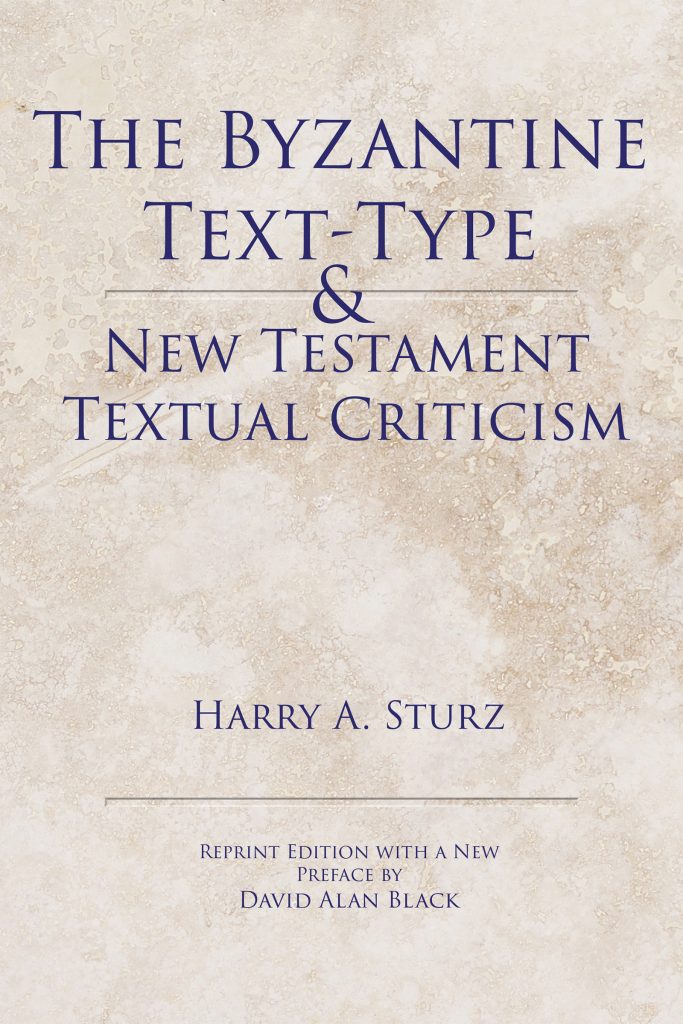
  • Book: The Byzantine Text-Type & New Testament Textual Criticism

    Book: The Byzantine Text-Type & New Testament Textual Criticism

    In my business role as president of Energion Publications, I’ve just cleared the proofs for the release of the book The Byzantine Text-Type & New Testament Textual Criticism by Dr. Harry Sturz. This is a reproduction of the original book, released in 1984 and is produced under license from HarperCollins Christian Books.

    Note: This discussion is not intended for experts, but for people who have only occasional contact with New Testament textual criticism. While I have studied textual criticism, I am not a specialist in it by any stretch of the imagination.

    We have thousands of manuscripts of all (a few) or part (many) of the New Testament. In preparing a Bible translation, translators must make choices of which manuscript readings they are going to use.

    It’s easy to overestimate the problem here, because significant and/or doubtful variations form a very small part of the New Testament text. Nonetheless, in public discussions, the variants get all the press, because we like to find things that are different, and therefore more interesting.

    One thing I learned early in studying textual criticism was that manuscripts should be weighed, rather than counted. What does this mean and how does it work? Well, in general textual critics divided manuscripts into three large groups, which were named for regions associated with them, though actually divided by characteristics of the text. We had the Western text, associated with Rome and parts west, the Alexandrian, associated with Alexandria, Egypt, and the Byzantine text, associated with the eastern church.

    The vast majority of surviving manuscripts are of the Byzantine text-type, largely due to history. The church survived much longer, and many more copies were made in the east. In addition, a great deal of manuscript production in the west was in Latin. I’m brushing past a number of factors, but the bottom line is that there were more Byzantine manuscripts.

    In the 19th century, and somewhat into the 20th, there were a large number of manuscript discoveries, or rediscoveries, which produced texts that differed from the common texts found in the majority of the manuscripts. These newly-found manuscripts were older, in general, than the existing manuscripts, and in many cases included readings that scholars thought were more likely original. This produced a strong swing in scholarly work toward the text in these newly discovered manuscripts. The Alexandrian text got a lot of attention, with the western text following not far behind. A theory developed that the Byzantine text was the result of a major editorial effort, that produced a single, new text.

    As a result, two things happened. First, the Byzantine text was considered generally more recent than those newly discovered manuscripts, and second that it was likely to have readings that were essential 4th/5th-century revisions. At most, it could reflect essentially one manuscript.

    Opposed to this general consensus, on which the text of most modern Bible versions has been based, was the view that the reason we had more Byzantine manuscripts was that the text was actually better preserved there, so that it should be preferred, and manuscripts from the other text-types should be considered some sort of aberration.

    Dr. Sturz argued that the Byzantine text-type could and did preserve older readings. It was not to be preferred over all others, but its readings should be given due consideration in all cases. He provided evidence that many Byzantine readings show up in early papyri, showing either that if there was any unifying editorial process, it had not been one that erased all of the prior evidence.

    The general result of accepting Dr. Sturz’s argument is to improve the evidence that we have for determining the text of the New Testament, as well as change the weight we give to various sources.

    I am glad to be able to release this important book and make it available at a reasonably price again. On the Energion Publications retail site, it will be available for $22.99 (suggested retail 24.99) through Wednesday, which is the official release date.

    Below is an interview I conducted with Dr. David Alan Black (who wrote the preface to the new edition) and Dr. Abidan Shah.

  • Authorship of (Pauline) Epistles

    Authorship of (Pauline) Epistles

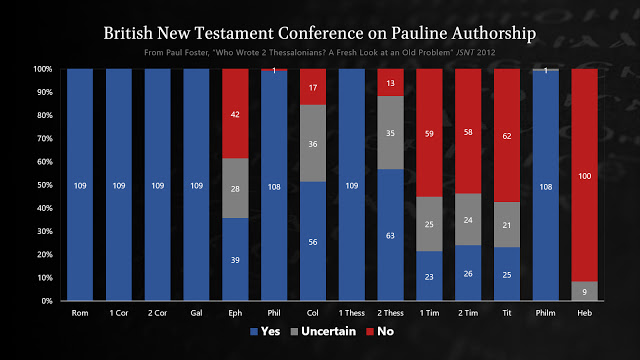
    Evangelical Textual Criticism has a post with the following graphic:

    Data collected by Paul Foster at the 2011 British New Testament Conference
    (Hat Tip to Peter Gurry on Facebook)

    While I imagine there might be minor variations in a survey of American scholars, I think the results would be similar.

    It’s always fun to see the numbers on Hebrews, since I would describe myself as uncertain (with the nine and not the 100), but also publish the book The Authorship of Hebrews: The Case for Paul by David Alan Black, which argues forcefully for Pauline authorship.

    I remain unconvinced of Pauline authorship, but Dave did more to move the needle for me than anyone, and I believe he argues his case in exemplary fashion, which is why I published the book.

  • Reading, Studying, Discussing, Teaching, and Proclaiming but not Practicing

    Reading, Studying, Discussing, Teaching, and Proclaiming but not Practicing

    I was struck by Dave Black’s note on Hebrews 4:14-16 from Wednesday on his blog. I extracted it to jesusparadigm.com, as Dave’s blog is a journal that doesn’t offer links to individual posts. (I have his permission.)

    I highly recommend his post. It struck me because Hebrews is such a central part of my reading and study. There are those who claim I can’t get through an hour of study, no matter what the subject, without referring to the book of Hebrews. Within Hebrews, 4:14-16 has to be one of my most quoted passages in the book.

    Dave talks about not going to our great High Priest first. That really struck me, because I think I don’t either. The other day I woke up in a cold sweat because I had dreamed about something critical going wrong. Now I’m working through quite a number of things that can justify worry, in a normal sense. I was telling Jody about my “awakening” and she just said, “Next time you wake up in a cold sweat, just remind yourself that Jesus has it all under control.” Jesus says, “Can anxious thought add a single day to your life?” (Matthew 6:27 REB).

    I don’t intend to do less. But I’d also like to worry less. None of the problems I’m facing have been alleviated by my worry. Not one.

  • Tuesday Night Study: Genuine Relationships

    Tuesday Night Study: Genuine Relationships

    Our study continues tomorrow evening with a look at chapter 4 of Dave Black’s book Seven Marks of a New Testament Church, “Genuine Relationships.” In this chapter, Dave discusses the church as community. I wrote an extended post on it when I was blogging through the book some time ago. I recommend reading that, and paying particular attention to the definitions provided by Ruth Fletcher. I’ve quoted a key line in the featured image, but in that earlier post I quote more and discuss at greater length.

  • Following the Path of Jesus

    Following the Path of Jesus

    On January 1 God called two texts to my attention as themes for the year. They are Philippians 1:27-30 and Ephesians 5:1-2. I haven’t said a great deal about this, though the theme of those texts has shown up in a number of posts. Then yesterday I saw Dave Black’s latest translation of Philippians 1:27-30, which I like a great deal, and I wanted to mention it. Reading a text in a modern, clear, might I say dynamic, rendering brings it home. Here’s the translation:

    Now the only thing that really matters is that you make it your habit to live as good citizens of heaven in a manner required by the Good News about Christ, so that, whether or not I’m able to go and see you in person or remain absent, I will be hearing that all of you, like soldiers on a battlefield, are standing shoulder to shoulder and working as one team to help people put their trust in the Good News. Don’t allow your enemies to terrify you in any way. Your boldness in the midst of opposition will be a clear sign to them that they will be destroyed and that you will be saved, because it’s God who gives you salvation. For God has granted you the privilege on behalf of Christ of not only believing in Him but also suffering for Him. Now it’s your turn to take part with me in the life-or-death battle I’m fighting — the same battle you saw me fighting in Philippi and, as you hear, the one I’m fighting now. (emphasis mine)

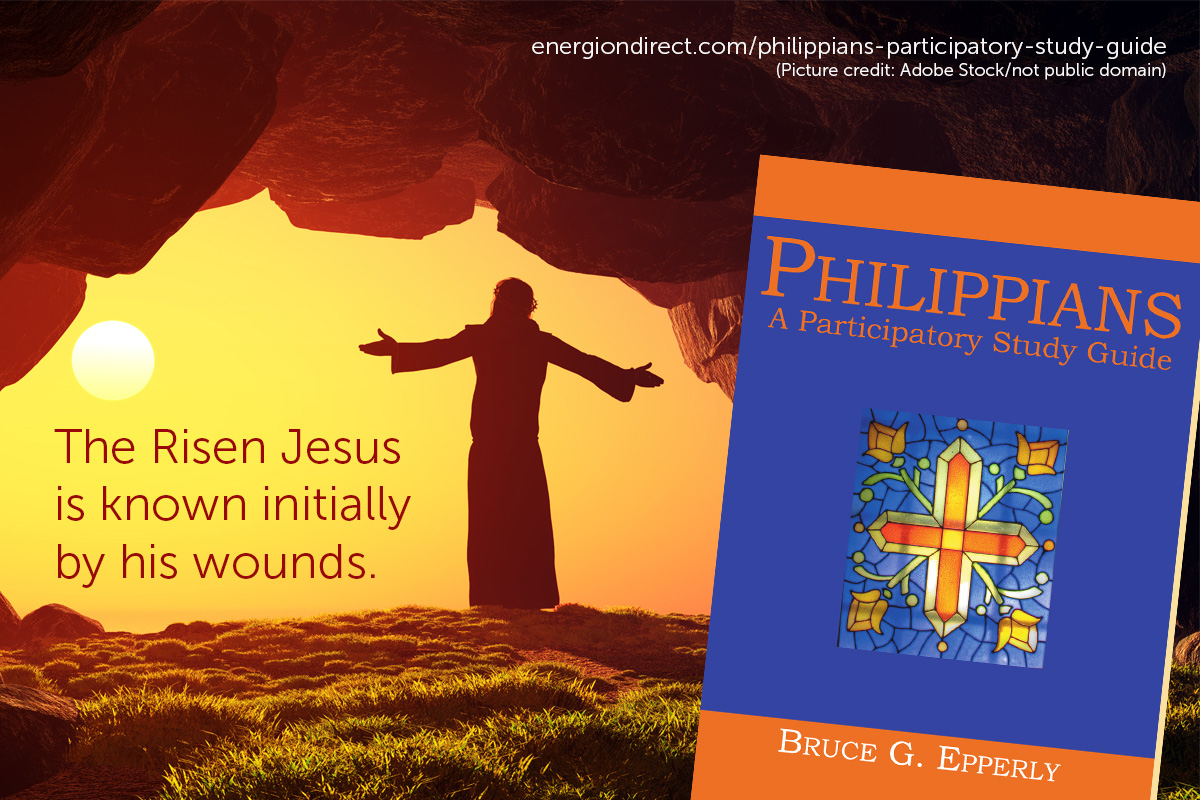
    This emphasized line led me to a quote from Bruce Epperly’s book Philippians: A Participatory Study Guide:

    Even now in our time, we can take confidence in Paul’s assertion that God is with us and that, in life and death, and celebration and persecution, Christ sustains us. We are resurrection people. But, our lives are also cruciform or cross-shaped. The Risen Jesus is known initially by his wounds, and we too may experience suffering and loss as a result of our relationship with Christ. Still, at the end of the day, integrity, fidelity, and the promise of resurrection life far outweigh any trials of this lifetime. – p. 19

    Bruce also quotes the song “I have decided to follow Jesus.” It’s a good song, but it’s one that should be very hard to sing. No, not musically, but due to meaning.

    (I must note here in passing that I love to use materials that come from very different theological streams. It is especially important, I think, when people from opposite sides of the spectrum agree fully on the meaning of a text, even more so when that text says something people would often rather not hear.)

    On the night when Jesus was betrayed, there were twelve people (at least) who had decided to follow Jesus. One betrayed him. One denied him publicly. The rest “advanced in the opposite direction.” We can take hope from the fact that so many found their way back!

    Ephesians 5:2 similarly gives us a hard call “walk in love.” Now we like that, because we often call very unloving things “love.” But the verse goes on “just as Christ loved us and gave himself for us. We have a very clear pattern for what love actually means. I’m a love proclaimer. I believe in the power of love. The reason love so often seems wishy-washy, that it so often fails, is that what we call love is often partial. It is not commitment, but rather a sort of generic liking. That’s why the key to following Jesus is not the experience of miraculous physical acts, or wealth, or healing for everyone in sight, or healing of all our emotional ills. The key to following Jesus is the willingness to take up the “privilege” of suffering for him.

    This, I must confess, is not the true story of my life. Nonetheless, just as I can travel northward by using the pole star as a guide even though I’ll never reach it, so I will keep facing this way, and trust in the grace of the One who gave himself first.

    (Allow me to call attention to two previous posts: God Perfected through Suffering and Thankful for the Gift of Suffering for Jesus?)

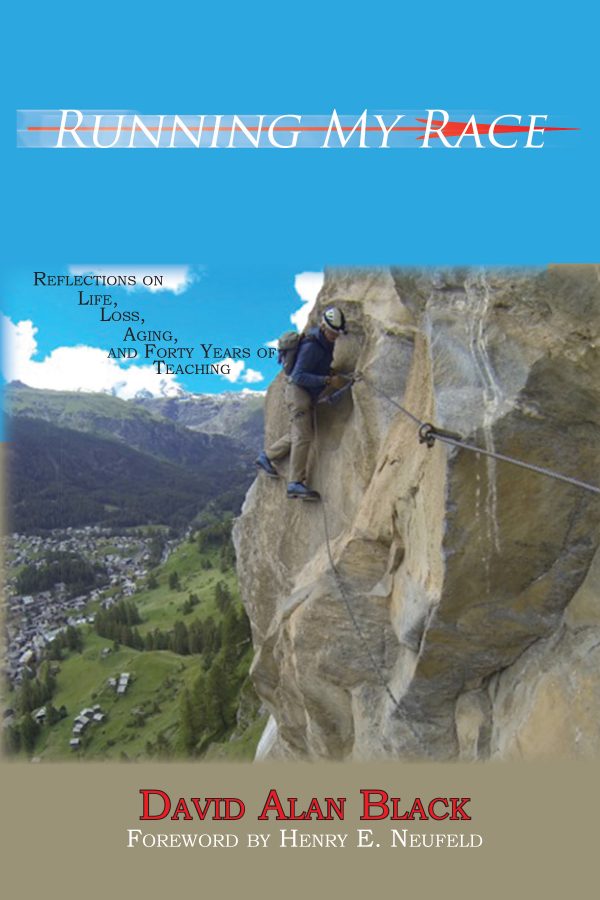
  • A Good Book Review – Running My Race

    A Good Book Review – Running My Race

    A good book review is not one that says nice things about the book, although nice is nice, so to speak. I occasionally read a positive review that makes me wonder whether the reviewer read the book. There are likewise negative reviews that make one wonder. As a publisher, I must take all these in stride.

    A really good review, however, is one that shows the reader read the book and also got from it something the author and publisher had hoped to get across.

    Thus a review of Running My Race (David Alan Black) on The Tired Blog. I was feeling fairly tired today, and then I read this review. It really cheered me up. If I can publish a few books each year that make readers uncomfortable, then I’m doing my job.

    Of course, as publisher I’d also like to note that Running My Race is a good book! 🙂


  • Dave Black on the Election

    One of the things that has disturbed me most about this election is justifications of bad behavior by those who claim to be conservative Christians. No, this is not behavior exclusive to them, but in this election it has been particularly clear. It was surprising to me. People I thought were truly about moral and ethical behavior, even if I often disagreed with their positions, have seemed to throw those positions overboard in exchange for the possibility of political power.

    One person who has stood apart from this trend is my friend (and Energion author) David Alan Black. Dave reacted in a blog post today. Always gracious, yet firm, I strongly admire his principled, consistent position. With his [blanket] permission, I’ve extracted the post (his blog doesn’t facilitate linking to a particular entry) onto JesusParadigm.com. I chose a title for it: We Can Be the People Who Tell the Truth.

    A taste:

    … How can we defend a so-called “Christian” America that is hypocritical, homophobic, anti-immigrant, sexist, and bigoted? We can’t. Nor can we invoke a social gospel that ignores the personal gospel of faith in Christ….

    Read the rest.

  • Seven Marks: Fervent Prayer

    Seven Marks: Fervent Prayer

    nt church booksThe sixth mark Dave discusses in Seven Marks of a New Testament Church is fervent prayer (pp. 39-42).

    There are a variety of views of what it means to be “the church” or what it means to be Christian. For some, it’s a matter of holding the correct set of beliefs. One knows that certain things are true and one gathers with other people who know the same things are true, and this is church. Evangelism, in that case, is convincing other people that the things one believes are true and thus they should join this group.

    I exaggerate a little bit here to make a point. I think prayer brings out a problem with this view, and it’s one that has been building through Dave’s book. Notice that all these marks of the church are activities. Dave quotes Acts 2:37-47 on pp. v-vi of his introduction. You might want to read that now. Notice that the description of the church is active. God is acting in the church and so are the people.

    Now I don’t want to suggest replacing believing or knowing with doing. Doing must result from knowing in some sense or from instinct and habit. Even the idea that doing is important involves thought and belief. Often, however, we can tell more about what we actually believe by what we do than by what we claim.

    I recall going to teach about prayer at one church. The prayer coordinator was dismayed at the low attendance of the conference. She told us that the church had determined that prayer was their second priority. In that case how could so few people attend a conference on prayer scheduled by their prayer ministry?

    The answer, I suggested, was to observe what people did, and particularly how money was spent. In particular, look at your property. How is it arranged? What have you spent money on? How much of your money has gone to sports facilities? How much to education? How much to outreach?

    Now I absolutely don’t want you to read that as a negative view of sports facilities. Used well, sports facilities can be a critical element of outreach, and in turn a focus of prayer. The question is what you are actually doing.

    In fact, the measurement of the commitment to prayer should not have been attendance at a prayer conference, but rather time spent in prayer, a prayerful attitude, and ultimately establishing lives of prayer. A conference might help that. Since I have offered a few, I’d like to think so! But one can spend amazing amounts of time in a conference on prayer without actually praying. One can have a nice looking prayer ministry, while neglecting prayer.

    Do we really believe in prayer? I’m not asking what miraculous things prayer can bring, but rather whether we believe prayer can provide communion with God. That, in turn, leads to asking whether we believe God is active in our lives, our churches, and our communities.

    The evidence of prayer in the American church suggests that we don’t. We may believe in prayer as an occasional spiritual discipline on the one hand, or as a means of pushing God into doing things that we want on the other, but as a means of communing with God, either we’re not sure it will work, or not sure we want it.

    Dave talks about an “attitude of prayerfulness” (p. 40). Such attitude is a reflection of belief and practice.

    I want to illustrate this by quoting from one of the other books I’m following through this series:

    Some congregations make a decision by voting; but many churches learn to choose through the process of discernment. Discernment, as it is used in everyday language, has to do with sifting through the information we’ve been given in order to decide a course of action. In the church, discernment describes the prayerful process of making a choice in light of the inspiration, leading, and guidance of the Spirit.

    Discernment can be practiced by individuals or by groups. When transforming congregations make use of discernment as a decision-making tool, they place their choices in the context of God’s transforming activity, assuming that they are called to something larger than self-interest and partisanship. Through discernment, they imagine not just what they want to do, but how they might share in God’s New Creation through the choices they make. (Thrive, pp. 126-127)

    This is a test for belief and practice. Can and will the Spirit guide our discernment? Will prayer help us in discerning what the Spirit is doing and where we can become part of that activity?

    There is a huge difference between having a short prayer at the beginning of a meeting in which you then carry out the normal business of debating (or arguing) and then voting and one in which one seeks to hear the Spirit and come to a consensus. The latter requires a certain amount of trust!

    In discussing the early church’s beginnings and prayer, Bruce Epperly (Transforming Acts, p. 26), under the heading “Don’t Do Something, Wait Prayerfully” says,

    In the wake of the ascension, the apostles return to their meeting place and, for the next several days, constantly devote themselves to prayer. We don’t know the nature of their individual prayer practices. They may have been a blend of quiet contemplation, praise, intercession, celebration of Jesus’ last supper, and thanksgiving. But prayer was their priority as  a community before they undertook any action. They knew that God’s power was coming, and also knew that power without prayer is destructive to us and others.

    “Power without prayer is destructive.” I fervently agree. Fervent prayer is a critical mark because it sets us up for everything else, just as it did the early church.

  • Seven Marks: Christ Centered Gatherings

    Seven Marks: Christ Centered Gatherings

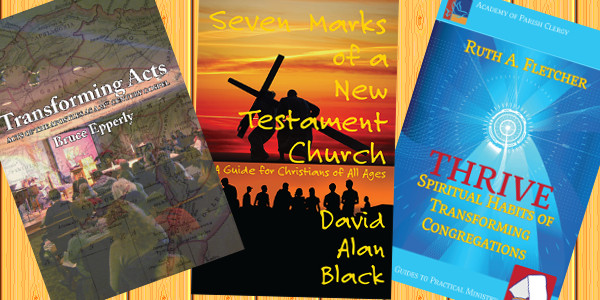
    nt church booksIt has been some time since I posted my last installment of my discussion of the book Seven Marks of a New Testament Church by David Alan Black, along with some commentary from the books Transforming Acts: Acts of the Apostles as a 21st Century Gospel, by Bruce Epperly and Thrive: Spiritual Habits of Transforming Congregations by Ruth Fletcher. My most recent installment was actually an excursus, Is There Such a Thing as a New Testament Church?. (You can find most entries in the series by searching for the words “seven marks.”)
    9781631990465mI find this topic as a whole, and this chapter in particular, are examples of a topic where we should read material from people outside our own tradition. We need to strip away some of the “stuff” that has gathered in our denominations and churches that keeps us from being Christ-centered. It’s easier to be building-centered, tradition-centered, or us-centered. All three of my authors suggest things that would take us away from those three centers and ask us to seek what is Christ-centered.

    Dave Black cites “They devoted themselves to … the breaking of bread.” in the heading to this chapter and indicates he sees this as a reference to celebration of the Lord’s Supper (also called Communion or the Eucharist). I was interested in how many references I had to choose from in all three books. One of the key points Dave makes is this:

    And how often was the Supper observed? If we compare Acts 20:7 (“On the first day of the week, when we came together to break bread….”) with Rev. 1:10 (“On the Lord’s Day….”), it seems that it was observed every Lord’s Day, that is, every Sunday. (p. 33)

    Of course, the frequency is not the most important point. I would suggest that the most important point is that this is something instituted by Jesus which calls us to remember his incarnation and sacrifice for us. It centers the act of worship around the person of Jesus who is, or should be, the center of our faith and worship. Thus, “Christ-centered gatherings.” Now there is more than performing a certain ritual to a Christ-centered gathering. In fact, if your communion service is just an act of ritual, you may well have a problem in your church. Let me bring in Ruth Fletcher on this point:
    ThriveBecause individuals who participate in the worship life of transforming congregations will have an active daily prayer life, images and words they encounter in the corporate worship will connect them with experiences of the Spirit they have had during the week. A phrase in a song, in a reading, or in the proclamation may well remind them of a time in which they experienced a call upon their lives, a clarity of purpose, or an impetus to take compassionate action on behalf of someone else. Those moments of resonance will be what infuse the worship service with a sense of integrity and power.

    Worship in transforming congregations will offer reminders of what the congregation is trying to become. (p. 134, emphasis mine)

    I would note that Dr. Fletcher is part of a denomination that practices communion on a weekly basis at every worship service. The question here is the next step. Why is it that we want to have Christ-centered gatherings? I think it is because of the last line, which I have highlighted above. We come together to center ourselves on Christ, and thus to prepare to be the body of Christ in the world when we leave in whatever way the opportunity presents itself.

    This is critical: If your worship service is not leading you to service, to acting as the hands and feet of Jesus, to being a witness, and to proclaiming the good news, it can hardly be Christ-centered. Certainly we focus on Jesus, but if we do so simply to get a dose of “specialness” for ourselves, to satisfy our own emotional, spiritual, and social needs we will fall short. By this I don’t mean that our spiritual needs are unimportant. They are, in fact, critically important. But they will never be satisfied unless we carry what we experience in worship out to wherever it is we go during the week.

    Now think of your last worship service. How much of the “worship service” led to actual service out in the world? I suspect that it cannot be real worship in the sanctuary of a church unless it leads to the presence of Christ, through you, outside. We tread the room in which we meet as a sanctuary. It even has some architectural similarities to a temple. But it is each one of us as a group, no, better, as a community, who is filled with the Holy Spirit and called the temple of the Holy Spirit.

    I would say that communion then is:

    • Christ-commanded
    • Christ-centered
    • Christ-commissioned

    And we are the body of Christ, commissioned to be his body in the world. What better way can we have to remind us of this than to participate in communion?

    I would like to suggest further that communion, and likely church fellowship in New Testament times was not a large amount of liturgy with a moment when a small piece of bread is provided and dipped into wine or juice, for that one moment of “communion.” Rather, when the saints gathered, they shared a meal. Many of our churches are too large to share a meal on this basis, and that in itself may be a problem. Large churches, of course, can have small groups that gather and have this type of communion. If we are to spur one another on to good works (see Hebrews 10:24), we need to see one another, hear one another, and know one another. In such a circle we can draw our community together and prepare to extend our circle.
    9781938434648sBruce Epperly notes:

    The story of Philip and the Ethiopian eunuch reminds me of the origins of the American denomination, the Christian Church (Disciples of Christ). From the very beginning, Disciples of Christ have practiced open communion and have been a model for the ecumenical movement’s communion hospitality. In the early nineteenth century, Thomas Campbell, a newcomer to the United States from Ireland, was appalled by sectarianism among religious groups in the new nation. Even Presbyterians from different sects would not take communion with one another. Inspired by his vision of the New Testament church, Campbell welcomed everyone to the Communion Table. “Don’t fence the table,” he proclaimed. “Anyone who seeks to follow Jesus as the Christ is welcome, regardless of denominational background.” As early Disciples of Christ proclaimed: “We have no creed but Christ.” Our unity in Christ and our allegiance to Christ compels us to expand the circle of his love to include everyone. (p. 78)

    I think that there should be nothing that does not lead us forward into a new sense of mission. But what happens in our churches? Do we feel a welcome such that we are nearly compelled to share this with others? Some may object that the call is not to the church, but if the church (building) is where the church (the body of Christ) meets, then should it not be inviting people to it as Jesus did? When Jesus Christ was here in the body, people flocked to him. He didn’t have to hunt for them because there was something there that they wanted.

    We need that attractiveness and welcome in the church. Not the excitement of new glitzy programs, entertainment, and excitement, but the welcome that says that here is a place where the longing of my soul can be satisfied. Here there is not just a building but a community of people whose unity and love for one another is so special that I want to be a part of it, and that they welcome me to be a part of them.

    I’ve met people who want to be prophets. Some have asked me to pray that God would call them as such. I always ask them if they are aware of the kind of life led by prophets in scripture. Is this what you really want? Similarly we need to ask ourselves about being the body of Christ. If our gatherings are Christ-centered, they will not be “me-centered.” If we are to be the body of Christ we must remember what happened to the body of Jesus, the Christ. Then, as we look to close our doors to those in need, even to our enemies, to those who hate and would kill us, we need to remember who it was that He gave his life for.

    Christ-centered? We need it. We claim to want it. Do we want it enough?