I never met Dr. John Sailhamer, but I appreciate scholars who propose and support theories that are substantially out of the ordinary. I don’t mean crazy, just creative and risky. I found out recently that he has passed away.
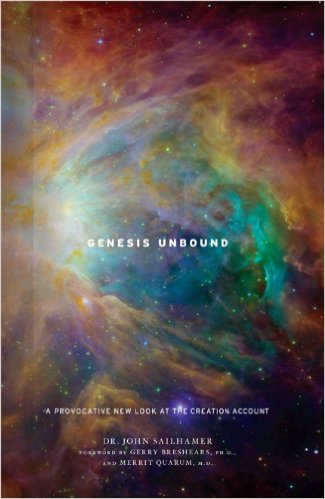
In celebration of his life I’d like to link to my review of his book, Genesis Unbound. At the time I reviewed it, it was unfortunately out of print and I’m glad to see that a new edition was published in 2011. I’m showing a link to it at the left of this post.
This is among the books that I strongly recommend that anyone involved in debated issues of creation or with an interest in it should read.
Evolution is one of those issues we often don’t discuss in church. There are actually quite a number of Christians who accept evolutionary theory in general or just a part of it, but quite often they just don’t want to get into the kind of acrimonious debate. Every so often (really quite rarely, all things considered) I’ll get an e-mail from someone who found my e-mail address on the list of board members for Florida Citizens for Science, and they wonder how I can be a Christian and be on that list. That is, unless they simply assert that I must not actually be a Christian. (This is a rambling post. [Which of mine aren’t?] Toward the end I do get around to referring to the SDA church in which I grew up and the UMC, where I currently hold membership.)
Now this post is more about “openly discussing” than about evolution as such. I grew up in a conservative Christian culture (the Seventh-day Adventist Church), in which it was one of the articles of our faith that we accepted the literal creation week. As a result of that, and of the resistance I met when I started to see things differently, I grew up with the impression that conservatives want to close off conversation while liberals were open. Each group was, after all, treating me in that way.
But the more I have experienced the world, the more I have observed two things:
Any entrenched group will tend (or at least have a strong temptation) to exclude outlying opinions
Outlying groups, especially those that actually have some traction, will tend to feel excluded even if they aren’t
The fact is that no matter how energetically we may work to be totally open, no discussion can take place on a completely unlimited field. Not all boundaries are limiting boxes.
A few years back I was teaching a Sunday School class and one of the members asked me to meet with him to discuss the future of the class. He wanted us to study eastern religions. I told him that I had no problem with the class studying eastern religions if that was what they wanted to do, but they’d have to get a different teacher. “Why?” he asked. Well, I explained, there are two reasons. First, I know very little about eastern religions. Second, I’m a Bible teacher. That’s what I do. He was quite surprised and told me that I didn’t really need to know much about eastern religions in order to teach it for the class.
That attitude is more common that you might think. On the one hand we have the idea that issues can only be discussed by a very highly qualified group of experts, and outlying opinions, those contrary to the majority position, should shut up and go away. That attitude can lead to stagnation. But on the other hand we have the view that all opinions need to have an equal place at the table, no matter how poorly supported they might be. This is another attitude that will prevent progress, this time by creating chaos and wasting time.
We live in a kind of tension between these two ideas. For example, I believe that creation vs evolution is a perfectly valid subject for discussion in the church. The debate on the interpretation of Genesis is alive and well, and carried out by highly qualified scholars in the appropriate fields. I think that there is really very little actual scientific debate on this same controversy, because I don’t see creationists doing original science that can actually challenge the various facets of evolutionary theory. I see some picking at this or that, but nothing one can get one’s teeth into. But I’m not a scientist, and I’m not qualified in any of the fields in question, so my opinion on that point isn’t particularly important.
What I think we should work toward is a creative tension between consensus and new ideas, between open discussion of all views and perhaps more productive discussion between people who are more selective. I think this sort of discussion is well served by a variety of confessional, non-confessional, and secular schools, whether the topic is religious or not. I regularly hear complaints that certain sectarian institutions should be shut down because they are too closed in their confession. I disagree. As long as those who attend know what the principles of the school are, and graduates are functional in the subjects they learn, I think that’s an appropriate way to add variety.
The problem is that “functional” is defined by too many people as “accepting what I already believe.” As an example, I hear from advocates of the historical-critical method in Bible study (and with some caveats I count myself among their number), that one isn’t “qualified” in biblical studies if one doesn’t “know” something so obvious as that there are three Isaiahs. But what if one knows that this claim is made, and knows why, but doesn’t accept it? One can be so absolutely certain of one’s scholarly conclusions that one cannot imagine an intelligent person disagreeing.
Conservatives will doubtless nod and agree, but from them I hear that if someone can’t make a good argument for the 6th century dating of Daniel, or for the Mosaic authorship of all or part of the Pentateuch, that person doesn’t really know what she or he is talking about. Or perhaps the secularly educated scholar doesn’t truly understand Calvinist theology. Or Arminianism. Whatever.
My suggestion would be that if all your knowledge comes from one source or type of source, such as all your academic ideas are those favored by the school from which you got your degree, you may be a bit narrow. And that means that the simple fact that your college is confessional on the one hand, or very secular on the other, doesn’t mean you’re ignorant or closed. Ignorance and closed-mindedness are cultivated attitudes. Especially in modern America, you have no excuse not to know how the other side thinks.
You also have a variety of avenues to challenge the other side, so you don’t really have an excuse when one school or organization doesn’t like your ideas and tells you to hit the road. I may not like it. I too have an ideal academic environment, one in which serious scholars who disagree are welcomed irrespective of confessional statements. But that’s my imaginary ideal. I think I got a rather decent education from confessional schools that were closed in many ways I wish they were not. But they were nonetheless good schools.
All this blather has been leading to two links with quick opinions on my part. The first comes from a Seventh-day Adventist source, in which an SDA writer responds to some claims of supposed challenges to evolutionary theory. It’s in Spectrum Magazine, titled Dangling or Not? A Response to Chadwick and Brand. This article critiques another in which creationists see some new scientific discovery challenging the foundations of evolutionary theory. Just as I’ve been hearing all my life that the end of the world is upon us because of some recent story in the news, so I have been hearing that evolutionary science was on life support due to some new discovery. I’ve become just as jaded to both. But this story takes place in an organization that really doesn’t want to open the door to full discussion of this issue. Being an advocate of evolutionary theory in the SDA educational system is unlikely to be good for your career prospects.
On the other hand we have the UMC general conference. Now in religious terms, as I’ve said, I see creation vs evolution (though I don’t see the two in conflict), as a valid debate. Amongst the advocates against evolutionary theory is the Discovery Institute. Before you read the rest of this, you should know that I truly dislike the Discovery Institute. I think they largely make what should be scientific and theological questions into political ones. But just because I don’t like them doesn’t mean they shouldn’t be heard in the church. Yet according to this article from UM-Insight, they were denied a booth at the UMC General Conference. Why? Because they are not in accord with our social principles. Hypocrisy anyone?
I recall when I first joined a United Methodist congregation, I asked the pastor if I had to affirm the social principles. He said, “Those? We don’t pay much attention to them.” I know a number of Methodists who would object to his saying that, but what he says is very accurate. The social principles are a box that few would like to be confined in, yet that provide an excuse for many things. Advocating to change them is a recreational sport. If the GC venue was running out of space, you have to exclude someone, but this is a particularly thin excuse. There are plenty of United Methodists, though presumably a minority, who would be sympathetic to the institute’s work. Many of them live in this area. I disagree, but in the church they should have a voice.
We’re starting a new series of posts on the Energion Discussion Network and the current author is my friend and Energion author Dr. Herold Weiss. He’s the author of the book Creation in Scripture, the first in a series discussing creation from the point of view of those who accept the theory of evolution. That note should tell you that Dr. Weiss’s work can be controversial, as are all discussions of this topic.
I don’t happen to like the terms generally used, but it is generally somewhere between frustrating and futile to try to change language. “Creationist” has become the label of those who believe in a recent (read 6 to 10 thousand years) creation in a literal week, while “theistic evolutionist” labels those who believe God is creator but that the process of evolution is how he has chosen to diversify life here on this planet.
Dr. Weiss does something in his first post in this series that tends to annoy creationists (using the definition above). He calls their view unscriptural. The typical view of a creationist is that their view is scriptural while the theistic evolutionist has chosen to ignore the Bible in favor of evolutionary theory. No matter how strong the evidence for evolution (and they will, with few exceptions, maintain that it is weak), they would not see how it could override the Word of God. So the argument, at least as they generally present it to me, should be couched in terms of their strong convictions about scripture and the weak convictions of the theistic evolutionists, which are to be defended.
But neither I nor Dr. Weiss thinks our position is biblically weak. In fact, I did not change my view from a young earth creationist, which I was until some time during my third year in college, because I had studied evolutionary science. My science requirement was fulfilled in a chemistry class, taught, by the way, by a young earth creationist. It was in doing research for a paper that I found that I could not reconcile the biblical texts on the basis required for young earth creationism. The starting point was chronology, and it wasn’t even comparisons with archeology. It was simply looking at what must have happened between two points in the biblical story, and determining that it was beyond extremely improbable; it was impossible. And further, there was no report of some sort of miracle to connect the dots.
From there the question changed for me. Why is God presenting the story in this manner? (I’m ignoring here all the things I have come to believe about biblical inspiration over the years and discussing my thinking at age 20.) From there I started to ask just what it means to me that God is the creator and how that doctrine reverberates through scripture.
And this is what I think creationists can learn from Dr. Weiss. No, I’m not suggesting they will all read his book and decide to become theistic evolutionists. He isn’t even trying to make that case in the book, and I know my own views would be unlikely to change in reading one book. What he does that is important is look at how creation, and its implications, is presented in various parts of the Bible. Creationists seem to me to be hung up in Genesis 1-3, important chapters to be sure, but not the only thing in scripture on the topic. And yes, I do think these chapters are important, even foundational, even though I read them differently. And no, I’m not claiming that creationists are ignorant of all other passages. What I’m suggesting is that they are not brought into the discussion enough.
Too much of the debate about creation and evolution is concentrated on when and how and too little is focused on so what now?.
I think it would be great if we spent more time on the third question. Yes, we’d still disagree on when and how, and we’d still argue that both of those questions impact the answer to the third, but we might have a chance to shed a bit more light. I think Dr. Weiss has facilitated that.
I commend Creation in Scripture (note that I’m the publisher, so that’s likely!) because it looks at multiple views of creation in scripture. Each of these viewpoints can help us understand something about God the creator.
Here’s a YouTube of Dr. Weiss talking about God the creator and creationism:
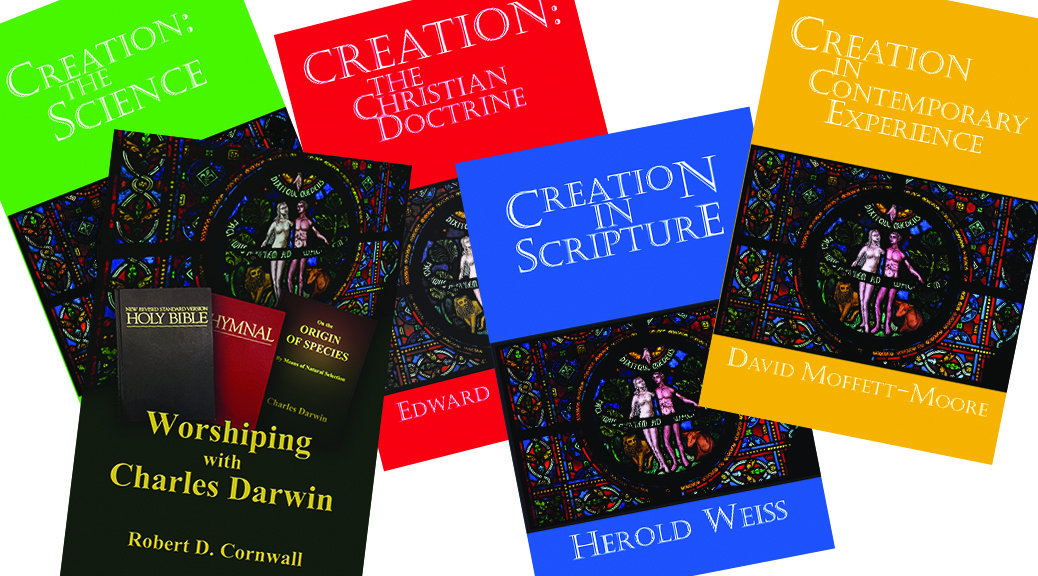
I’ve been promoting the creation book set from my company, Energion Publications. The authors of this set of books all support the theory of evolution. In fact, the contribution made by these books, I think, is that they are talking about how we should live in light of a belief that the “how” of creation, at least with respect to life, is by means of biological evolution. (This could have been a post over on the Energion company site, but since it’s also so much about my own beliefs, I thought I’d post it here.)
Here’s a clip:
Herold Weiss is a biblical scholar and is talking about creation and creationism from the biblical and theological point of view. It was his book Creation in Scripture that got the book set started.
“For creationism I have no use.” I publish that. I’m also a known advocate of excluding creationism from the public school classroom. I’m a board member of Florida Citizens for Science. So we know where I stand on the issue. I’m a theistic evolutionist, though I don’t like that term.
So would I publish a creationist book?
Short answer: Yes.
Now for the longer answer.
I’m often asked this question by people who wonder just how far to the liberal side of the spectrum I’ll go in terms of publishing. In this case, considering how strongly I’m identified with one side of the issue, we have the opposite question.
The easy way to figure out the general answer to this question is to read the company’s short doctrinal statement. As you read that statement, remember several things:
Energion Publications is not a church. Nobody is asked to sign or affirm this statement
We judge manuscripts, not authors. I have been asked about things an author said on his web site and whether they “fit.” That’s not my concern.
There are many issues of definition in even that short doctrinal statement. For example, amongst our authors we have quite a number of definitions of what the word “inspired” means with relation to scripture.
It does provide a general guide to let us focus on an audience
Having said that, if a book falls within that statement, we’ll consider it. Does creationism fall within those parameters? Absolutely.
So the longer answer is again, yes. But remember that this openness to publish covers a large number of other issues as well.
Why are all our books on creation written by those who accept theistic evolution? Again, a simple answer. Those are the ones that were submitted and accepted.
Aha! A snag! What our hypothetical questioner would probably like to know is whether this manuscript, the one he or she has in hand, expending from days to decades, would be considered for publication and what its chances would be. Would the fact that I have a firm position on the issue prejudice me against that manuscript?
Without doubt my beliefs influence what I do. But one of my beliefs is that the best thing to do with theological disagreements is to discuss them, entering into genuine dialogue. I consider creationism to be a very live theological debate and one on which we should be having dialogue in the church. I think actual dialogue on this subject is rather rare, but I’m ready to promote it.
In fact, I see myself as a publisher in the role of an advocate for advocacy. So if I publish a book on creationism I will also put every effort into marketing it.
That doesn’t mean that I will bend over backwards to accept the first manuscript on the topic that I get. I have been studying this subject since I first learned to read, and so I have a very good feel for the literature.
Let me provide an example. Dr. Kurt Wise, who earned his PhD under Stephen Jay Gould at Harvard, is a creationist. He wrote the book Faith, Form, and Time. The link provided is to my review. It’s a good book. I disagree with practically every word in it. I don’t see those two statements as contradictory. I consider it the best statement of a Christian creationism as is available for a popular audience. Wise starts from the premise that Genesis teaches a young earth and a literal creation week, so we must follow from that point and discover the science that proves God right. I disagree with that premise.
If you can send me a manuscript that is as good as that one (good luck!) I’m bound to publish it. And there are lots of other manuscripts that would be good. For example, looked at from the point of systematic theology, how does a young earth or a literal creation week (or both) fit into a doctrinal pattern? What other pillars of the faith lean on those concepts? One could write some excellent systematic theology in that area, and consequently argue with our existing volume, Creation: The Christian Doctrine, which argues that those are not important. It happens I agree with the latter book, but that won’t prevent me publishing a rebuttal!
Now if I had a category for science, which I don’t, I would require that material in it be reviewed by qualified scientists. That would be another matter. I don’t think modern creationism has yet earned a place at the scientific table, and I’m not the one to offer that place. It must be offered by scientists who are active in their disciplines. I’d have a team of them as readers if I were a science publisher. But the biblical, religious, and theological debate is very relevant and active.
For those who are interested, I didn’t become convinced that the earth wasn’t young or that the creation week wasn’t literal by studying biology. In fact, I never took a college course in biology. I’m not going to judge one’s biological pretensions. Well, unless they violate elementary principles, that is. It was through study of the scriptural material that I became convinced it was not possible that God was intended to provide either the “how” of creation or the timeline of earth’s history.
There’s a great deal of open territory for studying biblical studies and theology involved in that!
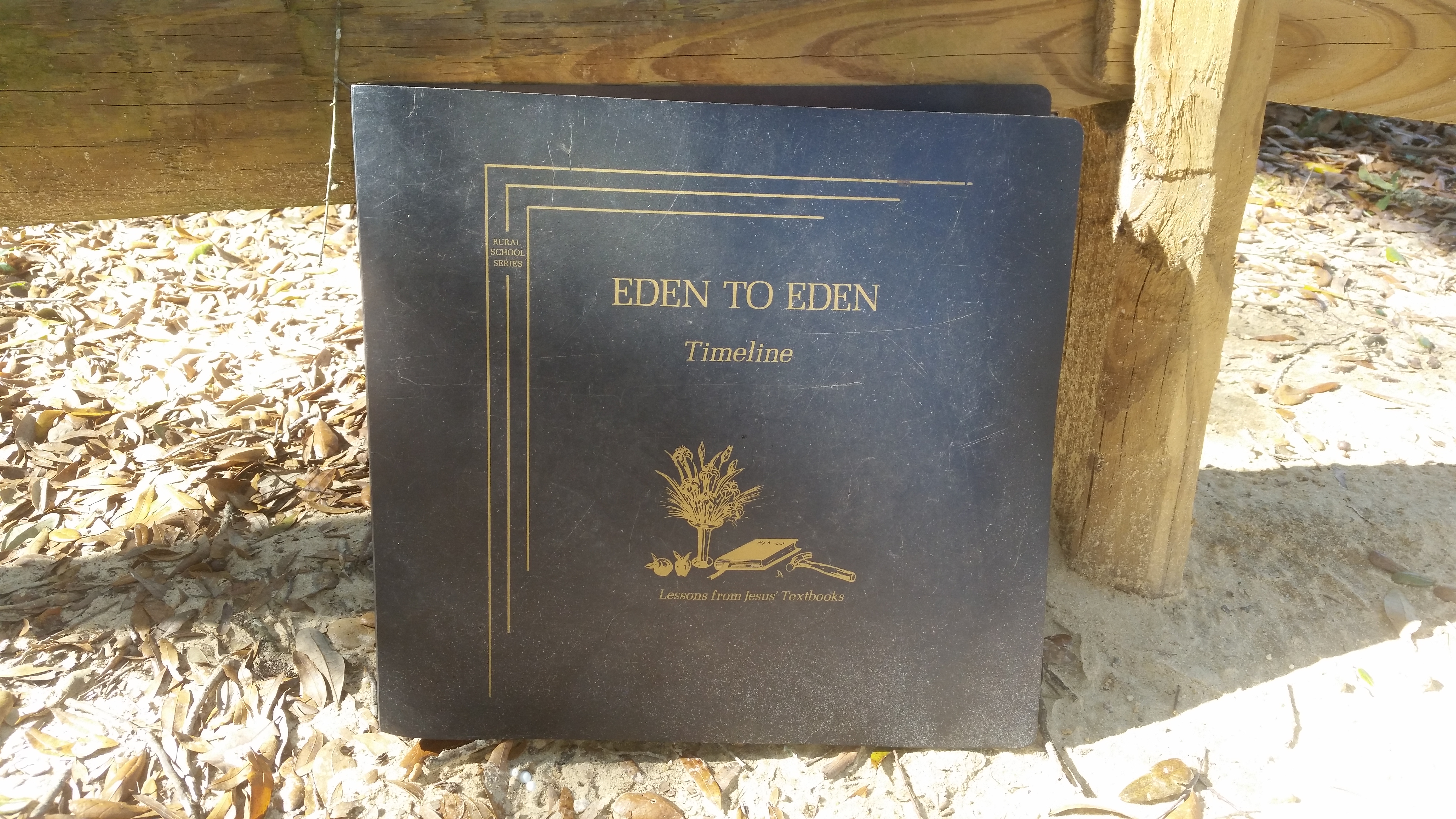
I can’t help but finish with some pictures that illustrate how thoroughly indoctrinated a creationist I was. These are pictures of the “Eden to Eden Timeline.” You can see in the second image that we were taught that the date of creation was 3957 BC, a correction of the more common 4004 BC. Students added pictures and colored maps as we worked our way through the Bible, entirely guided by this timeline.
The title indicates the topic. It starts with creation and ends with recreation. Everything is on a timeline, though the time of the final events is left open.You can see the date of creation represented here and also the proposed date for the end of this period with the flood.This shows how the timeline spread out. I did this outside by the fence, so it’s a bit scraggly. In our classroom we had the whole thing stretched out around the wall. Click on it for high resolution.
This event is not a debate about creation and evolution. While I vary the content from hangout to hangout, I avoid outright debates. Each of these authors accepts the theory of evolution but also believes that God is the creator. Dr. Herold Weiss started the series, which also includes Creation: The Christian Doctrine by Dr. Edward W. H. Vick, who is unavailable for this panel. What I have asked them to do for this panel is talk about how their beliefs about creation impact the way the read scripture, teach, worship, and live.
The YouTube embed to view the event is below. If you want to ask questions of the panel using the Q&A App, you’ll need to sign into Google+. There should be a link on the YouTube viewer at the time the event starts for you to do so.
I always find it interesting when Adrian Warnock produces a spectrum on some topic. I almost always disagree with some point on the spectrum, but the exercise is worthwhile. After all, if I produce a spectrum, there will doubtless be people who disagree at some point.
This time Adrian has produced a spectrum on beliefs regarding evolution. I think it generally covers the ground. At the same time, I think it skips over the majority of theistic evolutionists.
The reason may seem subtle, but I think it’s important. Adrian divides the theistic evolutionists between “passive” and “active” equating the latter with intelligent design. I have a couple of problems with that. First, I think natural laws are an expression of God’s will. That a law continues unchanged, or a process functions and finishes (if finishing is appropriate) does not mean that God is less active than when (or if) there is some sort of intervention. Thus God is not less active when he designs a process that works without active intervention than he is with something that requires him to step in from time to time.
Secondly, I think there is a problem with the concepts of intervention, active, and passive. God is. God is infinite (or something close enough we can’t tell the difference). In any case, in terms of interacting with the universe, God doesn’t have to prioritize. He isn’t less active one place than another. So the idea of God being active or passive is an effect of human perception. A process that continues consistently does not appear to require action by God, while one that varies or changes direction is more likely to seem to require such intervention.
Resurrection seems interventionist. Birth and death seems natural. To us.
The evolution of a new life-form seems “special” and perhaps to require intervention. The continued life of a single creature does not. To us.
I just don’t think there’s a real difference from God’s point of view, insofar as one can catch God’s point of view (not very far, I fear). My breath stops without God (Psalm 104:29-30). Gravity stops without God. When all of this works, it appears not to require God’s intervention.
I’m probably writing this too quickly (it’s Sunday morning), to be clear, but my point is simply that God is active whether the process he is using operates consistently and without identified points of intervention or whether (as in intelligent design) there are points at which God intervenes in some special way.
Otherwise, I love the spectrum. I’m glad Adrian included the ruin and restoration folks, who are often forgotten. I’m also glad he distinguished some nuances such as young earth/old universe, and “the earth is young but appears old” vs. “the earth is young and would appear that way if you got the science right.” (My descriptions, not Adrian’s.)
Andrew Wilson has a post on The Gospel Coalition (Voices) blog titled Why I don’t Hate the Word Inerrancy. In a certain way I have to agree with his conclusion:
But I don’t think the answer is to hate the word. If we were to abandon every word that had been tainted by poor use, we’d have to remove dozens of descriptors from our lexicon, beginning with “Christian”—only to find that the replacements we brought in were also sullied over time by clumsiness, groupthink, insensitivity, and arrogance. …
Just so! It’s pretty difficult to hate a word when the word hasn’t really done anything bad. It just fell into the hands of cruel people who have tortured it a bit.
But I still have to wonder about the value of the word in the first place. As a substitute for saying that God’s word is true, it draws much of its usage from the effort to narrow down the concept of what we mean by “true.” It ties truth to a collection of facts, to data, and not to the message. Properly interpreted, the message of the books of Kings in the Hebrew scriptures can be true without being accurate in every detail of the numbers. There are serious issues in the chonology of the divided kingdom, and resolving these is an interesting hobby, but it’s not really something that impacts the truth of the Bible message.
I think inerrancy, as used—and in effect a word is the way it is used—tends to put our focus on the wrong aspect of any story. It makes our first question be “did this happen precisely as stated?” rather than “what message does God have for me in this story?” That’s unfortunate.
I think there are worse problems for inerrancy than the ages and reigns of kings, but that provides a good starting point. Once we are past that, we need to look at how God communicates. How did God send us scripture? How did God cross the gap between infinity and our finite existence?
This is one of those questions that plagues discussion of topics such as the meaning of Genesis. I believe that God communicates to us in our language, and that Genesis communicated God’s message about creation to people who believed in an earth that was flat (though round, like a dinner plate), with the waters under and the heavens above. They also believed that earth was the center of the universe and had no concept of the size of the universe. In that context, God spoke about God’s involvement in human lives.
That means that the science of Genesis is doubtless in error, when looked at from our point of view. But it’s not in error by mistake. It’s in error intentionally. By God’s intention, not by the intention of the human authors who knew no better. It’s in error in the same way as my explanation of some technical topic might be if I presented it to a child.
And lest you get the idea that I think we are on a pinnacle or knowledge, I expect that, if the world continues and we don’t set ourselves back to the stone age through our own stupidity, people a few hundred years from now may consider our view of what the universe is like to be hopelessly primitive. They’ll look for new ways to tell the story of God’s involvement.
I don’t like the word “inerrancy” because it says that the Bible is going to mean what I think it needs to mean rather than saying that the Bible gives God’s message in the way that God wanted it to be presented.
As I read it, God did very little to scratch our modern itches.
There are few topics that get Christians more angry at one another than the subject of evolution. Those who accept a young earth (or young age for the universe) tend to think that those who accept the theory of evolution do it simply because they lack the faith to believe the Bible. To them, this is the first step toward rejecting Christianity and becoming an atheist. Those who accept the theory of evolution often think the young earthers are ignorant, perhaps willfully so. (All of this ignores the broad sweep of views between young earth creationism and a purely materialistic view of origins. There are many nuances on the line between the two. But that is a subject for another blog post.)
I disagree with both those viewpoints. Irrespective of my own beliefs (and I’ll get to those in a moment), I have met too many dedicated Christian believers whose faith is nurtured by Scripture and also accept evolutionary science to imagine that acceptance of evolution is necessarily the first step on the road to unbelief. I have also met too many intelligent and capable individuals who accept a young earth to believe that they are all ignorant or stupid. As a matter of principle, I never want to imagine someone is stupid because of their view on a single issue, nor do I want to think them immoral because of their view on one moral issue. Someone who is intelligent, competent, and functional, and yet believes something I find ridiculous, does not thereby become generally stupid.
As an example, my dad was a doctor (MD), and an excellent one. Yet he believed in a young earth and a literal creation week his entire life. I’m not going to go down the route of believing that he was somehow less capable of carrying out his profession in a competent fashion, which he did all his life, because of one issue. There’s the family connection there, but I know a number of other people in similar situations.
In spite of this, I am not arguing a middle of the road position. I have a firm position on creation and evolution. I was raised with young earth creationist literature. I devoured the literature written by George McCready Price and Frank Lewis Marsh, icons of my Seventh-day Adventist upbringing, as well as many others. I did not begin to doubt this view because of studying science. In fact, I changed my position through a study of Scripture. It all started when I wrote a college paper examining the text of the genealogies of Genesis 5 & 11 and looking at the resulting chronology. Archeology did enter into it, as I looked at the dating of events that would be required to match that chronology, but characteristics of the text itself first suggested that we did not have literal history there. Nothing I have studied since has changed my mind on that point.
But I’ve written on this subject many times before. Just try typing “evolution” in the search box. I’m writing this because I’ve just sent a book off to the printer titled Worshiping with Charles Darwin. That’s a provocative title. Carol Everhart Roper designed a provocative cover to go with it. That was intentional. It’s not actually the most controversial book I’ve published, even on this topic, but I’ve focused on the controversy. That’s marketing, but it also comes from conviction.
I look at this from two perspectives. First, as a Christian and a church member, I believe that this is a non-essential. That God is creator is an essential. How God created is not. I think we should have tolerance and respect in the church on this issue. But my belief in tolerance and respect does not mean that I don’t have a firm position on the issue myself. I believe that God is the creator of heaven and earth and that through the study of the world by the methods of the natural sciences we can learn how creation was accomplished and how the physical world functions. I believe we are in error both in theology and in science when we try to impose our theology on the findings of science. It’s bad theology because to claim that what we learn from the natural world is not reliable we make God a liar. It’s bad science because it imposes a conclusion prior to the data.
Thus I would be called a theistic evolutionist, though I object to the label. I am a theist, in that I believe in God. But my theism is not a characteristic of my acceptance of the findings of evolutionary science. Though I am strictly an amateur in any scientific endeavors, I do not modify the findings of science by saying “and God.” This is not because I do not see God in the natural world. It is rather because I see God everywhere in the natural world and not more so in one place or another. I do not see God more in my cat’s purr than I do in a pencil falling. Both things result from God. Science tells me how. Science does not discover God at some specific point. Science is studying God through studying God’s handiwork. But science does not improve its study of the handiwork by trying to pretend to find God at some specific point. That is why I don’t like linking the word “theist” to “evolutionist.”
But I also object to the word “evolutionist.” Evolution is not my philosophy. It is not my religion. It is not an article of my religious faith, though the fearless pursuit of accurate knowledge is. I am not an evolutionist any more than I am a gravitationist. I believe that gravity functions as science describes. I believe that evolution functions as science describes. I believe we will discover more about how each of these works. Neither gravity nor evolution is an object of my faith or trust. My trust in science is based on the method, a method that has proven functional repeatedly. It is not a matter of perfection either. Science will produce new results and alter previous understandings. But it has proven effective at correcting its own errors.
Now people who believe what I do about evolutionary science have tended either to keep quiet in church or to simply say that we believe the Bible teaches that God is the creator and the how doesn’t matter. I don’t agree with these approaches. What I think we need to do is think about how the discoveries of natural science impact what we believe about God and how they change how we tell the story of God the creator. Genesis 1 & 2 told the story to the ancients. We can listen in to that story and learn theology and generate our own liturgy. But I think to tell the story as faithfully as it was told so long ago we need to tell the story of the creator in the light of what we know about cosmology and origins. Belief that God has used evolution as the means of diversifying life here on earth, and presumably elsewhere in the universe, is not a withdrawal from an area of faith. Rather, it is a new look at the expanding story of God and our knowledge and experience of God. We need to tell that story faithfully and vigorously.
And this brings me back to the title of this recently released book. We could pretend that the discussion doesn’t matter, but that would not be faithful to the search for truth or to the integrity of the way we proclaim the gospel. I know of people for whom this issue has been a stumbling block. It’s time to talk about it openly. We’ve been arguing about it vigorously, but that’s not what I mean. We need to start looking at the implications and talking about how we tell the story of the gospel faithfully in the world God created and is creating. I think that is something worth celebrating.
Bob Cornwall has taken up one part of that task. I hope the conversation continues to grow.
My title is slightly modified from No Scientific Revelation in the Bible, posted by RJS at Jesus Creed, with links in turn to work by John Walton. I think this is an important point.
My argument since I was an undergraduate just trying to work my way through these issues, has been that if you can easily explain terminology used in terms of the cosmology of the time there is no adequate reason to try to read modern ideas into the text.
Some find every reference that might just allow them to sneak advanced scientific revelation into the text and try to claim that as evidence that the Bible writers had some advanced knowledge. But unless one makes a claim that is clearly different from what was commonly believed about the way the world works, and that claim matches later knowledge, there’s no basis to assume advanced revelation.
The Bible speaks within the world of its original hearers and readers. That shouldn’t be a problem for us. That is precisely what it should do. It’s our function to carry on the story in our world as we know it. Should the world carry on for so long, in another couple of millenia other people, who may know as much more about how the universe functions as we do compared to the ancients, will be telling the story within their context and their knowledge.
God didn’t intend to provide a science textbook, or a crib sheet for scientific advancement. I can make this claim because if God did try to do such a thing, it was a miserable failure. I prefer not to call God a miserable failure.