Threads from Henry's Web

Tag: creation

  • Psalm 119:25 – In the Dust

    Psalm 119:25 – In the Dust

    My soul is down in the dust.
    Give me life according to your word.

    Psalm 119 is an interesting–and biblical–combination of human action and dependence on Divine action. Verse 25, the first verse of the third section, is on the dependence side of the scale.

    If you’re trying to formulate theology, the variety here might be troubling. If you’re human, and having human struggles, they probably just sound realistic. I’ve had many days when I started out with determination, such as “I have kept” as in verse 22, and an hour or so later I’m at “I’m crawling around here in the dust, Lord!”

    God can and will work with either one. God is not limited by the ups and downs of human emotions.

    And the two Hebrew words of the second half of this verse are quite powerful: Give me life “according to your word.”

    “By the word of YHWH were the heavens made; by the breath of his mouth, all their host!” (Psalm 33:6) It’s the same word by which God gives life that God also created the heavens. The same breath that God breathed into the nostrils of a man made of dust–not just down in it, made of it–was the source of all that exists.

    When our determination to get everything done and to do it right falls afoul of our various weaknesses, interruptions, and weariness, we have all that to call upon.

    Will we remember that next time the load seems too heavy?

    (Featured image generated by Jetpack AI.)

  • Psalm 119:17 – Order of Operations

    Psalm 119:17 – Order of Operations

    Deal fully with your servant,
    So I may live and keep your word.

    There are numerous translation questions, including differences of opinion about precisely what the word I translate “deal fully with” actually means in this context.

    Another good option is what Bob MacDonald does in Seeing the Psalter:

    Grow your servant
    I will live and keep your word.

    Bob MacDonald, Seeing the Psalter, p. 381

    Again, let me remind you that I’m writing meditations, not expositions on these passages. There are many things one could get from a verse like this, especially considering the larger work that contains it.

    There’s an order of events in scripture that’s important to keep in mind, and it’s reflected in this verse. God grows, completes, matures, blesses, and the result is both life in the physical sense, and a good life, both produced by this initial action of God.

    It is often thought that Hebrew scriptures focus on human action, in which people keep rules, and God’s blessing follows. And there is a natural order that says that living in certain ways results in blessing. The world in which we live works that way. But Hebrew scriptures emphasize the power and action of God, prior to human action.

    “In the beginning God …” and then when there is a world and a garden, people are invited to live within certain parameters. I would suggest that the tree of the knowledge of good and evil represents the ever available option of take the suboptimal path. The fruit metaphorically represents that option. But God’s gift of the whole creation, of the garden, and of life precedes the limitation.

    At Sinai, God comes on the scene as the deliverer from bondage before becoming also the lawgiver.

    Gift comes before requirement; grace before law.

    Are you remembering that gift?

    (Featured image generated by Jetpack AI.)

  • God the Creator Interview

    God the Creator Interview

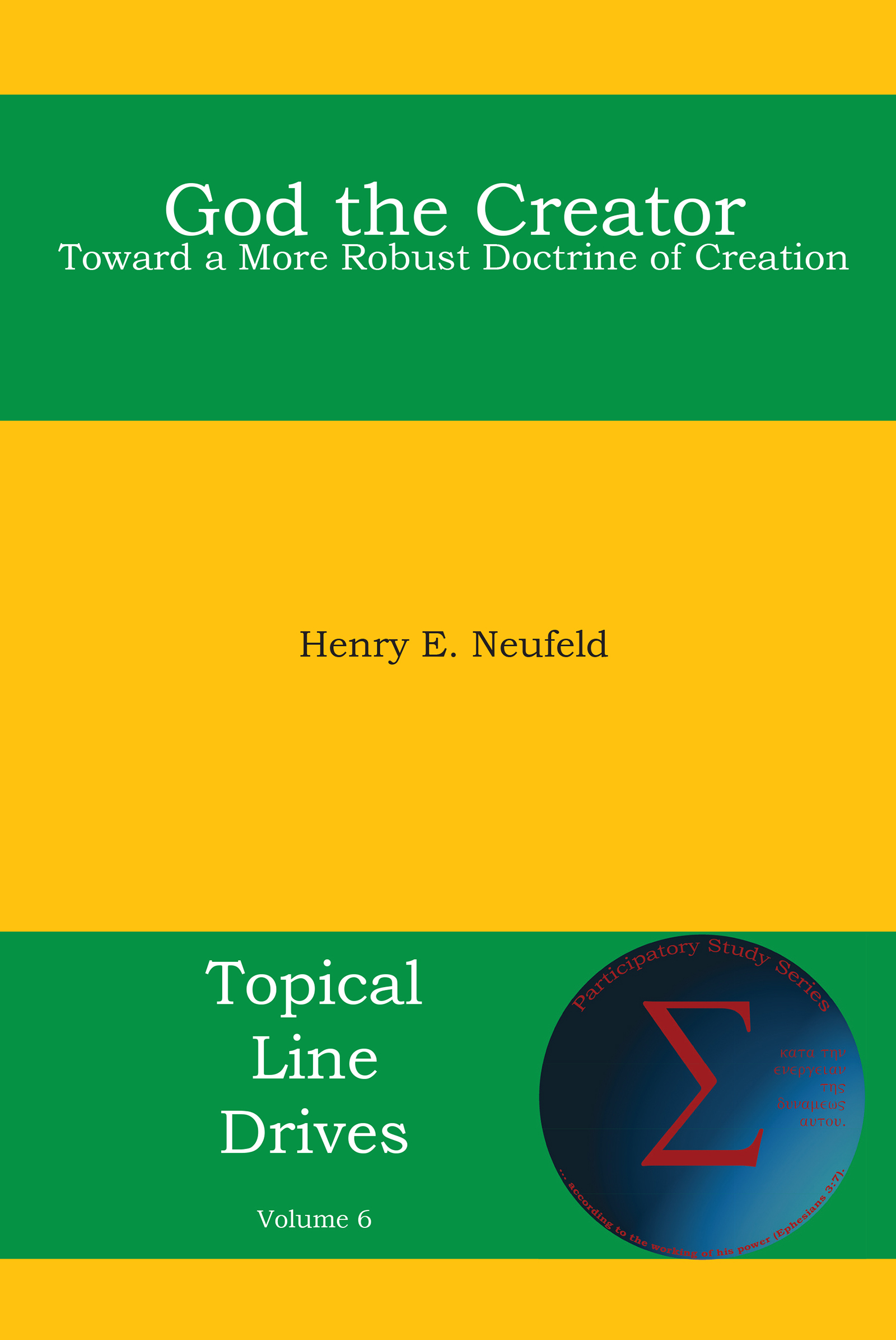
    I was recently interviewed by fellow Energion author Steve Kindle regarding my newly released book God the Creator: Toward a More Robust Doctrine of Creation. The video is below.

  • Genesis 2:4-9 – God Plays in the Mud

    Genesis 2:4-9 – God Plays in the Mud

    This is again from the Daily Bible Study series. One complaint I have about the reading is that they will split up chapters and even give the verses out of order. This is not, unfortunately, according to some coherent theory about the history of the text, so far as I can tell, but seems to simply be a convenient way to get the right texts for the Sunday reading.

    There is a substantial change in the text starting with Genesis 2:4. The precise division depends on who is doing the dividing, but usually it is Genesis 1:1 – 2:4a, and then 2:4b and following. These are the two creation stories.

    These two stories describe creation in quite different terms. In Genesis one we have soaring literary prose. It is powerful, and likely intended for use in liturgy, a purpose it has served well many times. The key theological elements, emphasized by the literary form are power, control, success, satisfaction, and blessing (and perhaps more).

    God is certainly involved, but the emphasis is on God’s power and glory and not on how close God is to creation. Genesis 1 could potentially be regarded as compatible with deism, seeing God as ultimate creator, but not as one interested in the day to day aspects of the world. Of course we have the Sabbath rest in 2:1-3, but a bit of interpretation, specifically not getting too literal, takes care of that. God is in charge.

    I should make a couple of quick points. First, Genesis 1 is not poetry. It has poetic elements in the language, but it does not have the characteristics of Hebrew poetry. It is powerful, well-designed prose. Second, Genesis 1 is not a myth, when myth is used in a literary sense. While it uses some of the language and symbolism of mythology, this symbolism is used in quite a different way. There is none of the conflict between supernatural characters, for example. One could almost call it an anti-myth.

    It is also not narrative history, nor is it science. It is theological in nature, and specifically liturgy. This doesn’t mean that it has no relationship to history or to science. It just isn’t trying to make testable scientific statements, nor is it trying to narrate a series of historic events in a form a historian might recognize. A good analogy might be the relationship of the liturgy of Good Friday and Easter Sunday to the events of the resurrection. Historical elements occur, but are never in focus. This is not a weakness. Liturgy takes its power from focusing on the divine elements and their connection to worshipers.

    But with Genesis 2:4b we come to a very different picture. We see God planting a garden, forming a human being out of dust and then breathing the breath of life into that body. As we proceed through the text, we will see God personally involved with the human being.

    There are those who think we solve problems with the text by noting different literary sources for Genesis 1 & 2. I do think that source criticism is accurate here in that these two stories of creation were at one point separate. But source criticism solves very little of what a text means as we have received it.

    The problem with trying to resolve contradictions by referring to sources (and there are chronological issues between Genesis 1 & 2 if you take them as intending to present the events in precise order) is that it doesn’t really solve anything. We still have the text before us, and that means that somebody, somewhere, sometime thought they worked together.

    This, to me, is evidence of the simple fact that this was not written, nor was it collected, by someone who was primarily concerned with chronology or with presenting narrative history.

    In combination, these tell an exciting story. There is a God of ultimate power who does not have to fight with others in order to create, whose word brings things into existence, whose will is carried out, and who has no peer. At the same time, this God of great power is personally involved with the creation, getting his hands dirty, so to speak, and coming in contact so as to provide breath.

    While on the sixth day, God is said simply to create the animals, in Genesis 2, the animals are created and brought before the original human so that he can name them, thus emphasizing and personally upholding the human’s authority and dominion. This same God of power is concerned that this first human is alone, and creates a woman, so we now have a first man and first woman, who are neither of them alone.

    Either of these views by itself would be incomplete. Personally, I like to join them to Psalm 104, in which God as creator is presented as sustaining life on a moment to moment basis.

    You can see my color-coded view of Genesis 1 & 2 here, and my thoughts on Psalm 104 here.

  • Genesis 1:1-2:4a from the Daily Study Bible

    Genesis 1:1-2:4a from the Daily Study Bible

    This is a day late, but the text for Sunday, the key text for the lesson, was the creation story of Genesis 1. This is a summary of what I taught, and some notes on what I didn’t.

    For obvious reasons, we discussed Hurricane Dorian. By Sunday morning we were pretty sure we would not be impacted in this area. I wanted to make the point that it is questionable to claim an answer to prayer regarding the movement of a hurricane. If God spared us because of our prayers, what did God have against the Bahamas? Let’s just pray that God will be with us and with whoever is impacted by a storm and leave the movement of the story to the processes of nature.

    I chose to spend my time in Psalm 19 and to discuss the relationship of God’s creative power to lawgiving, and then to God’s power and the proper place of the law. For my comments on this, see my earlier post.

    Yes, this Sunday was scattered, because we covered a variety of related questions. I’m not teaching this coming week, but I’m planning to take a look at the scriptures and post a few notes.

    Since the Daily Bible Study commented on authorship, I should like to my own color coded text for Genesis 1.

  • Exodus 31:12-17 – Daily Bible Study

    Exodus 31:12-17 – Daily Bible Study

    As I continue my posts on the Daily Bible Study readings for this week’s Sunday School lesson, I come to what may be, for many, a somewhat more troubling passage. It’s not that the passage mandates no work on the seventh day of the week, though that bothers some, but more that the penalty for violating this law is death.

    This frequently brings on the standard Christian response, which is dismissal: This is from the Old Testament, so we don’t have to worry about it. The big problem with that is that, by incorporating themes from Hebrew scripture into the New Testament and by basing any number of beliefs on it, Christianity has accepted this as part of our history, and part of our scripture.

    We face the fact that most of us work on the seventh day. Certainly by rabbinic definitions, but also by practically any definition, I have already worked on this seventh day. Some of the actions involved in posting this blog count as work. So I have violated a law from the scripture.

    I grew up as a Seventh-day Adventist, so I have another perspective from which to look at this. I grew up refraining from work, as we defined it (which differed from rabbinic definitions). Some Seventh-day Adventists have told me they believe I left the church because I didn’t like the Sabbath. This is quite incorrect. The Sabbath is one of the things I miss about the Seventh-day Adventist community. I don’t actually believe this is a command applying to Christians, so I do not feel obligated, but there was a great value in the obligation to rest at specific times.

    I believe the New Testament view would make all time sacred to God and all time to be used by the guidance of the Holy Spirit. I see a violation in failing to take the appropriate rest, not in the keeping of a specific day. This is because there has been a revolutionary shift brought on by the death and resurrection of Jesus. But this is not my primary topic.

    The focus of this statement of the Sabbath command is on God as the creator. This is quite frequently the case, such as in Genesis 2:1-4a and the Sabbath command in the Ten Commandments. The rest is tied to the creator. The authority for the rest is tied to creative activity. This is a theme repeated from most of our scriptures this week. God, as creator, asserts God’s power as legislator.

    In Israel, this law was particularly tied to idolatry, which, as we have seen in other scriptures this week, is a fundamental sin. The most attractive form of the temptation to idolatry is the temptation to attribute divinity to what is created. The sun, for example was seen in much of the ancient near east as the god of justice. This is why Psalm 19 asserts God’s authority over justice, and his creative and controlling power over the sun itself.

    I could discuss the nature of and use of the death penalty, but I’m going to avoid that on this occasion, except in the sense that it emphasizes the importance of the command in question. Idolatry separates one from God in a way that nothing else can. Nothing else can do so — logically — because all the other ways we might think of separating ourselves from God turn out to involve idolatry.

    When, for example, I do not rest as God would direct, and do not maintain my health, I am putting my own labor above God. This is a form of idolatry. I am more concerned with my own activities than I am with that Ultimate Concern.

    Thus the Sabbath command was very much central for Israel, and the thing to which it points—constantly reminding ourselves that God is Creator and the true Ultimate Concern, remains central for us.

  • Hebrews 11:1-3 – Daily Bible Study Text

    Hebrews 11:1-3 – Daily Bible Study Text

    Hebrews 11:1-3 begins thus: “Faith is the substance of things hoped for, the evidence of things not seen” (KJV). Most of the words here are at least a bit controversial.

    It may be easier to understand the passage if we accept that the writer is not trying to define “faith” or the Greek word “pistis,” but is speaking of the function of faith. In Hebrews we have a kind of hand-in-glove paired ideas of this faith or faithfulness. On the one hand, one of the key concepts of the book is God’s faithfulness, and it is from this platform that the author calls for a response of faith, endurance, and boldness.

    If you look back to chapter 3, verses 1-5, and especially verse 2, you will see the expression of the faithfulness of Jesus, who is faithful “as was Moses,” though the point of the passage is to say that Jesus is faithful to a greater mission and authority than was Moses. In verse 5 we are called upon to hold firmly to the boast and the boldness of hope.

    This is one of many cases of the author of Hebrews signaling upcoming topics. Though it is the boldness and the boast of our hope we are to hold onto tightly, we have some similar wording in 11:1 where faith is the “substance” of the things we hope for. I believe it’s necessary to get to a point in the semantic range of the word used for faith, so that it is a faithful acceptance and affirmation, it is the key to what we are to hope for.

    The context of chapter 11 makes this nature of the faith clear. It is a belief that drives endurance in hope that underlies the actions of all of the people of faith in the chapter. They didn’t just sit around and believe really intensely. They remained faithful to their call.

    But the real key is not their faith, or the genuineness of their belief, but rather the faithfulness of the one in whom they are believing and trusting. We have only to look a few verses back to 10:23 to support this idea: “Let us hold on to the confession of our hope without wavering, because the one who promised is faithful.

    Our faith is enabled and brought forth by the one who is faithful in everything, an idea that has been building from the beginning of the book of Hebrews. The one who is faithful has been faithful in accomplishing our redemption and thus we have but to put our faith in his, faithfully.

    Of course, the passages for this week all deal in some way with creation, so we have verse 3 telling us that it is by faith that we can understand God as the creator. Yet again we see God’s authority and power established by God’s creative power.

    This combined faithfulness of God with a response of faith is quite common in scripture. In Romans, we have a great affirmation of God’s faithfulness in chapter 8, followed by chapter 9, which some see as a complete change of topic, as though Paul said, “Well, I’ve got to say something about Israel, so here goes.” In fact, when I took Exegesis of Romans in college, the professor was content to make it just through chapter 8.

    There is a subject change, but it is incremental and not one that turns a big corner. Yes, Paul is going to talk about Israel and the salvation of Israel, but they way he does it emphasizes God’s faithfulness. It would be natural in a church of both Jews and Gentiles for people to ask after the firm, or perhaps fiery proclamation of God’s faithfulness at the end of Romans 8, to ask, “But what about Israel? It’s God’s biggest promise! Is God faithful there?”

    So the discussion that follows, rather than being a sort of excursus, is a historical and eschatological affirmation of the foundation of the book’s message: God is faithful.

    Which reminds me that one of the authors I publish, Edward W. H. Vick, commented in a couple of his books (Creation: The Christian Doctrine and Eschatology: A Participatory Study Guide), that we can’t really talk about soteriology without talking about creation and eschatology, and we can’t talk about creation without talking about soteriology and eschatology. These topics tie together frequently and powerfully in scripture.

    This week, with these scriptures, we’re not even going to try!

  • Link: What Was It Like?

    This is to go for the reading for the week of August 26-31, 2019 in the Daily Bible Study series. What Was It Like? This is especially related to the reading for August 29, Psalm 33:3-9.

  • Psalm 33:3-9 for the Daily Bible Study

    Psalm 33:3-9 for the Daily Bible Study

    I’m continuing with comments on the scripture passages for this week from the Daily Bible Study, which my Sunday School class uses as curriculum.

    This passage, like most of the passages this week, links God’s Word (whether in words or not) with creation and justice. We are to praise God because his word holds true, his work endures (v. 4). He loves righteousness and justice and his unfailing love fills the earth (v. 5).

    It’s interesting to note that this passage, very much like yesterday’s passage from Proverbs, states the attributes first and then makes the power explicit. “By YHWH’s word the heavens were made, by the breath of his mouth all their host” (v. 6). “He spoke, and it was, he commanded, and it stood firmly” (v. 9).

    I quote it fairly frequently, but I wonder how often we think about who this must be when we talk about being in God’s presence, or hearing God’s voice, or looking at something that we say must surely be the act of God.

    It’s possible for us to affirm the right things about God and never even imagine a tiny fraction of what all this would be like. Perhaps a slightly less casual attitude might be in order.

    The reference “Ephesians 3:14-21” is inscribed inside my wedding band. This is a powerful passage, and I just want to call attention to a few lines: “… that you may be able to grasp with all the saints the breadth, length, height, and depth, (19) to know the love of Christ that surpasses knowledge, so that you can be filled with all of God’s fullness.”

    We often—I often—don’t really get this. It is in the nature of a teacher to explain things, but in this case we have to say we can’t make this clear. It surpasses knowledge. It surpasses our ability to imagine it.

    And then verse 20: “Now to the one who is able to immeasurably more than we ask or conceive according to the power that is working among us …” And that points us back to Psalm 33 and the one who speaks and it is done.

    Do you ever pause and try to imagine this? Or is “we are the body of Christ” just a description of an ordinary gathering of humans?

    Here is a link to a story and a poem I wrote some time ago, but that I believe connect to our lesson this week: It Got Very Quiet up in the Mountains and What Was It Like?

    Featured image credit: Image by Arek Socha from Pixabay

  • Proverbs 3:13-20 from the Daily Bible Study

    Proverbs 3:13-20 from the Daily Bible Study

    Continuing my notes on the daily passages from this week’s lesson, I’m looking at Proverbs 3:13-20. I assume it’s clear to all that the subject is creation.

    13      Happy are those who find wisdom, 
            and those who get understanding, 
    14      for her income is better than silver, 
            and her revenue better than gold. 
    15      She is more precious than jewels, 
            and nothing you desire can compare with her. 
    16      Long life is in her right hand; 
            in her left hand are riches and honor. 
    17      Her ways are ways of pleasantness, 
            and all her paths are peace. 
    18      She is a tree of life to those who lay hold of her; 
            those who hold her fast are called happy.
    19      The LORD by wisdom founded the earth; 
            by understanding he established the heavens; 
    20      by his knowledge the deeps broke open, 
            and the clouds drop down the dew.  (Prov. 3:13-20 NRSV)

    We again find ourselves looking at God’s revelation through God’s work. I like to emphasize the importance of not just reading words from the Word of God, as we do in scripture, but also receiving the Word of God as revealed in God’s acts in history (as well as our own lives) and in Jesus.

    This passage is logically extracted from the chapter, which is not always the case, as I noted yesterday. You can see a simple inclusio which ties the passage together. In verse 13, the ones who are fortunate are those who find wisdom and get understanding. This is reflected again in verse 19 when these same to things (the words in Hebrew are the same just as they are in the NRSV). The tie between these two verses emphasizes the message. It is divine wisdom and understanding that the happy, or fortunate, ones have found.

    But I think one can further deduce that real wisdom (and not all claimed wisdom really is) and real understanding derive, just as does all creation, from God. It’s interesting how often we try to discover those things that God does. That is, as opposed to things that just happen. But the scriptural view of creation would say rather than all things depend upon God and function because it is God’s will that they do.

    As a believer in free will, I also note that my ability to choose along with the ranges of choices available all derive from God’s action and God’s will. There is no real independence. Everything derives in some way from God. I believe in free will, but each act of my will happens because God has permitted it and also set the bounds on it.

    Today’s scripture is very positive. It emphasizes the good things: Long life, pleasantness, peace, happiness. Yesterday’s passage was taken from a cry of deep despair. Job was facing just how unlikely it was that God would respond to him. The wise person is not always fortunate in everything. Job, called righteous, suffers. The season of his life reflected in the book that bears his name was anything but pleasant and peaceful.

    Is this a contradiction in scripture? Is it inappropriate to say of wisdom that “her income is better than silver, and her revenue better than gold”? (v. 14). Actually, I think that the contradiction, or better the tension, is in the nature of reality itself.

    We tell young people not to text and drive. A young driver collided with my car while probably texting. So we say, “Don’t text and drive. It’s safer.” There’s that hedging. But no matter how safely one drives, bad things can happen. When the other car collided with mine, I was driving within the speed limit and obeying all traffic laws. Indeed, I was paying quite close attention. Yet from a side street came something I was not prepared for.

    In life as well, unpleasant things can come upon us from a side street and smash our lives to pieces. It’s just the nature of reality. No matter how careful you are, there are things that happen that are beyond your control. As I write, people in Puerto Rico are awaiting Tropical Storm, likely to become Hurricane Dorian. Wisdom is useful. Good preparation is helpful. But there are some things that storm will do that nobody could have prepared for well enough.

    We don’t abandon preparation just because storms come when they come no matter what. We don’t abandon safe driving because someone else may be driving while impaired or sending an essential text at just the wrong moment. These things help, but nothing is certain.

    As a Christian, however, I believe that God has set a boundary. God permitted Job to be stricken by disaster, but God also set limits. I could definitely wish those limits were more, well, ummm, limiting! But odds are that when I want to see some flexibility in the boundaries, I will be less happy with the limits.

    Perhaps God thinks of that as well, noting how unhelpfully we beat against the limits set on creation.

    Featured Image Credit: Image by PublicDomainPictures from Pixabay