
I’m starting in about 15 minutes. Tonight I’m going to be looking at Revelation 21 & 22 and their use of 3rd Isaiah (chapters 56-66). I want to look at how imagery is used and reused and how this impacts the way we interpret.
I’m starting in about 15 minutes. Tonight I’m going to be looking at Revelation 21 & 22 and their use of 3rd Isaiah (chapters 56-66). I want to look at how imagery is used and reused and how this impacts the way we interpret.
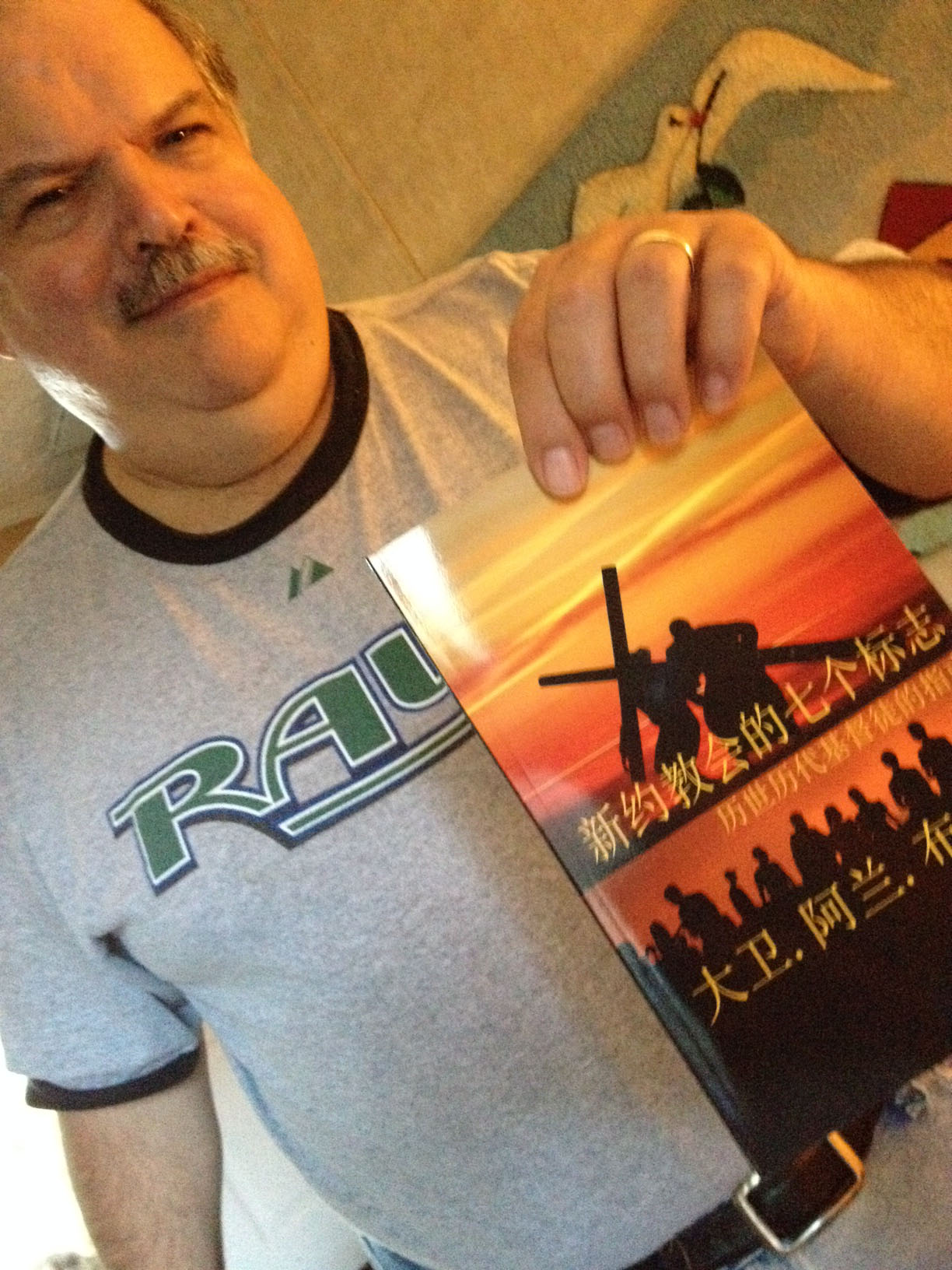
I suppose it had to happen sometime. Well, not really. I could have said no. But I have now taken a step off the edge and published a book I can’t even read. It’s in Simplified Mandarin. I got the translation, did the layout, and then had it checked by the translator. I ran some of it through Google Translate and it came back resembling English.
Really, I’m delighted to have released this book, and hope that many will enjoy it. For those of you, I assume most of my readers, who don’t read Mandarin, the same book is available in English, Seven Marks of a New Testament Church by David Alan Black. I’ve been blogging about it, and will resume that series soon.
Tomorrow I head to Atlanta for the annual meeting of the Society of Biblical Literature where my company, Energion Publications, has booth 2110. I don’t know if this means I will blog less or more, but I suspect it means something. If you’re there, be sure to drop by and say hello!
Tonight in my study on John via Google Hangouts on Air I’m going to talk about the law and Jesus, Jews and Christians, and Judaism and Christianity. I’m embedding the player below. In the meantime, read 3 ways to Confront the New Antisemitism by Rabbi Evan Moffic.
For tonight:
My sister was going through my older YouTube videos and called my attention to the one titled Idolatry and Trust from six years ago. It relates to some of my more recent comments on God in my study on John. I’m amused to watch myself in this, as I clearly had a written transcript and had it placed too low for me to both read it and look properly into the camera. Note also that the URL provided in the video no longer exists. For information, you can use this site.
This will be the second study. I’m going to mention a few things to think about. The question remains as to how many of these things I will be able to address, but I think it’s worthwhile to consider these in any case. The study will be via Google Hangouts on Air at 7:00 pm central time, Thursday, January 18. The event on Google+ is here. And here’s the trailer:
I’ll embed the YouTube below, but first, some things to think about! The major scripture for the study is John 1:1-18. If you haven’t read the book of John through completely recently, it will help to review the entire book.
One issue of source (and to a lesser extent redaction) criticism comes up for this passage, which is the question of whether John 1:1-18 was written as part of the gospel or whether it is an early Christian hymn adapted for and incorporated into the gospel. There are some folks who regard it as poetry with some prose comments added.
Read the passage and pay special attention to the boundary between John 1:18 and 19.
I’m going to list two, though one comes in two parts:
First, in verses 3 & 4 we have a verse division/sentence division issue. Should it read something like “… without him was not anything made that was made”? Or alternatively “… without him was not anything made. That which was in him was …”? You’ll probably find references to these two possible divisions in the footnotes to your translation. I just looked at the NRSV and REB as I was preparing this, and their notes are pretty clear. The NIV at BibleGatway.com isn’t showing a note. Does your Bible have a note?
The difficulty for the average student is that these translations don’t provide any justification for the decisions made. It would be impractical to expect them to. But if you have a Bible with study notes or a good commentary, you may find a bit more information.
Second, John 1:18 has two alternative readings, which the REB lists as “God’s only Son” (their text) and “the only begotten God” (alternative). Of course, if you read Greek, you should consult your apparatus to discover the evidence for these readings. How much difference does this make? What is the translation choice of the Bible you use? The NIV kind of combines the readings, while the NASB makes the opposite choice to REB and uses “the only begotten God.” I will definitely discuss this variant and something about how these choices are made.
Just for fun, I went through my files and extracted a paper on this verse that I wrote in college, for a course titled “Translation Problems.” Though it doesn’t have a date on it, I think this was in my junior year, which makes the paper more than 35 years old. Read it and see if you agree with my younger self! (I note here that this was written when I was still a Seventh-day Adventist, and references to Ellen White and “the Spirit of Prophecy” should be taken in that context.) Younger readers will doubtless be unacquainted with the quaint device used to produce this paper, a manual typewriter. If I remember correctly it was an old Remington, and no, it had no Greek font!
Well, combining theology and inter-textual relationships.
First, do you think the cultural/philosophical background for the phrase “the Word of God” should be taken from Greek thought (the word logos is so common in Christian speech that it has almost become an English staple!), or should it be found in passages in the Hebrew scriptures/Old Testament? This will have some impact on precisely how we read it.
Your answer doesn’t have to be one or the other. We discover the precise meaning of a word through it’s use in a particular context, and so this word can be shaped not only by the Gospel of John, but by the New Testament, and by its usage discussing concepts from the Hebrew scriptures, but from doing so in Greek.
Second, I want to explore a connection to one of my favorite books in the New Testament—Hebrews, and specifically Hebrews 4:12, though the prologue (1:1-3) comes into it. James Moffatt, in the International Critical Commentary volume on Hebrews, says: “Here the writer poetically personifies the revelation of God for a moment…. Here it [the Word of God] denotes the Christian gospel declared authoritatively by men like the writer, an inspired message which carries on the OT revelation of God’s promises and threats, and which is vitally effective” (p. 55). Moffatt distinguishes this from the usage in John 1:1-18.
Looking from the other direction, Leon Morris, in his volume The Gospel According to John (Revised) in the NICNT states that the only other place where the word (logos) is used undoubtedly with the same meaning is Revelation 19:13 (pp. 63-64).
I’m going to look at some elements of these two passages. Do you think they are more closely related?
Finally, I want to examine the concept of testimony. We start here with John the Baptist bearing testimony to Jesus, and near the end of the gospel we see Thomas brought to giving a testimony to Jesus: “My Lord and my God” (20:28)! We’ll tie this in later with the critical question of whether chapter 21 was originally part of the book or was added later as a sort of postscript.
Doubtless I will have many words on all these topics and perhaps a few more! The YouTube embed is below.
On Tuesday, January 6, 2015, I will be interviewing Dr. Bruce Epperly on his newly released book Finding God in Suffering: A Journey with Job.
I’ve just completed a trailer for this event:
You can watch the actual event here:
 The word “tithing” has undergone quite a substantial change in meaning over the course of my life. Growing up as a Seventh-day Adventist, it meant giving precisely 10% of one’s income to the church. This money had a special use in the SDA church, supporting pastors. For my parents, the tithe was just the starting point of their giving. They put aside an additional 10% and gave that to various other activities of the church. They called this offering. They had an additional fund, I believe around another 10%, that they used to help people personally.
When I started attending Methodist churches, I found that the term “tithe” had a somewhat different meaning. I think I ran into this first in a stewardship campaign, in which people were encouraged to begin to “tithe” at 2%. The idea of a “2% tithe” was somewhat puzzling to me, as I knew the Hebrew word was derived from “10” and was used pretty much exclusively in that sense. (Not 10%, as not every instance of 10th turned out to be precisely 10%, but always related to 10.)
So tithing had the meaning of giving, rather than a specific type of giving, and the number was no longer considered relevant. There was a sort of goal at 10%, but the other amounts were still considered tithing. If one needed to distinguish them, one might say “full tithe” but I rarely heard that.
In my own view, however, there was no obligation for Christians to follow the tithing laws from the Pentateuch, and even SDAs were not doing so. There was a more substantial effort on the part of SDAs to translate, but it nonetheless was not the same thing. It was not that Christians should be less generous. It was just not a law addressed to us. At the time, however, I was afraid to say that I didn’t believe in tithing. Why? I was afraid people would start giving even less, and the giving in Methodist churches (and many others) is rather dismal as it is.
In other words, I didn’t really believe in grace. I didn’t trust grace.
I believe that tithing can be a good starting point or guideline. I don’t believe Christians are called to give less. Rather, we are called to give more. I also don’t believe that we are necessarily called to give all to our local church. But we are called to give it to the kingdom of God, whether in the form of helping our neighbor in trouble, feeding the homeless, carrying out acts of love and mercy, supporting missionaries and all who are working in service to God and others. I believe this should be a response to grace, not a price we pay or a duty we fulfil. All giving, whether to support your local church, your local food pantry, or world missions, should be a joyful response to God’s grace.
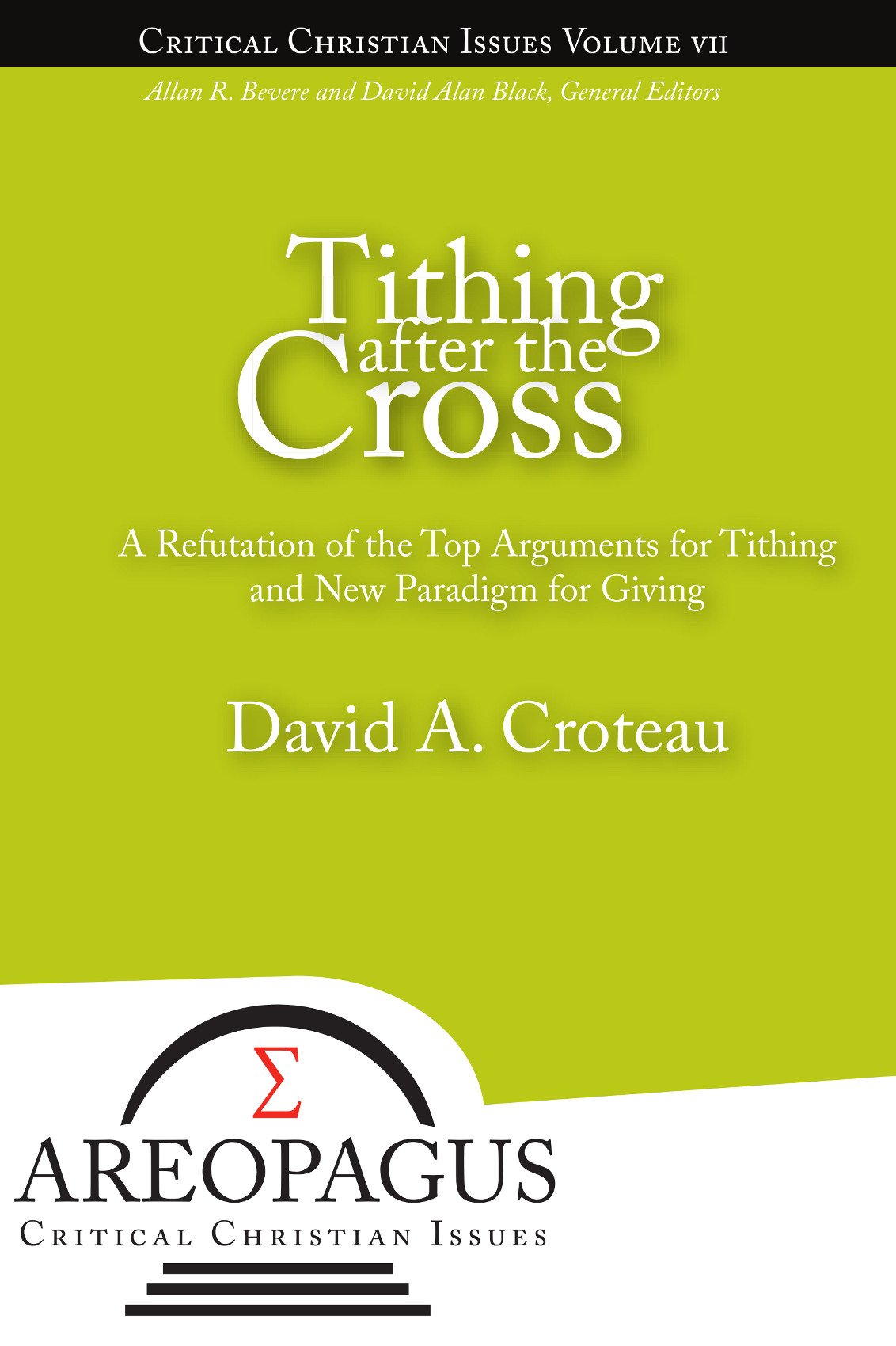
Recently I had the opportunity to publish a small book on tithing, titled Tithing after the Cross by David A. Croteau. He says boldly what I failed to say, and backs it up with a large amount of additional research. While he has written larger works, in this book he distils it into a short volume that anyone can read. Don’t worry! He didn’t “dumb it down.” He made a concise version.
This afternoon he’ll be on the Janet Mefferd show with an interview on the topic. Show time is 4:00 PM eastern time. I invite you to listen and then check out his book, Tithing after the Cross, on Energion Direct.
From time to time I hear the question regarding some act of terrorism, or by some act of a Muslim government: Where is the Muslim outrage?
I first want to note that I find measuring online outrage to be a somewhat hopeless task. I am outraged at many things that I never manage to mention on my blog. My blogging has a great deal more to do with my current schedule than with my state of outrage.
But I do want to call an article, Sudan Government Tells Young Christian Woman to Recant or Die, written by Harris Zafar. To quote, regarding her sentence:
As a human of conscience, I see this as a clear violation of fundamental human rights. Moreover, as an Ahmadi Muslim, I find the actions of Sudan’s government incredibly disturbing. They claim not only to be administering Shariah Law that is allegedly a 100% Islamic constitution, but also that “it is not allowed at all for a Muslim to change his religion.”
I found the entire article extremely interesting.
When it rains it pours, so I’ve been seeing a lot of posts about mission lately, and here’s another one that raises some very interesting points. (HT: Kouyanet).
Having served on and led short-term mission teams, grown up with long-term missionary parents, and served on mission committees, I find that a great deal of this resonates with me. Read it all and give it serious consideration. This is to be a series. I intend to follow it.
One thing that strikes me is that minor changes in the details are not the solution to the various problems (see Of Resources and Mission Priorities and Worship, Service, and Mission). Our problem is that we don’t view ourselves as on a mission in the first place. We view the church as a way to provide a moral education to our children, a place for networking, and in some cases a route to salvation.
Perhaps our committees, agencies, and denominations lack a sense of mission because our members lack a sense of mission. Perhaps that lack of a sense of mission comes from a lack of understanding the basic gospel message.