

Threads from Henry's Web

Tag: Calvinist

  • Psalm 119:171 – Sing Praise!

    Psalm 119:171 – Sing Praise!

    Let my lips sing your praise,
    for you have taught me your statutes.

    The underlying theme of Psalm 119 is praise to God for the law. The law is righteous. The law is good. Good things come of keeping the law, even though we have to ask God for the strength to do so.

    I find the relationship of may Christians to the law quite interesting. There quite an interesting theological/biblical discussion between various groups, particularly Lutherans, Calvinists/Reformed, and Wesleyans about the relationship between the law and gospel. As an introduction, let me commend the article on Wikipedia on Law and Gospel, though doubtless many, myself included, would pick at various points.

    In practice, however, we tend to simultaneously declare that we are saved by grace through faith, but then only apply this to the moment of salvation, of becoming part of God’s family. At that point, most of us would say that we are not saved by keeping the law. So we have a distinction here, because law is not the agent, even though law definitely has a role.

    But we turn from that and, whatever we may proclaim, we become people of rules. We want the ten commandments in schools, as though better morality will be achieved because of a display of the ten commandments.

    We aren’t really praising God for the law through all this. Rather, we’re considering that we have to have a stick to use to beat people into proper order. We ditch gospel and grace and become another behavior modification program.

    This is exemplified by the plea I have heard frequently from parents and friends, “Help me get my child/friend back into church.” The goal is to get them into the church structure and organization, such that their behavior can be made more … I’m not sure if it’s more Christlike or more Churchlike.

    I recall having this discussion in a church my mother attended, which she called, to their face, the church of the gottas. You gotta do this, you gotta do that. Having been saved by faith, or rather having been shoved across the starting line by grace received through faith, you gotta get busy running the race and making sure you get everything right.

    My own experience with teaching about tithing is an illustration. Is tithing a command applicable to Christians? For a long time I struggled with the fact that I couldn’t see that it was, yet as part of the leadership team of a church, I was afraid to say so, lest people give even less. I was already irritated by people who spoke of “tithing” 1% or 2%. “Tithing” refers to 10%, though 10% of what is subject to some controversy. But if you’re giving 1%, you’re not tithing.

    My concern, or to be honest, fear, was that if tithing was not a rule, then people wouldn’t give, and then programs of the church that I hoped would be well funded, such as children’s ministries and missions, would suffer.

    It took me a long time to realize that grace was the only thing that was ever going to bring sanctification, including sanctification of our wallets, doubtless the least sanctified of our possessions.

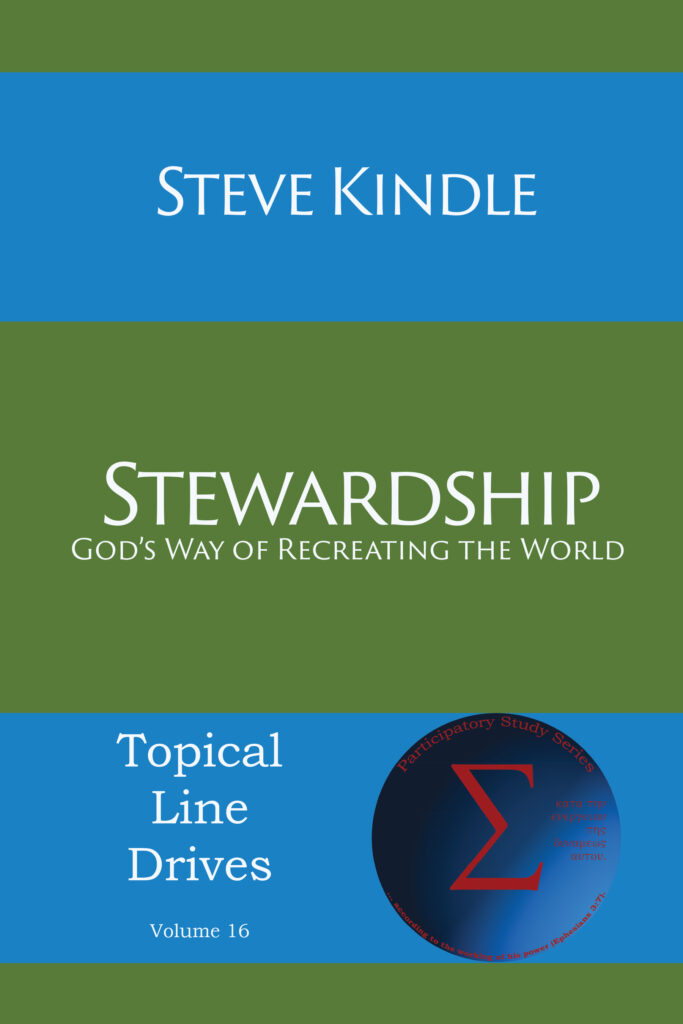
    The bottom line was that in Christ, everything is dedicated to Christ and we make our decisions on spending and giving based on that fact. I had come to this conclusion, but hadn’t expressed it all tat well until I read as an editor, and published the little book Stewardship: God’s Way of Recreating the World by Steve Kindle.

    Here’s a selection from page 25:

    The questions around how much to give are too often reserved for “Stewardship Drives.” So we compartmentalize our giving and tuck it away for another year. In all the talk of stewardship, seldom
    does it go much beyond the pocketbook. Whenever stewardship is reduced to a program, something is terribly wrong, and congregations and individuals continue to struggle.

    The apostle Paul revealed to us the key to successful fundraising in his appeal to the Corinthian congregation to assist in the collection he was taking up for the Jerusalem church. His formula:


    3For, as I can testify, they voluntarily gave according to their means,
    and even beyond their means, 4begging us earnestly for the privilege
    of sharing in this ministry to the saints— 5and this, not merely as we
    expected; they gave themselves first to the Lord and, by the will of God,
    to us,… — 2 Corinthians 8:3-5

    The Macedonians, in spite of their poverty, begged to give to the Jerusalem church—even beyond their means—because they first gave themselves to the Lord. Sure, it is possible to raise a lot of money using sophisticated methods based on psychological triggers and emotional appeals. These are too often resorted to as substitutes for the Macedonian way. A congregation that first “gives themselves to the Lord,” recognizes their stewardship partnership, and everything they do springs from that commitment. So let’s not encourage tithing, that’s about money. Let’s encourage
    seeing all we have as God’s and act accordingly.

    Steve Kindle, Stewardship: God’s Way of Recreating the World, p. 25

    This same approach applies to everything about Christian living, and it’s something we should pay attention to. If we could focus on that connection to God, and the motivation of love that is involved with it, better behavior, empowered by the Holy Spirit, would be the result.

    When we see the law in this way, as a gift, and as a description of what might be and what God is, we can receive it with praises. If it is a club to make people look and act like us, to be “churchy,” then it will always be a negative thing.

    But if we don’t focus on that core of being as the source of all we do, we will inevitably get back to a picky, rule-by-rule attempt at behavior modification, which is sure to fail in the end, not to mention causing a great deal of fiction along the way.

    How can you find joy in being and doing today?

    (Featured image is from Adobe Stock. Licensed, not public domain.)
  • From YEC to Theistic Evolutionist

    Since I’ve made this journey myself, I’m always on the alert for other stories of similar journeys. It’s interesting that I’ve found many more such stories amongst those studying science. On the religion side, it’s generally those who studies nuts and bolts material (textual criticism, history, archeology, and so forth) who start to see holes in the fabric of a literalist view of the Bible.

    Dr. Steve Matheson has an interesting post at Quintessence of Dust on this very topic, discussing the story of paleontologist Stephen Godfrey, as told in an article in Science. It’s worth reading Dr. Matheson’s summary even though the article is available only to subscribers.

    In these discussions by scientists I frequently see discussions of the need to prepare a theological framework to help people migrate their faith along with their science. I personally found this very difficult coming up as a Seventh-day Adventist. I ended up leaving the church entirely for a period of 12 years, before finding my own balance. There are a couple of problems. For many conservative Christians, any alteration in one’s view of the Bible is apostasy, and thus there is little room for adjustment. The view has to be shattered and then rebuilt. There are some careful theologians and specialists in Biblical studies who also have an interest in the people they teach who can help with this, but they are few and far between. On the other hand, there is too much of a tendency in those who make the journey to laugh at those who have not and expect them to jump. This is combined with a tendency to minimize the gap involved. I personally often have trouble expressing the differences in interpretation without sounding impatient and condescending, so I understand the difficulty. At the same time I know I’m speaking against positions I once held myself with some fervor!

    “Just don’t take it so literally” becomes the mantra. But “not taking it so literally” is not an adequate foundation. Just how do you take it? What does the Bible mean in a new context? Besides the problem of oversimplification there is a difference in terms of theology. There is not a single Christian theology to which one can appeal in this case. In particular dealing with issues like randomness and teleology, Arminians and Calvinists tend to see things very differently.

    I’d add one more thing. Because of my writing (on religion, not science), in which I state my positions, I was never able to conceal the change from my family, most of whom are still young earth creationists. That is probably the hardest single thing for them to accept about my faith as it now stands. It’s a good idea to understand that this is a significant issue. At the same time, I’m not going to keep quiet, simply because I know many are afraid to speak up because they feel that there are so few who will understand. It’s important to be present and accounted for!

    In any case, I’m glad to see the discussion going on.

  • Can a Liberal Learn from Mark Driscoll?

    I’m using the dreaded “L” word for myself again, because if I was put up against [tag]Mark Driscoll[/tag] I would certainly come out as liberal, no matter how moderate I think I am. Regular readers of this blog know that I disagree with him on a substantial range of issues.

    There’s a profile of Driscoll available on the Christianity Today web site (HT: Adrian Warnock). There’s some interesting things here, including most of the stuff on which I differ. Occasionally I stir people up through what I write on this blog, but in real life, I put much of my effort into reconciliation. I try to be a peacemaker in church. I’m not a [tag]Calvinist[/tag] by any stretch. Even good [tag]Arminian[/tag]s suspect me of heresy in the pelagian direction. I’m [tag]egalitarian[/tag], not [tag]complementarian[/tag], and if the bad guy is threatening the playground, I’m going to call 911 before mixing it up with them myself.

    Yet there are a number of things one can learn here. Driscoll really believes what he is teaching, and I think the evidence is good that he cares about his church and the people of his community. He’s willing to meet them culturally, something that other church people ranging from right to left are not willing to do. To many of us church is our culture, and others have to leave the “world’s culture” and become part of the “church’s culture.” But we have no particular reason to assume that the church’s culture as we practice it is actually better than the world’s culture. Driscoll seems to have caught on to the fact that from the point of view of the church, especially the mainline church, reaching the person down the street is just as much cross-cultural ministry in many cases as is going overseas.

    Nonetheless, I deplore Driscoll’s position on women in leadership and in ministry. I believe it would be quite possible for the church to articulate and practice a strong theology of family and of leadership without wedding itself to the single model of the dominant male. At the same time, egalitarians sometimes behave as though men don’t need to learn any leadership and even foster the “let women take care of spiritual things” attitude. We need to learn to respond to those attitudes.

    Too often what we practice is not the empowerment of all people to use the gifts God has given them and to follow God’s call on their lives, but it is rather a “let those who will do it go ahead.” We’re afraid to challenge men in spiritual leadership because we might sound too much like Driscoll. I am willing to confess to weakness when it’s there, but in this case, I’m not myself confessing to this practice. I have regularly preached that men need to be ready to get up on Sunday morning and lead their families to church. They need to be actively involved in both church life and in the moral life of their family and community.

    A family can only be properly led when both father and mother take up their appropriate gifts. But this does not allow looking down on supposedly “feminized” men either. That male leadership can involve the man cleaning the house, doing the dishes, changing diapers and helping get the children dressed. It might involve a husband getting the children to Wednesday night activities because the wife is working or out of town on a business trip.

    In other words this is another part of modern culture that we could meet with the gospel, rather than try to change into a first century image that exists largely in our own minds.

    I would suggest reading the Christianity Today article asking yourself this: “How can I make my spiritual life connect more with the age? What are the essentials of my spiritual and ethical beliefs, and what are just my church culture?” All of us could do with such a checkup.