
Threads from Henry's Web

Tag: 2 Chronicles

  • Quick Note on the Chronology of Daniel 1:1

    Quick Note on the Chronology of Daniel 1:1

    For those who hold to the historicity of the story of Daniel and generally to an early dating, Daniel 1:1 is a critical text that presents some problems. As I proceed with my eschatology series, and starting going through the book of Daniel verse by verse, I’m trying to keep all the options in mind and explore interpretation based on the different views.

    As I talked about this last night (February 4, 2016; video embedded at end of post), I thought I was being confusing, and at one point said “Nebuchadnezaar” when I should have said “Pharaoh Neco.” I want to clarify the people and dates and how they apply to the text in question.

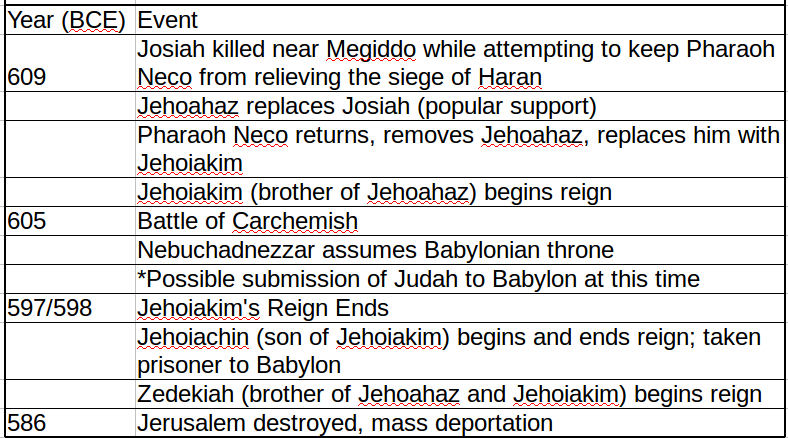
    First, here is a chart of the most critical dates. Note that you will find reference sources that differ on these dates by a year. It is beyond this post to discuss the different calendars and accession year vs non-accession year dating. The sequences involved are adequately handled by the dates I’m using.
    Click to view full size
    Click to view full size

    Biblical sources for this time period may be found in 2 Kings 23:29 – 25:30 and 2 Chronicles 35:20 – 36:23.

    Now for Daniel 1:1, my translation:

    In the third year of the reign of Jehoiakim, King of Juday, Nebuchadnezzar King of Babylon came to Jerusalem and put it under siege.

    Here is a list of the problems:

    1. Unless it is described in 2 Kings 24:1, which seems more likely to describe the events of 598/597 BCE, there is no siege and exile set for 605. It is nonetheless possible that there was one, as the Babylonians became dominant over the territory after winning the battle of Carchemish in 605. There might have been a small exile at that time. Even if 2 Kings 24:1 describes later events, Jehoiakim would have to first submit to Babylon before he could rebel. He was put in power by Pharaoh Neco.
    2. Nebuchadnezzar, as “King of Babylon” could not attack Jerusalem in 605, as he was not yet king of Babylon, but rather became king in that year.
    3. Even if there was a small set of exiles, or perhaps hostages, taken in 605, it doesn’t fulfill the description of the siege.

    The question here is how you evaluate the evidence. One critical element would be one’s determination on other grounds that the Book of Daniel is or is not historical. As an historian one would look for the most probable reconstruction of the evidence. Most scholars tend to support the later dating, even evangelicals, but you can find other arguments regarding dating via my Dating of Daniel Resources page.

    I’ll discuss dating and historicity further in my series, but for now I think this will clarify the issues discussed in the video.

  • Review – Cornerstone Biblical Commentary 1-2 Chronicles

    I previously reviewed the Cornerstone Biblical Commentary on Leviticus, Numbers, and Deuteronomy on my book blog and have posted a number of notes about it on this blog.  So when I had an opportunity to review the volume in the same series on 1 & 2 Chronicles, I jumped at it.  I would say many of the same things I said about that previous volume with regard to this one, so if you want my thoughts on the series in general, read that previous review.

    Chronicles as a whole is not a staple of Christian teaching.  We use a number of individual passages, especially the various prayers, but as a whole, the method is a bit foreign.  From a historical point of view Samuel-Kings is closer to the events it relates as an historical source, while the emphasis on genealogy in Chronicles goes against the grain of our western minds.

    In this commentary, author Mark J. Boda has managed to continue the quality commentary that I expect from this series.  My personal tendency is to criticize a commentary such as this one for not including enough comment on issues of biblical criticism, the language, and translation issues.  But those are not the primary focus here.  This commentary is designed to be read by the non-theologian and people who do not read Hebrew.

    At the same time it does have considerable information on the structure of the book and on the language.  I found the introduction to the genalogies (pp. 25-31) particularly helpful, because it takes on issues such as the purpose of the genealogies and why they are included in the way that they are.  I’ve previously written about the importance of genealogies and why they should not be neglected.  These pages make many of those points and a number more as well.

    In the section on 1 Chronicles 1-9, the commentary section follows a consistent structure that differs from what it follows in the rest of the book.  The first portion discusses sources.  Chronicles is one of those sections of the Bible where we have source explicitly referenced and easily discernible.  The second portion discusses structure and content.  While most readers will probably be going more directly for content, the excellent discussion of structure is one of the strong points of this commentary.  Finally, there is a section on significance, particularly important because we are dealing with genealogies.

    The whole commentary is 449 pages, including the text of the NLT.  The remainder of the commentary starting with 1 Chronicles 10 is follows the more standard format of comment on short passages in succession.  The discussion is thorough.  References to Hebrew are transliterated and explained adequately for someone who does not know the language.  (Those who do read Hebrew will, or at least should, want to know more.)

    I would like to have an index in a book like this.  I realize that people generally read commentaries by going to the section on a passage in which they have an interest.  I would like to be able to follow some themes, such as prayer, through the commentary, and an index would be extremely helpful.

    The bibliography occupies 13 pages, and will prove useful.  I don’t have enough knowledge of the literature in this area to criticize the content, but it looks quite good in general.

    I’m delighted to be studying these two books using this commentary.  I personally want more comments on the language, but that is something I can get from other commentaries.  This one is accessible and useful especially to the pastor or teaching in the church.