
Threads from Henry's Web

Category: Terrorism

  • No Crime so Heinous

    No Crime so Heinous

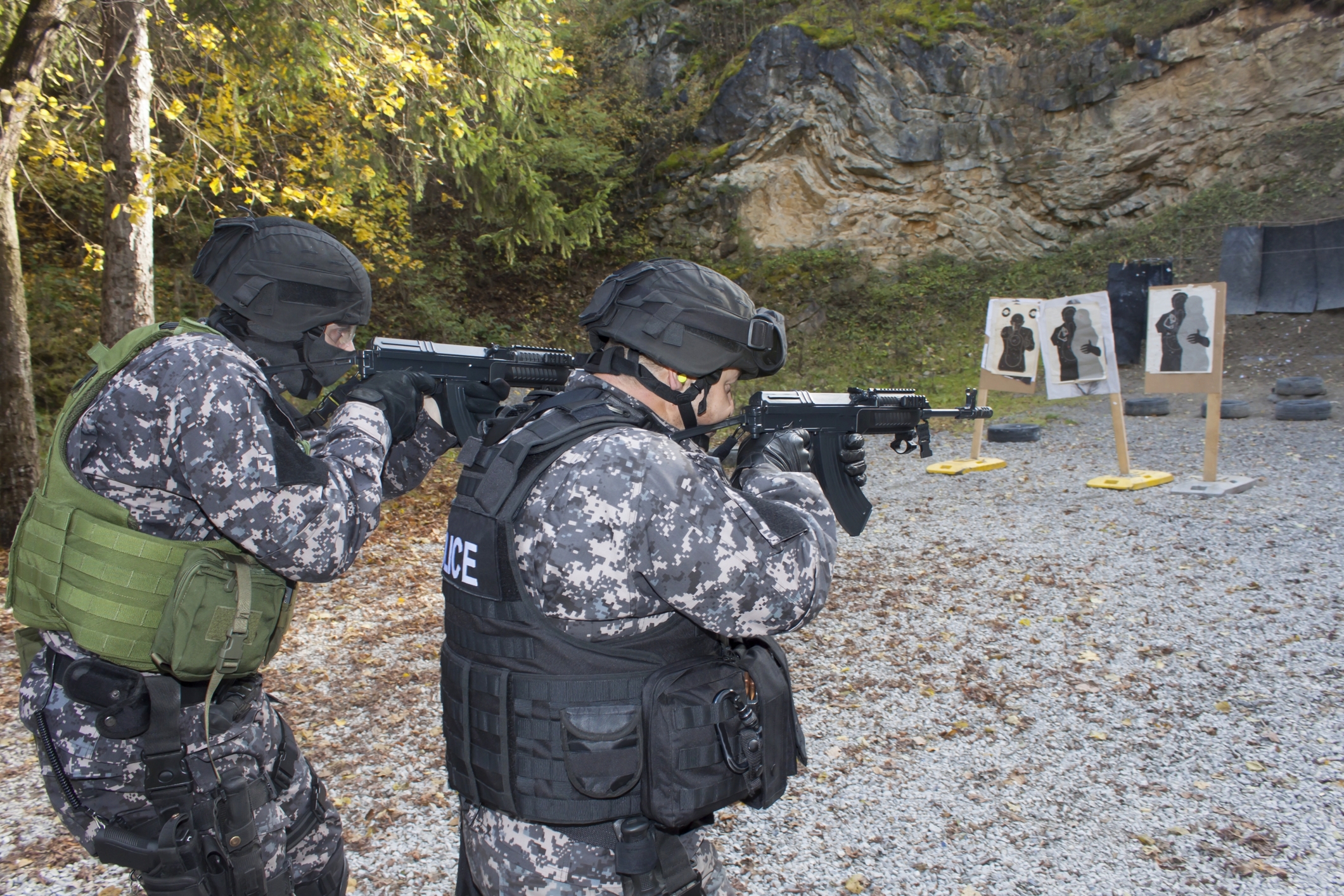
    Fight against terrorism, Special Forces soldier, with assault rifle, police swat
    © Martin Šandera | Dreamstime Stock Photos

    There is no crime so heinous that we should punish someone who didn’t commit it.

    I’ve said this frequently about domestic crime. It seems obvious, but it is also something we forget when somebody has committed a crime and somebody has been accused of the crime. People who have no idea what the evidence is are instantly convinced that the somebody accused should be convicted and punished. Evidence doesn’t matter. But if somebody (actual criminal) and somebody (accused) are not the same person, all we’re doing is encouraging the commission of another crime (well, morally if not legally) when we ask that the accused be punished.

    I’ve noticed that the more heinous the crime, the less likely people are to give consideration to whether the person actually committed it. I hope that the officials charged with carrying out justice will be duly cautious and follow evidence, but elected officials are especially subject to following the baying of the uninformed crowd. And face it, in most of these criminal cases almost all of us are uninformed. It takes serious effort, effort that few of us are willing to expend, to develop an understanding of a case that merits attention.

    I take the same view of terrorism. There is no act so heinous that we ought to punish people other than the offender for committing it. I am fully in favor of vigorously going after those who committed the crime. I celebrate the success of the French police thus far and their recent raid. I’m even in support of going after ISIS bases, provided we can do so effectively and in a well-targeted fashion. I’m not fully convinced of the effectiveness of air raids under these circumstances, and I say that as a life-long advocate of air power and an Air Force veteran, but in principle it’s a good idea.

    But when we start to take out our anger at a heinous crime on people who did not commit it, that’s something very different. Times like this, when we feel that we are under attack, demand more, not less, patience and consideration. They demand more wisdom, not less. We should not permit our fear or our anger to make us less that we should be. And I fear we are doing so.

    This is not the plea of a pacifist. I deeply respect pacifists. True pacifism requires incredible courage. But I am not a pacifist. I would be quite willing to wield a weapon or aid in military action that was properly directed.

    But taking out the hate on Arabs generally, Muslims, or even Muslims in some defined area is not going after those who actually commit these crimes. (And yes, I prefer that we use a crime-fighting rather than a war-fighting metaphor.)

    More importantly, however, we should not take out our fear and our anger on those who are refugees from the very criminals we should be hunting. I consider it morally wrong.

    It is not our military people or our police that are disturbing me. They have a job to do. But they are directed by our politicians, and what I hear from them is dangerous.

    A friend of mine put a great comment on this on Facebook. You can read it here.

  • Who Are We After 9-11?

    Any number of speakers and writers, myself certainly included, have talked about the various things we need to do to make our country safer from terrorist attacks. We’ve also sung the praises of rescue and relief workers and of various leaders during the time of crisis.

    Other countries of suffered greater losses proportionally than we did, but I’ve learned that one cannot compare one type of grief and loss with another. Besides the grief and the loss, the attacks of 9/11 made us feel vulnerable. I didn’t lose anyone I knew personally, so there is a bit of distance, but in the time immediately after the attacks we were united as a nation in a way very rarely seen.

    There’s a question that I think is more important than just how safe we are, how we will prevent such attacks in the future, and the general strategy of the war on terror. In what ways has 9/11 changes us as a nation and as people?

    An individual who goes through tragedy, loss, or extreme hardship may come out of it stronger and as a better person. He or she will undoubtedly come out changed, but that change can be for the better.

    But it is also possible for a person to come out changed for the worse.

    • Fear can grip one’s life, so that all focus is on preventing any such tragedy again. A parent who loses a child can constrict the lives of her other children so that there is as little risk as possible of a repetition.
    • Anger can take over, so that revenge is the only goal, and one can no longer deal reasonably with people who are related in any way to the cause of the tragedy.
    • Resentment can poison one’s mind, so that one cannot see clearly what needs to be done.
    • One can lose all sense of balance, resulting in a continued life of misery

    I think a nation or a group of people have many of the same options. What will you become as a result of what has happened? This question goes far beyond the immediate response to danger. I’m not chiding anyone for responding to danger. My own objections to the war in Iraq do not result from a conviction that we shouldn’t respond, but rather than Iraq was the wrong place and time for it.

    But there are other responses that I think we need to look at. About a year after the 9/11 attacks I visited my brother. I flew into Buffalo and took a taxi. The driver was a Sikh, wearing the traditional headgear. I asked him how it was for him right after the attacks. I recognized he was a Sikh, but was he mistaken for a Muslim (or Arab, unfortunately the same thing in some people’s eyes) and was he in any danger. He told me that he had to abandon the traditional headgear and wear a much smaller and less obvious head covering after the attacks, because he was taunted and had been in danger.

    Now it’s unrealistic to expect that there won’t be a minority of people who will react in inappropriate ways, often because they are already filled with rage and hate for other reasons. The major event simply provides them with an excuse to be who they are anyhow.

    We still have a certain strong tradition of freedom. It has been weakened by attacks from various directions. I don’t give either major party a “pass” on this issue. Constitutional freedoms are up for grabs when people are afraid. The one thing a politician can’t survive is appearing soft on terrorism.

    I think that is behind Obama’s vote for the FISA bill, a tragedy in my view, and the Republican sneers about making sure terrorists are read their rights.

    Those are both the result of fear, and they do not do us any credit as a people. In particular I was struck by the phrasing of “reading terrorists their rights.” The fact is that we don’t read “criminals” their rights, we read “people” their rights. Those people may be criminals, but they have rights so that we can determine whether they truly are criminals. People have rights so that we can accurately determine whether they are also terrorists.

    This idea of restricting the government from arbitrarily determining who is good and who is bad and acting on it without accountability is deeply enshrined in our constitution, and derives many of its elements from common law that goes much further back. There is no crime that is so heinous that we should punish an innocent person for it. The very idea that we would determine arbitrarily prior to any process just what sort of person an individual is should strike terror to our hearts.

    It’s quite possible for us to respond to external threats in such a way that we become our own worst enemies. Will we live in fear, or will we make a stand that says that no matter what external terror puts us through we will remain who we are?

    There will be freedoms and conveniences we must give up. We must be prepared for more security at airports (I actually wish it was more vigorous than it is), and for more scrutiny when entering or leaving the country. There are justifiable shortcuts that are necessary. While I oppose FISA as passed, there is certainly a need for wiretapping as part of our security efforts.

    I also don’t think this is a Republican or Democratic issue. If we had had a Democratic president I suspect very similar things would have happened. It’s the result of being on the hot seat, which is not so easy, despite the fluency of some of us who criticize!

    But I think we need to reflect beyond remembering the loss and remembering the sorrow, and get a very clear vision of who we want to be. If we give up who we really are in exchange for security, just what are we securing?

  • Different When WE Do It

    As I’ve watched the debates about various aspects of our behavior as a nation (the United States), I am very concerned with the way we seem to be able to rationalize things that normally would be totally unacceptable. The same action can be acceptable when we do it and a gross violation of justice when done by someone else. Something that is acceptable done to another person is a horrible violation of our rights if it is done to us.

    Here are just a few stray thoughts . . .

    When we grab terrorists and torture them, we are just protecting ourselves. When Russia does it in Chechnya, it’s a human rights violation.

    When we arrest someone without a warrant it’s a necessary part of defending ourselves against terrorism. When someone else does it, it’s an abuse of power.

    When we invade a country it’s preemptive defense; when someone else does it it’s naked aggression.

    This extends to our personal lives. As a nation we have a low view of congress, but we generally have a favorable view of our own congressman. We like it when our congressman brings home the pork; all those other congressmen ought to stop! We dislike attorneys as a profession, but we generally like our own attorney–at least as long as he wins.

    The other guy’s defense attorney is a sleaze who is prostituting himself to get a criminal off; our attorney is just using the best possible strategy to see to it that we get a just result.

    When we consider the justification–or more likely rationalization–for some of the things we are doing in the war on terror, we need to ask ourselves how we would react if some other country, or some other person, did the same things. I think we would find it much harder to justify these actions when done by others than when we do them.

    There is, of course, the argument that we must do these things in order to survive. But let me ask this: If I survive by lowering myself to the point of torturing someone else, just who is it that survived? Do I want to be that person?

    Who would Jesus torture?

  • 9-11 Links

    I want to link to a few posts from other blogs, both from the Moderate Christian Blogroll and from other blogs to which I subscribe.

    Crossinator remembers his day on 9/11/01.
    Through a Glass Darkly gives us a relevant quote from the Gettysburg address.
    Tom Sims reminds us of both positive and negative things that have come from that day.
    Levellers is observing a day of blogging silence.

    And the following don’t have anything to do with 9/11, but I wanted to mention them anyhow:

    Bruce Alderman is not going to be raptured and Christine is giving us more nifty poetry with a great picture.

    I wrote the devotional for my wife’s devotional list, and though I didn’t plan a 9/11 theme, one jumped out, grabbed me, and made me insert it. It is here.

  • JFK Terrorist Plot

    This news caught my attention not just because of its general importance, but because of the involvement of people from Guyana. I lived in Georgetown, Guyana as a teenager and have some fond memories of the country. When they mention that Abdul Kadir is a former Member of the Guyanese parliament, I’m betting most readers have to go look up where Guyana is. But when they mention he was once mayor of Linden, Guyana, I know where that is. My youth group sang and played in the town square once, oh so long ago.

    None of that is terribly relevant to the story. The important thing here is good police work, and down to earth human intelligence combining to thwart a dangerous terrorist attack. This is one of the aspects of the war on terror that I think is being terribly neglected at this point. No matter what we do militarily in other countries we will still have to have substantial security here at home. Notice that the people involved here are from Guyana and Trinidad & Tobago, two countries that are not high on the list of terrorist sources. This points out the difficulties of completely blanketing the world in the type of security we want.

    One blog I read regularly has already commented on the importance of law enforcement, and treating terrorism as a law enforcement problem rather than a military one. There is a good point here, but not a sufficient one. Treating terrorism purely as a law enforcement problem is not going to be sufficient either.

    The problem with the war in Iraq is not that it treats terrorism as a war, but rather that it stretches strategic resources without adequate return. I do think we are unbalanced in the way our resources are used, with too much going to military action and too little to intelligence and law enforcement, but that is because we are trying to occupy a country long term. Law enforcement will be much more difficult when there are countries to which terrorists can run with impunity. The key is to carefully analyze each set of actions as to cost and benefit, with the goal being security here at home, not revenge or a desire to appear to be doing something.

    This plot certainly illustrates the remaining dangers. It’s frightening to me on one point. Though they got caught by good old human intelligence (an informant), they showed a better strategic grasp than many middle eastern terrorists. The Al Qaeda attacks thus far have been aimed to create fear more than economic disruption. These guys seem to understand the value of economic disruption to their cause. We need to be on guard for attacks on this type of target.

    Of course, law enforcement at all levels involved is to be congratulated on a job well-done in foiling this plot.

  • Protecting Rights and Fighting Terrorism

    In a comment on her blog, Laura of Pursuing Holiness drew my attention to this story in the New York Times about the posse comitatus and related material about the insurrection act of 1807.

    First let me note that I consider the posse comitatus to be a good idea, but my primary point in posting about it is not to argue that point. Go ahead and read the article and study that one out for yourself.

    But the thing that worries me primarily about all of these actions is the way that we allow freedoms to be eroded without due consideration in the face of danger. There is a strong potential for trouble in both directions. If those on the libertarian side simply argue in favor of civil liberties without looking at safety issues, then eventually safety concerns will get out of hand, and popular support for certain stronger–and potentially dangerous–measures will continue to grow. We’d like to think that we can somehow get the people of the country to stand on principle though the heavens fall, but in reality, many people will give up a great deal of freedom in exchange for security.

    Amongst those who are not so libertarian (and there are people in both these groups on the left and the right), there is often a tendency to take hold of any rule that looks like it makes the law tougher and imagine that it will, in fact, increase safety. That is also very dangerous. If you pass a tough law, and safety doesn’t result, then there’s an automatic drive to get tougher and tougher until it works. I think this is part of the reasonw why we have in the United States one of the toughest criminal justice systems in the free world, and yet we also have one of the highest crime rates.

    The question, I think, is one of effectiveness. We are coming to believe our own spin. If someone on TV says that a certain action will improve our security enough times, then we become convinced that it will. If a law has a title like “Law to Increase the Security of Air Travel” or “Law to Make Everyone Smarter” we assume that each law will accomplish its goal. But when we look into those laws we may find that very little of the bill actually has to do with the topic.

    One way these things happen is when various projects are offered to particular districts in order to secure votes on some other issue. Such things are happening right now in the Iraq war vote, as Laura notes in another post. (You can follow her links to the source stories.) You might like to think that primarily your congressman is deciding whether to support or oppose a bill on principle, but that is often not the case. Why are congressmen susceptible to such pressure? Primarily because that’s what we, the people, will vote for. The key to having a strong hold on your district is bringing home the bacon, or to be more direct, the pork.

    Now I went on that detour to make this point: Because of this complex system of dealing, and because bills are often passed with many unrleated provisions attached, it is very difficult to tell in detail just what a congressman supports. Voters guides can often be accused of partisanship precisely because they have to pick and choose so carefully. John Kerry got on the wrong side of this one with his “I voted for it before I voted against it” issue on body armor. The issue gets very tangled because of the combinations of provisions.

    It was in just such a way that the provisions that weaken civil liberties in a dangerous way were tucked into a defense appropriations bill, and passed without making congressmen stand up and be counted on the specific issue. Even opponents sometimes give up on such amendments, letting them ride through because you don’t want to hold up a big bill such as defense appropriations over a minor issue. But we elect our congressmen to do just that kind of watching.

    One of the reforms that I support in connection with this issue is the Read the Bills Act (RTBA). You can find a good blog post on the reason for this bill and its intent here. This is not my central point, although it would make it considerably easier to do the things I’m about to suggest. (Hat tip on the prior post to Dispatches from the Culture Wars.

    (more…)