Threads from Henry's Web

Category: Religion

All posts relating to religion, including those on the relationship of religion to other fields, such as science and politics

  • Some Comments on Writing Introductions with Special Attention to John

    Studying JohnI’m planning to start doing some discussion of Bible passages using Google Hangouts on Air during the coming year. Basically, I’m going to work through material I intend to use in Sunday School. One may ask why I’m doing this, considering that the last time I tried, I had little success. Well, the difference is that before we just created a hangout and waited for discussion. In this case, if necessary, I’m just going to talk through the material I’ve prepared and record it for my YouTube channel. This will be my personal channel, which I’ve been neglecting for some time, not my business channel. Thus whether anybody shows up or not I’ll be talking! (Could be a sign of insanity.) Watch for more information here.

    I’m planning to follow the recent book Meditations on According to John by Herold Weiss, which approaches the book thematically. It’s that approach that I like. I will not necessarily agree with everything in the source book, but I’ll stick with the general structure. I’ll be consulting other materials, of course. Right now I’m reading The Gospel According to John (Revised) by Leon Morris in the New International Commentary on the New Testament series.

    Introductions to Bible books are a very interesting art form. One has to cover a broad range of material and draw on many parallels (or not) as well as many themes from the book in order to provide some generalities to help the user in study. The readers, on the other hand, will not necessarily be prepared to hear all of that yet, because they haven’t yet read the book. I recall one of seminary professors remarking that he wanted to offer Introduction to the New Testament and Introduction to the Old Testament as senior rather than freshman religion courses. He thought students were not ready to appreciate a good introduction until they’d been exposed to, and struggled with, more of the questions. He was only partially saying this tongue-in-cheek. I know that I’ve enjoyed reading Old Testament introductions and theologies much more since I completed my MA program than I ever did as an undergraduate.

    But the art of introduction is to provide the material without completely putting the reader to sleep, and come to some conclusions without losing your entire reading public. The problem is that by now there are so many theories on each book of the Bible that it’s very hard to sort through them all, classify them, decide what needs to be covered in detail, and then focus in on a conclusion. And then, suppose you’re wrong! What happens the someone’s understanding of the book ? We consider context important, and this sets the context, but it’s also easy to place a book in the wrong place.

    For example, was the gospel of John written before or after the destruction of Jerusalem in 70 CE? The consensus indicates it was written later, but there are a number of clues in the book that point to an earlier date. Then there are multiple theories for the origins of the book. Does it involve sources, or was it written more or less as is? How many sources and what did they contain? And whether or not there were sources, who was the author, and if you have sources, who authored them and who was the final redactor? All of these questions have an impact on how you will understand the book.

    I’m reading conflicting introductions right now. Leon Morris leans toward Johannine authorship of the gospel and the epistles, and also toward an early date. Herold Weiss tends to see sources, a late date, and an unknown author. I kind of like that as I get to look at both sides. And the thing is that I find lots of reason to doubt almost all conclusions. In this sort of a mass of theories with evidence light on the ground doubt is a very reasonable position!

    I consider myself a defender of biblical criticism. I appreciate such methods as form, source, and redaction criticism. The problem is that to a man with a hammer, everything looks like a nail. To a biblical scholar with form criticism on his mind, everything is an orally transmitted pericope. To a biblical scholar with redaction criticism on the brain, everything appears to have been added by one redactor or another. And with all due (dis)honor to William of Okham, entities are multiplied all across the landscape. I believe there is orally transmitted material in scripture. I believe there are books that are constructed from sources. In fact, Samuel-Kings identifies sources. I believe that there have been redactors. But the details are very hard to pin down.  The more general ones can be stated with some certainty, though not beyond reasonable doubt. the more detailed the conclusion, the less certain one can be.

    Now in the gospel of John, I’m not sure that there are really sources in the classic sense of the word. It seems to me to be a rather heavily united work. Are there stress lines? Yes. I see some places where it doesn’t seem to be sewn together as well as we might like. But after publishing more than 125 books, I can’t count the number of times I’ve told an author, “You’re transition here doesn’t make any sense.” Books written by human beings don’t always meet the criteria of the theology professor in the ivory tower. That’s because it’s hard to find the Bible book written by someone in an ivory tower!

    So was John written by the apostle John or another eyewitness? Is it valuable in studying the historical Jesus? First, let me note that I’m quite weary of reading discussions that hinge entirely on preconceptions about historicity. One senses that certain scholars don’t want any of the gospels to be written by eyewitnesses, because that would suggest too much historicity in the life of Jesus. It’s easier to dismiss if we don’t have actual eyewitness reports. On the other hand we have folks who must conclude that the gospels were written by eyewitnesses because they must be history. We can determine who was the author based on the evidence (if there’s enough) without necessarily giving up everything else.

    For example, I’m not nearly as excited about eyewitness testimony as it seems everyone else is. This comes from my experience with storytelling and hearing. My mother is now 96 years old, and we can sit down with various family members and get into some amazing disagreements about what went on. I remember a rare occasion in a recent discussion when I disagreed with my mother on something that happened and she said, “You know, I think you’re right.” That was astounding. Normally I defer to her because, quite frankly, she has a better memory than I do. But as I compare my memory with the stories others in the family tell, and compare their memory in turn with what others remember, I find that human memory is rather fallible, especially as our lives move forward. Since our family seems to be fairly long lived on both sides, I’ve had plenty of opportunity to hear stories evolve over time.

    But perhaps a better parallel to oral transmission of stories in the gospels is my experience in church discussing reports of contemporary miracles. These stories also change. Persons with more authority in the group tend to tell the most authoritative version, and other people’s stories will converge toward theirs. Over time, there will be different versions. If you were there, you may not recognize the story by the time a few years have passed.

    As a result, I no longer conclude that if we have eyewitnesses, we somehow have a reasonably accurate history, and if we are hearing from the next generation, we immediately do not. Rather, stories can achieve new highs or new lows within hours or days when humans are involved. In my opinion, there is history to be derived from the gospels, but since our kind of history is not what the gospel writers were aiming at, it’s not surprising that it’s hard to achieve. The question is how well the achieved their own aims.

    And so we come to the question of whether any gospel, and particularly the gospel of John, were written as history. The answer, in my view, is yes and no. The problem is that we tend to take this as a binary question with an easy “yes” or “no” answer. No, I don’t think any gospel writer sat down to write history. By that I mean that they did not have as their primary consideration recording of facts in historical sequence for the purpose of providing a precise view of what happened. But that doesn’t mean that they didn’t care what happened at all. What they were interested in was in presenting the meaning of what happened. God has intervened in history and has been present in the person of Jesus of Nazareth. What does this mean? Now to get to the second question means that you have to have some basis in actual events, but your presentation and what you think is important may be different.

    In this I take an example from preachers’ stories used as illustrations. There are some stories that have been repeated many times and now exist in many different versions. But generally differences come from the lesson the preacher wants to take from that illustration. The story will be shaped to its final purpose. That may annoy a consistency freak (and I confess to being disturbed by stories that exist in more than one version), but it’s natural human story telling. Thus we get different numbers of demoniacs when Jesus crosses the sea, or different numbers of times that the cock crows, or that Peter denies Jesus. I think efforts to reconcile this stuff are doomed to failure and of no practical value. In fact, they are some of the best evidence that we’re dealing with real stories told by real people. If someone made it all up, they’d be more consistent.

    So I’m open to the idea that John the apostle wrote the gospel, and that it does, in fact, contribute to our knowledge of the historical Jesus. But I’m more interested in how it contributes to our understanding (rooted in history, yes, but not stuck there) of who Jesus was and is. Interestingly enough, I find that when I read Weiss’s essays, I don’t suddenly find that I must reject his conclusions if I change my mind about the dating of the book. (I haven’t changed my mind about the date, but I might, and I don’t hold my current view of a late date very tightly.)

    As i study the book I’m going to be focusing on theology, but always mindful of history. I’m really enjoying the journey so far.

    PS: A couple of resources from Energion Publications on this topic.

    9780954018719

    Meditations on According to John

  • Rambling Through Ephesians

    Rambling Through Ephesians

    Wedding Band with Ephesians 3:14-21 insideThis past Sunday I was reading the Lectionary passages for Christ the King Sunday in which the epistle is Ephesians 1:15-23, in which Paul gives thanks for the Ephesian believers. I find the style of Ephesians quite fascinating, and especially these long prayer passages. In fact, I used two of them in a pamphlet I wrote some years ago, Prayer Scriptures for Prayer Warriors in which I paraphrased some passages of scripture into the form of prayers.

    The image to the left is of the inside of my wedding band, which is inscribed Ephesians 3:14-21. This passage of scripture was read as a prayer and Jody’s and my wedding, and it’s something we want to be reminded of regularly.

    As I finished reading Ephesians 1:15-23 I couldn’t help but go on reading. I ended up reading the entire book and then going back and reading the first 14 verses as well. There were a number of things that struck me and I’m just going to mention a few thoughts that came to me as I read. One element, that of thanksgiving, stuck with me through the week. I’m going to blog about it for my Energion Publications thanksgiving message. This is a rambling post as the title indicates, so be warned!

    Even though I read 1:1-14 last, let me start at the beginning of the book. Right in verse one the words “by God’s will” stood out to me. Paul is an apostle by God’s will. Frequently I think we remember our will and our gifts in connection with whatever vocation we follow. We may acknowledge God’s call, but we remember mostly the human process and recognition. I have heard people talk about who was involved in laying hands on them and praying, as though this was more important than the call of God. I do not want to diminish the historical connection to the community that’s involved in the human recognition, but I think we’re in much more danger of forgetting that we are who we are by God’s will. I can say, “I’m Henry Neufeld, publisher by the will of God.”

    Now there could be a tendency to make this a matter of pride. I am what I am by God’s will, therefore all must recognize how important I am. But this isn’t the point here at all. In fact, we will see some comments on our call later, the call to be a servant, not an overlord. We like to read “chosenness” and “calling” as something that makes us special and puts us above. That’s not the way it works in God’s kingdom.

    I’m going to skip past the entire Thanksgiving prayer of 1:15-23, as I plan to base a thanksgiving message on it, but it has been an encouragement to me all week. I’ve been thinking about thanking God  always, particularly for people. Who are the people you can thank God for?

    Ephesians 2:8-10 provides one of the greatest encapsulations of the gospel in a few words that we’re going to find anywhere. I think if we read it frequently, it would help us. We’re saved by grace through face, and it’s not the result of works. But at the same time one of the gifts God gives is to begin restoring to us the purpose for which we were created. One analogy I like to use for salvation is that it is like the gift of a toolkit. A toolkit is a wonderful thing, but merely having it is not very useful. There are many things it can do. Now the toolkit analogy can break down. All happens as God works in our lives. Both our justification and our sanctification are God’s gifts to us. We may debate the matter of choice between Arminians and Calvinists, but whether we have a choice about receiving this gift and remaining in God’s plan, but in either case it is totally God’s power.

    2:20-21 – the foundation of the apostles and prophets and Christ the cornerstone remind me of Hebrews 1:1-4 and 2:1-4, an interesting set of parallels.

    3:12 – both “access” and “boldness” remind me of Hebrews 4:14-16.

    4:1 – walk/live in a way that is worthy of your calling. I tie this back to verse 1, by the will of God. Our temptation is to think “special me.” God seems to see it the other way around. We need to live up to the calling. Continuing through verse 14, look for all the instances of various forms of “one” and “all.” It’s an interesting theme. Again, this looks back to our calling. We are always called to help build up the body.

    4:15 – “speak the truth in love” is one of the most difficult ones to keep, but the most important. We are often tempting to abandon truth for a form of love, or, on the other hand to abandon love while we boldly defend some height of truth. Very few are the vigorous defenders of truth who nonetheless are able to do so with respect and in love.

    4:22 – I’ve heard Ephesians and other epistles divided between the faith and salvation part and the “works” or the “what then” part. Ephesians mixes these together with another example here. It is because Christ is faithful that we can leave behind the former behavior.

    4:34 – giving grace to others. There is a call of grace. We are treated graciously and called to gracious living. God provides the example

    5:1-2 – imitators of God. That’s a high standard, but it’s one that is quite common in scripture. This is one reason it’s very important to look at the nature of God. If we are to be imitators, we need to know what God is like. Is God a God of violence or gentleness? Love or hate? Or are those alternatives actually appropriate? Perhaps God combines characteristics in ways our minds find difficult to comprehend. “Be imitators” is a challenging task.

    We should note further that this opens the section on family relations, which is often read as though it is about authority. But as we get to 5:25 we realize that husbands, whatever else they may be charged with, are to love their wives as Christ loved the church. That means being ready to die for her. If we’re fighting for any position here it’s for the privilege of being the first to die. Any volunteers?

    Of course chapter 6 brings us the familiar “armor of God” passage. We should remember that this armor is designed to be used in fending off evil, not in attacking other people. The spiritual warfare metaphor can be very helpful, but if someone doesn’t pay attention to the entire message, it can be used very destructively. I’d strongly recommend the entire book of Ephesians so as to understand the context in which the armor is provided.

    Be imitators of God. Imitate God. Ouch! Wow! I think that one will stick with me for some time.

    You may wonder why I wanted to ramble through this book. There are two reasons:

    1) I’m frequently asked how one can enjoy reading the Bible. Many people find it to be a task. I don’t find it easy to answer this question empathetically. For me the odds are more that I will get carried away reading the Bible and get lost in thought. I didn’t come by that attitude by my own efforts. To a large extent it started with the way my parents taught me. Scripture can be hard to follow in early reading. The first time you read through the Bible or even just the New Testament you may find it slow going. But the more you know, and the more you can draw connections, the more interesting it gets. My early studies of computers were similar. I had to put the work into early reading so that later reading could be much easier. In the case of the Bible, my parents got me started, and it’s a start I’ve been thankful for ever since.

    2) It’s important to do devotional study. One of the strong temptations of my life is to neglect my devotional life while telling myself it’s OK. I’m reading plenty of Bible passages in preparing to teach Sunday School or to write something. I’m usually at some point in the editorial process of a good Christian book. So my excuse for not doing devotional reading is that I’m reading plenty of scripture. But you also need to spend time with God through scripture, not checking references or debating someone’s theology or preparing a manuscript. Ephesians  has stuck with me through the week and helped me deal with certain things that were going on. If I hadn’t let God lead me to do this reading, I would have had a more difficult time during the week.

    So I encourage you to find time for devotional reading, time when God can lead you to the next passage or the next thought. And keep at it until it becomes second nature to you, however long that may take!


  • From My Editing Work: Discipleship Is Costly and Liberating

    From Reframing a Relevant Faith, forthcoming by C. Drew Smith:

    When Jesus comes upon these fishermen they are doing what they normally do on any given day; they are fishing. Indeed, this was their life; this was their existence. Fishing was what was routine and comfortable for them. While their occupation as fishermen was hard work that brought many challenges, it is what they knew and it is who they were. Yet, when Jesus calls them, he calls them to leave their lives as they know them. He calls them to turn away from their normal existence and to let go of what they know best. How costly is such a decision?

    While leaving fishing may not seem big to us, let’s take into account what Jesus demands from another. A rich man approached Jesus wanting to know how he might gain eternal life. Jesus told him to keep the greatest commandments; to love God and to love others. Jesus then told the man, “Sell all your possessions and give to the poor.” At this demand, the man turned away, refusing to accept the cost.

    We must be careful not to distance ourselves too much from this story. In calling us to follow him, Jesus always demands that we relinquish our claims; our claims of independence, our claims to security and freedom, our claims to what we own, and our claims to live our lives as we see fit. To answer the call of discipleship is always costly. If it is not, it is not discipleship.

    Yet, even as we speak of discipleship as costly, we must also view it as liberating. The call to the two sets of brothers to leave what they know, what gave them comfort and security, is at the same time a call to find liberation and hope in something that is transformative. While their lives of fishing certainly gave them a sense of normality, they were unknowingly missing what authentic life with God was like. Jesus’ call for them to leave their nets and follow him was a call to embrace a new liberating existence. (pp. 75-76)

    I just sent Drew the proofs for this one. It’s still available for pre-orderm but will be going to the printer in the next couple days.


  • When Fear Drives

    When Fear Drives

    Recently the topic of risk and danger has come up in several discussions of Christian Ministry. Shauna Hyde, who I interviewed along with Chris Surber, has spent the night in tent town with homeless folks and earned the informal title “vicar of tent town.” People have told her she’s crazy. But she manages to live the gospel and build relationships that wouldn’t happen any other way.

    Chris Surber, involved in the same interview, is headed to Haiti with his young children. There are folks who claim he is crazy for doing so. He describes some of the comments in his forthcoming book Rendering unto Caesar.

    Back in the days when I had a newspaper route (annoying work, but it happened at night, which was convenient), I would regularly stop to help people in the “bad” neighborhood in which I worked. I recall one Sunday morning when I stopped and just kept my headlights on a man who was changing his tire. He was very grateful. When I mentioned this in my Sunday School class it derailed the discussion as people informed me how I shouldn’t risk my life in this way.

    Such, I think, would have been the Sunday morning conversation had the Good Samaritan been a Sunday School teacher and reported on his stop on the road to Jericho. His stop, I think, was much more dangerous than my sitting in my car with the headlights on.

    In an interview regarding hospitality, the subject of danger came up again. Chris Freet has written a book titled A New Look at Hospitality as a Key to Missions. As soon as we began to discuss hospitality, we had to discuss danger. Strangers actually invited into our home? Perhaps we need to rethink this and use some central location with proper regard for security. After all, in the 21st century we have sexual predators and various violent types among the broad category of people classified as “strangers.”

    I have to ask myself whether the 20th or the 21st century is more packed with dangerous people than any previous period in history. I really doubt it. As Christians we claim to be followers of Jesus. It was not entirely safe to do these things when Jesus commanded them. We can’t claim that additional dangers in the 21st century have rendered these commands null and void.

    My parents were always hospitable. Many, many times we had guests at the dinner table. You could not visit my parents’ church without receiving an invitation to lunch afterward. My parents would never have considered allowing you to leave unfed. They just never did it. We did this when we were overseas as well. We took people into our home. It was something I felt was normal. How likely are you to get invited out to lunch in a 21st century American church?

    And it was not without risk. Once when my parents sheltered a woman and her child in our home the result was that we had to flee as angry people approached intending to kill us. This was eventually settled and we returned to our homes, but there was certainly risk.

    We have story after story of missionaries risking their lives and the lives of their children. I was allowed to go on mission trips into the mountains of Chiapas, Mexico when I was eight and nine years old. We’d travel through the mountains, accept the hospitality of the villagers, and conduct clinics. (My father was an MD and my mother an RN.) My task was to carry out the garbage, get supplies and deliver them where needed and to carry messages. Was there risk? Of course there was! What would happen if one of us was injured in these isolated areas? After all, the reason we were there was because medical help was not readily available.

    1893729222My mother tells a story about me. It embarrasses me a bit. Don’t think that I was some sort of extraordinarily spiritual child. What I’m interested in here is her actions. This is extracted from her book Directed Paths, pp. 51-52.

    Even a child is known by his doings, whether his work be pure, and whether it be right.

    Proverbs 20:11

    While we were in the Chiapas mountains, a measles epidemic broke out in the nearby village of Rincon. Many were dying. They sent to our clinic for help. Although nurses and helpers were in short supply, we sent as many as we could to give penicillin and help with treatments. Our older children, Betty Rae and Robert had returned to the states for school. Patty, who was twelve at the time, went to Rincon every day to help.   She wanted to be a nurse and this was a great experience for her. The need was so great, the nurses taught her to give shots and helped her to learn how to do treatments. At the time, Henry was only eight but he begged for permission to go help. I knew he could be useful in helping to carry food, water and run errands, but he had never had the measles.

    He kept saying, “Mama, please let me go. Patty is helping and I want to help, too.”

    “But, Henry, Patty has had the measles. You haven’t. I don’t want my little boy to die.” I told him.

    His answer stunned me, “Jesus gave His life for me, and why shouldn’t I give my life for the Chamulas?”

    I had no answer to that. The next day, Henry went with the group. He was a great help. He also got the measles which made him extremely ill. We thought he truly was going to give his life for the Chamulas. We provided nursing care, treatments and penicillin, but Jesus did the healing. Henry made it and the glory goes to God.

    I believe that many 21st century folks would be horrified by her actions, because I see them react with horror at so much less risky actions. It’s possible some would consider this child abuse. We admire the courage of missionaries at a distance, but are otherwise somewhere between concerned and horrified. I’ve heard the same responses to the idea of people going to help with the Ebola outbreak. Close everything off. Don’t let there be any risk.

    Can followers of Jesus say that? I think not! I think the same force of the love of God that had Jesus reaching out, touching, and healing the lepers should drive Christians. The fact of risk is not a reason to quit carrying out the gospel commission nor is it a reason to quit actively loving and helping our neighbors. And it is no reason to allow ourselves to be shut down.

    What is right remains just as right under threat of death as it ever is when we’re in complete safety. I know it’s a great deal easier to say that than it is to put it into practice. I don’t proclaim myself a paragon of virtue. I can name so many people who have done or are doing bolder things than I have even considered.

    But the call remains the same as it was when Christians faced the lions. Will the American church be driven by fear or by the gospel commission?

  • From My Editing Work: Claim Your Identity as a Theologian

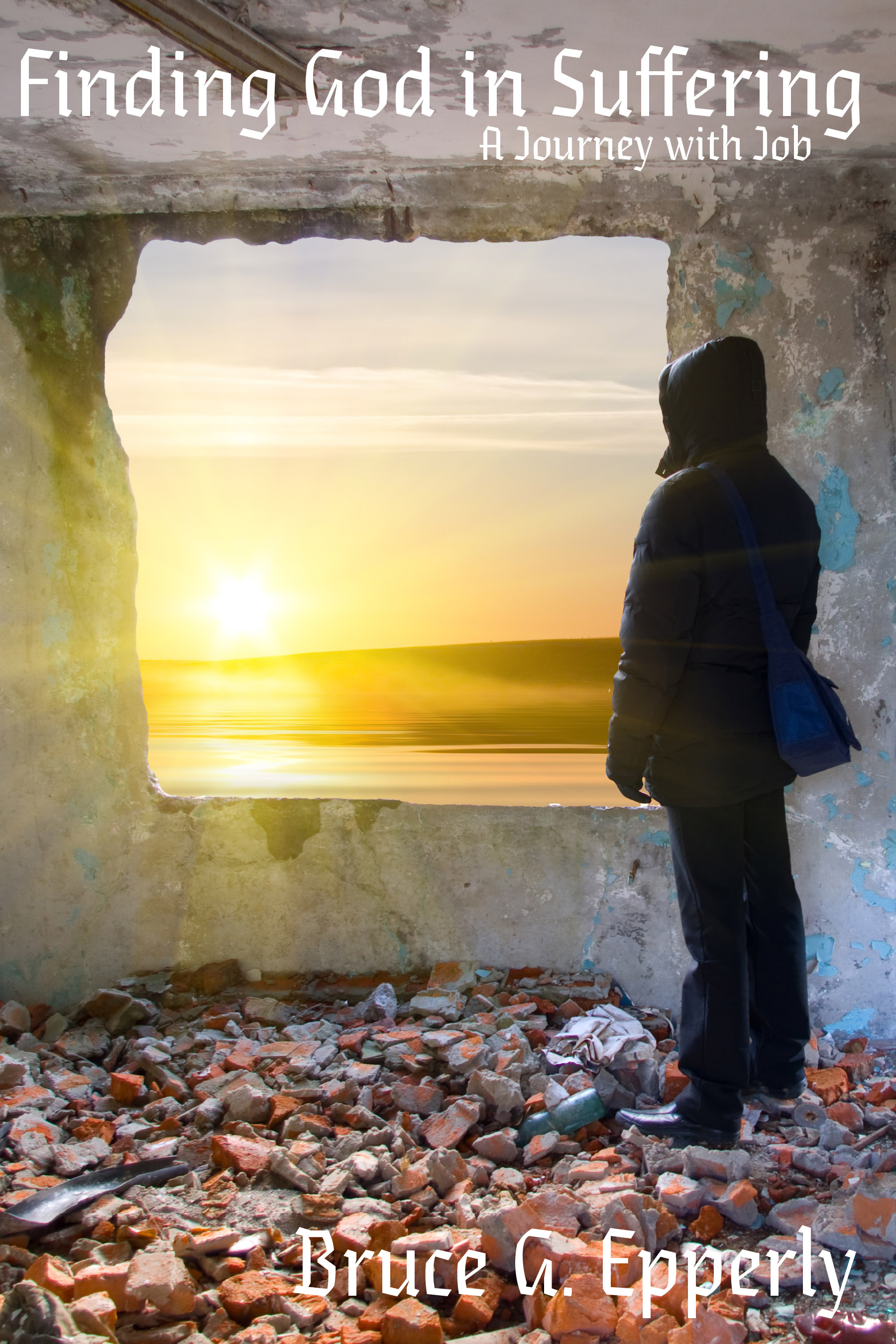
    Finding God in Suffering: A Journey with JobFrom the forthcoming book Finding God in Suffering: A Journey with Job by Bruce G. Epperly.

    The book of Job invites us to claim our identity as theologians.  Job shouts out to us, “You are a theologian” because we have experienced the pain of the world and are trying to make sense of it.  Job shouts to us: “Don’t let the word ‘theology’ put you off.  By whatever word, we strive to make sense of the senseless and meaning of the meaningless.”  We become theologians the moment we begin to ask hard questions about life and the One who creates the universe and gives birth to each moment of experience.  Theology asks questions of life, death, meaning, human hope, and immortality.  It also raises questions about the meaning and purpose of our brief, and often challenging and ambiguous lives. For Job, theology and spirituality are intimately related.  As Episcopalian spiritual guide Alan Jones once asserted, spirituality deals with the unfixable aspects of life – or what I would describe as life’s inevitabilities.  Sooner or later even the most fortunate of us must make theological and personal sense of what is beyond our control, while taking responsibility for what we can change.

  • The Potential Arrogance of Moderation

    Before you continue, look at the tag line for this blog. I self identify as a moderate, though I have a somewhat eccentric view of being moderate.

    My view of moderation doesn’t really solve the problem, however. As a moderate, I believe I should examine the whole spectrum of views on any issue before trying to select a particular view to advocate. There are two reasons for this: 1) There’s no guarantee where on the spectrum the best approach on any issue will be, and 2) If compromise is necessary, as it may well be in a variety of social or political situations, I know what the options are. I’m not a centrist, i.e. I don’t believe that I need to be toward the center on all or most issues. My actual beliefs, politically and doctrinally, may be on different sides of the spectrum on different issues. For example, I can (and do) believe both in drug legalization (for the most part), but at the same time believe in fairly vigorous law enforcement.

    But there is a potential for arrogance in this view as well. Let me just illustrate this personally. Every day I see a stream of social media posts from people in a variety of points on the political and religious spectrum. No day goes by without me sighing a bit at some people who seem over the top about one issue or another. It’s very easy for me to become arrogant and think, “Wow! I’m so much smarter than all those people who get so worked up about ______.” If I’m on one side of the spectrum or another, I get a double dose of feeling superior. I’m so unextreme! “Lord, I thank you that I am not as other people are, overwrought over so many extreme political or religious positions.” You should pardon the paraphrase.

    But a moderate position, or each position that falls within it, is an opinion on a topic as well. It is something that I prefer, something that I advocate. It may be that I am not passionate enough in my own advocacy of that position. It’s easy for moderates to sink into apathy and spend their day not advocating stuff. It’s also easy to decide that because others are so extreme, a lack of a position on an issue is a better.

    But people’s passion is not wrong, and a lack of a position is not a virtue. In many cases my decision to advocate on some issue or another is a strategic one. Where should I spend my time? What is my emphasis going to be? As a publisher, I place myself as an advocate of advocacy. I’m looking for passionate people to write books about the subjects that drive them. It should not be surprising that they are, in fact, passionate about the issues they write about. In fact, some of them are passionate about not being at the extremes, and that is also not a bad thing.

    One of the positions I’ve noticed (and participated in) is a desire to draw Christians back from being too invested in the politics of this world. I believe we should be involved, but always remember our commitment, our ultimate allegiance, is elsewhere. But even this can be a cause for arrogance. If I can take the election results more peacefully than my neighbor, that makes me so much better as a person, doesn’t it? Actually, I think not. I will suggest some moderation in tone, but you see, that is a position as well. I think reasoned advocacy and relationship building is the better approach to dealing with political and religious issues.

    Wow! Who’d a thunk it? I must be a moderate!

  • Author Interview: Christopher J. Freet on Hospitality as a Key to Missions

    Tonight in our Tuesday night hangout series, I will be interviewing Christopher J. Freet, author of the newly released book A New Look at Hospitality as a Key to Missions in the Areopagus Critical Christian Issues series regarding the topic of hospitality. We are open to audience questions. You can view this event on the Energion Publications Google+ page or use the embedded YouTube viewer below.


  • Some Thoughts on Ecclesiology from Someone Utterly Unqualified

    Some Thoughts on Ecclesiology from Someone Utterly Unqualified

    Several things I’ve written lately lead to thoughts on ecclesiology, though that is hardly one of my subjects. People do sometimes make assumptions because I’m a member of a United Methodist congregation. So I’m going to make this personal, first saying why I am in a United Methodist congregation and second saying what I see as ideal in a church. This is just a bit of rambling—fair warning!

    I prefer to call myself a Christian who is a member of a United Methodist congregation rather than a Methodist. That can be clumsy, but I don’t think of myself so much as a member of the denomination as of the local church. There’s a fairly simple reason why I’m part of a UMC, and that reason can be found in the early pages of the United Methodist Discipline. While I am hesitant to identify fully with a theological stream, the doctrinal standards of the United Methodist Church come closest of any I know to what I can affirm. There are less restrictive statements I could also affirm, but they tend to affirm too little, in my view.

    My great disappointment with United Methodism is that so few Methodists are aware of this theological heritage. I’ve written about this before. The pastor of the first United Methodist congregation I joined confessed to me later that when I came to his office and borrowed a copy of the Discipline, he thought it was likely I would never return. If I had read the later parts about organization, committees, and so forth, it’s quite possible I would have been driven off. Sometimes I feel one requires legal training to navigate the authority structures of a United Methodist congregation.

    I should confess that, in addition to a lack of training in church administration or ecclesiology, there is another reason I’m utterly unqualified. My attempts at involvement in church politics or governance have not been terribly successful. They have generally been bad for my health and not very constructive for the church. I do well in one on one encounters. I’m much less successful at committees. And whether they call them “teams,” “working groups,” or just “committees,” these groups of people make a UM congregation run—or not. My observation is that most Methodist churches function because the actual power structure knows how to work its way around the paper power structure. That could be excessively cynical. When I joined my current church, I told the pastor that if he needed someone to park cars or teach Sunday School I was there for him, but if he needed someone to be on any committee, count me out.

    But my ecclesiology is not formed particularly by the structure and order of the United Methodist Church. I find that the hierarchical system tends very much to spend its time maintaining the institution and then wondering why the acknowledged work of the kingdom isn’t really happening. Pastors are moved in an arbitrary way, often without regard to the state of whatever ministry they’re carrying on where they are. Relationships between pastors and churches are hard to form, unless the church is large and has a greater influence on who will be on the staff and how long that person will stay.

    That set of complaints may sound negative, but I don’t see the United Methodist system as horribly deficient either. It has its problems, but in my experience so do all other systems of governance that involve humans. While the UM system may move a pastor when he really should stay, congregational systems often pair dysfunctional pastors and congregations until both pastor and congregation are spiritually dead. While the hierarchy may make for a certain amount of political structure maintenance, it also provides both connections to other places, and can move a dysfunctional pastor before he or she does more damage. Large structures allow the church to bring a wide range of resources together to accomplish great things.

    Unfortunately, I don’t think that either system guarantees that any of these great things will be accomplished. the combined resources of a large denomination could do great things, but they often get siphoned off to maintain a great headquarters building (or something similar).

    Summary: Every kind of church structure I’ve experienced (and I haven’t experienced all) has it’s problems and its benefits. While there may be a form of organization that’s better than any other, I’m not sure what it is.

    There are, however, some principles that I would want to see. If I could find a church manifested some of these, I think I’d want to make it a base of operations:

    1) Recognition of more than one form of ministry. Modern churches tend to recognize pastors and put them in charge. There aer more gifts and more offices. I think setting people apart by laying on of hands should apply to all the various ministries of the church. The pastor doesn’t need to be a church administrator, publicity coordinator, facility manager, and general problem solver. There should be evangelists, teachers (sometimes pastor-teachers, sometimes just teachers), administrators, helpers, and yes, prophets. (See Ephesians 4:11-16, though I don’t regard the list as exhaustive.)

    2) Because there are many forms of ministry, everyone in the congregation is set apart. I’d like to be part of a congregation where the assumption is that everyone will have some sort of service. Let’s lose “member” vs “attends” and think of “attends” vs “active.” In my book Identifying Your Gifts and Service: Small Group Edition, I call for every member to become a gift spotter. The assumption should be that being part of the body means exercising gifts for the body.

    3) Communion, preferably in the form of a common meal, becomes the center of congregational gathering. This would be what we do for a “worship service.” I have a fairly high, sacramental view of the communion meal combined with a rather low view of ordination. I think the Spirit of God in the congregation is what should authorize communion. I don’t believe that there should be a distinction between clergy and laity, but rather a distinction between different varieties of servants. We set people apart not because we make them better than others, nor because we acknowledge them as better than others, but because we acknowledge that they serve in particular ways with particular gifts. When this time of communion occurs, I believe that God is really present in the elements and in the people through His Spirit.

    4) Leadership is strong, but is plural. There is no single person whose personality is stamped on the church. I believe this can be carried out under many different types of polity. One of the weaknesses in the Methodist system is that a pastor gets a level of respect because he’s sent by a bishop, and the bishop is way up there, so to speak. So the church centers around the pastor’s views and wishes. A pastor who wants to have a successful career will tend to work the nomination system and stack committees, especially the Staff-Parish Relations committee. Then a new pastor will come, and he may have a different personality. I believe that a church needs to have more people who exercise real leadership. I know there can be real problems with this, but as I’ve noted before there are real problems with any system that involves people.

    5) The church builds connections with a variety of other churches. The Methodist system speaks of connectionalism, and this is a great characteristic. I’d prefer to see a greater degree of connection between churches of different denominations down the street. So I see connections as important, but I think that they should not be restricted to one denomination.

    6) The church is accountable in some way. In the Methodist church, this accountability is to the bishop and to the structures of the church. I think more independent congregations can choose to be accountable. The only way to know what’s going on is to observe.

    7) The church has an identifiable, known set of theological essentials and affirms freedom in other areas. I know this stresses people out on all sides. Some don’t want any definition. Others prefer very limited freedom of teaching. I think the most mature congregation will be produced by having a carefully chosen and defined set of essentials and then allowing free discussion outside of that. I think there are many topics that should be non-essential and open to a variety of views.

    8) The majority of church income is used for outreach and service. As long as the majority of our money and effort is used to maintain the physical structure and the political forms, I don’t think we’re where we need to be. To be clear, what I mean is more than 50% of the money received by the church is going somewhere other than maintaining the congregation itself. Since I’ve been told that 5% is considered “mission minded” for a United Methodist congregation, I think this may be the hardest one.

    There’s the saying that if you find the perfect church, you shouldn’t join it. You’ll spoil it! I don’t think this is the perfect church, but it’s one I’d be willing to try to live up to.

    In the meantime, however, I believe that the local congregation of which I’m a member is doing a great deal of good ministry. The gospel is preached. I’m particularly impressed with programs for children and youth, and the educational program is moving forward. It’s too bad that it’s hard to get 1,000 people out of a congregation of > 3,800 to attend on a Sunday morning, but I think the pastoral staff have done a good job. No, it’s not my description of an ideal church, but to be honest, I don’t expect to find one of those. But where I have a chance I’ll keep advocating …

    Note: As a publisher, I publish some books by people more informed on these topics. I’ve been particularly impressed with two recent releases from opposite sides of the theological spectrum, Dr. David Alan Black (Southern Baptist) and Dr. Bruce Epperly (United Church of Christ). Dave’s book is Seven Marks of a New Testament Church and Bruce’s is Transforming Acts: Acts of the Apostles as a 21st Century Gospel. It’s interesting to see people from across the theological spectrum looking back to the book of Acts and the early church to learn how we might move forward in the church today. Don’t blame them for my ideas. Each has his own, and they are both worth reading.
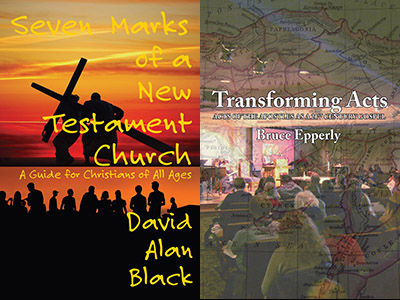

    seven marks and transforming acts

  • Yet More Hebrews and Old Testament-New Testament Continuity

    One of the things I love about both blogging and publishing is the number of interesting and capable people I get to interact with. It’s something I’ve missed since graduate school days—the opportunity to run my ideas up against people who can really challenge them.

    Dave Black has written some commentary on this matter of continuity between the Old and New Testaments. I’ve extracted the relevant entry from his blog and reposted it to JesusParadigm.com. (For those who don’t know, Dave’s blog doesn’t provide a way to link to a particular entry.) If you haven’t, read Dave’s notes. There is a great deal there. I intend to respond to the matter of who I publish over on the Energion Publications blog. (I’ll add a link here once I’ve done that.)

    I think Dave and I are quite close to agreement, though I do think we have some difference of emphasis. Perhaps his is a more radical approach, and I think the parallel to ecclesiology and the Anabaptist movement as opposed to the more traditional reformers. In fact, labeling them “more traditional” may summarize the whole issue. This does not, of course, tell us who is right. I think my difference with Dave here would be that I allow for more variation for time, place, and culture. I think that is in one sense a minor difference, but not truly insignificant.

    The problem with radical reformation is that it may get derailed in practice. As I read Scripture, God has always led his people with some consideration for their starting point. I’ll say a bit more on this in a later paragraph regarding the study of Torah. So the perfect, or even the “better” becomes the enemy of the good. I see this in my own church. I can look from one angle and say, “There is so much wrong with this church.” (Some might note as a problem that it has Henry Neufeld as a member!) But if I look from another angle, there is so much that is going right in the church, including the fact that the gospel is being preached there regularly. What do I want to reform and when do I want to reform it? Of course, the reality is that I have very little to say on that. The pastoral staff and the church council do most of that work, and I’m involved in neither group.

    But there is a problem with the “gradual change” folks as well, and I think the reformation provides examples of this. Gradual change often becomes stagnation. We don’t become more Christlike on a continuing basis, but instead become, in our own eyes, more Christ-like than our neighbors and then hang out there, or even begin deteriorating from that point. I think that if you look at the energy and focus of the Methodist movement during John Wesley’s lifetime and then at the United Methodist Church now, you don’t see progress.

    But how does this relate to the Old Testament/New Testament continuity or discontinuity?

    To steal a phrase from Paul: Much in every way!

    I see the progress from the Old Testament to the New as one of moving to the next chapter of a book, one that we, as Christians, see as the climactic chapter. So there is a substantive change as we enter into the final phase, the solution of the whole mystery, the resolution of the conflict. That is very different. But at the same time, we should not say that previous chapters were bad because they weren’t providing the whole solution. Rather, those chapters led up to the final chapter. They provided the clues. They provided the background. the seeds of the conclusion were planted there.

    The priesthood of all believers, for example, is foreshadowed in Exodus 19:6, but it is a strong New Testament concept. The latter verses of Exodus 20 (after the giving of the 10 commandments) tell us something of why. The people were afraid and didn’t want god speaking directly to them. There was comfort in having Moses and Aaron handle that part for them. There was comfort in having a priesthood. I suspect that the priesthood of all believers frightens us now for the same reason. We share the same human failings as the people around Mt. Sinai. We’d like something solid and comfortable that doesn’t tell us things that are upsetting. They turned to the golden calf. We turn to our denominational structures. “We’re Methodists,” I’m told, “We don’t do things like that.” It’s the same avoidance.

    Hebrews uses Jeremiah 31:31-34 which foreshadows the same idea. From looking at these texts in their place in the story, I began to see certain of the texts not as a destination, so much as a road map leading forward. The author of Hebrews taps into that road map and proposes to draw the path forward and say something about the destination. But everyone knowing the Lord is something that looks good on paper, or when spoken by the prophet. Just don’t make anyone implement it. Or is it not the same attitude that is displayed when someone says, “Please just tell me what this means! Don’t go into all those details!”

    There is a tendency to think of the professional class of pastors keeping the people away from their priesthood. And there are doubtless times and places where that is what’s going on. But I see more of a refusal to take that much responsibility for our own souls, our own calling, and our own decision making. Because of the priesthood of all believers the failings of the church are my failings. I do not get to blame this on others. Jesus has called me. I do not have permission to blame it on the paid pastor.

    But God’s ideal for Israel, expressed in many of the very passages quoted in Hebrews, was the same. It was for all to know God for themselves. This is one of the things I have learned in studying about what Christians call the “ceremonial law.” It was a teaching tool. It was not God’s intention to leave the priesthood in the hands of the few. It was God’s intention to eventually have a nation of priests.

    Is there discontinuity? Yes, but it is the discontinuity of turning back to the ideal, to what God had planned all along. It is radical in the extent to which it is not radical.

    Dave asked how much we differ. I think not that much on the Old Testament/New Testament discontinuity, though I am ready to have this view adjusted. On the nature of reform and how to carry it out, perhaps we differ a bit more.

    I’ll have to write some more about ecclesiology. That might get us to the more serious differences.


  • Hebrews Backgrounds

    Since I’m revising my Hebrews study guide, and have been for more than a year, I can bring up complaints against the old one. One of the most common complaints was that people had a hard time connecting the background reading to the current passage. I included three reading lists: 1) Minimum reading, 2) Extra reading, and 3) Advanced reading. My normal response to that complaint was to suggest just using the minimum reading, and people generally found that worked. The problem is that sticking with the minimum reading results in diminishing the value of the study. Hebrews is a connected book.

    I could say that about any book of the Bible, in that one can see the canon as a form of story, the story of the people of faith who become the church. I say that not to diminish the Hebrew scriptures, but rather to emphasize that, combined into the Christian Bible and Christian canon, the story extends into the story of the church. Being able to see Bible passages in the context of the broader story is very important. Hebrews, however, is very much about the connections, and thus understanding it is very much about knowing the background. One can, of course, jump in at the end of the story. This is like looking at the last chapter of a mystery to find out who really did the deed without looking at the process by which the characters found out about it.

    Hebrews asks, and I believe answers, the question of how we, as Christians get from being centered on Torah to being centered on the person of Jesus. How do we go from the scriptures of the people of Israel to the message and mission of the church? In these questions lie the avenues to many errors. One of the most critical errors, I think, is to see Hebrews as proposing a massive disjunction between the Old Testament and the New, a view that the Old Testament was superceded because it was bad. This error results from the forward momentum of the book being read as a denial or denigration of the old. In reality, Hebrews does not put aside the Old Testament any more than the reader of a book dismisses a previous chapter because he begins to read a new one. The old chapter wasn’t bad. That’s not why you turned the page. If the previous chapter was bad, you’re more likely putting down the book entirely. (Note: I follow in this post my usual practice of using the term “Hebrew Scriptures” when referring to the books we Christians call the Old Testament as an historical document and “Old Testament” when I’m referencing those same books as part of the Christian Bible. I see these as different views.)

    So when Hebrews starts out talking about how God spoke to our forefathers, this isn’t to say, “Wow, what a lousy mode of communication God used, but now, finally, at the end, God has gotten it right!” Rather, it is to say, “Look at the new thing God is now doing right on time! The foundation is good, so we’ll build on it. But it’s not the whole house.” (I must note that this foundation/house distinction has its own problems. I believe the author of Hebrews sees God’s intention in all of the Old Testament passages he quotes. He’s not saying that God created something new out of whole cloth. The new covenant of Jeremiah 31 is not nearly as new as it looks at first glance. Rather, in this passage God expresses his intention to carry out his plans in spite of human failings. We may fail, but God’s plan continues.

    So in order to understand the book of Hebrews one needs to understand this background. If you read it without knowing the material referenced, you may get the idea that this is intentionally new and surprising, when instead it is designed carefully to be (and look like) a natural next chapter. “See,” the author suggests, “this is what God has been building up to for generations.”

    I’ve said before that the most formative books for my theology have been Hebrews, Ezekiel, and Leviticus in that order. I didn’t actually study them in that order, though I have always been fascinated by Hebrews, but a college independent study working on the first chapter of Ezekiel led to many other things and finally a study through Leviticus using Jacob Milgrom’s wonderful three volume commentary in the Anchor Bible series. So while I could hardly call myself an expert in Torah, I’ve read somewhat more in this area than the average Christian. Working through Leviticus gave me a different view of both Leviticus and Hebrews. The sanctuary system of worship was not really an end in itself, as we so often read it. Rather, it was a means to an end. The details here are well beyond a blog post that is already getting longer than it should!

    Some argue that the author of Hebrews must have been a priest due to his knowledge of, and interest in, the temple service. I would suggest that isn’t the case. The knowledge that is needed to write a book like Hebrews is a strong knowledge of the Old Testament passages in the context of their story. Too frequently we see “reading in context” as a matter of making sure we read the verse (or even chapter!) before and the verse after. That’s important, as single phrases can be taken out of their immediate context.

    But there is also a broad cultural and historical context. When was the passage written? Who wrote it? To whom was it addressed? All of these are questions that help us understand a passage. I would suggest that the author of Hebrews knows his scriptures well and knows the story. When he seems to deviate, as he does in many stories in Hebrews 11 (compare the story of Moses in Exodus to Hebrews 11), he is doing so for a particular purpose. (Hint: I believe it has to do with the “why” of perseverance.)

    In terms of revising the book, I do intend to keep my reading lists, though I’m adding some notes to help draw the lines between the passages. I think it’s important. One of our problems in reading about the Bible is that we are not well enough acquainted with the Bible itself. Thus someone can suggest something that correctly quotes a number of Bible texts, but still misses important points.

    Let me give an example. One of the blogs I read (HT: Arthur Sido) pointed me to an article by Greg Boyd talking about the “eye for an eye” command of the Old Testament being superceded. And there is much of interest to interpretation, I believe, in those “you have heard … but I say” statements in the Sermon on the Mount. In applying particular commands to particular times and circumstances, one must be aware of those circumstances. Now I’ve provided the link so you can decide if I’m being unfair to Boyd, but it seems to me that he applies an out of context judgment to Elijah, and as a result manages to quite vigorously dismiss a great deal of the Old Testament.

    Some questions that need to be answered:

    1) Does “an eye for an eye” or, in fact, any of the “but I say unto you” statements of Jesus apply to Elijah and the prophets of Baal? To me, this looks like applying a command to a situation and a time without any consideration. Reading Matthew 7:1 we might well resist judging our contemporaries for such an act, but we have little hesitation in condemning Elijah with no regard for circumstances or context at all. If you haven’t already, please read at least the second to last paragraph of Boyd’s article. How parallel is the situation of Elijah and that of the disciples who are inconvenienced by having to turn to another village (Luke 9:51-55)? I fail to see here a suggestion of how Jesus viewed Elijah.

    2) Do the words of Jesus in the Sermon on the Mount turn the corner on God’s judgment, i.e. bring us to a point where judgment no longer occurs? Consider, for example, Ananias and Sapphira (Acts 5:1-11), written by the same hand that recorded Luke 9:54-55. Peaceable scene, isn’t it?

    3) While I believe strongly that we have trajectories in scripture, i.e. we are going somewhere with each statement, so we may see modifications, we need to be sure that the place we’re going is not entirely of our own making. One of the things that happens in Hebrews is that the author sees his destination rolled into the texts he cites. He’s building on something he has read thoroughly.

    4) What about the eschatological sayings of Jesus? Are these also to be dismissed?

    My own response to Greg Boyd’s article is not some sort of revulsion that he suggested an action by Elijah was demonic. Rather, it’s that he pulled so much out of so little with relatively little basis. I’m afraid that it strikes me as inept handling of scripture. I’ve heard so much better, scripturally faithful arguments for non-violence. This is writing your own story in the white spaces without bothering to truly understand the story as you have it.

    Is there a need to respond to violent passages in the Old Testament? Indeed there is! And while we’re at it, let’s respond to a few violent passages in the New Testament as well. But let’s do so by understanding rather than dismissing. I think that’s the pattern Hebrews has set, and it’s a good one.