
Threads from Henry's Web

Category: Language

  • Lazy Labeling

    Lazy Labeling

    I frequently hear various people complain about labeling. We shouldn’t label people, they tell me. But labeling is essential. Language wouldn’t function without labels.

    For example, sitting right next to me as I write this is a cat. I label him “cat” and I tell you he’s a cat, and we communicated. Behold, the cat, also named, labeled, that is, Li’l Mo.
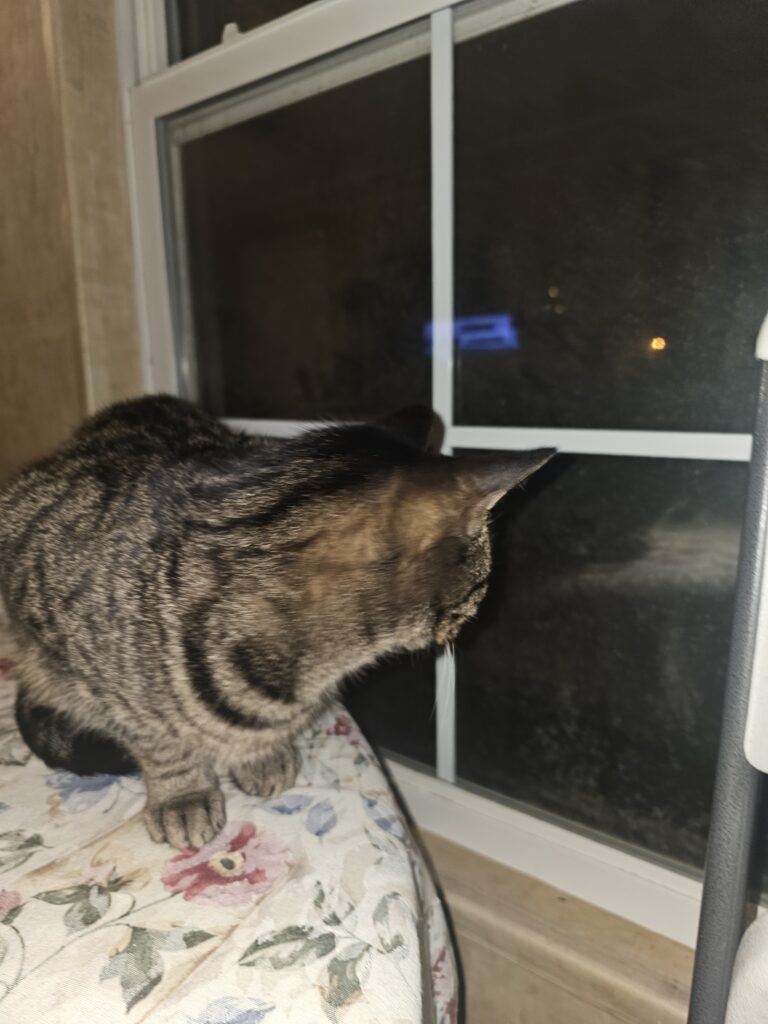
    Li’l Mo, a Cat!

    Thus the label is useful. None of you are shocked at the picture after being told it would be that of a cat.

    But …

    A Tale of Two Cats

    Now behold two cats.

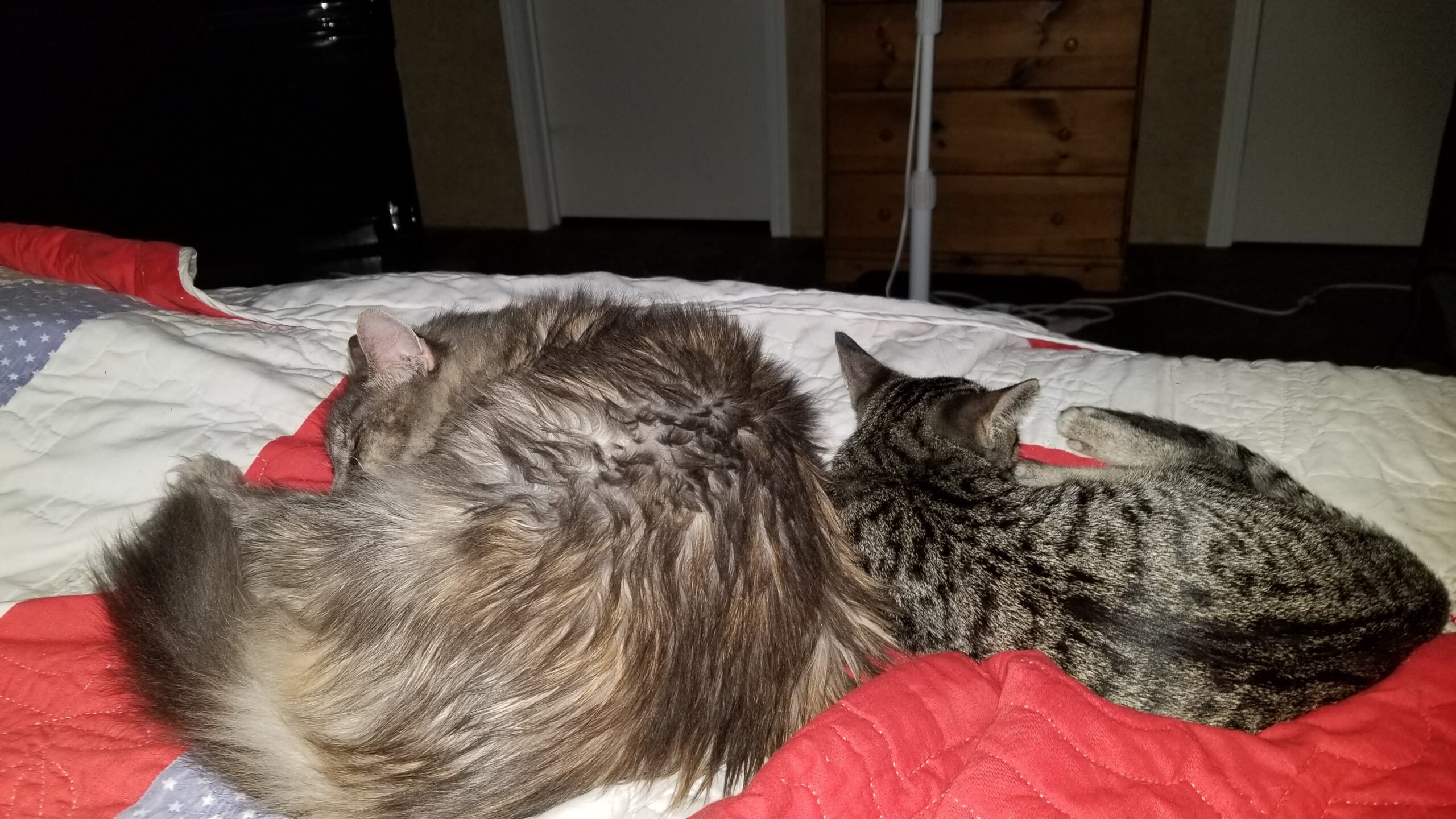
    The cat with longer fur is Cheena. In this video, which was taken only a couple years before Cheena crossed over the rainbow bridge at 16 years of age, Li’l Mo is about 6 months old.

    I credit Li’l Mo with extending Cheena’s life by perhaps a year because she seemed to gain new energy with him around. She mothered him, in the way a crotchety old aunt might, not too clingy, but playing with him and occasionally putting him in his place. As long as she was alive, she remained the dominant cat.

    So we have two animals labeled cats, one labeled Li’l Mo, and one labeled Cheena.

    Where Labels Cause Problems

    I have repeatedly noticed something interesting when I describe these two cats. I love both. I remember Cheena fondly and frequently.

    Cheena was very set in her ways. She would spend her time sleeping on the bed, specifically on my side. She didn’t want a lot of attention but about once a week she’d spend an hour or so on my lap. She adored having her hair brushed every night. She was picky about her food. She was dignified, and would take what I called “princess strolls” through the house, head high, looking left and right, making sure everything was in order.

    She also hated the vacuum cleaner, and would hide at the opposite end of the house when I brought it out. As most animals do, she hated the vet, but unlike any other cat I’ve had, she was very sweet about it. I remember after I picked her up from surgery after her foot got infected (Li’l Mo bit it!), the vet offered me a carrier box as they saw I hadn’t brought one with me. “No,” I said, “I don’t need it.” A couple of members of the staff followed me and watched as I carried her across a waiting room filled with dogs and a few other cats while she just hung out against my shoulder. Not a peep or a wiggle.

    Cheena was generally unconcerned with the activities of the humans as long as she got dinner on time and found me in my chair where she could sit on my lap.

    When I tell people about Cheena, they often say, “Well, she was a cat.”

    Mo, on the other hand flies around the house like a mad cat. Princely strolls are only occasional and generally short. He also hates the vet, but I wouldn’t even think of taking him there without a carrier. Oddly, he’s totally cooperative with the staff, and totally uncooperative the entire rest of the time. He’s unafraid of the vacuum cleaner. If he deigns to notice it at all it’s to chase it and pounce on it. He has no concept of riding peacefully on my shoulder. He is deeply concerned about his food being on time.

    When I tell people about Li’l Mo, they often say, “Well, he’s a cat!”

    And therein lies the problem, though it’s usually not an issue with cats. It’s not important, except to me regarding my cats, and perhaps to the cats, that people notice their individuality. But in many other cases, it very much does matter.

    A Personal Example

    A friend of mine for some years never conducted what I would regard as a complete conversation. Whether the issue was religious, political, or even how to accomplish some task, he would jump in when I was half-way through explaining my position and say, “Yes, I understand completely.” He would then carry on the conversation in a way that made it clear to me that he had checked off my view as matching some compartment he had created in his mind, and I was stuck in that compartment. Discussion would die.

    I found this very frustrating, as he was a person with interesting ideas and I would have enjoyed exploring our differences more seriously. But once I was placed in the compartment, the discussion was over. He never appeared to be thinking of me negatively. He’d usually put me in a compartment that was agreeable to him., but it was still frustrating.

    Lazy Labeling

    And that is the problem with labeling. Not the use of labels in itself, but refusing to use accurate, or at least carefully chosen labels. This doesn’t mean we can’t use general labels. Cheena and Li’l Mo are (or were) indeed cats. They’re also individuals.

    My views might generally fall into a category chosen, but they might also differ in important ways.

    Make the Effort

    In relationships and discussions of ideas, be willing to do the work of understanding and labeling accurately. Your life will be enriched for the effort.
  • We Now Pause for a Bit of a Rant

    We Now Pause for a Bit of a Rant

    Scot McKnight (whose work I deeply appreciate) quotes Dennis Prager (whom I rarely read) on his site, talking about the difference between the “left” and “liberals.” You can follow the link to read what set me off.

    Labels are necessary if we are to communicate. Words are, pretty much, labels. All labels have limitations. The word “tree” can evoke different meanings. Different people might have different boundaries between a tree and a shrub, for example. That’s why we have words, and not just a word. We have phrases, clauses, sentences, and yes, even paragraphs. You use those to explain the detailed boundaries of the way you are using a particular label.

    The problem is not labels. The problem is the misuse of labels. Politics gives birth to lots of misuse because those in politics want to have shorthand ways of vilifying opponents. So we take a group’s label, find all the bad things done by anyone who might fit that label, and apply them to the entire group. That’s why we have videos from liberals (as defined today, not the century old definition used by Prager), showing stupid conservatives. This is supposed to leave us with the impression that everyone on the right is an idiot and knows nothing.

    In turn (and I don’t care who went first, just “in turn” in terms of this rant), we have conservatives producing videos of stupid liberals.

    Wow! I am so utterly dumbfounded! There are stupid Republicans. And Democrats. And liberals. And conservatives. And Christians. And non-Christians. And …

    The only thing we should get from such videos is a low opinion of the people who make them.

    My problem with these labels is that while I know stupid people who hold a variety of positions, I also know intelligent ones. Intelligent conservatives, liberals, progressives, leftists, rightists, and so forth. I find no sense in which you can determine intelligence by political position. Further, I know of no way to discover how charitable someone is through a label. Sure there are surveys, but do you really want to assume that a survey applies to each person you meet? I find it much easier to just talk to them and then listen.

    My father, for example, was a vigorous opponent of what he called socialized medicine. Yet he gave away medical services or charged less than the market would bear all his life. He never turned anyone away over money. He died as John Wesley suggested with very little. Without a doubt he cared, cared deeply, and did something about it. I’m sure my conservative friends will applaud.

    But there are others, “leftists” if you please, who believe very firmly that everyone should have medical care. They don’t believe private charity can accomplish it, so they work to make it available to everyone using the mechanism of government. Their purpose is not to “get” the drug companies, the health care equipment manufacturers, or the doctors. Their purpose is to provide better health care for more people. They aren’t evil. They take a different approach.

    There’s plenty of room to debate these approaches. But none of this will happen if we assign all possible evil characteristics to our opponents, and all possible good ones to our allies.

    One of the characteristics that will prevent any movement toward unity is the desire to vilify groups of our opponents, not by labeling them, but by misusing their labels or by mislabeling them.

    A little generosity in the use of labels would go a long way. And no, don’t assume I blame most mislabeling on the right because the quote that set me off was from Dennis Prager. This issue has plenty of blame to go around. Several times.


    (Featured image credit: Openclipart.org.)

  • A Prescriptive Grammarian Goofs

    I enjoyed a post by Geoffrey Pullum at Language Log today for several reasons. (The post provides notes and links to reviews of Strictly English: The Correct Way to Write… and Why It Matters. You’ll see soon why I don’t include a purchase link for the book.) First, prescriptive grammarians get on my nerves and are frequently wrong in my experience. (If you wonder how I can call them “wrong” when I’m not a prescriptivist myself, then read on!) As an editor I often encounter confident assertions that this or that text is just plain wrong, or simply terrible, only to discover that the original text is actually much more in accord with current usage.

    But again, as both editor and publisher (my own company, Energion Publications), I enjoy book reviews. It may surprise some people that I enjoy both good and bad reviews. This is a great example of a negative review. Consider:

    I know that a few tender souls will feel that there must be something good in everything, and that I really shouldn’t be so negative. So I will say one favorable thing about the book. Holding it in my hands did not make my skin erupt in a horrible disfiguring disease. There. I’m done. Don’t tell me I don’t know how to be fair and balanced.

    And he doesn’t stop there. He provides specific examples of some of these problems, some of which he calls “staggeringly erroneous.” You’ve really made it when a statement of yours is called “staggeringly erroneous.”

    Of course, I probably wouldn’t be so delighted with the sting in the prose of this review if I didn’t agree so thoroughly with the conclusions.

    Language is complex. Language changes. Language is fun.

    Oh! I almost forgot! There really is such a thing as a singular they.

  • New Meaning to Language Police

    This story gives new meaning to the idea of language or grammar police. (HT: The Agitator)

  • Quote of the Day – Passives

    From Language Log:

    If passives were UFOs, the country would be frantic over all the sightings, but the Air Force wouldn’t be scrambling any jets.

    I have two pet peeves with regard to passives. First, there are those who find passives where there are none, as in the post cited by Language Log. Second, there are those who refuse to use any passives at all. It’s quite possible to overuse passives, but sometimes a passive is appropriate, and sometimes it provides variety.