Threads from Henry's Web

Category: Diversity

  • Suzanne McCarthy on Complementarianism

    Suzanne McCarthy has been blogging on complementarianism over on the Better Bibles Blog. I have been following her posts with interest, and I would like to commend them to my readers. The entries to date are: Modes of Communication I, Modes of Communication II, Modes of Communication III. Suzanne obviously doesn’t subscribe to the “snazzy but inaccurate title” school of thought–just tell them what you’re talking about. 🙂

    I’ve written about this topic a few times myself, largely out of my frustration with the number of women I see in the church who are gifted and called from my observations and yet are not being used to their full potential. Even amongst those who claim to affirm leadership roles for women in the church there is often an inertia, or perhaps a sort of default that suggests that women must be exceptional to be in leadership.

    What Suzanne has done in these last several entries is point out some of the inconsistencies in how one applies the complementarian position, and I think she makes some good points. I’m not sure I’m going to get the time or the tolerance any time soon to read her complementarian source material.

    Nonetheless, it seems to me that the key here is that the wrong principles are being used. We’re setting up the category of “women” as a spiritual entity, with a prescribed set of spiritual roles. That ignores the reality that while women and men are truly different–and I’m not egalitarian in the sense of saying women and men are somehow interchangeable!–women differ from women and men differ from men as well.

    The principle I would suggest is that we observe both the men and the women, as well as our children and young people, and simply choose for leadership roles those whom God has gifted for those roles. If we do so honestly, I think we will find that God is, in fact, calling many women to leadership and wonderfully gifting them for it.

    When we ignore the call and gifts of God, we’re putting God in a box and we are a barrier to the building of the kingdom. Let’s not do that!

  • Creation and Evolution Summer Camps

    Summer camps to indoctrinate children on creationism? Look at this article: Beliefwatch: Camping.

    I certainly have no objection to churches teaching their beliefs at summer camp, and I congratulate the Unitarian-Universalist church on having a camp on discoveries in science. What I sincerely wish we would see would be a Christian camp that would teach about the variety of views of God’s creation that are held by Christians. This could be a unity building event, letting children know that Christians disagree on how God created, but we all agree that God didcreate, and that he is the creator.

    Such classes could help ease the current atmosphere in which a Christian who is serious about his or her faith is often beaten back to the peripheries by misguided people who believe only creationists, or in some cases even young earth creationists are really Christians.

  • Is this the Gospel? (Overview)

    In an earlier post I responded to the Together for the Gospel statement, which I do not think represents any real “togetherness,” nor do I think it represents the gospel. Now I want to be clear that I am not suggesting that my side, whatever that may be, needs to exclude the writers of such statements. At the same time I do not want to minimize my concern over the approach to Christianity that this statement represents.

    In this entry I want to simply look through the 18 articles and point out where it is that I disagree. In later posts I’ll deal with individual elements. I will only use brief quotes, but you can get the full context of each statement from the link above.

    The Opening

    We are brothers in Christ united in one great cause

  • Unity, Diversity, and Confusion

    Recently I wrote a couple of entries, first on diversity and liberalism, and then on the Together for the Gospel statement. The issues I discussed in those two posts raise quite a number of questions about truth, unity, and Christian fellowship. Many might decide from my comments thus far that I don’t care about truth or correct doctrines at all. But that is not the case. “Doctrine” is simply teaching, and we all have some form of teaching. Even the doctrine that correct doctrine is not primary in salvation is itself a doctrine.

    Where are the boundaries where disagreement is permissible or not permissible? How can we tell what is essential and what is not? It’s easy to quote St. Augustine, “In essentials, unity. In non-essentials, liberty. In all things, charity,” but it’s a great deal harder to define precisely what one means. Two sincere people who accept the idea of unity in essentials and liberty in non-essentials can nonetheless get into quite a fight over just what is essential.

    I think we could view the situation as a sort of continuum.

    Unity by Exclusion Unity in diversity Disunity by confusion
    Doctrinal continuum arrow Non-doctrinal

    To the far left of this spectrum (no left-wing/right-wing implications intended), we have those for whom doctrine is central and absolute. I’m seeing the folks who wrote the Together for the Gospel statement I discussed in my post Who’s Together for What?. For them the way to defend the gospel is to be both very clear and detailed on what is truth, make sure people know it, and only respect those who are fully on track as bearers of the gospel. In the center of this continuum we have those who have a small number of essential doctrines on which they require unity, but outside of that boundary diversity is permissible within the community. On the far right of my continuum, we have those who hold nothing, or almost nothing, as essential, and thus have confusion because they are not defined as a community. Even greater confusion results when a community cannot agree on just where they stand.

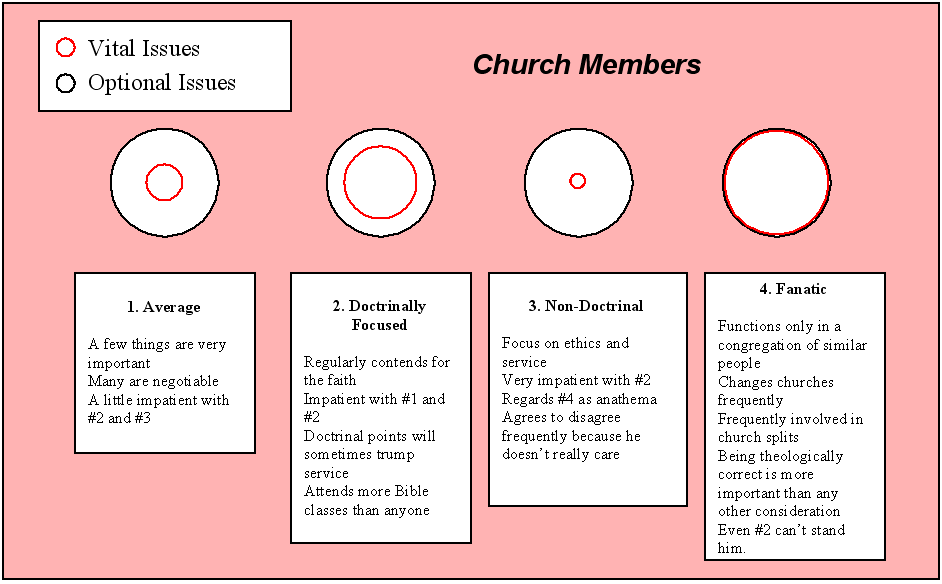
    Let me provide an illustration from another article I’m working on that looks at the type of people who might be part of such organizations:

    Church member attitudes toward doctrine and diversity
    Click the image for a larger view

    Churches that attain unity by exclusion tend to have a large number of essential doctrines. These churches tend to split, and the people in them tend to move from church to church looking for a precise match to their desires. I am not saying that such a church cannot practice unit and cannot teach the gospel; merely that it is difficult to maintain unity in that atmosphere.

    I believe the United Methodist Church, of which I’m a member, tends toward the other extreme. We tend to allow diversity in everything and require unity in nothing. We add to that a debate over where we should be allowing diversity, what is essential, and what is not.

    the-methotaku made a great comment on my previous post, Liberalism and Diversity, in which he started to do precisely what I had planned to suggest in this article–define the distinctives of Wesleyan and then United Methodist theology. Go back there and take a look.

    One reason it is often hard to define the essentials is that one can’t define “essential” without asking “essential for what?” Many people are tired of denominationalism, and I am also concerned when denominations promote themselves over Christianity as a whole. I like to call myself a “Christian, who is a member of a United Methodist congregation” rather than “Methodist.” Why? Because my primary identity is Christian. I don’t think John Wesley would have a problem with that.

    But in order to be a community in ministry to the world, I need to become part of a more tightly defined group. Rather than the very small number of doctrines I suggested as a definition for “Christian” I need some additional points that make one “United Methodist” rather than Presbyterian or Pentecostal, for example. When I define such items, I am not saying that these are additions to what makes me a Christian, rather, they define how it is that I am going to live my Christian witness in the world through a community.

    I can cooperate with anyone with whom I can agree on the essentials for that specific mission. That means that if I am dealing with an enterprise that is broadly Christian, I can cooperate with anyone who accepts basic Christianity. When I meet as a member of a congregation for worship, I expect some additional unity, though I still can allow diversity. I could easily form a small group that would share a larger number of “essential” doctrines–essential to our group, that is.

    But in each case I must try to keep these essential doctrines to the minimum required for that particular community. When I engage in charitable activity in general, for example, I don’t need to find people who agree with me doctrinally. All I need is to find people who agree that there is a human need to be filled.

    It is my prayer for the United Methodist church that we’ll reduce confusion by defining what it is that we find essential and learning to live with it. I don’t know where those lines should be drawn. I would suggest two things–they should be as inclusive as possible while allowing us to be defined as a community, and we should not use what defines us as a community to condemn those who choose a different one.

  • Who’s Together for What?

    A group of evangelical men has gotten together with the purpose of defending the gospel from, it would appear pretty much everyone. In their statement, T4G Affirmations and Denials, they say:

    We are brothers in Christ united in one great cause

  • Liberalism and Diversity

    A couple of weeks ago while teaching I was asked about the title of my book Not Ashamed of the Gospel: Confessions of a Liberal Charismatic, and what I meant by “liberal charismatic.” Now this isn’t an ad for my book–no, really, it’s not!–but that title was not one I gave myself, but rather one I picked up from an opponent, someone who didn’t like either liberals or charismatics. But I have had both titles used about me from time to time by people who were not intending to insult me. I prefer to call myself a “passionate moderate” but I really don’t mind being called liberal or charismatic.

    I also had my attention called to the case of an individual who is a candidate for ministry in the United Methodist church. This individual has a mentor who is very liberal, while the candidate is evangelical. Things aren’t going well. Now I don’t have good, objective statistics on this sort of thing, and because of slippery definitions I’m not sure anyone can get them. But I have heard conservatives, evangelicals, liberals–people from pretty much every perspective–talk about the people that they cannot tolerate in one position or situation for another. I’m sure that a liberal mentor in the situation I mentioned might ask me something like, “But do you think I should help someone who will judge and exclude homosexuals from ministry become a pastor?”

    That’s an excellent question. It falls into a general category of questions that help us define the boundary of what we are each willing to tolerate, or the diversity that we are willing to celebrate. It’s much easier to celebrate diversity in general than it is to celebrate individuals who are very different from you. No matter how liberal you perceive yourself to be, there are probably some group of people, perhaps many groups of people, that you just can’t deal with.

    For me, it’s the true fundamentalist, such as King James Version Only advocates, and people on the fringes of the young earth creationist movement. Some of those folks I just find annoying. So what happens to tolerance?

    Let’s put it this way. For me, tolerance is a value. It is not an absolute belief that I must tolerate everyone and anything that anyone might happen to want to do. I value tolerance fairly highly. In fact, so highly that I would rather be a little less annoyed by the people I mentioned who get on my nerves. I want to treat them more fairly. But my tolerance is not absolute. Paul Hill had freedom of speech. I certainly didn’t like the way he used it, but it did not make me want to eliminate freedom of speech from the constitution. At the same time, I have no tolerance for the way in which he used his speech. I would have no difficulty condemning it in the most forceful terms. As for his actions, when he killed a doctor and a clinic escort in pursuit of his anti-abortion views, I definitely do not find it appropriate to tolerate those. I would note that I also think some of his speech prior to his act at a minimum came very close to incitement, and might have been dealt with on that basis.

    All of us have limits to our tolerance, and all of us should. What I value is the idea of making our circle of tolerance as broad as possible. We need to find a way to accept into our lives people whose views and culture differ greatly from our own. We will benefit from doing so. Our communities will benefit when we do so. Often accomplishing this is simply a matter of learning to look at similarities rather than differences. I have found that with groups of Christians one can often find common ground simply by listing similarities. As long as we’re thinking about those things, we seem very much the same. If we choose to list differences we will tend to feel different.

    There is good reason to look at things both ways. Comparing and contrasting work together. But when we are trying to accomplish something good in our churches and in our communities, very frequently we need to make looking at our similarities the primary goal.

    But does tolerance and diversity mean that one has to agree with what everyone says? There are people who seem to work that way. “Well, that’s OK for you, even though it doesn’t work for me,” someone says. Such people often regard totally contradictory beliefs as equally valid. This type of thinking elminates our critical faculties, at least from our interactions with other people. What we need to do instead is accept and celebrate that there are people who are different, even when I disagree vigorously with their beliefs. In debating those beliefs I can improve my own skills and expand my own knowledge. And yes, horror of horrors, I might find out I was wrong about something and have to change my mind.

    When we exercise tolerance in a community, there is also a need for boundaries. One problem I frequently see with church groups, and especially with the United Methodist Church of which I am a member, is that people attempt to be in community without bothering to define what it is that defines them as a community. Let me use this as an example. In the United Methodist Church we have a fairly substantial and well-defined body of doctrine. When I first joined a United Methodist congregation, I had the notion that people actually had some comprehension of what those doctrinal statements said, and that there would be discussion of such things in the church. I was even concerned that in some cases my views were too liberal for the doctrinal statement while in others, such as with the social principles, my views were too conservative.

    What I found in practice was that there was a huge amount of ignorance, and a general idea that we ought to be tolerant. Since nobody had any idea what the doctrines were, they never questioned me about my positions, and they looked puzzled when I questioned them. As I’ve taught Bible classes in Methodist churches, I’ve found that the dominant feeling is one of confusion. I think this confusion is the result of an attempt at undefined tolerance. The United Methodist Church needs an agreement on what is required, and what is optional, and then we should expect that the required items be accepted by all those who are part of the community, while the optional items are open to one’s personal opinions. This wouldn’t mean mind control; one can always join another denomination. Unlike citizenship in a nation, one doesn’t have to leave the country because one changes one’s church.

    As a passionate moderate, I would like that number of doctrines that we say are essential to be very small. In a pamphlet I publish, Understanding Christian Apologetics, I list just four items, derived from Elgin Husbheck’s book series Consider Christianity. A particular denomination should have more items than those, but nonetheless should be certain that what is listed is what they want to have defining them as a religious community. There can be a larger list that is of commonly held beliefs that are open to disagreement and individual opinion. I believe one could be tolerant and still expect someone who could not be defined by the standards of such a community to find a community where the standards are more congenial.

    People in such a community could still cooperate with others on points of agreement. I think this is an essential for a functioning society, particularly a democratic society. I am always delighted when movements in our two political parties get together across party lines. I wish we did that sort of thing more. We could come together for a period of time on some specific issue, and work separately when we disagree. In such a community the pastoral mentor I mentioned could be held to a standard: There are certain doctrines that must be accepted for ministry in our community, and if someone is within those limits they should be accepted.

    I’m using the United Methodist Church as an example. In the broader community, the key is viewing tolerance and celebration of diversity as a value. It is not a binary condition–one is tolerant or one is not. We may have more important values that will override it. We may even find people who we do not celebrate and who we do not want in our society. That’s all part of living. Provided that we deal with those options appropriately, there is nothing wrong with this.

    I’m going to go forward being tolerant over a large range, but expressing firm limits to my tolerance.