
You can find all the details on the Energion Publications news page.
You can find all the details on the Energion Publications news page.
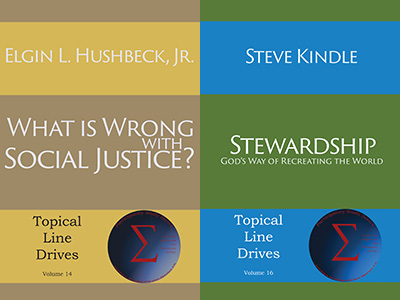
I’m going to shamelessly link to a post by Allan Bevere in order to publicize a hangout I’ll be hosting next month. Allan’s post is Once Again, The Civil Religion of the Religious Right AND the Religious Left, and I’m interested because I think Allan might well dispute both of my guests.
We tried for this hangout this past Tuesday, so it has now been rescheduled to June 9. My two guests will be Elgin Hushbeck, Jr., author of What is Wrong with Social Justice, and Steve Kindle, author of Stewardship: God’s way of recreating the world. (Note that the two books are not written in response to each other; they are just typical books by each author.)
I will try to be neutral in hosting, but I do have opinions on the topic. Most importantly, I think Christians, as a community, would do well to step away from prescribing the means by which individual members should accomplish social goals. Despite what Allan notes regarding the words of the prophets being addressed to Israel as a theocracy, I think they do express principles on which I should act.
How those principles apply to my current faith community and the country of which I’m a citizen is more debatable, and it is that debate that I think is good. For example, the principle that laborers should be treated well is a principle expressed by the prophets. Exploitation of laborers draws some strong words. What should be debated is how this can be accomplished. Does a minimum wage improve working conditions, or does it just increase unemployment? What is the net effect of social welfare payments from the government?
I know that people of good will can disagree on these points, and I think people of good will should always be willing to discuss, to work together where possible, and to compromise when that seems indicated. The church, while upholding the principles expressed by the prophets, should, I think, be a safe place to work out the “how” on an ongoing basis. That means I don’t think this is a debate that will—or should—end.
That’s why I was so delighted to host the beginning of the debate, in turn disappointed that audio problems prevented us from continuing, and again delighted that both authors were available for a June 9 rescheduled hangout. They were both vigorously and courteously discussing the definition of justice and what social justice is, and I plan to ask them some questions based on what I’ve said above.
 Note that Allan Bevere has a book that relates to this topic and expands on what he says in his post: The Politics of Witness.
I failed to post on this earlier, but in about 20 minutes I’ll be starting this study. Of course, there’s always the option to watch it later (or not!).
YouTube viewer:
You can go to the event for more information or watch using the embedded YouTube below. I’ll be talking to Thomas about the text of John and textual criticism in general for about half the time and then talking about John 17 in the second half with some discussion of rhetorical criticism.
I will resume my study of According to John tonight with chapter 12 of Herold Weiss’s book Meditations on According to John, I Have Overcome the World. We’re going to look at the meaning(s) of “world” in John and what it means to overcome it. You can either watch via the Google+ event or with the YouTube embedded below.
I know it’s very late, but I’ve had an extremely hectic week. Here’s the link for tonight’s hangout. I’ll be interviewing Dr. C. Drew Smith, author of Reframing a Relevant Faith.
According to John: Interview with Drew Smith
And the YouTube:
That’s a very broad title, but I do want to look at the connection. One of the places where we, as Christians, find the most disagreement is in our study of the Bible. In my view, there’s a good reason for this. The Bible is a complex book. Yes, one can find common themes, but there are also many topics on which we can disagree legitimately. While I object to any claim that the Bible doesn’t have inherent meaning—I always say that at least we know it’s not talking about the pink elephant—I still recognize that serious students can come to different conclusions. I find the demeaning way that we refer to scholars who are far from us on the theological spectrum quite unhelpful. Is it not enough to say “I disagree,” or “I disagree strongly”?
This relates closely to views of attaining Christian unity. Let me highlight two opposed approaches. First, we have the idea that somehow we must eliminate the differences in Bible study. For Catholics, this generally leads to a reference to the magisterium of the church. Protestants often look with some longing at such an authority, an authority that might bring some sense out of the chaos of protestant views of scripture. So you know my prejudices, let me state bluntly that, irrespective of what set of doctrines and interpretations such a magisterium imposed, I would not be a member of the resulting church.
The second approach is to say that we can have unity of purpose and action in a chaos of individual ideas and spiritualities. The application of this can be quite variable. Do we look to a small list of teachings which are sacrosanct while allowing freedom on all others? Do we allow for just any position at all? Or do we perhaps unite on practice?
I believe that the difficulty we have with Christian unity is our own hostility to what is different. I recall meeting with members of a church about a particular service of which they disapproved. It turned out that not only did they not attend that service, but that no matter what was changed, they would not begin to attend it. I had to tell them that I could hardly present to the pastor the idea that a service should be altered in form so that nobody would attend! They were hostile to spirituality and forms of worship that someone else was doing when they weren’t even present.
I’m actually quite a doctrine driven person. I don’t know which actually came first, the doctrine or the practice (though I suspect in my life it was practice), but when I think about things now I start from doctrine and move to practice. That’s just the way my mind works. So the doctrinal standards of a church congregation are important to me. I don’t join a church that strongly proclaims doctrine that I cannot support. I was considering joining a church once before I discovered their approach to politics. In fact, the problem was that I discovered that, contrary to any statement they might make, they had a congregational approach to politics. So I went elsewhere.
In protestant churches, and particularly among charismatics in my experience, there is a desire to fight the doctrinal chaos with a sort of mini-magisterium. This results in a “don’t go against the pastor” or “don’t touch the Lord’s anointed” attitude. The pastor is the one who makes the determination. I object to this as strongly as I do to larger versions of the magisterium. Protestantism by its very nature (and I’m an unrepentant protestant) is a break from submitting one’s conscience to that sort of authority.
I would suggest that what we need in Christianity is not a unity of conformity, but rather a unity of attitude and spirit. We claim to follow one master. Let’s allow others to follow him, rather than trying to make them follow us. Let’s approach this with the greatest measure of grace for others. If we need to meet in separate buildings, no problem. Let’s do what is best for loving God and loving our neighbor as ourselves. But let’s do it without hostility. Perhaps we could manage to resolve our differences in worship practice by meeting in separate times of worship in the same building. There are many ways to work together.
What set this off this morning? Well, Dave Black posted about not needing teachers and the Holy Spirit as teacher. I reposted it to The Jesus Paradigm so we’d have a permanent link. I agree with what Dave says. He honors scholars, pastors, and teachers, while at the same time acknowledging that the Spirit of Truth is available to us all.
I don’t want to make this a commercial. Hmmm. Yes I do! Here are some books I publish that relate to this topic: I’m Right and You’re Wrong: Why we disagree about the Bible and what to do about it, When People Speak for God, The Jesus Paradigm, Seven Marks of a New Testament Church, From Inspiration to Understanding: Reading the Bible Seriously and Faithfully.
Tonight in my study on John via Google Hangouts on Air I’m going to talk about the law and Jesus, Jews and Christians, and Judaism and Christianity. I’m embedding the player below. In the meantime, read 3 ways to Confront the New Antisemitism by Rabbi Evan Moffic.
For tonight: