
The Tuesday Night Hangout will become a Wednesday Night Hangout because of a technical glitch. We’ll do this tomorrow night at 7:00 PM central time.
The Tuesday Night Hangout will become a Wednesday Night Hangout because of a technical glitch. We’ll do this tomorrow night at 7:00 PM central time.

Tonight I’ll be talking with my wife Jody, author of Grief: Finding the Candle of Light, in a hangout titled “Grief 12 Years Later.” We will talk about our experience 12 years after our son James went on to be with Jesus.
Many Christians struggle over the experience of grief. We hope we can help with some ideas drawn from our experience, from scripture, and from wrestling with God. Once the live discussion has concluded, you will be able to view it using this same video embed.

I’ve recently said and written a few things about the gospel commission, including my claim in my concluding presentation for my video series on eschatology that eschatology is all about the gospel commission. You’ll hear more about this in my foreword to Dave Black’s new book Running My Race. It’s in the final stages of production and should be available soon.
This isn’t a new perspective on my part, but as soon as I start using words like “evangelism,” “mission,” or “the Great Commission,” I start getting questions about whether I believe in dialogue or whether I’ve started to think that all non-Christians are horrible people.
On the other hand, each time I start talking about respect, interfaith dialogue, inclusion, and similar topics, someone is bound to ask me whether I’ve given up on evangelism and mission. Perhaps I no longer think Jesus is important.
So let me put both of these things together. First, I am never going to abandon the Gospel Commission. It’s what being a Christian is about. I follow Jesus and I help others follow Jesus. I am a witness to Jesus as I follow Him. I proclaim his good news, and that good news is the central fact of my life. If I didn’t believe that, I would not be a Christian publisher. Frankly, while there are many things I enjoy about publishing, it’s hard work, the pay isn’t as good as it is for my other occupation (small network technical support), and I’d hardly keep at it without this greater “joy set before me.”
Second, I believe that respect and love for one’s neighbor are central to the gospel. If I don’t love my neighbor as myself, I am not following Jesus Christ, and in turn I can hardly be effective in making other disciples, who would, in turn, be expected to love their neighbors as they love themselves. (There’s a “loving God” thing in there too, but see 1 John 4:20 for my emphasis in this case.)
Contrary to the perception of many Christians, not only is respectful dialogue not opposed to carrying out of the gospel commission, it’s essential to it. But there are reasons it so commonly doesn’t seem so.
Evangelism is tainted, I believe, by two false directions, each of which bears an abundance of poisonous and rotting fruit.
The first false direction is the idea that evangelism is about giving the maximum possible number of people their “get out of hell free” card or, seen more positively, getting them their ticket to heaven. In this diversion from the gospel message we look for ways to get people to say the right prayer, then wipe the sweat from our brows (evangelism is hard work!), and say, “One more person saved.”
This leads to other spiritually dangerous activities, such as promising people prosperity if they accept Jesus, emotionally manipulating them, or even converting them at sword point or gun muzzle. We can justify whatever behavior we might engage in on the grounds that even if we did use underhanded methods, the person should thank us for not burning in hell forever.
This can also (or even in turn) lead to other shallow approaches to faith, such as the meme I saw on Facebook today built around the old idea of the wager of faith. As I understand faith, the wager simply isn’t—it isn’t faith and it isn’t even a wager, since there’s nothing of value on either side. Believing in Jesus isn’t an “in case” sort of thing. It’s not a wager, it’s a total commitment. Pascal’s Wager is an intellectual approach to a spiritual problem.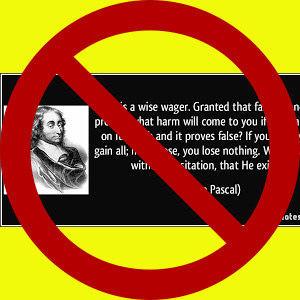
Further, this sort of evangelism doesn’t actually represent love for one’s neighbor. It’s a sort of concern, but it’s more like the hunter has concern for the deer. No, I don’t mean the killing part, though that can happen as well, but rather the concern is for how the deer will fill the hunter’s needs.
The second false direction is one of church growth. In this case, evangelism is simply the process of adding members to the church, and more specifically your church. At least this has a longer term goal, i.e., to get the person into a church community. But far too often, this simply feeds into another selfish numbers game. The value of the person is not in who they are or who they can be, or even what God wants them to be, but rather on church statistics. While evangelicals are more likely to go for the first diversion, even progressive churches can fall for this second one.
As the saying goes, however, sitting in church doesn’t make you a Christian any more than standing in a garage makes you a car. I think we can identify what’s really important to us by what we pay for and what we report on, and in many of our churches I’m afraid that the concern is increasing membership, which, in turn, is to produce increasing financial support, which will allow us to get more members.
What I believe about evangelism is this: It’s a lifestyle. You live as a disciple of Jesus, and you will, in turn, make disciples. I don’t mean that we should all shut up. Of course you talk about your faith because it’s not just important it’s fundamental. There’s another dichotomy between living our faith and proclaiming our faith, but I think it’s also false. Talking about our faith is one way we live it. If we’re talking too much, that’s ineffective living of our faith. I do not keep silent about something that is fundamental.
In looking at motivation, I can say that it is a command, and it is. But at the same time it simply follows essentially from what Jesus has done for me. I will share a good thing. Sharing a good thing doesn’t mean forcing others. It’s a natural and friendly thing to share, just as it’s a natural and friendly thing—not to mention loving—to let the other person make their own decisions, including about how long they want to listen.
Conversion, in turn, is something between God and the person converted. It’s gotten almost cliched to say that I can’t convert anyone; God does. But unfortunately we turn right back around and pretend it’s all about us. Grab hold of that mustard-seed of faith (I usually feel that I have somewhat less than that, but whatever) and trust God with salvation, conversion, and the spiritual health of others.
Further, however, trust God to let you know how you need to be involved, and listen. Listen to God. Listen to other people. God loves each person involved more than you do. He even loves you more than you do.
In studying eschatology (and I just completed a video series), I’ve found that God is deeply concerned about the spiritual health of God’s earthly children. I see the story of Revelation as being one of repeated opportunities, with the bottom line message that God does have this under control. Our part is to follow Jesus and make disciples.
That doesn’t require being rude, obnoxious, manipulative, violent, or disrespectful. It requires love, and love values the other person, not some imaginary thing I think that person should be.

Titles for people, that is.
Thomas Hudgins makes some important points on this issue in a post on the Energion Discussion Network. I tend not to be radical (well at least I think so), but on this it seems like Jesus was pushing us pretty strongly away from hierarchies and spiritual authority.
There’s a great—and quite sarcastic—line in Herold Weiss’s book Meditations on According to John, p. 152:
The sacraments were established toward the end of the first century when Christianity was becoming institutionalized and starting to create official channels through which the Holy Spirit could flow under ecclesiastical control. (emphasis mine)
I’m thinking that often we consider the people we put in leadership to be such official channels. Isn’t that what we mean when we want the pastor, rather than some “ordinary” member to pray for us?
We are all ministers. “To each of us was given grace according to Christ’s gift” (Ephesians 4:7).
Christopher Ritter is complaining, though only in the nicest, most creative way, about critics of the new Wesleyan Covenant Association. It’s interesting how efforts to reform often end up creating new denominations, even when the leaders don’t intend to do so. Just look at the example provided by Ritter in his post.
I commend Ritter for his excellent way of presenting his complaint, but at the same time I have to ask whether a movement to reform the United Methodist Church at this point is not also likely to contribute to the division of the denomination. It seems that we require such organizations to deny that they contemplate schism in any way. It’s part of the game. I suspect that the WCA people are entirely sincere in that desire.
Reality may not be on their side.
I’m a member of a United Methodist congregation. I would note that when my wife and I discussed the idea of moving to a new church prior to this move, we thought that our next church congregation would not be part of the UMC, but here we still are, and here we will stay as long as we believe God is leading us to do so.
What I’m not going to do is get stirred up over the survival of denominational structures. My friends sincerely wish to prevent schism, but as a church, we’re the product of a group that broke off from a group that broke off, and that earlier break-off was not very holy, I might note. Not to mention that I don’t see very much Jesus in the structures of any of the above.
Unless the Holy Spirit changes a bunch of people, the UMC is at an impasse over same-sex marriage and inclusion of LGBT people. We are a divided church. We can claim to be united, but it’s a fake. The question is whether the structures will follow the actual practice or whether we will continue to find ways (and spend large amounts of money) to pretend.
What is needed is to change our focus to become Christ’s body in the world, Christ’s witnesses, the bearers and proclaimers of Christ’s gospel. We are a church that is apathetic, self-centered, and wasteful. We are more concerned with our buildings and our power than with the gospel of Jesus Christ.
But that is something that can change. I don’t know about the denomination, but the only person who needs to change in this is me. And you. And you. Each of us.
Is the church building taking up more money than caring for your neighbors? Get rid of it.
Do you pay more for Sunday School curriculum than for evangelism or textbooks for needy children? Cut it out of your budget!
Is your primary concern for your worship service done your way at your time? Drop it. Be concerned about your neighbors.
If you let the gospel become central, many things that seem critical right now will fade into the background. You may not change church headquarters, but you can change you.
No, it’s not the end of the world. It’s the end of my series. I went into my hiatus in presenting these studies one episode short of completing the series, so tonight I’ll be wrapping up the eschatology series and preparing for my next series which will be looking at Paul’s letters and their background, especially in Hebrew scripture.
Here’s the embed:

A little over a week ago I reviewed the NIV Cultural Backgrounds Study Bible using the Olive Tree electronic edition. On Tuesday I received my hardcover copy from the publisher. (Note: I received this copy free of charge in exchange for an honest review. No other strings were attached!) This is not an extraordinarily new experience in Bible editions, but it is a good one.
The Bible is 6″ x 9″, so fits nicely on all my disorderly stacks of books. It’s about 2 1/4″ thick, which makes it substantial, but not the largest Bible I use. The picture at the top shows it in my (not necessarily its) natural environment. That’s my actual desk, and so you can see it in comparison to the other study Bibles I have around it. You can click on the image to see it in high resolution. These days I rarely carry a physical Bible to church, other than my Greek & Hebrew testaments (I have years of marking and marginal notes in them), so I don’t worry that much about the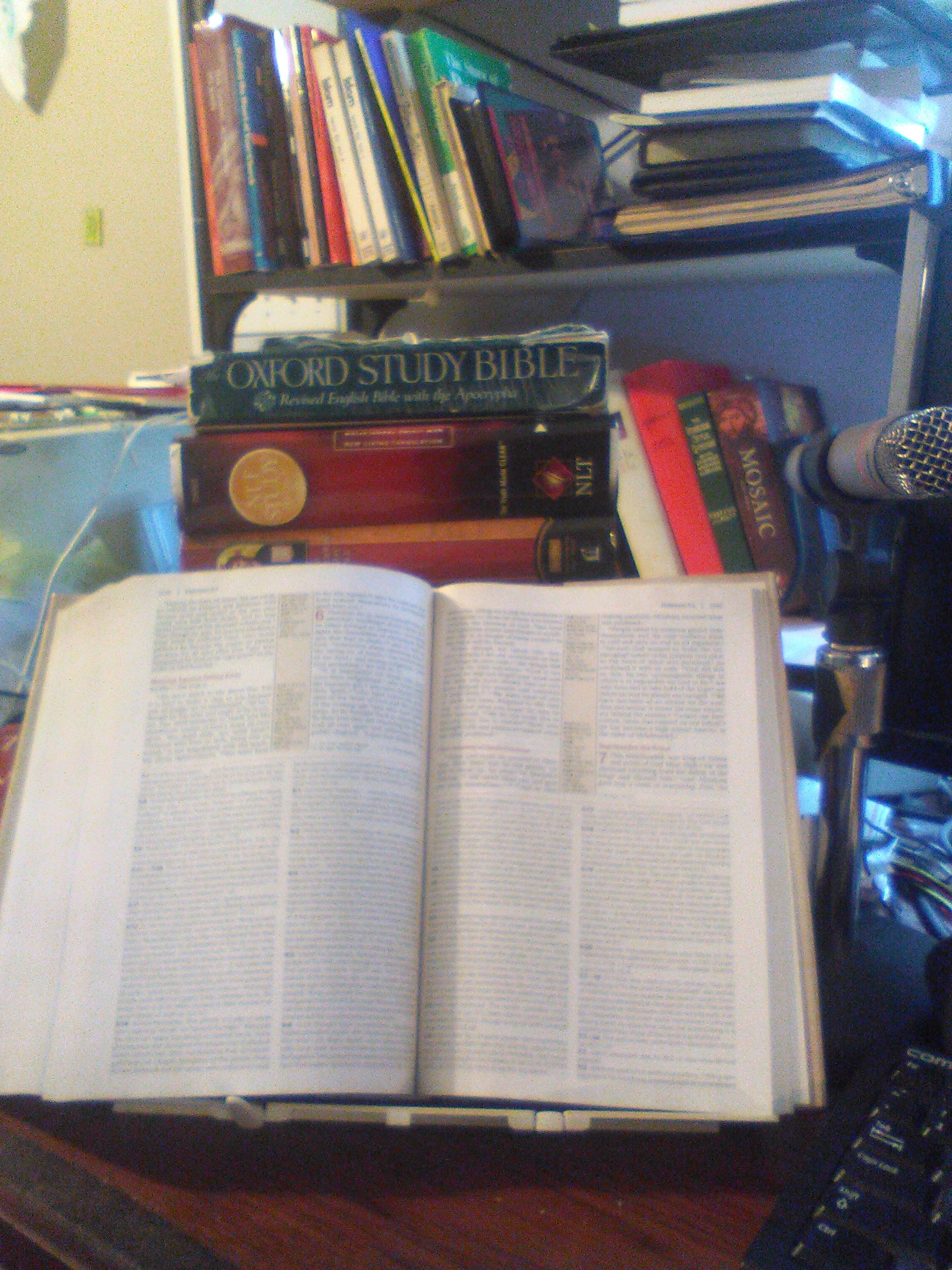 physical size of a study Bible.
These days I rarely carry a physical Bible to church, other than my Greek & Hebrew testaments (I have years of marking and marginal notes in them), so I don’t worry that much about the physical size of a study Bible. That said, I can say that I prefer working with the electronic edition of this Bible, even though I am not well-acquainted with Olive Tree software. There is a great deal of information to present, and the size of an edition is always a compromise.
 In this case, the text is small (as is common with study Bibles). The image just below shows it by comparison with my own Revelation: A Participatory Study Guide, which is printed in a 12 point font. The notes appear slightly smaller, though I’m not good enough to say for certain, and the impression may be created by a different (sans-serif) font for the notes. This note on text size is not intended as criticism, but it is one of the major reasons I prefer to use an electronic edition in which I can set font size. This is a problem for just about every study Bible out there. There is so much information to be included that something has to give. Having done page layout on a large number of books myself, I understand this completely.
The biblical text is printed in two columns with reference notes in the center. This is a classical style of presentation, but not one of my favorites. Again, I should emphasize that nobody can avoid all criticisms for the layout of a text. Doubtless others would complain about a single column with notes on the outer margins, for example. The double-column format is so standard that I have only a couple of Bibles that don’t follow it. An excellent example is The Jewish Study Bible (JPS Tanakh Translation), which uses a single column for the text with notes consistently in a narrower column to the right. I find their edition quite friendly.
There are a variety of excurses and notes included directly in the text section, besides the standard notes which are in two columns at the bottom of the page. The notes supplement and follow-up on the introduction, generally providing information that is applicable on a wider basis, i.e. not to just the text in question. For example, just before the text of Isaiah we have an introduction to “The Oracles of the Prophets,” followed by a short introduction to the book of Isaiah itself. But about three pages in we have a nearly three-page section titled “The Historical Background of Isaiah,” which provides a great deal of helpf ul information that will also relate to others of the prophets.
But just after these sections, on p. 1122, is an inset titled “Dating Methods.” No, this is not for those of you interested in origins and how rocks and fossils might be dated. Rather, it presents the basics of how one tries to place a particular oracle at a particular date. This is a tightly packed, extremely useful essay. Everyone should read it, no matter what portion of the Bible you’re studying. That’s why I chose Isaiah for this brief tour!
I mentioned that I will comment on some more specifics regarding the book of Hebrews. I will do so, but this past week has been intense, and I didn’t yet get to it. Nonetheless, the picture to the left at this point is the introduction to the book of Hebrews. I will go through that introduction in more detail in a post I hope to publish by Saturday.
Having the physical copy of this Bible in my hands makes me completely comfortable in recommending it. It’s easier to scan the portions I’m not emphasizing. For example, in using an electronic version I rarely “leaf through” the book, and thus might have missed the excellent introductory material for Isaiah. My main concern with study Bibles is that people tend to take the word of the note writer as to the meaning of the text. It’s certainly appropriate and valuable to get the opinions of others, but when one doesn’t find out why the writer believes a certain thing, one is left with either accepting it on authority—surely the author of such a fine volume would have his facts straight!—or having to dig elsewhere for that background information. That’s the value of this type of explanation.
For a few more notes on study Bibles in English, see my aer.io store collection.

Ticket scalping. Civilization will surely fall if they don’t get together on this one!

Our crop of candidates, all parties and all levels are admirably intellectually equipped to guide our nation through the 1990s.
As an example, one need only look at the incidents of hacking and the response to them. This is only going to get worse. It may not be the next war, but at some point we will see a war fought entirely from computer terminals. With our dependence on technology, and lack of understanding of how it functions, we could see devastation without the use of physical weapons.
In this situation one careless or malicious individual can wreak massive havoc.
Too bad those we elect will be leading us into 2020 and not 2000.
Here.
There’s nothing quite so annoying as hearing people spin the polls.


