Threads from Henry's Web

Author: henry

  • Can We Cure Christian Insanity?

    Can We Cure Christian Insanity?

    Albert Einstein is frequently credited, incorrectly, with saying that insanity is repeatedly doing the same thing but expecting different results. Repeatedly point out that the attribution is incorrect is likely a form of insanity, as it will doubtless still be attributed to Albert Einstein. (You can read the details on the Quote Investigator.)

    I like the form given by George A. Kelly in 1955 (as quoted in op. cit.):

    “… we may define a disorder as any personal construction which is used repeatedly in spite of consistent invalidation.”

    The Quote Investigator

    The phrase “… in spite of consistent invalidation” is my sort of language! I must note that I use that sort of language on people frequently, with the most common result being blank looks. Not what I was looking for. Yet I repeat.

    By this definition, however, many, many churches can be diagnosed with some sort of disorder. We have churches and whole denominations diminishing in numbers, worrying about those diminishing numbers, holding meetings and conferences about them, without ever actually making substantive changes.

    I’m reminded of a pastor who once told me how his church had asked him for a plan to grow their congregation and to reach their community for Christ. He labored over the plan for months, and it was presented to the church with some fanfare, ceremony, and excitement. The members agreed that this plan would bring in new people, and they thought it would reach people in their community for Christ. But they decided not to do it because their church would no longer be the church of their childhoods. They wouldn’t really like it anymore.

    One disorder in the church is that we can determine the quality of some church by numbers. Mainline denominations are criticized because their numbers are dropping. It’s often considered the end of the argument: “Our church is growing, so we’re better. Yours is shrinking, so you’re worse.”

    But there are large, growing churches with quite different and contradictory theologies. We’ve discussed and tried to cure our numbers problems for years. Is it possible that our obsession with numbers is one sign of church insanity? Is the number of backsides contacting the pews of our church buildings each Sunday a good indicator of spiritual health, or even of church health? More importantly, is finding what appears to be a good strategy for church growth the right way to be the Body of Christ in the world?

    Why am I writing this at Christmas?

    Well, I’m really writing it in Advent, and this advent season, I’d like to consider the possibility that the best strategy we can devise is not God’s strategy, the best measurements we can devise do not measure what God wants measured, and finally that God’s strategy might look totally hopeless and useless to us.

    Think of yourself in the Roman world in the late 1st century BCE or early 1st century CE. What do you see as your problem? How do you measure it?

    Lots of modern Christians criticize the Jewish people for “expecting the wrong thing.” I’d like to take note of two things. I suspect if you think that, you haven’t been reading the texts in the Hebrew Scriptures with care and attention and looking at them in context. There were plenty of indications that God’s plan was to free his people politically and make them the center of the nations and to do it now! Second, Christians criticizing the Jews seem to be looking for the same things as the Jews were. We’re chucking stones through openings in our glass houses. One of the great Christian pretensions, quite insane, is that somehow we would do better than Israel did, that we are somehow better people.

    And it was not only the Jews who wanted freedom from the Romans. History looks back on the Pax Romana with a certain amount of approval. As brutal as Roman government was, it did provide an unprecedented degree of law and order. Many still wanted to rebel, and the Romans provided them with many reasons to do so. One reason for their failure, however, was that people appreciate law and order, as long as they are not the ones suffering the penalties. Line the roads with people dying on crosses, and as long as one can convince oneself that one is not headed to the cross next, one will often support the oppressor.

    One thing we often forget about the rise of tyrants is that it is not just the tyrants who are involved. Often a weak, divided, corrupt, and ineffective opposition is the would-be tyrant’s best friend.

    So clearly I must be advocating for a good grand strategy, mobilizing the right people, making the opposition effective, getting the right weapons, and acting in a unified way.

    As a member of a United Methodist congregation, the strategy should be greater grounding in Wesleyan doctrine, more advertising of Methodist churches, more money spent on hospitality and relationships with our visitors, and more people inviting others to church. Right?

    That would, after all, be the equivalent of uniting the opposition to a tyrant around a clear plan, led by people who are known not to be corrupt, with plenty of financial backing, and perhaps even weapons and people with training willing to put them into action.

    Good strategy, yes. God’s strategy, no.

    You see, this is a Christmas post (yes, I know, posted in Advent). Faced with probably the most efficient army the world had known up to that time (at least the world as seen from the Mediterranean), with a brutal but effective means of enforcing rule, and a government willing to apply that method with the necessary ruthlessness, God did not summon up an army. Not even an army of angels. The only angels around seem to have been bringing messages or singing songs.

    God didn’t find a charismatic political leader to organize a party, nor did God bring a political leader to take effective action in the Roman senate. He didn’t perform a miracle to wipe the oppressors out so that others could fill the vacuum.

    Faced with a terrible, intractable situation, God went stupid. I say that with the utmost respect. Awe even. Reverence.

    God sent a baby, born of a nobody, barely surviving childhood, raised on the wrong side of the tracks. Donkey tracks, that is!

    Not a good plan, Lord! Bad strategy! Losing, even!

    This was grace in action. “While we were still sinners, Christ died for us” (Romans 5:8). Let’s expand that. While we were still sinners, Jesus came as a baby, lived as we have to live, encountered dangers and we have to encounter them, lived through reproach, and then died the horrible death that the authorities had prepared for someone like him.

    The reality is that if we’re honest, we will confess that this strategy would never occur to us and we wouldn’t really try it. As evidence, I will point out that we never seem to plan church strategies of that kind. Our strategies are not designed to give without waiting for a return.

    If they were, then church growth groups couldn’t sell their services to churches by promising more members. Stewardship consultants wouldn’t be able to sell churches their services by promising a certain amount of increase in the weekly take in the offering plate.

    We’ve been doing those things for years, and yes, business plans built around such activities can work for a time. That stewardship consultant very likely can increase your weekly offering.

    But here’s the problem. That success is not a success of the Body of Christ, but rather of your organization, your people, and your goals. It is advertising one thing but then offering people another when they come in the doors. The greater offering intake, greater influence in the community, and better social programs don’t solve people’s basic needs. These things may make your church successful, provided what you’re selling is Sunday morning entertainment and a platform for social programs.

    But if that is what you’re offering, don’t be surprised when people down the street, with any number of motivations and programs, provide a better mechanism for people to influence the social realm and even help people economically than your church does.

    Perhaps we need to look at our behavior, recognize our “disorder,” and look to God for a strategy. Perhaps we need to prepare to go out into the world, build relationships, walk alongside people in their need. As recipients of God’s grace, perhaps we can be sharers of God’s grace.

    Some will be saying, “But those big buildings, the money in our offering plate, and our big platform are helping us serve the world.” If they are doing that, great! Thanks be to God for that great blessing!

    But if you still feel that something’s missing, or if the pews start to empty as people realize they can do as much by sending a check to their favorite charity, then consider that you may need to go out into the world in the way that God sent his son. (But remember also that people may be leaving because they don’t want to take up their cross.)

    No, we cannot cure our insanity. Only the grace of God can do that. The starting point is to realize that we are insane, that we can’t cure it, but our gracious God can.

    Yes, I’m a publisher. Let me recommend a book.

    Featured image credit: Adobe Stock 95049255. Not public domain.

  • Theology and Exhortation in Hebrews

    Theology and Exhortation in Hebrews

    I’m continuing to read Guthrie’s commentary on Hebrews (George H. Guthrie, Hebrews, The NIV Application Commentary, Kindle edition) and I am enjoying his approach. That doesn’t mean agreeing with everything, but I find that his approach is likely to be particularly helpful to preachers and teachers as he attempts to bridge the cultural differences.

    In the introduction he makes a strong differentiation between the theological portions of the book and the exhortation, even indicating in his translation some of the sections that overlap between both. When I read this part it made me somewhat uncomfortable. I think the distinction can be artificial in Hebrews, and problematic elsewhere.

    In the commentary, however, he carefully draws the connection between the exposition (as he calls what I would call theology) and the exhortation. The exhortation derives from the theology.

    It’s important to see this close relationship, and while I was uncomfortable with the hard distinction, I am very happy with the close connection drawn in the commentary on the text.

    When I took a class in Exegesis of Romans, based on the Greek text in college we only managed to get through chapter 8, and it was generally accepted that this was OK, because we had done the important parts. In churches, on the other hand, I frequently hear exposition of Romans 12, 13, or 14 (generally separately, for more, see here), which treat these passages as separate topics. Paul tends to build his theological foundation and then draw from that for his exhortation, but the two are closely connected.

    In Hebrews we have an even clearer connection between then two elements, and I believe the mixture is quite intentional. There is no sharp distinction. Yes, we westerners can classify and separate, and yes, you can distinguish the application from the theology, but when doing so you should avoid missing the author’s point, which is that his exhortation is rooted in a theology, and particularly in a Christology. He does not exhort without laying the foundation.

    I consider this important for a reason that is perhaps different than that of the author. I think this close theological tie is what allows us to sort through applications and discover what is temporary and what is permanent. It even allows us to find ways in which the underlying theology can provide new guidance.

    Just today I was reading a comment asking whether we can translate certain texts to permit women in certain ministry positions. I think that is the wrong approach. The question is really how we can apply the theology to our time and place and come out faithful to God’s action and revelation.

    In the case of Hebrews it also involves understanding the way in which theology is expressed and separating the expression from the content. I think Hebrews is a superior place to practice this because I see the theological basis and form of expression so thoroughly laid out in the text.

  • Guthrie on the Authorship of Hebrews

    Guthrie on the Authorship of Hebrews

    I took note of this quote from George Guthrie’s discussion of authorship:

    As with other matters of background we are almost entirely dependent on evidence internal to the book. So, what does the work reveal of its maker?

    George H. Guthrie, Hebrews, The NIV Application Commentary, Kindle edition

    In a way, this is the key issue. If you favor internal evidence, you will doubtless favor someone other than Paul as the author. If, on the other hand, you consider the early patriotic accounts, you are much more likely to consider Paul.

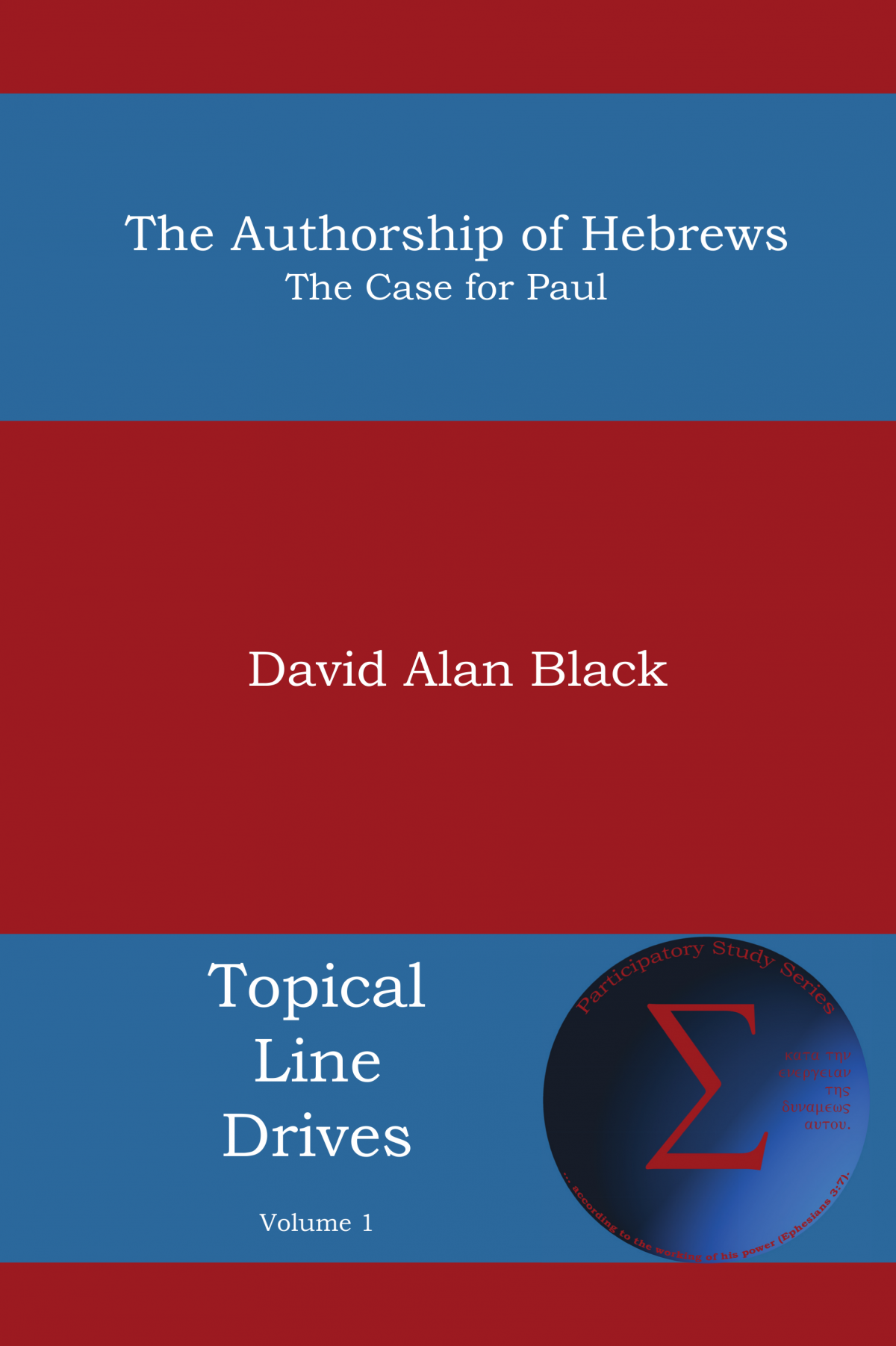
    This was underlined for me when David Alan Black asked me this: “So if the book of Hebrews claimed Paul as the author in the text you would accept Paul as author?”

    The answer to that is yes, absolutely. The internal evidence would never lead me to Paul apart from external statements, I don’t see enough issues in the text to convince me Paul was not the author if the claim was made in the text, assuming that the claim was textually secure.

    I publish Dave’s book The Authorship of Hebrews: The Case for Paul, and I credit editing that book for changing my view from “anyone but Paul” to “unknown, but Paul is an option.” One of the key values of Dave’s book is the discussion of the internal evidence.

  • Link: A Messy Incarnation

    Energion author Bruce Epperly talks about the messiness of the incarnation in God’s Birth: It’s Fragile and Messy. I consider the incarnation to be the center of good Christian theology.

  • We Have Sinned

    We Have Sinned

    This week as the story of yet another prominent Christian who had fallen passed through my news feeds, a young man who was pleading guilty to 18 counts related to sex with minors, I was led again to Daniel 9 and Daniel’s prayer of repentance.

    We argue about the impact of prayer and what God does with our prayers a great deal. Does prayer change God? But there is a much more important question, in my view: Does prayer change us? Whatever it does, I think it reflects how we are thinking.

    The Bible is quite hard on its main characters, never giving them a break. Their faults are put on display for all to see. Even the heroes of the Bible are presented with flaws. Daniel is one of those that is presented at all times in a positive light. There are those who believe he is the one referenced in Ezekiel 14:14, where he’s in a list with Noah and Job, both of whom are described as righteous.

    But when Daniel begins to pray, he uses the third person plural: “We”

    We have sinned, we have done wrong, we have incurred guilt, and we have rebelled by turning aside from your commands and decisions.

    Daniel 9:5 (my translation and emphasis)

    I think Daniel had something there about a response to sin.

    You see, our tendency is to blame others. Other people in other traditions, using other forms of church governance, believing other doctrines, and just generally being different from me/us (the righteous one/ones) fell into grave sin. They should correct their traditions, fix their church governance, clean up their doctrinal statements, and become more like us!

    For decades, Protestants have spent their time looking down on Roman Catholics because they had pedophiles in the ranks. We Protestants, being wise enough to allow marriage in the ministry, obviously wouldn’t have such a problem.

    They have sinned. We’re OK.

    But the fact is that we have sinned, and the more news comes out, the more glaringly obvious it is that we are all falling short.

    We have sinned:

    • By looking at the sin of others and assuming we ourselves are immune
    • By ignoring what Jesus said about not lording it over one another and making hierarchies
    • By considering some people to be above accountability because they are anointed leaders
    • By failing to be accountable to one another
    • By turning aside less important people, claiming their word should not stand against the word of the holier, the more educated, the richer, the more powerful, or the more respected
    • By shifting the blame from perpetrators to the victims
    • By thinking our witness for Jesus could be made better by covering up than by confessing
    • By seeing the least of these as least, rather than as God’s children, pearls of great price
    • By thinking that we can ever criticize and judge from the outside
    • By believing, contrary to Romans 13, that our behavior is only church business, and refusing to report crimes to the appropriate authorities
    • By feeling all holy inside when someone’s sin is exposed and we realize (or imagine) that their sin is not one that attracts us.

    If the church is to be a witness we need to be an honest and genuine witness to who we are. God knows who we really are. In a self-righteous prayer, we do not deceive God. We just deceive ourselves. We help ourselves believe that we are exempt.

    It is in feeling that we are exempt, better-than, holier-than, more Spirit-filled, more Christ-like, more like a real church, and less subject to temptation that we prepare for a fall. Our fall, my fall, may not come via sexual temptation. But if I become superior and arrogant, if I fail to realize who I am, my fall will surely come.

    May God have mercy on us all.

  • Above and Below: Thoughts on Exodus 32

    Above and Below: Thoughts on Exodus 32

    Yesterday I taught the Sunday School lesson for my class. The primary scripture was Exodus 32, the story of the golden calf. Our Adult Bible Studies title for the lesson was “The Permission Trap” and the goal was “To recognize the consequences of giving ourselves permission to do that which we know to be wrong.”

    In one sense, one can’t argue with that. The Israelites knew they shouldn’t be making an idol, and that is precisely what happened, Aaron’s claim to miraculous sourcing notwithstanding. (Have you ever thought, “I know nobody is going to believe this, but I need some excuse”?) The Israelites did sin, and there were consequences for their sin.

    The question in my mind as I read the lesson was whether this is actually the intended message. No, let me be honest here. I pretty much disagreed with that as the primary message.

    It’s quite possible for something to be true on one level and to miss the mark when one goes deeper. The point here is not to say that making calves is OK, but rather that the message is somewhat deeper than “Remember not to make golden calves.” When interpreting stories, I would suggest that finding the moral (or a moral) of the story is not the point at which you have found the meaning. In fact, finding that moral can often prevent you from truly learning from the story.

    To lead into this, let me note one Christian reaction, which is to blame the Israelites for being so faithless while imagining that we would do better. I would imagine that people who think this way have either spent very little time in the wilderness, or even in campsites, or they have ignored their own behavior. People who get away from their normal source of food and other supplies tend to get nervous. So the idea that the Israelites were faithless while we would be faithful involves looking at our own characters through rose-colored glasses.

    That rosy view of our own characters also results from seeing only the surface problem. We cannot imagine ourselves constructing a golden calf and then dancing around it. We think we could avoid that. Unfortunately, our idolatry often takes less work-intensive forms.

    To lead in from another direction (anything to avoid getting to the subject!), let me note that I read from Brevard Childs’ commentary on Exodus. Childs is one of my favorite commentaries, up in the top three. He goes through some of the source and redaction critical ideas on the chapter and does an excellent job as always. He points to some critical aspects of what the chapter teaches based on some of the “problems” certain people have noted in the text.

    In an aside about the aside, Childs is a foremost, if not the foremost, advocate of canonical criticism. Canonical criticism involves seeing a passage as part of the whole canon of scripture. By nature, it can make a text look different depending on your religious tradition and view of the canon. For example, Jewish and Roman Catholic interpreters are working from a different canon of scripture than one another and than protestants. I would say that Jacob Milgrom does the best job of seeing the canonical picture from different perspectives. His own perspective is that of a conservative Rabbi, but he looks at usage and interpretation in other traditions.

    In practice, scripture comes to us a part of a canon, whether that is the canon of our religious tradition or perhaps of our own making. We will read differently based on the setting in which we place the book. I will read a passage differently myself if I’m trying to understand Israel as an ancient near eastern people, Judaism as a faith, Christianity, or simply looking at a document as a piece of literature. I think we do well to be aware of all of those and I personally don’t privilege one or another point of view. (I would comment Edward W. H. Vick’s book From Inspiration to Understanding: Reading the Bible Seriously and Faithfully on this topic, particularly section 2, Canon.)

    For my Sunday School class, I looked from the canonical view, and that leads me to think that the calf itself was an instance, a symptom, and not the underlying problem. I think the text is arranged to emphasize that.

    Note, for example, that after we have the introductory story we begin and end dealing with the results on the mountain. In verse seven, YHWH tells Moses about the peoples’ failure. The conversation between YHWH and Moses goes on through verse 14, at which point YHWH repents (more on this in a moment). In verse 31 Moses returns to the mountain for a conversation about the same topic again.

    The thinking on the mountain and the thinking at the foot of the mountain are quite different. The people are impatient with God’s timing. Moses doesn’t seem to realize that so much time has passed. This is a good place to put yourself in the shoes of the people at the foot of the mountain. Supposing you are climbing a mountain with a guide. The guide tells you to wait in the based camp while he goes away for some purpose. It could be supplies. It could be information. It doesn’t matter. If the guide doesn’t return in good time, what do you do?

    Consider that you have no way of knowing where the guide is. He might have fallen over a cliff. He might have been killed by a wild animal. He might even have gotten lost. If any of those things occurred, and you keep waiting in camp, you could wait until you die. How long do you wait before you move out and try to save yourself? Your life could depend on accuracy.

    Yet the meeting on the mountaintop moves at its own pace and the Israelites have to wonder. It’s Moses who has done everything. (We can remember, from the comfort of our easy chairs, that Moses was the agent of God’s action, but to the people, it looks like Moses.) Moses met with Pharaoh and announced the plagues. Moses stretched out his rod over the Red Sea. Moses announced the Manna. Moses struck the rock and brought water. And now Moses is gone.

    Be honest! How long do you wait?

    Moses hears what God has to say, and God proposes destroying the people. I don’t want to go into detail about this conversation, except to note that this is often the time when we get into debates about foreknowledge, predestination, and whether God can repent. I would suggest those debates don’t go well in this story. Let the story be the story.

    Consider: If God is at least as intelligent as an ordinary human, don’t you think he’d know what reaction Moses would have at this point? We don’t have to settle issues of theology and philosophy to understand that God is making a point, and that the storyteller is making points about God and about Moses. Even a God without foreknowledge would know the outcome of this conversation.

    We make this point of God’s faithfulness before we hear about what Moses did in the camp. There are consequences and results of my actions, yet neither my actions nor those consequences cause God to be unfaithful. This is stated before Moses goes down to deal with the people.

    Let me compare this to someone who gets drunk and falls off of a cliff. This behavior was perhaps sub-optimal. Can God forgive? I think doubtless God does. But the body is still lying broken at the bottom of the cliff.

    In Israel’s case, God can forgive the unfaithfulness, but behaving in an unfaithful manner has results. Let me put that into my own perspective. I tend to worry about money. When one problem is solved, I immediately find another one. Since I run a business with many bills, and in many cases narrow margins, I can always find a bill to worry about. Many bills have been paid. God can forgive me for being a worrier, and yet I will suffer the health effects of sleeplessness and tension.

    The Israelites have a simple problem. It’s said that in war (and I suggest everything else) most tasks are simple, but are very hard to accomplish. After this event, for example, would be the story of the spies and the decision to turn back. Faithlessness breeds trouble.

    Moses takes visible action in the camp. I can’t say that I’m in love with his procedure, but he is, after all, Moses, and I’m so not. Visible, human inflicted consequences can have a substantial impact on behavior. Behavior can be important in many ways. I see no contradiction here between God’s faithfulness expressed on the mountaintop and Moses’ actions taking control of a camp that was very much out of control.

    And then we have the final, enigmatic statement. After the next debate with God on the mountaintop, we are told that God punished the people. We are not told when and we are not told how.

    My suspicion is that faithlessness has its own punishment built in. I gain nothing and lose much by worrying. That’s how things work. For punishment to occur, all that is required is for God to continue being God, and maintaining the universe.

    As a final note, I want to look at the basis of God’s grace and faithfulness. In verse 13, Moses appeals to the promise God had made to the patriarchs. There are those who hold that in this passage Moses is calling up the collective and collected merit of the patriarchs. Because of their merit, God should show grace to God’s people now.

    There is no indication of such a thought in this text. It is not the merit of the patriarchs to which Moses appeals. Rather, it is God’s promise, God’s oath, sworn on himself to those patriarchs. That is why the appeal is precisely what works. It is an appeal to something solid and firm, the faithfulness of God who promised.

    One can look through this story for the details of what was done wrong, and there is plenty of that. But the ultimate failure, and I know my ultimate failure, is that I lose trust. It’s the sin that underlies the sins, sin “living in me” (Romans 7:17).

    I’d rather deal with the sins because I can measure them, count them, and even deal with them in some sense. How many times was I angry today? Can I be angry fewer times tomorrow? It sounds doable. But under it all, there is that sin, which is not one I can deal with myself.

    That requires the One on the mountaintop.

    (Theme Image Credit: Adobe Stock # 279252149. Licensed, not public domain.)

  • Of Publishing and Facts

    Of Publishing and Facts

    Today a post by one of my authors was removed from Facebook. On reading the post I must conclude that if a reader finds a problem with it that would justify removing it from social media, the problem is with the reader, not the post.

    At the moment we are seeing people in a variety of positions on the political spectrum resorting to government action to protect their kind of content. The debate, of course, is whether these things are factual.

    I like factual. I dislike fake. I go to fact-checking sites, where I read not only their rating, but their reasoning for it, and the evidence they provide to back up that reasoning. Sometimes I disagree with the fact-checker. I expect that. I appreciate those sites that provide both reasoning and references.

    I am a publisher (Energion Publications). From time to time I am asked whether everything I publish is true. My answer is that it is not possible that it is all true because I publish books that are opposed to one another. I have authors with a variety of opinions and viewpoints from progressive to conservative, to a number who object to that spectrum, as I do.

    They can’t all be right.

    I have had people question whether I should publish certain viewpoints. In fact, I once had complaints about a book I published from both sides. A conservative said it was too liberal. A liberal said it was too conservative. That is a valid discussion.

    When I publish a book I disagree with, am I promoting some viewpoint I shouldn’t? That is a question I have to ask and answer with each book. If I disagree strongly with the content of a book, should I publish it?

    For me, that question is always much more one of approach then of actual content. Yes, there are viewpoints that I think are not really needed as part of our public conversation. I make a choice not to publish those. But there are other viewpoints that I think are dead wrong, yet I think need to be part of our discussion. I will publish those.

    Inevitably, some people will object.

    My response is simply that I am a private company and that I make the rules. I’m also a firm believer in free speech. I’m not anxious to shut some other publisher up because he or she follows different rules than I do. I am also not anxious to force some other platform or publisher to advocate for material of mine that he or she considers inappropriate.

    All of this is carried out by private individuals working under the umbrella of free speech. Free speech does not mean I have to support or even respect your viewpoint. It doesn’t force private individuals (as practiced in the USA) to support various positions.

    As a result, while I think Facebook has an atrocious system for determining what to publish, I do not advocate—in fact, I vigorously oppose—any effort to force them to present or not present something legally. I don’t care how big they are. They got big by doing things that kept people coming back to their platform. There is nothing they are doing that will not be made worse, in my view, by government regulation.

    At the same time, I think there is a way to deal with Facebook. For example, I publish my primary material on a separate platform. Facebook can reduce my reach by cutting off access to their platform, but my material is still online. One of the ridiculous aspects of modern discourse is that people trying to get Facebook (or other social media platforms) regulated are at the same time providing the very numbers that make those platforms strong.

    And of course, I am still on Facebook. Why? Because most of you are. I can be as annoyed as I want to be, but I’ll still be there using social media to get my own message out.

    And to share pictures of cats. Always cats.

    The one—and I believe the only—solution to disinformation is an educated and informed public, a public which demands truth. I’m not that optimistic about this in general, but no matter how much disinformation others consume, you can be a fact-checker. And no matter how many regulations you pass, there will still be some people who will believe whatever rumor best suits them.

    (Featured Image by Steve Buissinne from Pixabay)

  • Genesis 2:4-9 – God Plays in the Mud

    Genesis 2:4-9 – God Plays in the Mud

    This is again from the Daily Bible Study series. One complaint I have about the reading is that they will split up chapters and even give the verses out of order. This is not, unfortunately, according to some coherent theory about the history of the text, so far as I can tell, but seems to simply be a convenient way to get the right texts for the Sunday reading.

    There is a substantial change in the text starting with Genesis 2:4. The precise division depends on who is doing the dividing, but usually it is Genesis 1:1 – 2:4a, and then 2:4b and following. These are the two creation stories.

    These two stories describe creation in quite different terms. In Genesis one we have soaring literary prose. It is powerful, and likely intended for use in liturgy, a purpose it has served well many times. The key theological elements, emphasized by the literary form are power, control, success, satisfaction, and blessing (and perhaps more).

    God is certainly involved, but the emphasis is on God’s power and glory and not on how close God is to creation. Genesis 1 could potentially be regarded as compatible with deism, seeing God as ultimate creator, but not as one interested in the day to day aspects of the world. Of course we have the Sabbath rest in 2:1-3, but a bit of interpretation, specifically not getting too literal, takes care of that. God is in charge.

    I should make a couple of quick points. First, Genesis 1 is not poetry. It has poetic elements in the language, but it does not have the characteristics of Hebrew poetry. It is powerful, well-designed prose. Second, Genesis 1 is not a myth, when myth is used in a literary sense. While it uses some of the language and symbolism of mythology, this symbolism is used in quite a different way. There is none of the conflict between supernatural characters, for example. One could almost call it an anti-myth.

    It is also not narrative history, nor is it science. It is theological in nature, and specifically liturgy. This doesn’t mean that it has no relationship to history or to science. It just isn’t trying to make testable scientific statements, nor is it trying to narrate a series of historic events in a form a historian might recognize. A good analogy might be the relationship of the liturgy of Good Friday and Easter Sunday to the events of the resurrection. Historical elements occur, but are never in focus. This is not a weakness. Liturgy takes its power from focusing on the divine elements and their connection to worshipers.

    But with Genesis 2:4b we come to a very different picture. We see God planting a garden, forming a human being out of dust and then breathing the breath of life into that body. As we proceed through the text, we will see God personally involved with the human being.

    There are those who think we solve problems with the text by noting different literary sources for Genesis 1 & 2. I do think that source criticism is accurate here in that these two stories of creation were at one point separate. But source criticism solves very little of what a text means as we have received it.

    The problem with trying to resolve contradictions by referring to sources (and there are chronological issues between Genesis 1 & 2 if you take them as intending to present the events in precise order) is that it doesn’t really solve anything. We still have the text before us, and that means that somebody, somewhere, sometime thought they worked together.

    This, to me, is evidence of the simple fact that this was not written, nor was it collected, by someone who was primarily concerned with chronology or with presenting narrative history.

    In combination, these tell an exciting story. There is a God of ultimate power who does not have to fight with others in order to create, whose word brings things into existence, whose will is carried out, and who has no peer. At the same time, this God of great power is personally involved with the creation, getting his hands dirty, so to speak, and coming in contact so as to provide breath.

    While on the sixth day, God is said simply to create the animals, in Genesis 2, the animals are created and brought before the original human so that he can name them, thus emphasizing and personally upholding the human’s authority and dominion. This same God of power is concerned that this first human is alone, and creates a woman, so we now have a first man and first woman, who are neither of them alone.

    Either of these views by itself would be incomplete. Personally, I like to join them to Psalm 104, in which God as creator is presented as sustaining life on a moment to moment basis.

    You can see my color-coded view of Genesis 1 & 2 here, and my thoughts on Psalm 104 here.

  • Genesis 1:1-2:4a from the Daily Study Bible

    Genesis 1:1-2:4a from the Daily Study Bible

    This is a day late, but the text for Sunday, the key text for the lesson, was the creation story of Genesis 1. This is a summary of what I taught, and some notes on what I didn’t.

    For obvious reasons, we discussed Hurricane Dorian. By Sunday morning we were pretty sure we would not be impacted in this area. I wanted to make the point that it is questionable to claim an answer to prayer regarding the movement of a hurricane. If God spared us because of our prayers, what did God have against the Bahamas? Let’s just pray that God will be with us and with whoever is impacted by a storm and leave the movement of the story to the processes of nature.

    I chose to spend my time in Psalm 19 and to discuss the relationship of God’s creative power to lawgiving, and then to God’s power and the proper place of the law. For my comments on this, see my earlier post.

    Yes, this Sunday was scattered, because we covered a variety of related questions. I’m not teaching this coming week, but I’m planning to take a look at the scriptures and post a few notes.

    Since the Daily Bible Study commented on authorship, I should like to my own color coded text for Genesis 1.