
My wife said some important things in her devotional yesterday, First Century Church Wanted. If I might summarize, many of us want what the early church had, but we don’t want to do what the early church did.
Author: henry
-
If All Else Fails, Blame the Latest Technology
The Christian Post has a headline that reads Apologist Josh McDowell: Internet the Greatest Threat to Christians. Now if you read the article, you’ll realize the biggest problem here is headline writing rather than what Josh McDowell had to say. In the end he concludes that Christian parents need to be knowledgeable. I’d have a hard time arguing against that.
At the same time, I have to ask just why the availability of knowledge about atheism is such a serious threat to Christianity. In my view, we should be reading and discussing those arguments fairly early in our children’s lives.
Holding a position or belonging to a group because you don’t know any better is not a particularly valid choice. If the only way we can keep members is by limiting knowledge, then we deserve our fate.
McDowell is arguing for more knowledge. (For what it’s worth, I don’t really find his books very helpful in that regard, but that’s beside the point.) The problem is that I frequently hear Christians speak as though the best thing would be if we could restrict the availability of the knowledge.
That ship has already sailed, and it was a leaky one at that.

-
Quote of the Day – Way of Christ vs Way of Caesar
From the forthcoming participatory study guide to Philippians, by Bruce Epperly:
The way of Christ differs markedly from the way of Caesar, who was also worshipped as a deity. Christ’s peace is based on non-violence and inclusion, while Caesar’s peace is based on the sword and subjugation.
(Used by permission.)
-
A Sinful Job Description
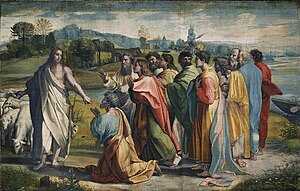
Image via Wikipedia The Christian Post has an article on depression amongst pastors and ministry leaders, which, in turn, links to an article at The Gospel Coalition. Now the Gospel Coalition article is part one of a five part series, so I’m not going to comment on how far they will go before they are done, but I think they could expand on their first item: Unrealistic expectations.
Not only are our expectations of pastors unrealistic, but they are sinful, and our descriptions of them are deceitful. The surprising thing is not that there are depressed pastors and ministry leaders. The surprising thing is that we have any functional leaders at all! I have long believed that if we described what we want in a pastor in a job description, nobody would be able to fulfill the role.
What we want, I believe, are Christ figures, who, rather than leading the church, will be the church, and will eventually sacrifice themselves, and probably also their families on behalf of a local church. That local “church” is only a church in name, because they are not behaving as the body of Christ, but rather delegating that task to a paid professional. Visiting the sick and shut-ins, serving in the community, spreading the gospel message, giving, and study of the Word are all functions of everyone, not just one ordained person.
Just leading the teaching ministry of a mid-sized congregation would be a solid, full-time job for one person, and that only if he or she spends most of the available time equipping other teachers in the church.
As long as we have unrealistic–yes, sinful!–expectations enshrined in our church organization, we’re going to have leadership problems, not to mention plain old “living the good news” problems.
Related articles
- C. J. Mahaney Steps Aside To Face Charges (antagoniz.wordpress.com)
- Three Pastoral Musts That Don’t Often Get Mentioned (via Jared Wilson) (mgpcpastor.wordpress.com)
- Our Pastor is Lazy (jevlir.com)

-
Quick Note on (Biblio)blogging
I note quite a debate around the blogs I read regarding just what is a biblioblog. For a long time, this blog was listed as a “related” blog, then a few months ago was “upgraded” to a biblioblog, and I’ve been in the top 50 ever since, and even made the top 10 a time or two. I’m not going to join the debate. As long as I’m so classified, I will participate in the community by displaying the badge and linking to the biblioblog library. If the classification changes, I’ll still be linking to lots of biblioblogs (however defined), because I subscribe to a number in my reader, and read quite a few more via links from those.
As far as topics are concerned, I find that many times when I think I have written something significant, nobody notices. At other times, when I think I’ve batted out a few throwaway lines, I get a bunch of links. I’m not sure whether my “significance meter” is on the blink or if my readers are, on average, a bit weird. It could be both.
My most popular post at the moment is one that relates to the Bible, though it isn’t very academic: Ephesians 6:18 – Always Pray in the Spirit. That struck me this morning because yesterday I wrote a post titled A Sense of the Spiritual, in which I noted that it can be hard to really feel a Bible story as the original hearers might have without also having (or at least truly understanding, I suppose) a strong sense of the nearness of the spiritual realm as they did.
So much for reflections …
-
A Sense of the Spiritual
I once met a woman who claimed that Jesus had come to her in her kitchen and spoken to her. The reaction of friends, neighbors, and even family to this story was fairly negative. She was regarded as a bit odd, and finally quit talking about it. It was only with some hesitation that she told the group of which I was a part.
Now I see no particular reason to doubt that she saw precisely what she saw. It was, I believe, a visionary experience, and she would have no objection to its being described as such. But the general reaction to such an experience varies between tolerance and avoidance.
That story came to mind as I was reading the lectionary text from Genesis 28:10-19, which tells the story of Jacob’s dream of the ladder at Bethel. Jacob has a dream. Note that like the lady I met, he doesn’t try to claim some sort of physical presence. Yet his reaction (v. 17) is that “this is none other than God’s house, and this is heaven’s gate.” For him the presence of God was a profound reality, even though it was manifested in something as simple as a dream.
If someone said they saw Jesus in a dream, we would have a more positive reaction than people did to the visionary experience. We expect dreams. But we wouldn’t generally respond as Jacob did, considering the experience a profound spiritual event.
One of the things I suggest in trying to understand stories in the Bible is that we come as close as we can to understanding the way in which the characters in Bible times would have reacted. Otherwise we will fail to get the full impact of the story.
Spiritual things were very near, and God’s presence, even in a dream, was deeply sacred.
-
Book: Thank God for Evolution
Dowd, Michael. Thank God for Evolution. New York: Plume, 2007. 380 pages + front and back matter. ISBN: 978-0-452-29534-6. (All numbers in parentheses are page numbers from this edition of the book.)
I was interested in this book from the moment I saw the title, not because I immediately expected to agree, but because it, along with its blurbs and description, takes a celebratory approach to evolution. My own position is that evolution is a fact and a valid theory, but it requires some theological work to deal with that. So a book that claims that evolution is not only compatible with Christianity, but something that Christians should thank God for, sounds pretty challenging to me.
The early pages of the book set some pretty high standards. In the “Author’s Promises” Dowd makes some very strong promises, claiming that he is bringing forth a new form of Christianity. For example, speaking to “devoutly committed Christians” he says that “. . . whether you consider yourself conservative, moderate, or liberal, my promise to you is that the sacred evolutionary perspective offered here will enrich your faith and inspire you in ways that believers in the past could only dream of” (xxvi). He also expects that his exposition will be enriching to atheists and freethinkers, amongst many others. That’s a tall order, and if you read the complete section of author’s promises, you’ll find the mission gets even more daunting.
I was reading this book along with my Sunday School class, and I tried to look at it in two ways. First, I wanted to see how much it challenged my thinking and made me reconsider things I already believe. Second, I wanted to see how well it fulfilled the author’s own stated mission.
So how does he go about his task? He divides his presentation into five sections:
- The Holy Trajectory of Evolution
- Reality is Speaking
- The Gospel According to Evolution
- Evolutionary Spirituality
- A “God-Glorifying” Future
The first section lays out the view of evolution that underlies the rest of the book. I would summarize this by saying it’s a very directed and goal-oriented view of evolution. The evolutionary process is not just natural laws being laws; it is a process that is leading the universe, and of course our world, to ever greater heights. The second section attempts to relate the concept of revelation with science, and deals, in a sense, with epistemology. The third section attempts to restate basic Christian doctrines in terms of evolutionary theory. The fourth expands this into a more general spirituality, including presenting some ideas of spiritual disciplines. In fact, the fourth section goes so far as to discuss speaking in tongues and relating it to this evolutionary spirituality. The fifth section, to be honest, started to feel rather redundant, but I’d summarize it by saying that it restates the evolution of the entire universe such that it is leading to the fulfillment of the dreams of an American 21st century liberal. Many of these dreams are not at all bad–the question that remains is whether evolution is inevitably pushing in that direction.
As usual, let me state the positives of this book. I’m afraid my reaction is not all that positive, so this is harder than usual. The author’s style is engaging, though I must temper that note by noting that it seems redundant from time to time. The section of spiritual disciplines and some on evolutionary psychology were interesting, though understandably a bit basic. I’m not sorry I read the book, but it doesn’t go onto any of my “you ought to read this” lists.
There are a some things this book is not. It is not an outline of evolutionary theory. There are some basic descriptions of evolutionary processes, but nothing that I find challenging, and I am not trained in any of the natural sciences. (I should note, however, that I’ve been reading books on creation and evolution since I was about 10 years old.) It is not a deep book of theology. While it runs through a number of theological concepts, the major contribution, in my view, was in redefining terms. It does not deal extensively with scripture. If you want to look at how to interpret scripture in the light of the principles expressed here, your guidance is limited to telling you not to take the Bible literally, and to look for revelation of God in the ongoing, evolutionary story of the universe around you.
Before I discuss the success of this book at attaining its stated goals, I want to write a note on accommodationism. Accommodationism is the view that science and religion can be accommodated and need not conflict. The problem with this is that it doesn’t define “religion” and “science.” My religion and mainstream science can be accommodated, but let’s say someone believes that the only way to faithfully read Genesis 1 & 2 is as historical narrative description the creation of the world, then that particular form of religion and mainstream science cannot be accommodated.
I might want to suggest that this view of Genesis 1 & 2 is less important or less essential, but it’s not my place to tell others what about their belief system is essential. I can suggest, but obviously the decision is theirs. I cannot claim to have accommodated their faith to science unless, in the process, I have respected what they regard as important.
Similarly one must define what one means by science. I see science as a way of studying the natural world. If something is supernatural, it can only be observed by science as (and if) it impacts the natural world in a measurable way. So I don’t understand science as the one and only way to know. Yet there are those who do. If one believes science is the one and only way to know, then accommodation with religion will again be impossible.
Thus accommodationism itself tends to become a scientific and religious position on its own, rather than a reconciliation of other positions. In accommodating science and religion, proponents often alter the components in ways that will not be acceptable to adherents of the supposedly accommodated views.
Note that I distinguish a form of political accommodationism, in which proponents of the teaching of evolutionary theory work together even though their positions on religious and philosophical issues may differ greatly. This is simply agreement on certain goals, something much different, in my view.
What Michael Dowd has done, in my opinion, is to create an accommodationist religious position, with some prejudice to both Christianity and evolution. It’s hard to say which takes the bigger beating, though I think Christianity in any orthodox form comes in for the worst treatment.
Evolutionary theory, it seems to me, loses as well, by being presented as a teleological process. It is a very optimistic view, which essentially holds that all the competition and death and suffering of biological evolution leads ultimately and (almost) inevitably to cooperation, enlightenment, peace, and joy. It’s not that I disagree with the kinds of goals that Dowd expresses. His hopes are very attractive. I actually wish I could believe they are as inevitable as he seems to think. I just don’t think it’s so.
Christianity comes in for redefinition. All the words are there, but they come into new meanings. You can claim that resurrection or eternal life means coming back as some sort of stardust (97-100), but that’s not what it means to most Christian believers, and I suspect you’re not going to find that many who want to exchange one view for the other. Similarly, the “realization” of various miracles (Appendix B, 357-370) is going to fall flat for most evangelical or orthodox Christians.
In fact, I would say that if you being this book as an orthodox or evangelical Christian, and substantially accept what it teaches, you will no longer be recognizable as a Christian, except in vocabulary. You’ll use some of the words that Christians use, but you will not mean the same thing. I try not to tell other people whether they can call themselves Christian; I believe God can deal with the labels issue. But these changes in vocabulary are so radical that they really no longer appear to relate to the same religion.
In a sidebar titled “Realizing ‘the Centrality of the Cross’” (210) there is a great illustration of what I’m saying. In describing the traditional Christian understanding of this phrase Dowd says that “. . . it is often taken to mean that only Christians who believe that God’s Son suffered and died on teh cross for their sins will ascend to a place somewhere outside the universe called heaven. Everyone else will be tortured forevere in hell. . . .” In its place, evolutionary Christianity would say that this refers to “vertical integrity,” or “getting complete with the past and being responsible for the future . . .” and “horizontal integrity,” “being in right relationship with my nested world.”
Now the vertical and horizontal components do form a sort of cross, but the only connection between those two views is in the vocabulary. Further, the orthodox position could be stated much better, and would subsume integrity, though in quite a different way. I do like the concepts of horizontal and vertical integrity, but they are not the essence of “the centrality of the cross.”
The main purpose for which I could recommend this book would be in order to understand this evolutionary Christianity movement. Many of the theological positions would be better studied from writers expressing theological positions such as process theology or panentheism. I rate the book three stars out of five.
I believe that both Kenneth Miller’s Finding Darwin’s God and Richard Colling’s Random Designer provide a better presentation of ways to reconcile Christianity with evolution.
Related articles
- Another accommodationist book on evolution (whyevolutionistrue.wordpress.com)
- Evolution is not a threat to religion (tangenttalk.blogspot.com)
- Crevolution! (thecynicalchristian.blogspot.com)

-
Philippians: On Grace, Faith, and Works
The following is another extract from the forthcoming study guide on Philippians in the Participatory Study Series, by Dr. Bruce Epperly:
For Paul the issue is two-fold: 1) the status of Gentiles as members of the Christian community and 2) the relationship of grace, faith, and works. As apostle to the Gentiles, Paul affirms that God’s grace is universal and freely-given. God’s grace includes all persons, regardless of ethnicity and race. Just as all have sinned and fallen short, Jew and Greek alike, all are equally welcomed into God’s realm. To place certain requirements on Gentiles would fracture our unity in Christ and place them in the category of second class Christians, who must do something extra to receive God’s freely given grace. If we must do something extra to receive God’s grace and our place in the community of faith, then the grace of God is nullified and is dependent on our achievements. In practice, then a person will never know if he or she has done “enough” to receive God’s grace and promise of salvation in this life and the next. While Paul recognizes that grace leads to action, our ethical actions and religious practices do not earn God’s love. God loves us because we are God’s beloved children, regardless of our sin and brokenness (53).

