Threads from Henry's Web

Author: henry

  • Seeking, Dialogue, and an Ecumenical Center

    I’m an advocate of dialogue in everything, certainly including matters of faith. Sometimes, however, dialogue is confused with seeking. There’s nothing wrong with seeking, but it is not identical with dialogue, though they do overlap.

    Dialogue can and should occur between people who do have an idea what they believe. It’s hard to have an exchange about beliefs if you don’t actually have any. This describes an extreme case, however. Seekers are rarely totally without beliefs, and someone seeking dialogue is unlikely to be locked in on everything. But I wanted to start with the contrast.

    For good dialogue to take place, I believe, one needs to identify what one believes and also distinguish between core beliefs, things that anchor you spiritually, and those beliefs that you hold more loosely. Not everything is of equal importance, after all.

    This is the idea of an ecumenical center. That’s not a middle of the road or moderate set of ideas. It doesn’t mean that one is a centrist. It simply means that certain ideas are central to your system of beliefs. In one sense you might say these are the things you’re going to hang onto. But I think it’s more a matter of these are the things that feel secure to you. In fact, you can discuss them without feeling threatened because they are so much a part of you.

    For example, I would place the belief that Jesus has come in the flesh, the incarnation, as my core belief. I talk about everything in those terms. I even talk about my understanding of scripture from that perspective. One can debate this on a chicken and egg basis, and I wouldn’t be able to tell you which came first. It is just central. When someone challenges the incarnation, it doesn’t bother me. That’s something that is firmly founded in my thinking and my spiritual life, reinforced by study and experience.

    I think some people are uncomfortable with dialogue because they believe they can’t have firm beliefs and still dialogue. I disagree. I think having a few firm beliefs is a good starting point for dialogue. It gives you something to say. It may make you a bit more interesting, even!

    Dr. Bob LaRochelle has done a good bit of thinking about this idea of an ecumenical center, thinking in particular about the things that we share between denominations and how that can be a basis for cooperation. He’s one of our Energion Publications authors, and he’ll be talking about this on a Google Hangout on Air tonight, October 21, at 7 PM central time. I invite you to watch this and think about what things are central to you.

  • Prophecy and All Believers

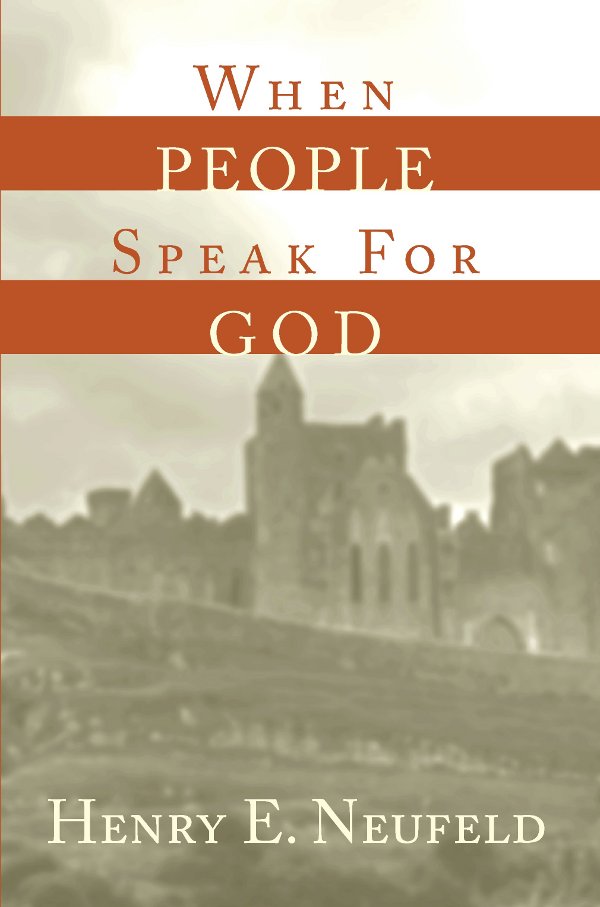
    We had an interesting discussion today in Sunday School. We were discussing the 3rd chapter of my book When People Speak for God,  titled Messengers – God and Prophet. The questions at hand were just what is prophecy, who are God’s messengers (with a side-order of how can you tell) and how does getting a message from God work.

    I started by repeating an important point, I  believe, that prophecy in a biblical sense is not the same as prediction.  I do not deny prediction as a part of prophecy,  but thinking of prophecy as primarily about prediction will provide a distorted view of prophecy. Denying all prediction will distort one’s view as well.

    Further, discernment is always a requirement. A key passage in considering discernment is 1 Kings 22. What lessons one might draw from that story might be quite interesting. But that discernment was needed is quite clear.

    Combining the result of that story with  Jeremiah 42 & 43 and my own observations of life I think that we have a greater problem with doing what should be done after we know what it is, than ever we do with actually discerning what is right and wrong.  The most common question I hear (and ask,  for that matter) is “how do I know what God’s will is?” when the real question should be “how can I put into action what I already know is right?”

    This led us to the question of naming prophets.  Who in the church today might be called a  prophet?

    In the church I think we should be much less about who is in the office of prophet than was the case in Old Testament times,  and much more about all God’s people being prophets, perhaps a fulfillment of Moses’ wish: “Would God that all the Lord’s people were prophets and that the Lord would put his spirit upon them” (Numbers 11:29).

    I think that this goes well with the idea of the priesthhood of all believers. It is not about finding people to occupy an office of prophet, but rather to recognize this gift when it is received and exercised.

  • Happy 60th Birthday, Jody!

    Happy 60th Birthday, Jody!

    jody at disneyToday is my wife Jody’s 60th birthday. She’s 60 years young today. I know that’s a cliche, but in her case it’s also very true. At heart she is quite flexible. Attaining the big six oh has not cost her sense of humor, her flexibility, or her ability to relate to young people. I’ve always been amazed at the way young people just collect around her.

    I got married late. I had a hard time imagining shaping my life to the needs of someone else.Now I can’t imagine living without her. We have become one.

    Marriage, whether you’re young or old, is an exercise in mutual submission. Before I was married I thought this was a matter of big issues. But in reality it’s a constant thing as you work with little things. For example, a birthday party. Jody likes lots of people and thrives on activity and noise. I think three is a crowd and four is in danger of becoming a mob. I’ve forgotten my own birthday, and even done so when I was a teenager. I forgot my 13th birthday, in fact, and was quite shocked when my mother said Happy Birthday that morning.

    Jody wanted a great birthday party for her 60th. I thought she deserved it and was determined to make it happen. Fortunately for me, fate, in the form of daughters, both heart and blood, who took over, planned, and executed everything. So this afternoon Jody will be gathered with friends from 2 pm to 5 pm. She demonstrated her sensitivity to my personality by telling me I didn’t have to be there the whole time. That was nice, but I rather think I should be there the whole time.

    I can’t help drawing serious lessons, so here goes. I recall preaching at a church once where we had just become members. Few people knew me, but the pastor knew my background, so when he was out of town he invited me to take the pulpit. I did so. The practice at the end of the service was for the preacher to walk down the center aisle to the back door first, at which time the congregation was dismissed. Thus the preacher could shake everyone’s hand as they left. As I reached the second pew going down the aisle, an elderly lady grabbed me by the arm and said, “Young man, you don’t know what sort of things are going on in this church! There are four generations of my ancestors in that cemetery [she waved at the windows to where it was located], and none of them would approve of the goings on in this church!” I extricated myself without starting a fight, but I remember thinking that the first place I’d go for advice on how to run a church would be the people in the cemetery!

    That woman represents how so many of us get old and crotchety and spend our time criticizing those who are young and still have energy, hope, and ideas. Jody is precisely the opposite. She believes that one of the great things about being old is that you have the opportunity to encourage young people. You can give advice, but you let them be who they are. They haven’t yet been broken into cynicism by the world around them. Being with her is refreshing.

    She has arthritis and significant amounts of pain, but she’s keeping active and moving forward. I look forward to her encouragement in the years to come and hope I can be a true companion to her as God intended.

  • Some Notes and Links

    Yesterday I ranted about the church. Dave Black pulled some of the better material out of it and commented, so I posted it to The Jesus Paradigm so we’d have a link.

    I also posted some notes on recent releases and some not-so-recent ones regarding the church on the Energion Publications news blog.

    I blogged about publishing The River of Life a few days ago. Now Energion author and series editor Bob Cornwall has published a review of that book. I want to mention that when I talk about new releases on Monday on the Energion Publications news blog, I’ll be announcing another book, Reframing a Relevant Faith by Dr. Drew Smith, that will make a nice companion. At that time I will tell you who said of  this new book: “One of the best presentations of the progressive Christian vision I have read.

    My own work this weekend involves working on the release of a new novel, Molecricket, for our Eucatastrophe Press imprint. I’ll provide links and images on Monday.


  • Not Looking for the Perfect Church, but …

    Via Allan Bevere I located this interview with Scot McKnight, in which McKnight makes a number of interesting statements. The one that caught my attention most was:

    … A proper kingdom theology leads people to the middle of the church, not away from it. So it makes a difference when church is on the decline and people are saying they are committed to the kingdom but not so much to the church. You can’t have kingdom without church.

    First let me note that I am a very churchy fellow. Except when I was not a (practicing) Christian, I have been a member of a church congregation, and those congregations have largely been deonominational. I’m the sort of person who finds a church in the phone book when traveling on a weekend, and goes and worships with a local congregation. I’m a member of First United Methodist Church of Pensacola, who, I am sure, would rather not be blamed for what I say! First UMC is not a perfect church. I’m sure that can be said of all the First UMC of ____ congregations around. Nonetheless the gospel is preached there, and much good ministry is accomplished.

    Second, Allan Bevere is a friend, and co-editor of the Areopagus Critical Christian Issues Series published by my company, Energion Publications. I like Allan. What’s more, I agree with him on many things, especially what he said about this topic.

    Third, I found very little that I disagree with theologically in Scot McKnight’s comments.

    My problems are largely practical. It’s all well and good to tell people to connect with the church. I’ve been doing that myself. In fact, I find that most people who are struggling spiritually have one thing in common—they’ve lost that connection.

    But here are some of the reasons I’ve heard just recently for not connecting with local churches:

    1. The church lacks convictions. Face it, fellow Methodists (I’ll leave the rest to check their own surroundings), we’re not a church of terribly strong convictions. When I was looking at joining a United Methodist congregation I was told by one pastor that he didn’t care what I believed. If I wanted to “enjoy their fellowship” I could join. I’m not sure whether he wanted me to abstain or lie during the membership vows.
    2. The church has convictions, but people can’t live with those convictions. I’m not referring to any particular issue or any side of any particular issue. I’ve heard this from people across the theological spectrum. Really!
    3. The church is so little oriented toward kingdom work of any variety (any of the five elements to which McKnight refers) that the person doesn’t how he or she could work for both the kingdom and the church.
    4. The church is so fractured, that people have a hard time identifying what is actually Church.
    5. The church behaves as though it is a kingdom in the throes of a civil war.
    6. The king is, at most, a figurehead.

    I could go on, but I won’t.

    I have personally felt elements of all of those things. Of course the kingdom and the church should overlap, but sometimes I feel that the theologians and preachers are hammering the people who are trying to accomplish something for the kingdom, as problematic as that may be outside of the church, while the churches (to be distinguished from Church) continue to fail to make it possible to accomplish much of anything. It often sounds like people should be able to find and identify a good church, one that will truly be part of the kingdom, without any particular guidance. When they get there, the reason they should stay is that they need the church, whether or not it is functioning for them.

    Now I’m sure readers are going to get all tense about the phrase “functioning for them.” I believe that the primary issue in finding a local congregation is discovering the place where, and from which you can best serve Jesus. This is necessary because we don’t have a single church. Paul didn’t write to the Corinthians about our sort of problems, because we’ve gotten much worse. Not only do we have divisions; our divisions are institutionalized. So I have to locate a church congregation where I can be part of the Church, and thus carry on kingdom work. The followers of Cephas, Apollos, Paul, and Christ have separated themselves into different buildings with signs and trademarked logos.

    Once I find this congregation, I’m as likely as not to be pushed into various congregational or denominational programs to make sure that I’m properly socialized to the way that particular congregation does business. I recall being pursued early in my time in the United Methodist Church by folks from the Lay Speaker program. I needed to be certified before I spoke. I needed to coordinate before I spoke anywhere, because I might be seen as representing the UMC. But I wasn’t being invited to speak for Methodism. I had other things going on. Once I’ve checked off the boxes, the congregation wants to make sure I’m doing things for that congregation. Perhaps we should recognize that people gain skills in other churches, other denominations, and even in their secular occupations.

    Now because I am fully convinced of what Allan and Scot are saying, I will find that congregation and I will be a member, and I will make my kingdom work part of Church. What I won’t do is find myself stuck with that congregation or denomination. If I can get together with other parts of the Church irrespective of denomination, I’ll do so. But we get back to “functioning for them.”

    I’m seeing a great deal of hostility to any notion that a person should get something out of church. But the fact is that if you don’t get something out of church, you’re not going to be doing any ministry from church. No, you shouldn’t be self oriented. You should look for a place where you can serve. But a church congregation (and the whole church), should be a place where we serve one another. We give and we receive. And if we don’t receive, we won’t be giving for long, I don’t believe.

    That’s one of the problems with our expectations of pastors. The actual job description for our pastors—I mean what you’d get by following them around and describing what they actually do, not the paperwork lies we use—is both ungodly and stupid. Nobody can do the job. We put men and women into a place where nobody can truly succeed. Those who do succeed at all remold the job. I do not mean to denigrate the many fine pastors I know who are doing wonderful kingdom work from their church congregations. The problem is that we require them to be paragons just in order to succeed. We make every effort to destroy them. That’s the extreme of giving but not receiving.

    (Yes, Jesus said it’s better to give than to receive. But if we have an entire Church of people giving, there will be a lot of receiving going on as well!)

    It isn’t wrong for a couple with children to want to see that the church congregation they join will help them raise and nurture their children. It’s not wrong for a person who is ill to hope to be visited, encouraged, and prayed for. It’s not wrong for missionaries to want a home base that will actively support what they do and who will want to listen to their stories when they return. It is not wrong for the elderly members to expect that they will be helped and respected in their declining years. All of those things involve the congregation “functioning for” various people. If I want to support children’s ministry, the elderly, service to the sick or imprisoned, or engage in social action, why would I join a congregation that shows it’s intention not to do those sorts of things?

    But, object many of my fellow churchy folks, there are good congregations out there. People should be more determined. They should seek out the right congregation. They should find a way to serve! They can start those ministries!

    And here you’re expecting the non-theologically trained, non-church-oriented, ordinary people who just want to get about doing good to fix your church first. If the church is spending 70% or more of its budget just maintaining the machine, why would someone who really cares about the poor, for example, decide to join up and handle the problem before they do what they are called to do? That’s what we ask of many of them. We are dedicated to the buildings, to the structure, to the programs, and to the traditions, so they should come on board and be satisfied with just a tiny percentage of the effort and money of the church going to the sorts of ministry to which they are called.

    I don’t believe that the solution to our church problems will come by persuading this generation that they need to come on board and solve our problems before they can do kingdom work. Those of us who are in the church need to be prepared to be radical. Sometimes one must acquire buildings, but very frequently one must get rid of buildings. If a church is failing, it may well be time to shut it down.

    I’m not opposed to paid staff. But our paid staff should be people who help get the rest of us out doing ministry. For example, I would be very sorry to see a scholar-pastor such as Dr. Wesley Wachob at  my home church in a bi-vocational ministry. I think the best use the church can make of him is in a full-time teaching role. But his job (and I’d be surprised if he doesn’t understand it this way, but don’t blame him for my words!) is to get another 3,000+ of us out there doing ministry, not as paid ministers, but as every member ministers. (Every member in ministry is a good Methodist program. Too bad “every” is such a small number in so many cases.)

    Do I have a solution or is this just a rant? Well, I admit it is somewhat of a rant. But I do believe that each of us who are in the church can make a difference by being different. Have convictions. If you don’t know what they should be, study. Learn. Be prepared to stand aside and see things done differently, even in ways you don’t think will work, as new people come in the door. See the church everywhere believers may be found, and not just in your congregation.

    And for the 21st century in particular, realize that social relations are different now. I hear moaning in church about a decline in people knowing one another as aging church members (and I must admit these aging church members are my age!) talk about how social media is ruining everything. They ought to be in church or at our Sunday School party, but they’re on Facebook. Yes, indeed! They’re on Facebook. And that’s part of their social circle and how they connect. And because I want to be able to connect with the current generation and those between, it’s one of the ways I connect. Many of my closest friends now I met through electronic media, some long before it was called social media or the internet became so universal.

    For example, I met Elgin Hushbeck, Jr. on the CompuServe Religion Forum in the days when I had to dial-up a CompuServe outlet in order to connect. Elgin is now one of my authors. He spoke some years ago at a pastor’s conference I was coordinating. It all started through non-traditional media. It was through Elgin that I met Dave Black, who I now count as one of my closest friends. They’re part of the Church, I am connected to them, and it didn’t start in a church fellowship hall.

    Then there’s Allan Bevere, who I know is committed to the church and is committed, I believe to all the types of ministry I’ve discussed and more. Further, he’s willing to be in the heart of the fray. I met him via blogging. In fact, I think our earliest exchange involved him telling me I didn’t know what I was talking about! We’ve met in real life since, but it all started among the blogs. He, in turn, introduced me to Bob Cornwall, a Disciples pastor in Michigan, who is also one of my authors and the lead editor for a series I publish. My point here is not to invoke these people in support of my views. Rather, I’m pointing out that there’s a whole new way of congregating in the 21st century, and we churchy folks need to get used to it. It may not just be an adjunct to what we consider “real” socializing. It’s more likely a new reality.

    All of these people are in the Church with me, as I see it.

    I don’t think the concept of the church is out of date. The media may change, but the idea is there. What we need to do is truly practice being the body of Christ in whatever place and by whatever means there are at hand. In doing so, we need to be radical, in the sense of pulling up by the root those things that keep us from doing what we need to do. Our theology on the importance of the church won’t bring these people in. I hope it will convince us that we need to get real about the message and practice of the gospel.

  • Dating of P52

    This article is fascinating, both because of subject and because of how it demonstrates how paleography functions (HT: Dave Black Online).

    I’m posting it here both for the interest and because I have cited P52 in discussing the dating of the Gospel of John with various classes. Just a few points:

    1) In my own defense (and that of others who use it), I have always pointed out the potential error in paleographic dating, and used the +/-50 years figure as an approximation. Thus I would have always pointed out that P52 could be as late as 175 CE. It appears possible it could be even later. On the other hand it could be somewhat earlier, even with the evidence cited in this article. Think of a 100 year window moving forward or backward. One might say 2nd century. In fact, I suppose one has!

    2) One should also consider that the likelihood that one has laid hands on the earliest copy of a work ever produced is unlikely. So while the gospel cannot have been written after it was produced, it also was not likely written at the same time. A date of 150 or 175 CE would imply some distribution of the gospel at that point. Unfortunately, this amount of time is inherently unknowable. Still, I think it suggests that trying to date the book at or about the time a copy was produced is also questionable.

    3) The article also illustrates the considerable problem with dating a small fragment, which simply compounds all of the difficulties involved in paleographic dating. With only a small amount of text to work with, one has difficulty finding sufficient data points to narrow down the result.

    Still, the article is totally fascinating!

  • Tentmaking in Silicon

    The title of this post is a mite more exciting than the contents. It’s a bit of personal reflection on my own life and business.

    It’s just over 10 years since I started Energion Publications. In fact, I was rather surprised, when I looked at the first book we released, to see that it has a copyright date of 2004. We had one book before that, but it was one we bought out as we started the company.

    When we started Energion Publications, I was earning my living by managing small networks, with an occasional sideline in custom software development. I kept that business while I built up the publishing operation. It was an absolutely necessary part of the program. Starting a new publishing company ten years ago, and surviving the past 10 years, required some source of additional income.

    But my goal throughout was to be able to drop the computer work and work full time as a publisher. I kept thinking that the publishing business should be not just self-supporting; it should be able to support me as well. There are some quite good reasons to desire that result. If I just take the last two days, I had over 8 hours of my time taken away from urgent work meeting publishing deadlines. These were things that couldn’t have waited. One involved a power outage and a nearby lightning strike (only one small part actually had to be replaced), and the other a software vendor who provided incorrect license numbers with a software upgrade, thus effectively shutting down an entire office. Both could be fixed. But they came at a very bad time for me.

    As an aside, you may ask, why am I blogging if I’m so far behind on work? There are two reasons. 1) I can’t actually work as many hours as I’d like to on book production. A moment comes when the brain says, “Enough!” and I have to take a break. On the other hand, doing a bit of blogging is one of my forms of relaxation, so I can do it as prevention. 2) We sell more books when my wife and I blog. I haven’t quite figured this one out, and it may just be correlation without causation, but more likely it has to do with total web traffic. More people read this blog than read our company blog. It took me a bit to see blogging as anything other than fun, and I still refuse to be guided by business needs in my personal blogging, but the fact is that it appears to be useful beyond what I would have imagined. So here I am.

    I have also tried to consider the publishing efforts a business. Yes, it does ministry, because it makes Christian materials available. But it’s a business. My behavior isn’t always in tune with that. There are things I publish, not because I think they will make money, but because I think they should be available. I’m an independent publisher. My wife and I can make decisions like that as we need to.

    That independence is important. I recall being in a discussion once in which a young pastor hinted at something about ministry from the book of Acts. One of the members of the group told him the idea sounded dangerous. He responded that he wouldn’t say it to the bishop, but it was a possibility he had to raise. I had to jump in to say that I didn’t report to any bishop, so I could say that the verse meant precisely that! At the time it was a joke. Then I got to thinking.

    There is a place for independence. There is a place for accountability. Because I have two jobs, I have a certain independence. Because my business is not attached to any denomination I am free to publish what I and those who advise me believe is important. Not things that I (or they) necessarily agree with, but things that should be heard. Again, because I have two jobs, I can consider publishing something that doesn’t appear to have potential to become the next Christian bestseller.

    So over the last year there has been a change in the way I think about these two jobs. I no longer look for the time when I will no longer be doing IT work. Rather I consider the IT work as the tentmaking that allows me to pursue the ministry of publishing. Yes, I still run the publishing enterprise as a business. It’s organized on a for-profit basis. I’m not going to start doing fundraising or seeking donations. That’s another thing that I’m freed from by my other business. Sometimes it means I can give books to those who need them.

    Is this a form of bi-vocational ministry? I don’t really know what to call it. I just thought I’d reflect in public on why I work the way I do. Jody and I appreciate the prayers, support, work, and the advice of those who have supported us as we work.


  • Remembering Dr. Leona Glidden Running

    Dr. Leona Glidden Running, 1916 – 2014

    (I’m not sure of copyright on a picture I’d like to use, so see it here.)

    When many people in theology and religion are asked about influences on their views, they’ll list major figures, such as Tillich or Barth. My tendency is to list people closer to home. I have indeed been influenced by Tillich, but the important influence was the man who introduced me to Tillich’s work, Dr. Gerald Winslow, who was then at Walla Walla University in the theology department. I disagreed with him a lot and enjoyed discussing with him. Walla Walla College, as it then was, provided a number of other influences, such as Lucille Knapp, from whom I took my first two years of Greek, and who influenced me with her love for scripture, but most importantly, I think, with her goal of keeping the poetry, emotion, and beauty of the text even while one was digging deeper into the technical aspects.

    I should mention Dr. Alden Thompson, from whom I took 2nd and 3rd year Hebrew as well as Biblical Archeology, Dr. Malcolm Maxwell, who nearly got me to believe him while studying the Exegesis of Romans. No, in the end I couldn’t accept his reading of the text, but the experience was unforgettable. Time would fail me to mention everyone, but I do want to mention one person whose teaching I resented at the time, though I came to appreciate him deeply later. That’s J. Paul Grove. I remember doing Hebrew Prophets with him, and having to turn in three sermon outlines per week. I wasn’t going to be a pastor, so why should I be making sermon outlines? Great practice! I used the skill later. I’ve even preached a couple of times.

    I also need to mention Dr. Sakae Kubo, because without his efforts I would never have met Dr. Leona Running. He hounded me about applying to graduate school and for a fellowship. I figured that any fellowship that would be awarded to just one person per year was unlikely to be awarded to me. He just gave me a look. I won the Weniger Fellowship and thus headed out to do my MA at Andrews University in a program offered by the graduate school in cooperation with the Seventh-day Adventist Theological Seminary. There I met Dr. Running.

    I was concentrating in Biblical and Cognate Languages, and she was to be my advisor. Many people have written about her academic accomplishments, which were considerable. There’s an excellent article in the Summer issue of Andrews University Research and Creative Scholarship. (The article is on page 3 of the PDF.) I want to talk about the person.

    I’m not sure how to characterize her influence on me. There are so many ways a graduate advisor can influence a student. For many, it can be pure academics. Dr. Running cared about her faith and her church. She was an outstanding scholar. But she cared about her students. One of the first things she told me was that I needed to supplement my income by tutoring Greek and Hebrew. She taught the introductory classes and would tell the students I was available. I detected the possible influence of Dr. Kubo on this, since she had only just met me. Somebody had to tell her I could handle it! So I became a tutor besides my work at the library. While Dr. Running cared about her students, she was quite rigorous academically, and for students who had not taken introductory Greek or Hebrew (mostly the latter) as undergraduates, the one quarter introduction could be quite overwhelming. I remember not a few students calling me with just hours to go before a test, hoping I could bring them up to speed with a bit of tutoring.

    While I was at Andrews, my uncle, Don F. Neufeld, died. This was a major blow to me. He was the one who had gotten me into biblical languages in the first place, and had himself become quite a serious influence on my life. I had spent many hours of enjoyable discussion with him, especially when I was a student at Columbia Union College during my freshman year. Dr. Running introduced me to thinking about grieving, to giving myself the time to grieve, and not to be concerned with how other people felt about it. She put every bit of the effort and energy into helping me through that time that she did into teaching me languages.

    And she had energy. Energy and focus. She expected similar energy and focus from students. Sometimes this worked well for me. I took Akkadian and Middle Egyptian from her, and audited the second quarter of Syriac. I remember my final test in Akkadian. It was open book. Those who have studied cuneiform will realize how important that was. But when she presented me with the test, it was a legal size sheet of paper filled with cuneiform text on both sides. And no, they were not huge characters. I was devastated and tried not to show it. The idea that I could translate that within two hours at that point was ridiculous. But I dug in. I think I translated about a quarter of the total. I got an A. When I asked her about it, she told me she didn’t want me going over it. She wanted my first effort.

    In Middle Egyptian, she wanted to improve my artistic skills. There’s this little chick one draws for the ‘w’ sound, and it occurs a lot. It was, she told me, quite easy to draw. I had but to make the effort. And she’d show me how to do it several times. My drawings of ‘chicks’ never did satisfy her.

    She was also going to be the head of my thesis committee, but theology and politics got in the way, and my thesis was converted to a project, even though it was the same text that would have been a thesis. It was her recommendation that led me to go ahead with the project and get my degree rather than trying to fight it out. Her idea was that I would get into a doctoral program and who would care what my MA thesis was. For once she was wrong. Though I took some further graduate hours, studying linguistics, I never did enter a doctoral program.

    There are actually some academic projects of hers that I discovered only after I had left Andrews. She was much more interested in teaching and in developing character. She kept in touch and took a long term interest in students. She probably talked to me more about advising on a Spanish translation of the Bible than on anything else. As the articles I referenced have noted, she was truly skilled in multiple languages.

    Let me quote:

    In 1957, Leona was accepted into the PhD program at Johns Hopkins University. She was interviewed by the renowned biblical archaeologist William F. Albright,who sat her down and began talking to her in Spanish,switched to French, then German and finally English.By the end of the conversation, Albright told her that she had passed her entrance exam. (source)
    That paragraph is so descriptive of what it was like to work with her. Working with her was an encouragement both to scholarship and to faith, and to put faith in action.
  • Discussion on Verbal Aspect

    I exchanged a few e-mails today with Dave Black about Greek verbal aspect. He has quoted me on his blog, and I’ve extracted the material for the jesusparadigm.com site, so there’s a permanent link. What I said wouldn’t make a full discussion, so it’s best to read it there in the full context.

    My own background involves an MA in Religion, concentrating in Biblical and Cognate Languages, which was built on a BA in Biblical Languages. I’ve tutored a few people and taught Greek and Hebrew in churches from time to time, but this is not my profession. I have taken about 12 graduate hours of linguistics.

  • 1 Thessalonians 1:1-10 – What Paul is Thankful For

    I couldn’t end this run of posts on 1 Thessalonians 1 without commenting on the content of the passage: Paul’s prayer of thanks. (See posts on structure and translation survey.)

    I think it’s important to notice what Paul is thankful for. He is thankful first for the fact that they received the Word and that action resulted. The action, in turn, resulted in witness and further proclamation of the Word. Within that passage we have an excellent pattern for spreading the gospel.

    It is often difficult for us to balance faith and works. That is a good thing, because I don’t think it’s balance we’re looking for. It’s not a proper proportion of faith and works that becomes a recipe for results. Rather, God acts in us by grace, received by faith. God’s grace makes the response of action possible, and the action of God’s grace makes the following witness possible, because the witness must be to what God has been able to do.

    Paul is thankful that the Thessalonian believers have become a witness as God has acted through them. God chose them (1:4) because the gospel came to them not just as words but as active power (1:5), which resulted in them imitating those already impacted by the power of the gospel (1:6), which results in them being an example (can we say witness?) to others (1:7), and that, in turn, means that the word of the gospel goes forth from them.

    Do you see the generational effect here?

    Think: This was successful ministry. In our ministries, when things aren’t working, where is this broken?