

Threads from Henry's Web

Tag: Word

  • Psalm 119:105 – Light

    Psalm 119:105 – Light

    A lamp for my feet is your word,
    and a light for my path.

    This text begins the next eight verse section of Psalm 119. We’ve been looking at the value of God’s Word throughout the Psalm, but especially in the last several verses. This verse is well-known and evokes many other verses from scripture.

    We can start in Genesis 1:3 – And God said, “Let there be light, and there was light.” The chaos of the deep covered by darkness is captured by the light. The light is brought when God speaks, a physical manifestation of God’s Word. God’s Word is found in the Bible, but it is much, much more than that. Psalm 104:1b-2 describes this light as covering.

    Exodus 13:21 ties these elements together as God goes before the people as a pillar of cloud by day and a pillar of fire by night providing guidance no matter what the state of the natural light. Light thus evokes both God’s creative and God’s guiding power.
    Jesus picks up this theme when in John 8:12 he says that he is the light of the world. Anyone who follows him will not walk in darkness. This also connects the light (light of life) back to the Word, which is the subject of our text today, as well as of the entire Psalm. God’s Word is more than words on paper, it is “alive and active” and represented in the person of Jesus and in the presence of Jesus in the world through his church.

    This takes us to Matthew 5:14: “You are the light of the world.” The light stretches from creation to divine guidance for God’s people, to God’s people providing that light. I connect this with the principle of God’s blessing, expressed in Genesis 12:2 – “I will bless you … so you will be a blessing.” We receive light to be light.

    How then are we to react to the works of darkness?

    With the proclamation of the light! By sharing the connection to the guidance God has given us. Let me translate me from my own poetic paraphrase of Isaiah 58. This selection begins in verse 11:

    God will guide you continually,
    satisfying your needs in the wilderness.
    God will strengthen your bones.
    You will be like a watered garden,
    like a water spring,
    one flowing year-round.

    You’ll rebuild old, despairing ruins;
    You’ll restore ancient, strong foundations.
    You’ll be called the one who repairs broken walls
    and restores streets lined with homes.

    Henry Neufeld, “Isaiah 58 – A Slightly Poetic Paraphrase” – The Jevlir Caravansary

    Where will you spread light in the darkness today?

    (Featured image generated in Adobe Express [which uses Adobe Firefly] according to my description.)

  • Psalm 119:103 – Tasty & Sweet!

    Psalm 119:103 – Tasty & Sweet!

    How tasty are your words to my lips,
    sweet in my mouth.

    This verse calls to mind Psalm 19:11. You might consider reading all of Psalm 19 at this point.

    I don’t know how you respond to reading, hearing, or discussing scripture. I’ve discovered a wide variety of attitudes toward it over the years. For some, it’s largely boring reading. They’re not quite sure why they should bother. For others it’s a source of a few nice verses that are encouraging, sometimes taken out of context. For many, it’s read as a duty. I’ve met quite a number of people who say they read scripture as a duty, and find that they get very little out of it.

    I don’t want to make scripture reading another “work,” something you have to do because God requires it and you might be lost if you don’t read or hear enough. God created a variety of people and knows there are a variety of reactions to reading anything, much less something as varied and complex as the Bible.

    There are those who claim that it’s all very simple. These people usually only read the parts that fit into whatever simple scheme they’ve created in their mind.

    For me, the Bible is a critical part of life. I don’t have a scheduled daily time for reading it. I turn to it frequently. I use it’s words as part of my thinking about other subjects. I can’t stay away from it. Even while I spent 12 years away from church entirely, I still read it from time to time, and when I did so more on my return, I still had the language skills needed to read in the original languages.

    I studied biblical languages because I thought that the Bible was the one place to learn the truth, to come to understand God. I thought that to do that I had to pick my way to an understanding of every detail. Even though I was passionate about the Bible, it also often was tiring, because I found very often that I couldn’t make things are clear as I wanted them to be.

    Still I continued to study. I’m a addict. I need my time with the Bible, which is also, for me, time with God. Jody has told me that she recognizes a particular look I get when reading, and that it indicates to hear that I’m spending time with God and enjoying it.

    For me, God’s Word is alive and active. God’s word extends well beyond the Bible, because it is by the Word that God created everything. But God’s word provides the structure by which I understand that, a structure presented in the form of words. This literary form is the way in which I understand the Word. There are those whose language is math, or music, or even the mysteries of quantum physics, something I don’t comprehend at all.

    My suggestion here is to find the way God can speak to you and spend time in that communication. You may not be a word addict, one who can’t find enough words to satisfy. God will find ways to communicate with you.

    I wrote a poem about this, titled What Was It Like?. I can’t get away from words, but I can celebrate those who do. But the message will be there in one form or another.

    Where will you feel God today?

    (Featured image generated by Jetpack AI.)

  • Psalm 119:27 – From Precepts to Wonders

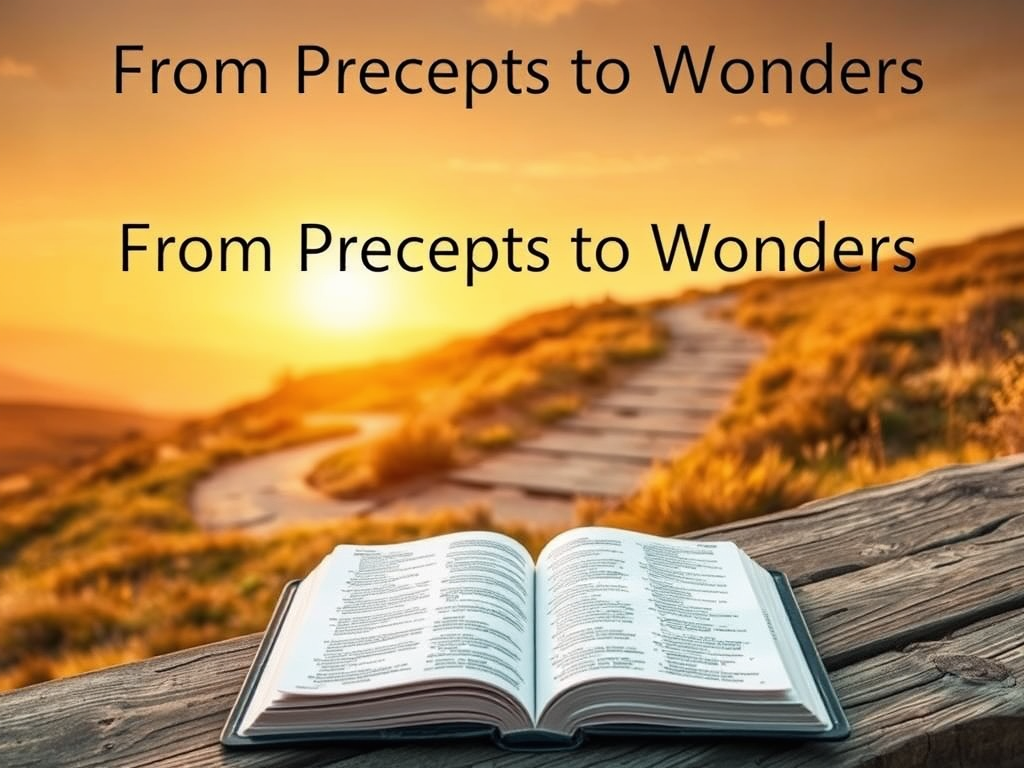
    Psalm 119:27 – From Precepts to Wonders

    Explain to me the way of your precepts
    and I will tell of your wonderful acts.

    We tend to think of particular rules or principles for living as fairly boring, somewhat annoying, and often unreasonably restrictive. We seem to live in a debate between what we ought to do and what we actually do. Even the most law and order oriented people I know have rules they don’t feel they need to keep.

    As Christians, we come at law largely from the perspective of salvation. Our works cannot save us. Yet many of us are so oriented to law that we have to work that back into the equation again, such that eventually our Christian lives are taken up by the question of how to keep the rules and what might happen if we don’t. Some of the loudest voices I have heard with regard to grace and justification by grace through faith turn to the worst sort of works as they attempt to produce–and urge others to produce–the supposed fruit of that faith. (Hint: You can’t. God can.)

    Christianity becomes for so many of us a process of producing “good church-going people” who are “pillars of their community” and as such good people are surely going to heaven because they are keeping up with all the things their culture believes are the proper things to do.

    Well, right until these pillars fall down because they really aren’t such examples of everything that is good and right.

    And then we, as Christians, announce that the Hebrew scriptures are all about law and empty of grace because we can find examples in Israelite history of just such pillars of the community, and we can find rules that look a lot like they might describe the behavior of good “temple-going people” who are pillars of their community.

    Like David.

    Oops! For those who actually read the Hebrew scriptures (in translation is OK!), this image really doesn’t work. Not if you pay attention.

    I’m currently listening on Audible to the translation of the Hebrew Bible by Robert Alter as I walk on the treadmill. (I moved my after-dark walks and too-cold walks to the treadmill!) Tonight I was listening to the story of David and Bathsheba (2 Samuel 11-12). If David was a man after God’s own heart, I would imagine some grace was involved.

    But as we look at this passage, we are again looking at a much broader understanding of “law.” Note that in Psalm 119, we have at least two more general terms for law, Torah (instruction), and Word, as in God’s Word. Translating these as “law” gives modern English readers the wrong impression. As I read, I see in the term “Torah” a depiction of God’s guidance and interaction with people, i.e. an extended story of relationship. It’s about who God’s people are. In “Word” I hear the creator of the universe who is revealed in word and deed. Neither of these terms describes a code of law, such as Hammurabi’s code, or your state’s traffic code.

    What they do describe is a very deep relationship and an identity, God’s people, that becomes the key identity for those to whom it applies.

    In the New Testament book of Hebrews we have this same nature and identity, both Torah and Word, wrapped into the person of Jesus. I think it is worthwhile for us to know as Christians that when a Jew affirms loyalty to Torah, this is no more (or less) an affirmation of loyalty to a set of rules than ours is when we affirm loyalty to Jesus.

    Now Jews and Christians can both be legalists, forgetting Who it is they serve, and getting stuck on details, but this shouldn’t be blamed on scripture. We humans are like that. We like to get tangled up on the little things that we can understand and handle. Or at least that we think we can.

    But God is above and beyond that. God has a purpose for us that is so far above any of our thoughts that we can’t even imagine it.

    I’m drawn back again to Isaiah 55:

    For my thoughts are not your thoughts,
    nor are your ways my ways.
    This is the word of the LORD.
    But as the heavens are high above the earth,
    so are my ways high above your ways
    and my thoughts above your thoughts.

    Isaiah 55:8-9 (REB)

    And here in Psalm 119:27 we have the psalmist asking God to help him understand God’s precepts, and the result will be that he will speak of God’s wonderful acts. The reason is that everything God has to say points to God as God the creator and the author of all that is wonderful.

    And it all starts with trying to understand the little things, the precepts. Baby steps. Trembling, unstable, stumbling, hands reaching out along the path to wonder and amazement.

    What’s your next step?

    (Featured image generated by Jetpack AI.)

  • Quote of the Day: God’s Word and Our Words

    Creation: The Christian DoctrineI’m working on editing Creation: the Christian Doctrine by Edward W. H. Vick. It’s quite an enjoyable task. I regularly learn new things while reading Dr. Vick’s work. In this case he’s talking about knowledge of God. He has already contrasted this with knowledge of the natural universe. We, as finite creatures, cannot by normal means understand the transcendent. Only as God acts and reveals himself can we attain such knowledge.

    It is because God has expressed himself and continues to express himself that God is known. A clear distinction is to be made between the divine reality, the form by which God is expressed, and the knowledge human beings acquire of him.

    So we, the human creatures, cannot by observation, sensation
    and deduction, arrive at a knowledge of God. We use such methods in our successful search for knowledge within the cosmos, but they are not the ways that we can come to a knowledge of God. But as God reveals himself and the Word is grasped, the human can understand the expression by which the revelation is made possible and expressed. We never transcend the limitations of our language, even in speaking of the revealing act of God. We are creatures and our language is anthropomorphic. But that does not mean that there are not poorer and better ways of using our language! The very use of language should remind us that God is transcendent.
    He is Creator. We are creatures. Without the Word, we would know nothing of the transcendent God.

    (Creation: The Christian Doctrine, pp. 54-55, forthcoming from Energion Publications.)

    Vick develops these ideas further in his earlier books History and Christian Faith (distributed by Energion) and From Inspiration to Understanding: Reading the Bible Seriously and Faithfully.