

Threads from Henry's Web

Tag: Wesleyan

  • Psalm 119:171 – Sing Praise!

    Psalm 119:171 – Sing Praise!

    Let my lips sing your praise,
    for you have taught me your statutes.

    The underlying theme of Psalm 119 is praise to God for the law. The law is righteous. The law is good. Good things come of keeping the law, even though we have to ask God for the strength to do so.

    I find the relationship of may Christians to the law quite interesting. There quite an interesting theological/biblical discussion between various groups, particularly Lutherans, Calvinists/Reformed, and Wesleyans about the relationship between the law and gospel. As an introduction, let me commend the article on Wikipedia on Law and Gospel, though doubtless many, myself included, would pick at various points.

    In practice, however, we tend to simultaneously declare that we are saved by grace through faith, but then only apply this to the moment of salvation, of becoming part of God’s family. At that point, most of us would say that we are not saved by keeping the law. So we have a distinction here, because law is not the agent, even though law definitely has a role.

    But we turn from that and, whatever we may proclaim, we become people of rules. We want the ten commandments in schools, as though better morality will be achieved because of a display of the ten commandments.

    We aren’t really praising God for the law through all this. Rather, we’re considering that we have to have a stick to use to beat people into proper order. We ditch gospel and grace and become another behavior modification program.

    This is exemplified by the plea I have heard frequently from parents and friends, “Help me get my child/friend back into church.” The goal is to get them into the church structure and organization, such that their behavior can be made more … I’m not sure if it’s more Christlike or more Churchlike.

    I recall having this discussion in a church my mother attended, which she called, to their face, the church of the gottas. You gotta do this, you gotta do that. Having been saved by faith, or rather having been shoved across the starting line by grace received through faith, you gotta get busy running the race and making sure you get everything right.

    My own experience with teaching about tithing is an illustration. Is tithing a command applicable to Christians? For a long time I struggled with the fact that I couldn’t see that it was, yet as part of the leadership team of a church, I was afraid to say so, lest people give even less. I was already irritated by people who spoke of “tithing” 1% or 2%. “Tithing” refers to 10%, though 10% of what is subject to some controversy. But if you’re giving 1%, you’re not tithing.

    My concern, or to be honest, fear, was that if tithing was not a rule, then people wouldn’t give, and then programs of the church that I hoped would be well funded, such as children’s ministries and missions, would suffer.

    It took me a long time to realize that grace was the only thing that was ever going to bring sanctification, including sanctification of our wallets, doubtless the least sanctified of our possessions.

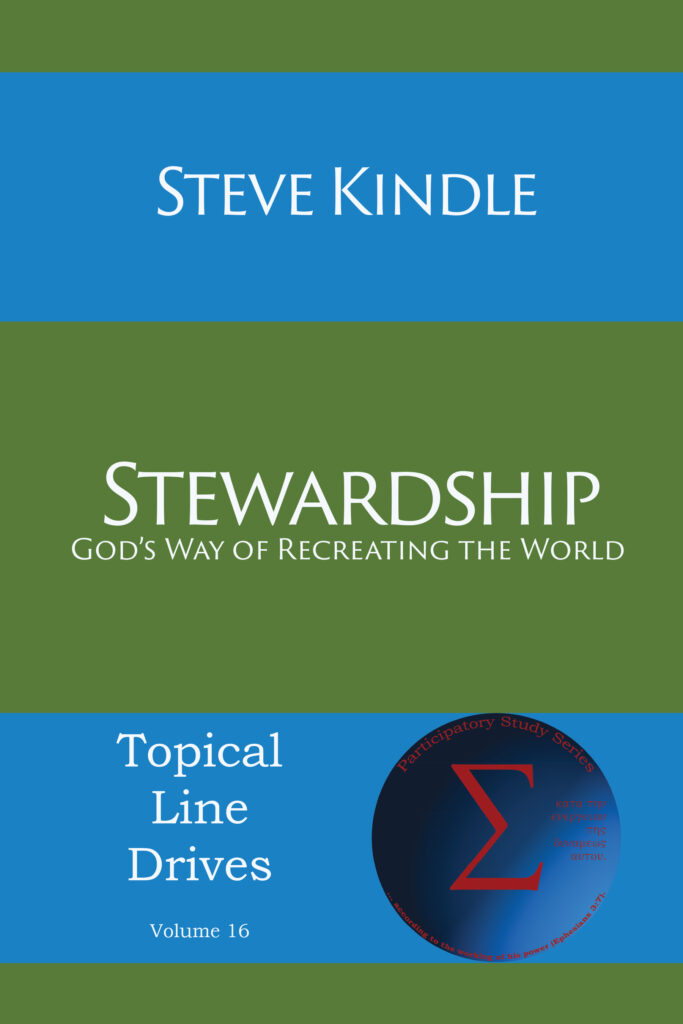
    The bottom line was that in Christ, everything is dedicated to Christ and we make our decisions on spending and giving based on that fact. I had come to this conclusion, but hadn’t expressed it all tat well until I read as an editor, and published the little book Stewardship: God’s Way of Recreating the World by Steve Kindle.

    Here’s a selection from page 25:

    The questions around how much to give are too often reserved for “Stewardship Drives.” So we compartmentalize our giving and tuck it away for another year. In all the talk of stewardship, seldom
    does it go much beyond the pocketbook. Whenever stewardship is reduced to a program, something is terribly wrong, and congregations and individuals continue to struggle.

    The apostle Paul revealed to us the key to successful fundraising in his appeal to the Corinthian congregation to assist in the collection he was taking up for the Jerusalem church. His formula:


    3For, as I can testify, they voluntarily gave according to their means,
    and even beyond their means, 4begging us earnestly for the privilege
    of sharing in this ministry to the saints— 5and this, not merely as we
    expected; they gave themselves first to the Lord and, by the will of God,
    to us,… — 2 Corinthians 8:3-5

    The Macedonians, in spite of their poverty, begged to give to the Jerusalem church—even beyond their means—because they first gave themselves to the Lord. Sure, it is possible to raise a lot of money using sophisticated methods based on psychological triggers and emotional appeals. These are too often resorted to as substitutes for the Macedonian way. A congregation that first “gives themselves to the Lord,” recognizes their stewardship partnership, and everything they do springs from that commitment. So let’s not encourage tithing, that’s about money. Let’s encourage
    seeing all we have as God’s and act accordingly.

    Steve Kindle, Stewardship: God’s Way of Recreating the World, p. 25

    This same approach applies to everything about Christian living, and it’s something we should pay attention to. If we could focus on that connection to God, and the motivation of love that is involved with it, better behavior, empowered by the Holy Spirit, would be the result.

    When we see the law in this way, as a gift, and as a description of what might be and what God is, we can receive it with praises. If it is a club to make people look and act like us, to be “churchy,” then it will always be a negative thing.

    But if we don’t focus on that core of being as the source of all we do, we will inevitably get back to a picky, rule-by-rule attempt at behavior modification, which is sure to fail in the end, not to mention causing a great deal of fiction along the way.

    How can you find joy in being and doing today?

    (Featured image is from Adobe Stock. Licensed, not public domain.)
  • Seeking Sinless Perfection

    Stripped image of John Wesley
    Image via Wikipedia

    Because I have some online watches for names of Energion Publications authors, I found the post In Search of Sinless Perfection, which quotes Alden Thompson. This comes from a Seventh-day Adventist background, but I must mention that I have been surprised by how much from my own SDA background simply translates into Methodism. One may easily underestimate the impact of the fact that Ellen White, early SDA leader viewed as having the prophetic gift, was a Methodist before she joined the Adventist movement.

    In any case, Ellen White quotes aside, Loren Seibold, author of the article gives a number of the reasons I have for questioning the idea of sinless perfection. Certainly the Wesleyan doctrine as actually taught by Wesley (try here for more, though you may find the account less plain than you imagined) seems less problematic than its various descendants.

    I love the introductory story, which ends:

    Then the perfect man hung up on me.

    Perhaps not the ending one imagined for a conversation with a perfect man!

    I too am a believer in sanctification. Where I must get off this particular train, however, is where one gets a personal knowledge that one is perfect. I just can’t see how that would work.


    Enhanced by Zemanta
  • Wesleyan-Arminian vs Calvinist Self-Identification

    I found this interesting article at Baptist Press via the Methoblog’s Twitter feed. The article discusses an apparent divide between the Southern Baptist Convention and other denominations on how many pastors, particularly young pastors, are identifying themselves as Calvinists. One interesting note is that while identification as Calvinist outside the SBC is not increasing, identification as Wesleyan or Arminian is decreasing over this same time period.

    Now I have to confess that my first question regarding such a report is just what the methodology was. Usually when you dig down to the actual questions, you find out that a survey doesn’t produce quite as much information, or at least the type of information that reports indicate.

    In this case the human tendency is to say that this indicates there are more Calvinists and less Wesleyans or Arminians around today. And that may indeed be true, especially including all denominations. But it’s important to realize that this report didn’t define any of its terms; it simply asked about self-identification.

    That’s important. I’m wondering how many of those questioned are knowledgeable enough to properly classify themselves. I’ve encountered a few United Methodist pastors who couldn’t identify all of the five points of Calvinism, and thus would have a hard time determining whether they were Calvinist or not. And considering that there are five points of Arminianism, which actually predate the five points of Calvinism (as a form of expression, not as theological beliefs), I have to wonder how many pastors (not to mention lay members) could actually tell an interviewer just what it means to be Arminian.

    I have found even more in the charismatic and pentecostal streams who don’t acknowledge any connection to their Wesleyan roots, if they are actually aware of them. This results in some interesting theological mixes in charismatic and pentecostal thinking. One that I find most interesting is that eschatology derived from dispensationalism is quite popular, while other views associated with dispensational theology, such as cessationism, are excluded.

    I’m not saying one cannot produce a similar eschatology without resort to dispensationalism, but I certainly have not seen it done very well in most Wesleyan, charismatic, or pentecostal writing or teaching. (Caveat: I have not done a thorough survey of the literature. That’s something I’d like to do at some point. This is anecdotal.) It is nonetheless interesting to watch people grab random pieces of Daniel, Isaiah, Joel, and other books, mix them with 1 Thessalonians, Matthew 24/Mark 13/Luke 21, and mix them with Revelation, without any real framework for just how the text should be interpreted in its original context, and what is the proper framework to use in connecting them. While I do not accept classical dispensationalism (more modern progressive dispensationalism seems hard to reject outright–it says so little!) I must admit that it does provide a fairly stable framework on which to hang these various texts.

    I recall one class I was teaching on Revelation, in which the students insisted I dedicate a class to teaching about the tribulation. While I do believe there will be troubled times before the end, I do not believe in a “Tribulation” in the sense of a seven year period. In any case, I made my best effort at bringing in the texts while not actually lying about what I thought of the relationship between them, and the class got pretty glassy eyed as we looked at each one. I would note that most of them still accepted the tribulation at the end. They were well steeped in the “Left Behind” series.

    But I must reign myself in and return to topic, or at least somewhere in the vicinity of the topic. I’m wondering what others have experienced. Is self-identification accurate in terms of Calvinism and Arminianism? How many people who identify themselves as “neither” might simply not know enough about the roots of their current theology? How many are identifying with more modern movements derived from one or the other? (I think this latter idea would be more likely for Wesleyan-Arminians than for Calvinists.)

    Finally, how many think they have transcended this debate in some way? I’d be interested in comments or links to blog posts on the subject.

  • Christian Perfection – Not So Plain to Me!

    One of my early experiences teaching in a United Methodist Church involved giving a series on the Wesleyan doctrine of Christian perfection. That may seem surprising for a new member of a United Methodist congregation, but my background in the Seventh-day Adventist Church involved a good deal of Wesleyan talk (though not the doctrine of Christian perfection), and the pastor was also well aware that I had borrowed the United Methodist Discipline before joining his church, and had read all the doctrinal sections. Further, I’d read Wesley’s compilation, A Plain Account of Christian Perfection.

    To make a long story short–and I intend this to be short!–I discovered that of the group of 30 or so people who arrived for the first class, only the pastor and I were aware that there actually was any such doctrine.

    To be honest, I still wasn’t the best one to teach such a doctrine. I suspect that if I were trying to be a United Methodist pastor, rather than a theologically educated layman, I would choke on the “going on toward perfection” question. And yes, I know that the words come from the book of Hebrews, one of my favorites. (I’ve even written a study guide!) Nonetheless, I think I’d want to nuance my answer, perhaps to such an extent that it wouldn’t be an answer at all.

    In any case, I like short descriptions of this doctrine so that United Methodists, and others who are curious about it, can get a good idea of what John Wesley was teaching. (Hint–he wasn’t teaching what most people think when they first here the phrase “Christian perfection.”)

    So all this verbiage (never use one word where 1,000 will do!) is to introduce a good link on the subject, from Craig Adams’ web site Commonplace Holiness. He is presenting a public domain book, and the whole thing is there, but section 2 provides a good definition. If you are interested, you can follow this further by going to the table of contents and finding more.

    In any discussion of a controversial topic, it’s a good idea to get the definitions straight, and this topic certainly qualifies.