Threads from Henry's Web

Tag: Theodicy

  • Theodicy Again

    Theodicy Again

    Some time ago I did seven interviews on theodicy, or the problem of evil. One of the people I interviewed was Elgin Hushbeck. He and Larissa Munz now produce the Into the Desert podcast. They just released a video titled Christianity’s Biggest Problem, which I’ll embed below.

    The key value for this video is the way in which it outlines the question and potential problems.

    Playlist of My Theodicy Interviews

    Includes one with Elgin Hushbeck.

  • Theodicy Interview with Rev. Steve Kindle

    Theodicy Interview with Rev. Steve Kindle

    I posted the video from my interview with Steve Kindle in my theodicy video interview series. The video is embedded below, and you can find out information on this series at Theodicy Interview Series.

    The next interview to be posted is by Steve with me, asking me to answer the questions I’ve set up for this series. Following that, I’ve added an additional author, Dr. Terrell Carter, author now of three books from Energion Publications, and several from others.

  • Theodicy: Interview with Dr. Ron Higdon

    Theodicy: Interview with Dr. Ron Higdon

    This is the sixth interview in my series on theodicy (check the link for a full list). Ron Higdon has experienced and dealt with the issues of theodicy practically as a Christian believer, as a pastor, and as a father. His interview is distinguished by his immediate reference to where the Bible starts on this topic. The video can also be found with more resources listed on henryneufeld.com.

    Ron Higdon: Theodicy
    Note: The next interview is with Steve Kindle, and is already recorded. Steve, in turn, interviewed me, and that is also recorded. I hope to follow up with both of those videos posted this week.
  • Allan Bevere on the Problem of Evil

    Allan Bevere on the Problem of Evil

    My latest interview on theodicy, or the problem of evil, is with Dr. Allan R. Bevere. Allan is a retired United Methodist pastor and has a PhD in New Testament from the University of Durham (UK). You can find detailed information on this interview series, along with links to previous interviews here.

  • Questioning Omnipotence

    Questioning Omnipotence

    Thus far I have interviewed three people regarding theodicy, or looked at from another direction, the problem of evil. You can follow the link for current interviews. Tomorrow, I will be interviewing Dr. Allan R. Bevere, retired United Methodist pastor for the fourth interview in the series. I have commitments for several more interviews.

    One of the questions that I repeat in the interviews from multiple angles is that of omnipotence. Is God omnipotent? What does that mean?

    Today I want to share a link to a brief essay from someone who does not believe God is omnipotent and does not believe the concept is scriptural, Dr. Thomas Jay Oord. He is suggesting the word “amipotent” instead. He is writing a(nother) book, but he offers this summary of the idea as it relates to scripture: Omnipotence Not in Scripture.

    The most recent interviewee, Elgin L. Hushbeck, Jr. strongly affirmed omnipotence.

  • Theodicy Interview with Bruce Epperly

    Theodicy Interview with Bruce Epperly

    The second in my series of interviews on theodicy is now available. Dr. Bruce Epperly discussed this with me for around an hour. You can see the video below. (The first interview can be found here.)

    The purpose of this series is to showcase a variety of views on theodicy and even ways of expressing those views. I expect the next interview to be with Dr. Allan R. Bevere.

    Speaking of Allan, he participated in a discussion on the problem of evil with Bruce some time ago. You might want to go back and listen to that as well.

  • A Robust Theodicy?

    A Robust Theodicy?

    As I conduct interviews on theodicy with various authors, I’d like to suggest this:

    We need a theodicy (and in fact a full theology) that is as comfortable in Job as in Deuteronomy. This would be the expression of a faith that isn’t forgotten in good times or repudiated in bad.

    Here again is the first video:

    I will be interviewing Dr. Bruce Epperly and Dr. Allan R. Bevere on Thursday, November 10, 2022 and will be posting those interviews over the next couple of days. Further interviews will be announced here.

  • Theodicy Interview Series

    Theodicy Interview Series

    Yesterday I interviewed Dr. Robert LaRochelle as the first in a series of interviews on theodicy. You can find more information on this series on the page titled, shockingly, Theodicy Interview Series, which also includes the questions that will be asked of each interviewee for this series.

  • Job 9:4-10 – A Sunday School Text Used Out of Context

    Job 9:4-10 – A Sunday School Text Used Out of Context

    I like reading the texts before I’ve read the lesson material so that I can see what I can learn from them without the direction of the lesson topic. So why do I call this text “out of context” when I haven’t even seen how it will be used by the lesson material.

    The reason is simply that the text trims out the material that would let us know the speaker or the point in the argument at which this text appears. If we look back to Job 9:1, we find that this is one of Job’s responses to his friends, the friends who have come to make sure his depression is as deep as possible.

    When you consider that when God appears in this story, God doesn’t think much of what has been said before God’s appearance, it is perhaps not helpful to take theology out of any of the speeches from chapter 3 through chapter 37. While God commends Job, it is not for Job’s speech.

    In my experience, most Christians who quote from Job at all quote from the speeches of Job’s friends, and don’t trouble to take note of who is speaking. That’s because Job’s friends maintain what most of us feel, which is that many, if not most of the bad things that happen to people are the result of their bad decision. God, according to this view, is in the business of rewarding good behavior and punishing bad.

    Job doesn’t really counter this so much as simply assert his innocence. In this passage he’s declaring God powerful, but also distant. That’s Job’s problem with all this. He’d like God to show up and answer his questions. God hasn’t done that.

    What is trimmed out of our reading is the fact that this is Job speaking (v. 1), and that he has just declared that God will not answer. His comments on God’s power are not so much praise as they are a declaration of God’s distance. At the end of verse 3 he declares that God won’t respond one time in a thousand.

    With all that trimmed, this can sound like a declaration of praise for the Creator. What it actually is, is a complaint about the distance of a God who allows Job to suffer and yet refuses to explain himself.

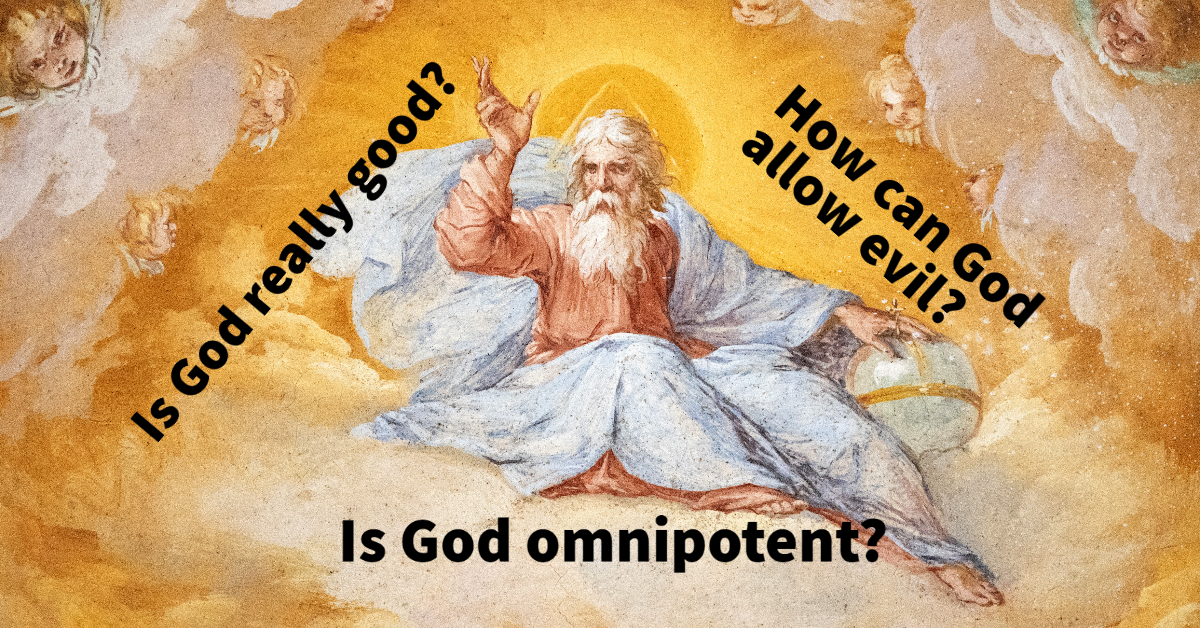
    Job is often referred to as a theodicy, a justification of God’s behavior. Theodicies usually try to explain how God can be good, all-powerful, and yet allow suffering or evil to exist. The book of Job doesn’t actually attempt any theodicy. Job is answered, insofar as he is at all, when God appears and challenges him. In the story, Job never finds out what was going on in the background. We, the readers are privy to the council, and to what God is proving through Job’s suffering.

    Equally interesting to me is the fact that Job is quite satisfied with the answer, even though on a logical basis it’s not much of an answer. What Job longs for is what he sees lacking: God needs to take note of him. Once this has happened Job is quite happy.

    One of the reasons for that, I suspect, is that Job simply sees that God truly is that great, and is in turn grateful that God has paid attention to his complaints at all, even though God doesn’t answer the questions Job has raised.

    So let’s go full circle back to the point about context. Sometimes texts can be used out of context. The problem is that we generally try to make scripture authoritative. If one uses a text out of context and pretends that this reading is authoritative because it is scripture, that presents quite a problem.

    When I was in elementary school we had a program of scripture memorization that included memorizing lists of four texts. We’d have four texts on the Sabbath (I was Seventh-day Adventist at the time), four texts on the state of the dead, and so forth. Today I would view a number of these texts as taken out of context. And for their purpose, some of them were.

    On the other hand there are allusions and literary borrowing. Revelation, for example, is filled with verbal allusions to various passages in Hebrew scripture. These are not used as proof texts, but rather form part of the literary fabric from which the report of John’s vision is woven. As long as we understand what is going on, there is no problem. The problem is that we often see only one use in scripture: proving doctrinal points.

    I’m reminded of the saying, “Good fences make good neighbors.” This is quoted in a pious way, indicating that by erecting effective barriers, we can live more peacefully. I actually think this is quite correct. Boundaries, well-defined and reasonable, are very helpful to relationships.

    That was not the meaning of this line when it was first written. You might take the time to read the Robert Front poem.

    Sometimes in our Bible reading we need to realize that we are reading a story, seeing a picture, getting a sense, and not learning a doctrine.


  • A God That’s Cool

    A God That’s Cool

    Whats God Really LIke

    In the introduction to his book What’s God Really Like? S. J. Hill tells the story of a student who announced at the end of a term in a class he taught, that she had discovered that God was cool.

    I don’t know how you react to that, but the moment I read that line I knew that I’d be offering the author a contract to publish the book. I’ve long been annoyed by all the theological words we use to describe God, even when those words are true.

    My question is this: Do we understand the words? Does “omnipotent” mean anything to me? Does “infinite?” One can get infinitely wordy and yet communicate very little.

    What’s more, how likely are we to be attracted to a relationship with a God because of all of these ultimate words? It’s not that I do not believe God is ultimate. In fact, I like the language of Paul Tillich that God is our “ultimate concern,” and that making anything that is not actually ultimate our ultimate concern is idolatry.

    This idea of ultimate concern leads to the claim that faith in God is something that involves and demands everything. To quote Tillich, “Faith as ultimate concern is an act of the total personality. It happens in the center of the personal life and includes all its elements” (Dynamics of Faith, Nook position 16).

    Notice how I jumped into theological speaking in discussing this topic. I think Tillich is talking about a dynamic God, an exciting God, and I even personally love what he has to say about this God. But can we say this a bit more to the point?

    A God who engages your whole personality, who is ultimate in everything, will have to be more dynamic than a set of theological definitions. God must be more than a collection of attributes. To be truly dynamic, the God we’re talking about here must be exciting, interesting, all-encompassing.

    In a word, Cool!

    Unless, of course, you mean something different than I do by “cool!”

    In his little book Finding God in Suffering: A Journey with Job, Bruce Epperly notes:

    Old Testament scholar Terence Fretheim once noted that the most important theological question is not “Do you believe in God?” but “What kind of God do you believe in?” The author of Job would concur with Fretheim’s vision. Job is a God-filled book, reflecting the deep piety of its author and his main character. Like the Psalms, Job describes a faith for every season of life and shows that piety can be revealed as much in our questions as in our affirmations.

    Bruce G. Epperly, Finding God in Suffering: A Journey with Job, p. 8

    Now who could possibly go to the book of Job to find a cool God? That’s a frightening place! A God who was involved in all that couldn’t possibly be cool.

    Let me detour for a moment. I recall traveling with a friend who was not a Christian. We had a long time to discuss things. My son James had died only a few weeks before. After a considerable discussion of the nature of my faith, my friend said, “I so admire you for keeping your faith through all of that.”

    I was a bit shocked. It was my faith that had held me together. I had spent much of that time with God, something yelling and screaming. Sometimes weeping. But also sometimes laughing.

    The God that could ride with me when I had hours to travel to a speaking engagement while James was in intensive care is a God I can call cool. Yes, I can use terms like merciful, kind, compassionate, and loving. Those are all good. But the reality is more lively.

    Until I read S. J. Hill’s book, I hadn’t thought of the word. I like it.

    Bruce Epperly also comments that theology begins in the experience of disappointment and suffering (ibid, 3).

    My challenge as we explore the nature of God is to connect that point of entry with discovery of a God whose personality is pleasing. Yes, a God who is cool.