When I started Energion Publications just over 10 years ago, my primary interest was in Bible study materials. My goal was to get the people in our churches to study the Bible more, and to do so for themselves. My complaint about much of the material available was that it was often shallow and repetitive, and that people had often been seeing the same things over and over again. (I don’t mean that there were or are no good materials; merely that there are not enough materials that address people in the pews.)
It wasn’t just that some material was shallow. It was that often when the material was a bit deeper it tended to present conclusions without really teaching students just how those conclusions were reached. Quite frequently, church members were simply accepting the conclusions they were taught on authority, not because they had really examined them and come to accept them for good reasons. Their pastor, or some well-respected person from their denomination or tradition stream claimed that a verse meant a certain thing, so that’s what it meant.
When people from two different tradition streams would meet, debate could get heated as people fired spiritual canon loaded with pre-interpreted texts. They thought they were firing them at one another, but generally they were firing them past one another, because their targets had memorized a completely different interpretation for that particular passage.
I launched several projects in response to this. First was the Participatory Study Series, the first series I know of to intentionally select authors from different tradition streams to cover different books of the Bible. My idea was to give people a chance not just to study about the various methodologies, but to study a whole book of the Bible with the guidance of a qualified scholar from different traditions. Thus you can study Philippians with the guidance of process theologian Bruce Epperly and Ecclesiastes with conservative evangelical Russel Meek. As time goes on, this variety will increase rather than decrease.
There was still more to be done. Our conclusions about scripture depend heavily on our approach to interpretation, our interpretation depends to some extent on our view of authority, and both interpretation and authority depend, to some extent on our understanding of inspiration.
Thus I published Learning and Living Scripture: A Introduction to the Participatory Study Method, but that little book didn’t really deal with the conclusion. It embraced it and invited more! So I wrote my own book about inspiration and listening to God, When People Speak for God, and then acquired a truly masterful work, From Inspiration to Understanding: Reading the Bible Seriously and Faithfully by Edward W. H. Vick. Shoring up a more conservative viewpoint was Elgin Hushbeck’s Evidence for the Bible.
 With all those books, the question still remained. How does one learn to understand and even benefit from the variety of approaches to Bible study?
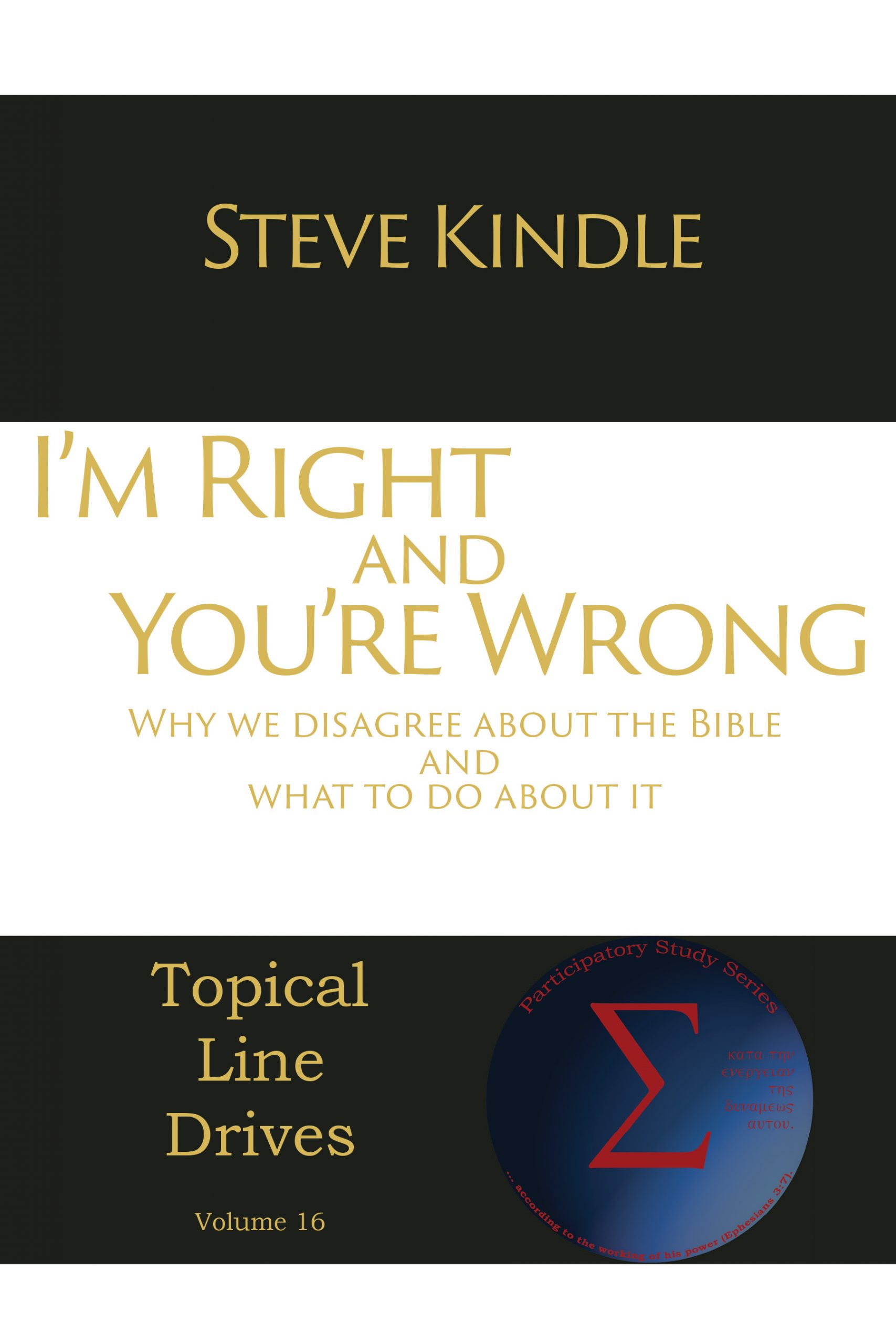
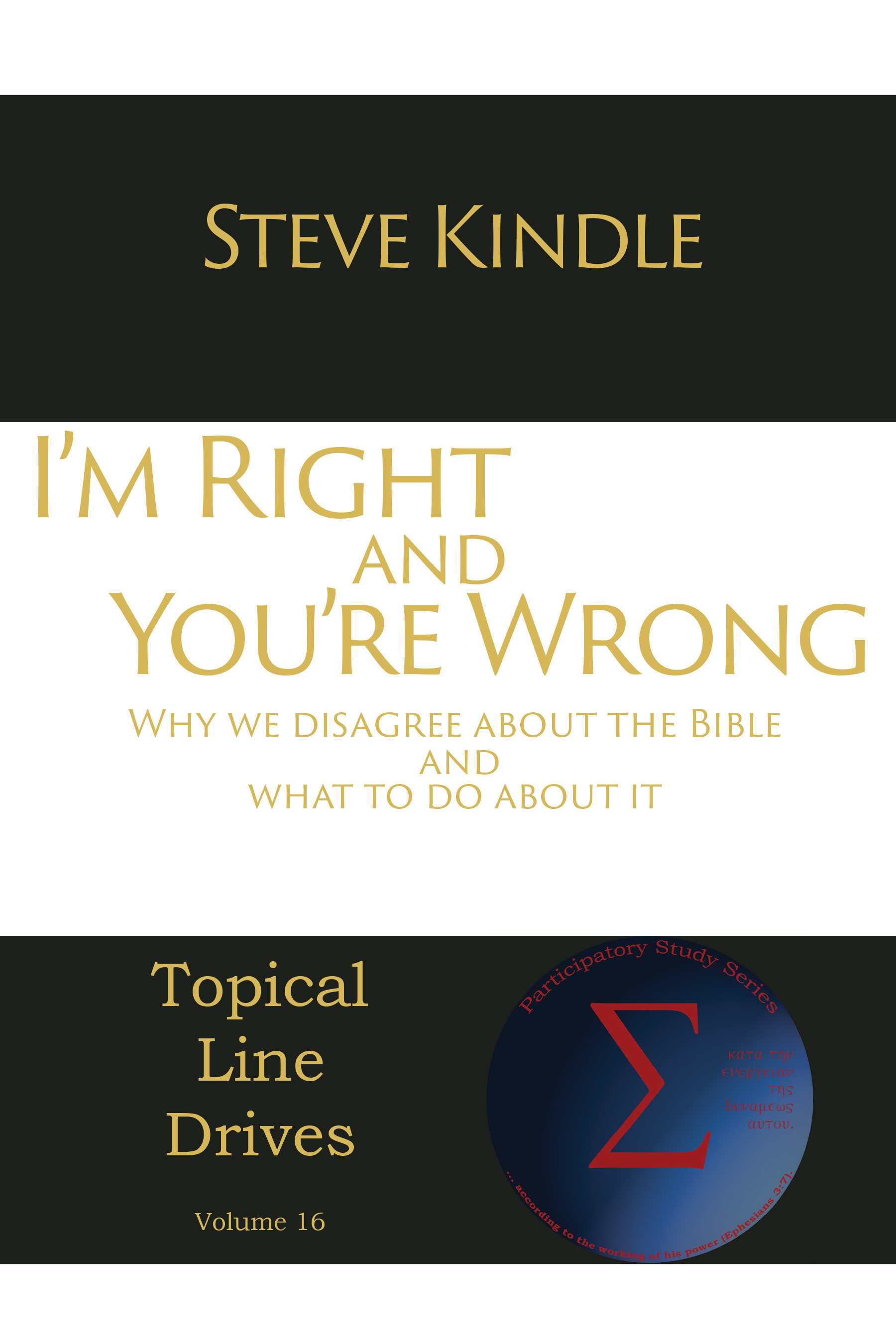
Well, now we have a short, easy-to-read book that will help you understand why we disagree about what the Bible says, and why so many of those disagreements are so intractable. It’s I’m Right and You’re Wrong: Why we disagree about the Bible and what to do about it. It’s a challenging title, and in just 40 pages, you’re going to begin to get a picture of the variety of scriptural interpretation.
Author Steve Kindle writes with a gentle passion. This is not a book proving that his approach to interpretation is the one and only right approach. He doesn’t deny that there is objective truth out there; he just doubts that we are going to be able to get there with are finite and not-so-objective minds. What he does instead is try to give us an idea how various approaches work.
There are at least two things you can do, starting with this book. The first is simply improve your ability to converse with people whose approach to the Bible might be different than your own. With the basic information Rev. Kindle provides, you can build your understanding by listening to others. Second, you can use the excellent footnotes to find more detailed expositions of these various approaches and learn more about them than could possibly be contained in a 40 page book.
As a publisher, of course, I would be delighted if you’d also embark on a journey with the Participatory Study Series and actually study some books using guides written from a perspective other than your own.
At a minimum, however, learn how to break through the hostility that often characterizes debates about the Bible to come to understand how someone else has become convinced that he’s right and you’re wrong!
Note: This book is already printing, but we’re leaving the pre-order pricing up for one more day. That means you can order from Energion Direct for just $3.49. If you take this opportunity to get 3 or more copies, shipping will be free. The shipping charge is just $2.00 on orders of less than $9.99.