20 ‘LORD, see how sorely distressed I am. My bowels writhe in anguish and my heart within me turns over, because I wantonly rebelled. In the street the sword brings bereavement, like the plague within the house.
The Revised English Bible (Cambridge; New York; Melbourne; Madrid; Cape Town; Singapore; São Paulo; Delhi; Dubai; Tokyo: Cambridge University Press, 1996), La 1:20.
I find it hard to blame the author of Lamentations, because he is speaking for Judah as they stand devasted by God’s actions. “Lord,” they ask, “Do you really know how terrible this all is?”
Their situation is real, and their question is justified. In fact, I suspect this book is in the Bible precisely because that is such an excellent question.
But I’ve told you that I do these verse by verse meditations not to do biblical exegesis, as interesting as that is, but to meditate on the words and see what may come to mind. In this case, I started asking the question: “What if this question is either not justified or not well motivated?
Let’s look first at “not justified.” I don’t know about you, but I can work myself into a serious problem by not paying attention or by compounding one error with another as I try to fix things. As decisions pile up and then cascade into a landslide of consequences, I have the urge to ask, “Lord, why are you letting this happen to me?”
There’s a simple answer. “Whatever a man sows, that will he reap.” God made the universe in such a way that actions have consequences. When consequences come, it’s possible you may not realize what caused them. It’s a good time to ask, “Lord, do you see what’s happening? Why?” But be ready for an unpleasant answer to that “why” question.
On the other hand, you may be able to see the path clearly. In that case, the why isn’t the right question. You know why. If you were running wildly along the edge of a cliff and suddenly find yourself in a heap at the bottom, the why is obvious. It’s just not very helpful. “How do I get out?” is a much more helpful question.
After that, you can remember the obvious “why” and don’t do that again!
But the question can sometimes come with bad motivation. It’s possible to become so caught up in troubles that trouble becomes your identity. You may not feel precisely proud of it, but it’s you. If you didn’t have your troubles, who would you be? Being a victim becomes a way of life.
Among Christians, there’s a particularly dangerous form of this in which people find affirmation of the “rightness” based on people attacking them or “persecuting” them. Want to feel sure you’re right? Just wait until someone attacks you for your beliefs. “Blessed are the persecuted!” (Matthew 5:10).
But offending someone or making them angry enough to take action against you is not necessarily an indication that you are right. People do get annoyed at others doing right when they know they are not. This can result in persecution in school, at work, or in life. But as soon as you take that as the indication that you’re right, you’re on a dangerous path. The persecution doesn’t indicate you’re right.
You’re blessed if you’re doing right and “doing right the right way” and are persecuted for it. You aren’t blessed if you’re being offensive in order to feel important or find affirmation.
So when things go wrong, ask yourself why first. Often, you’ll find that you know the answer, and the problem is you. Good news: You can do something about that!
17 Zion lifted her hands in prayer,
but there was no one to comfort her;
the LORD ordered Jacob’s enemies
to beset him on every side.
In their midst Jerusalem became
an unclean thing to be shunned.
Lamentations 1:17 [The Revised English Bible (Cambridge; New York; Melbourne; Madrid; Cape Town; Singapore; São Paulo; Delhi; Dubai; Tokyo: Cambridge University Press, 1996)]
“I’m praying.”
This is one of the most common comments among Christians, combined with “I’ll pray for you,” or “you’re on the prayer list.”
Honorable (or dishonorable) mention goes to “We’re sending thoughts and prayers.”
To back up our prayer claims we tell stories of answered prayer, whether from scripture or from our own lives. Daniel in the Lion’s Den makes a good example. Spending the night with hungry lions and coming out uneaten is quite a feat!
We’re less likely to talk about the times in scripture when praying didn’t come out so well. This verse is a good example.
Zion is praying, and we know the outcome. Exile is coming. The verse says God has commanded it. The prayers are not answered, not positively. Destruction comes.
Why is that?
One reason is that people are doggedly pursuing a path of destruction. If I get drunk, jump in my car, don’t wear my seatbelt, and proceed to drive recklessly, there are certain likely results. The best is actually if I get pulled over and charged with DUI. The worst is death—mine, or that of an innocent person.
But I prayed!
Yes. And God was probably trying to get through with an answer, but as I drove down the path to destruction, I wasn’t able to hear the answer.
Our verse says that the Lord ordered Jacob’s enemies to beset him on every side. Was God really trying to destroy Judah? It’s worthwhile studying this entire period of Israel’s history, not to condemn, but to learn from it.
Often God has us beset on every side, by wise counselors, by the prompting of the Holy Spirit, and by the unrelenting force of the laws of nature. If we don’t allow those barriers to derail our ride to destruction, who do we have to blame?
For years, I worked in IT, helping small businesses. I regularly told people that I could provide security tools and practices. Antivirus software could protect them. The one thing I regularly couldn’t protect someone from was their own actions. If you have a password and a secondary code that are both required for access, and you go ahead and give both of these to a bad actor, no amount of other security will protect you.
I remember a call from a client who said she had just accidentally opened what she was sure was a bad email attachment. I asked her what she had done. “Just what you told me to do. I shut down the computer as soon as I realized it.” I was able to get her system cleaned up and running in less than an hour. (The bad payload was ransomware with high potential to make one’s life miserable.)
At another office I walked up to a workstation to do some routine maintenance and noticed suspicious activity right on screen. I asked the user how long this had been going on. “Oh, I don’t know. Probably all day.” More than 12 hours and considerable expense later, the business got its network back. (Secure backups are wonderful!)
The software was there, the tools were there, the policies were there. Two very different results.
“I’m praying, Lord!”
“Yes, but are you listening?”
(Featured image generated by Firefly 4 Ultra according to a prompt generated by Gemini.)
It’s very easy to become secure when we are surrounded by people who look like us and think like us. It’s even possible to do so by pretending that we think alike. But in such situations, we often create secure worlds that are mostly of our imagination. By clinging to established rules and to accepted stories, we build an illusion of safety.
But history has a way of shattering such illusions.
In the early 6th century BCE, the inhabitants of Judah lived in just such a secure world. Falsely secure. They believed that the physical presence of the Temple in Jerusalem acted as an iron-clad guarantee of their safety, irrespective of any of their actions. After all, wasn’t this the dwelling place of the Most High God? They had promises to their ancestors, David and Solomon and others that their royal house would endure forever.
Then came 586 BCE. The Babylonian armies breached the walls, the city was leveled, and the Temple was burned to the ground.
For the Judeans, this wasn’t just a military defeat; it was a collapse of everything they believed about themselves and their world. Their understanding of God, the land, and identity was shattered. They found themselves marched off to Babylon—a minority in an empire that dominated the middle eastern world.
How do you sing the Lord’s song in a foreign land (Psalm 137)? How do you maintain a faith when all the physical “props” of your religion have been completely destroyed?
A Tale of Three Messengers
When we look back at this historical crisis, we see that God didn’t respond by handing the exiles a neat list of rules. He didn’t provide them with an explanation that would make them feel good. Instead, He sent specific people to match specific groups in their unique situations.
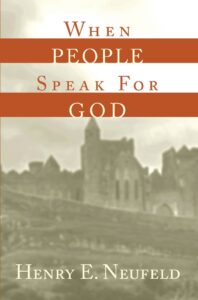
In my book, When People Speak for God, I explored these distinct exilic situations through the lens of three very different messengers:
Jeremiah: Jeremiah had the agonizing, unpopular task of speaking to those still in Jerusalem who were living in denial. He didn’t just speak the message; he wept it. His life became a symbol of a God who refuses to give up on His people, even when they are marching straight into a disaster of their own making.
Ezekiel: Ezekiel was himself an exile among the captives by the Chebar canal. He was given a wild, wheels-within-wheels vision of God’s glory departing the Temple and traveling east. The message was revolutionary: Yahweh is not a territorial deity bound to Jerusalem. He is mobile. He can travel into the “unclean” dirt of Babylon to personally be a sanctuary for His people.
Daniel: Daniel and his friends had to serve inside the very halls of the pagan Babylonian court. They faced the daily temptation to compromise their identity to gain power, status, and comfort. Even further, to simply survive. Yet, through quiet noncompliance, they proved that one can master the learning of the dominant culture without letting the one true God be pushed aside.
Obadiah: This is the fourth of three! While my book focused on three messengers, a fourth, Obadiah, completes this picture by ministering to the remnants of Judah who were still living in a largely desolate land. I’ll expand on his message below.
Each of these prophets spoke for God in a way that met the people exactly where they were, showing them that exile was not the end of the story—it was a life-size classroom.
This experience preserved the identity of the Jewish people by effectively remaking it, by detaching it from physical Jerusalem. With the temple in ruins, the God of the temple remained God, universal and sovereign. God was not surprised and was certainly not threatened by the powers that overcame the Kingdom of Judah. God was not limited by space.
Obadiah, that fourth prophet, adds a special spice to that message. He most likely ministered in the territory of Judah after the exile. His message is addressed, however, to Edom. What is the purpose of this message, addressed to a foreign people?
To the people who would have initially heard it, the remainder of the Judean population, those the Babylonians didn’t consider important enough even to take into exile, it meant that God was still watching them. (Note that Jeremiah, the weeping prophet, also ministered in Judea, but he was quickly taken to Egypt.) He provides a similar message in Jeremiah 49. God was watching over the population of Judea, and was willing to challenge those who would harm even this lowly remnant of the once proud kingdom.
That message, however, indicates God’s concern for Edom and for other lands. There is no point in words of warning for someone if there is no action possible to turn aside the doom that is proclaimed. Giving a warning is an indication of concern. Compare Obadiah to Jonah. Note that in Obadiah we lack the backstory. We don’t know how directly he might have confronted the Edomites. But what if the Edomites did listen, and stepped back from the brink?
Scrambling Our Modern Labels
Today, we are living in our own season of cultural exile and disorientation. Many Christians feel that they are diminished and less than they used to be. They mourn the passing of a Christian nation, and the presence of people from so many faiths. These things shake our sense of identity.
Sometimes that is the best thing for us.
To be a witness for Jesus in the world as we are called to be we need to have two things, and these things often seem to contradict one another. First, we need an identity. You have nothing to share if you have no identity. But secondly, we need a presence in the world outside our personal, limited visions. A wonderful witness is worthless if nobody encounters it. Your piety is useless if it exists only in the bounds of the church, your home, or people like you.
Israel, and then after the exile of the northern tribes, Judah was called to be a witness. For this, they needed an identity. They built that identity around a city, Jerusalem, and the Temple in it. That identity tended to separate them from the world. There was a need to draw them out of that limited sense of identity to a realization of just how great a mission God was calling them to.
Building that new identity started with the shattering force of the exile. There was no way to have an identity built around a temple that had been destroyed. A territorial identity could not survive with a people scattered from that place.
Through these four prophets, God worked on that new identity, one that made God’s people connect with a broader world and realize that God was not so limited as they had thought. The shatteringly complex vision of Ezekiel 1 tells the prophet something very important: God is here at the River Chebar, just as he would be at the Jordan. Your limited view, Ezekiel, has been shattered. See the vision and learn that your God is greater than you ever imagined.
Limited Vision Limits
When our vision is limited, then our actions will be limited. When the people imagined that God would protect them in Jerusalem because the temple was there, representing God’s presence, that imagination limited their ability to be witnesses to the world beyond.
Ezekiel expanded that vision into Babylon.
Jeremiah taught the people that God was still active in Judah, even when God was simultaneously active in Babylon.
Daniel taught that God was not only active in the camp of the exiles, the people who had thought of themselves as God’s people. God was fully active in the court of the king of Babylon. Not only that, but the King of Babylon was, reluctantly, open to guidance from the God of distant Judea.
Only the concept of God as the God of Israel, or the God of Judah was too limited.
God was the God of Israel. But God was also the God of the entire universe.
Vision needs to be shaped by what is beyond our limited surroundings.
Finding God on the Periphery
If you feel that God’s message is getting lost in the world. If you feel that God is often absent even from the life of your church, you need to find that vision. The vision of the God who sits above those wheels and is served by the flying creatures who are unlimited in their movement.
And in case you think this message was just invented in the early 6th century BCE, the God of the scriptures is, and has always been, the God of the edges. We tend to forget that as we read. For Abraham, more than a millennium earlier, God has a call to something beyond imagination (Genesis 12). Over and over we see biblical characters called to things they didn’t imagine possible.
For Gideon (Judges 6 & 7), some 600 years earlier, God has a call to the edge. When Gideon is called, he is hiding from the enemy in a winepress. There is nothing bold about him. But God changes Gideon’s vision and lets him see what God can do through him, rather than what he can do himself.
God wants to expand our vision. To do that, he has to get us to abandon our own limited vision.
Will it take a disaster to get your eyes off your own limitations?
I know this to be true, because I’m a Bible teacher, and I question the Bible with some vigor, and not only do I not answer all the questions I raise, I frequently emphasize that we don’t actually need answers to all our questions. Unanswered questions are the engine that drives an intellectually and spiritually full life.
The claim that one does not question the Bible is often taken as an expression of great faith. The person who doesn’t question has anchored their faith so firmly that they no longer need or want to question. But I think it’s precisely the opposite. The person who has stopped questioning and wants to prevent others from doing so has become spiritually and intellectually dead. Their faith is not incredibly great; rather, it is weak and easily threatened by questions. It takes no faith to believe in an unquestioned God. Faith comes into play when we challenge God with our doubts, our fears, and our questions.
Some of the greatest examples of faith in the Bible questioned God. Abraham did. Moses did. And what is questioning the Bible to questioning its ultimate divine source?
I want to be a Bible teacher who questions and who challenges others to question. I want to study with other teachers who question and challenge me to question. I do not exclude anything in my life from examination and questioning.